The Decision That Made Sense
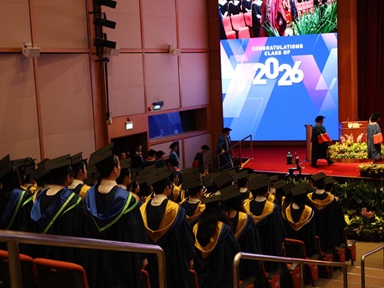
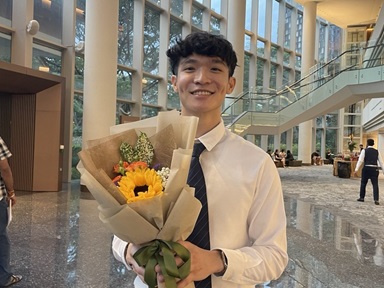
When Ernest Yong Shao En stood before the College of Computing and Data Science (CCDS) Class of 2026 as valedictorian, he opened his speech with a question from his very first programming lesson.
"Has the programming started yet?"
It was the question of a student who had arrived at NTU without any programming background.
Computing had not been his first choice.
He readily describes himself as a technophobe. The decision to enrol was, above all else, a practical one. Ernest lost his father when he was two and was raised by his mother. An NTU scholarship meant he could complete university without placing a financial burden on his mother.
It was, he says, simply the decision that made the most sense.
Over the next four years, Ernest would discover that university was about far more than learning to code. It was about learning from the people around him, contributing wherever he could, and making the most of every opportunity that came his way.
A question, and an answer
In his valedictory speech, Ernest recalled asking his tablemate whether the programming lesson had already begun.
Instead of dismissing the question, the student simply replied that it had not.
That brief exchange stayed with him – not because of the question itself, but because someone had chosen to answer it without judgement. Years later, Ernest would begin his valedictory speech with that same story as a reminder that small acts of generosity can shape someone's confidence to keep going.
It would become a pattern throughout his time at CCDS.
Learning wherever help was needed
When asked about the achievement he is proudest of, Ernest does not mention becoming valedictorian.
Instead, he talks about his final-year Multidisciplinary Project (MDP).
His eight-member team was developing an autonomous robot for a navigation challenge. Six weeks into the project, with only two weeks left before the competition, they had solved only one of the robot's fundamental tasks.
Although Ernest's role focused on software, he asked his teammates to teach him hardware programming so he could contribute wherever help was needed. Together, the team spent long days refining and rewriting the robot's code until it finally completed the course with the fastest timing.
For Ernest, however, the lasting lesson had little to do with the result.
"I learnt to ask and rely on others for help to achieve things greater than my individual effort can," he says. "I'm still grateful to everyone in my group for cooperating with and encouraging each other to keep going during that period."
Carried forward by others
The same mindset shaped Ernest's experience as valedictorian.
Standing for election had never been part of his plan.
His MDP teammates encouraged him to run. Friends from hall, orientation, exchange, student clubs and his classes helped design publicity materials, shared his campaign and encouraged others to support him.
Looking back, Ernest remembers not the campaign itself, but the people behind it.
"At every stage of the process, I didn't feel like any of it was the result of my own effort, but that I was being carried forward by people and communities greater than myself."
That generosity was something he encountered throughout university.
Whether borrowing notes from seniors, learning from classmates, studying past projects or exploring open-source code, Ernest found a community that was remarkably willing to share what they knew.
"One thing that has always fascinated me about the CCDS community is how willing people are to share what they know," he says. "You just need the curiosity to learn, and the courage to try."
Invest in people
Throughout university, Ernest set himself one simple goal: to try something new every semester.
It led him to join student organisations, participate in a local exchange programme, complete an overseas internship and pursue a minor in Malay. Each experience broadened his perspective and introduced him to people who would shape the way he thinks about learning, leadership and service.
After graduation, Ernest will join GIC, where he hopes to contribute to securing Singapore's financial future through technology.
When asked what advice he would leave for future students, however, he does not begin with technology.
"In the age of AI, my suggestion would be to invest in people."
For Ernest, that is not simply advice.
It is a reflection of how he has lived his four years at NTU.
Every milestone he speaks about – from his first programming lesson to his final-year project and eventually becoming valedictorian – was shaped by people who took the time to answer a question, share what they knew, or encourage him to step forward when he would not have done so himself.
As he reminded his fellow graduates in his valedictory address:
"We've come so far by standing on the shoulders of many others who came before us... None of us truly did it, alone."
For Ernest, success has never been about beginning with the perfect plan.
It has been about recognising the opportunity before him, committing to it wholeheartedly, and making that opportunity count – not just for himself, but alongside the people who helped him along the way.