The Best Computing Happens Between Disciplines
Before Caleb Yung could build an artificial intelligence (AI) model to detect atrial fibrillation from electrocardiogram (ECG) signals, he first had to learn how to read them.
Working on his Final Year Project with Dr Vidya Sudarshan in collaboration with Duke-NUS and SingHealth, the Computer Science student found himself reading clinical papers, consulting clinicians and seeking help from friends studying medicine to understand cardiovascular diseases and interpret ECGs.
For Caleb, it was a turning point.
"I learnt that good research begins with curiosity and humility," he says. "Rather than assuming I had all the answers, I learnt the importance of asking questions, learning from experts in other disciplines and being comfortable with uncertainty."
The experience transformed his understanding of computing. It was no longer just about writing code, but about understanding people and problems first.
Awarded the Koh Boon Hwee Scholars Award, Caleb graduates from NTU's College of Computing and Data Science (CCDS) convinced that the most meaningful technology is built across disciplines.
Beyond writing code
Caleb first discovered programming through H2 Computing at Yishun Innova Junior College, where he enjoyed solving problems through code.
Encouraged by his computing teachers after his A Levels, he began considering Computer Science as a university pathway. The final push came from his secondary school Mathematics teacher, Mrs Shaun Lee, who believed NTU would give him the opportunities to learn and grow.
He arrived expecting Computer Science to be about software development. Four years later, his perspective had changed.
"I thought Computer Science was mainly about writing code and building software," he says. "But I came to realise that computing is really a way of understanding and solving problems across different fields."
Research projects and collaborations showed him that technology creates the greatest impact when it is designed around the people it serves.
Learning through setbacks
Not every lesson came from success.
During a Year 3 Multidisciplinary Project, Caleb and his teammates spent countless hours building and testing a robot car. Despite everything working before the assessment, unexpected technical issues during the final evaluation meant they could not perform to their full potential.
"It was disappointing because we knew how much effort everyone had put into the project," he says.
The experience taught him that resilience matters as much as technical ability, a lesson reinforced during his internship at HTX, where he saw that research and innovation depend on continual iteration.
"Success is not about achieving perfection every time," he says. "It is about how we choose to respond when things do not go according to plan."
A journey shaped by others
Despite receiving one of NTU's highest student honours, Caleb is quick to credit those who supported him along the way.
Teachers encouraged him to pursue computing. Professors and supervisors challenged him to think more deeply. Collaborators from other disciplines broadened his perspective, while his family and loved ones gave him the confidence to embrace new opportunities.
"The biggest lesson I've taken from all of them is that growth is never an individual journey," he says. "Every opportunity I had has been possible because someone chose to invest their time, trust and belief in me."
Receiving the Koh Boon Hwee Scholars Award has strengthened his commitment to continue learning and to pay those opportunities forward.
Looking ahead
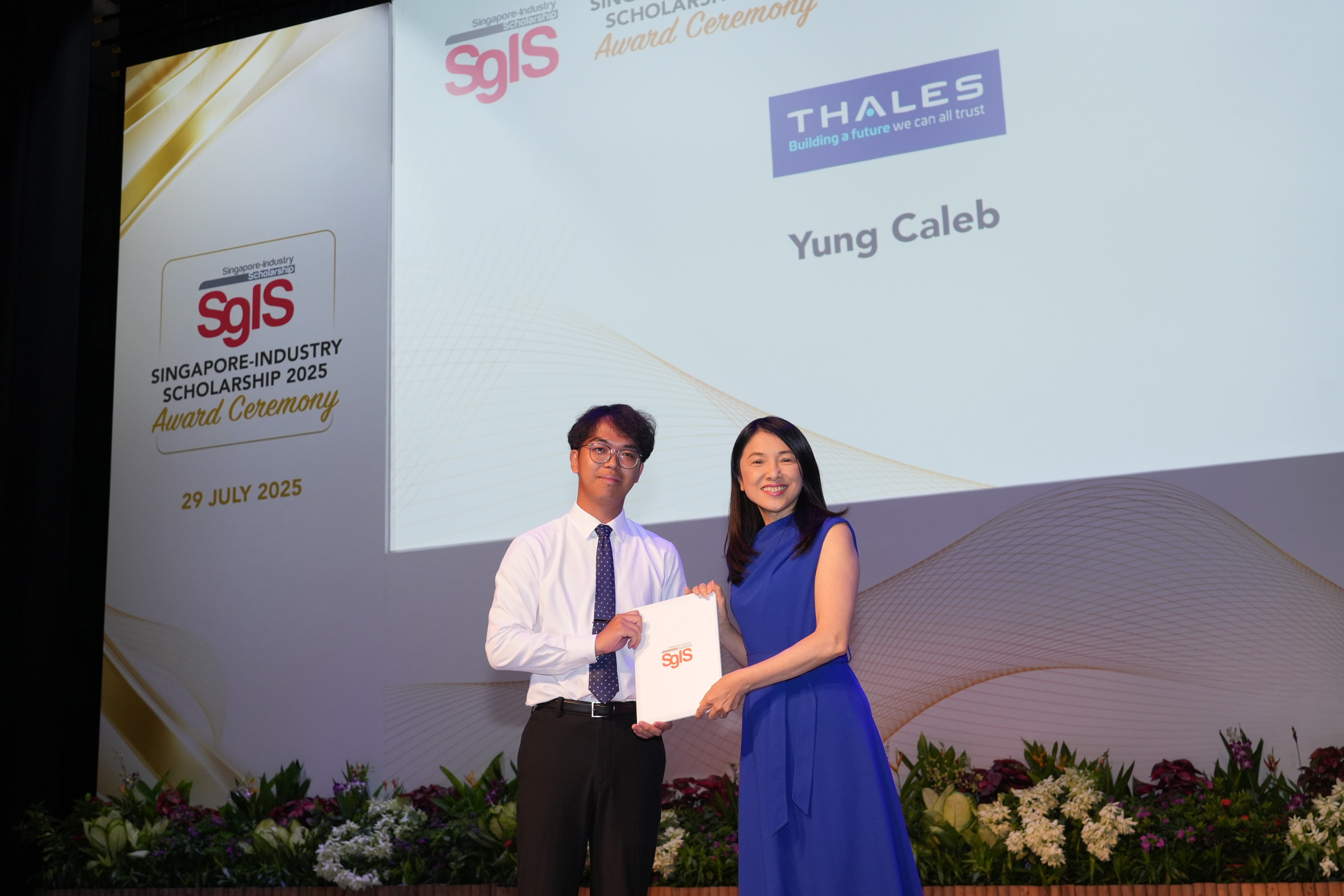
After graduation, Caleb will join Thales under the Singapore-Industry Scholarship.
During his internship there, he contributed to AI solutions for air traffic management and saw how computing could improve the safety and efficiency of systems relied upon by millions of people every day.
As AI continues to reshape industries, Caleb believes technical expertise must be matched by a willingness to keep learning and a responsibility to build technology thoughtfully.
"What excites me most is that computing has never been more relevant," he says. "As AI becomes increasingly powerful, I also believe our responsibility grows alongside it."
For Caleb, the future of computing belongs to those willing to learn beyond their own discipline, collaborate across boundaries and keep people at the centre of innovation.