NTU CCDS Alum Cyril Gliner Brings Machine Learning to a Formula 1 Team
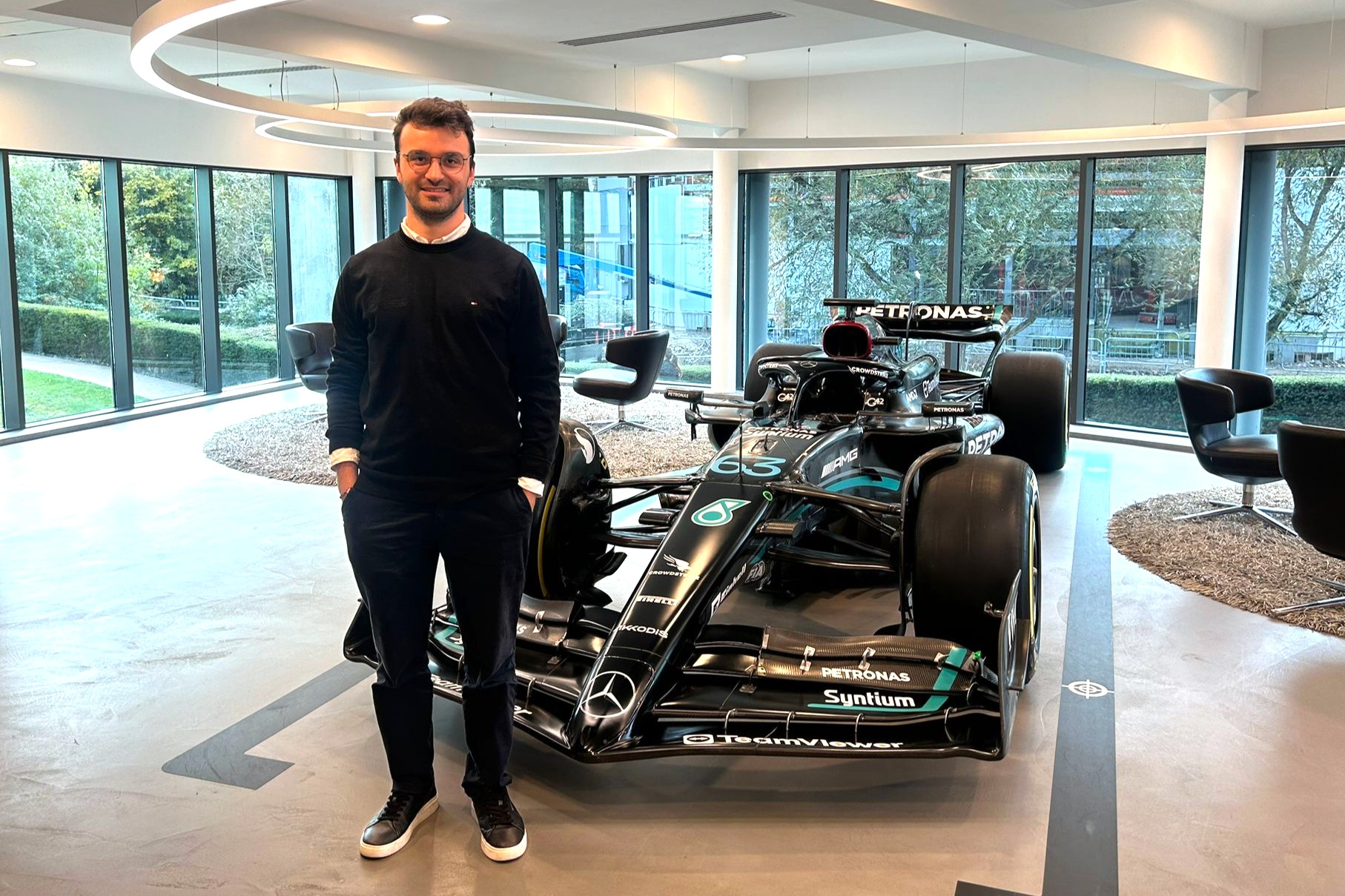
Cyril Gliner is an engineer whose job is to help build faster Formula One cars. Until 2024, he did that work from inside the simulation and modelling group at the Mercedes-AMG Petronas Formula One Team, the engineering function that uses physics-based models to predict how a car will behave before it is built.
What became clear to him and his colleagues over time was that those physics-based simulations, while highly accurate, were becoming increasingly time-consuming as engineers sought to test more ideas and optimise car performance. To iterate faster, they needed a different approach. They recognised that AI could learn to approximate these simulations, producing results much more quickly and allowing engineers to explore more design options in less time.
But knowing that and being able to act on it were different things. His group had been discussing the potential of machine learning to transform their work for some time, but had not found a way to begin.
So Cyril took a step few engineers at that stage of their careers take: he left the team to become a student. “I knew that to do something meaningful, I needed to learn the fundamentals of AI properly,” he says.
In 2024, he enrolled in NTU's Master of Science in Artificial Intelligence (MSAI). The MSAI at NTU’s College of Computing and Data Science (CCDS) is a coursework-based graduate degree designed for professionals and graduates who want to deepen their expertise in AI theory, methodologies, and applications. The programme trains students to design, implement, and manage AI systems while also cultivating the skills to address project management, policy, and ethical considerations.
In June 2025, Cyril graduated from the program and returned to Mercedes as a Senior Machine Learning Engineer.
What the MSAI gave him was less a body of AI knowledge than a new way of approaching engineering problems. The programme offered the coursework and faculty he had wanted, but the main work of the year was his thesis, on physics-informed AI for computational fluid dynamics (CFD).
CFD is one of the standard tools for designing aerodynamics in F1, and one of the most expensive – a single high-fidelity simulation can run for hours. Physics-informed models take a different approach; rather than learning the world from data alone, they build physical laws directly into the model’s architecture. The intent is a model that is both faster than conventional CFD and more reliable than a purely data-driven one.
“It helped me see first-hand how machine learning and physics can work together,” Cyril says, “and gave me practical experience of applying AI, not just learning about it in the classroom.”
His advice to students considering similar work points beyond F1. Start with the engineering, he said, not the model. “When you truly understand the physics or mechanics behind the challenge, the AI part becomes much easier to apply meaningfully. You’ll avoid many pitfalls and make sure you’re solving the right problem.”
Strong fundamentals, in his account, remain essential even as machine learning becomes a standard tool. The MSAI is one of several postgraduate programmes CCDS offers in AI and data science. For Cyril, the year there was less a departure from engineering than a way of extending it, the kind of step more engineers may take as the industries they work in continue to change.
When he returned to Mercedes, it was not simply to a different title. He brought with him a way of approaching engineering challenges that combined physics with machine learning, and a role focused on developing machine learning tools to support the engineers designing the car.
In F1, simulation and modelling are a mature discipline. Machine learning is newer, and teams are still working out where it fits. “There’s a lot more room to innovate,” he says. “An exciting opportunity to build something new and hopefully contribute to making the car faster.”