CCDS-developed Antibody Generation Model Captures Award at IEEE Conference
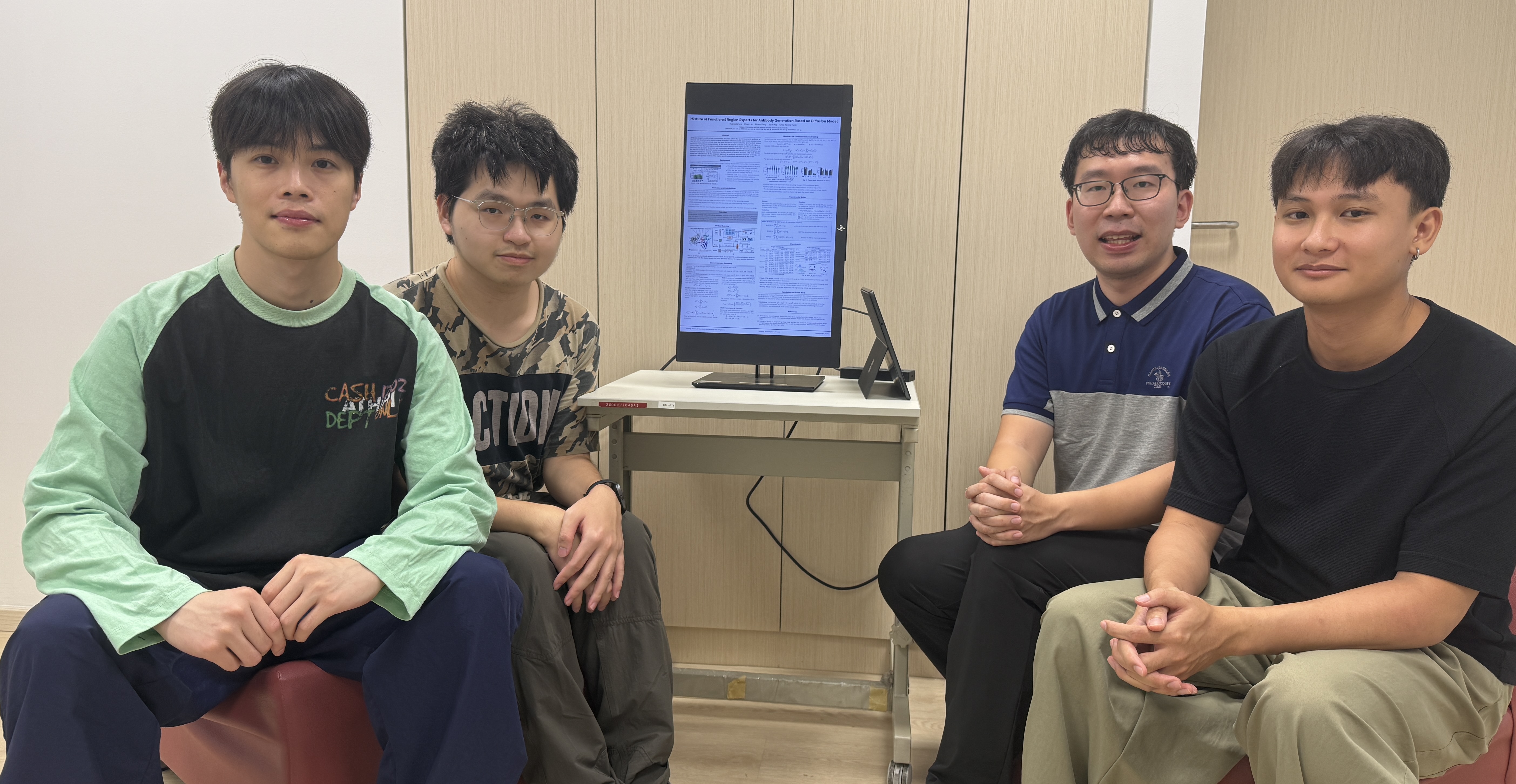
A team of NTU PhD students won the Best Poster Award at the IEEE 8th International Conference on Data-driven Optimization of Complex Systems (DOCS 2026) for developing an improved computer model for antibody generation.
The poster, “Mixture of Functional Region Experts for Antibody Generation Based on Diffusion Model” was presented by: Lyu Kuangda, College of Computing and Data Science (CCDS) PhD, Year 1; Pang Xihern, CCDS PhD, Year 1; Ng Jovin, CCDS PhD, Year 1; and Liu Chen, IGP PhD, Year 3. The project was supervised by CCDS professor Kwoh Chee Keong.
Antibodies are large proteins made by the immune system. They are often called the “foot soldiers” of the immune system because they recognize, neutralize, and help fight threats such as viruses, bacteria, or tumour cells.
This makes antibodies highly attractive as potential therapeutics. For instance, Merck’s therapeutic antibody Pembrolizumab (Keytruda), which treats many types of cancer, was the world’s top-selling drug in 2024, with $29.5 billion in sales.
However, creating custom antibodies is difficult. For an antibody to be effective, it must stick to a specific target. The technical term for this stickiness is “affinity”, and the target is called an “antigen”. Many factors control the affinity of an antibody for an antigen, but it mainly depends on the 3D structure of the antibody.
Antibodies have nearly infinite variation. Laboratory methods can only test a tiny fraction of the huge number of potential antibodies for any antigen. Even older computational methods, based on calculating the chemical and physical properties of proteins, are inefficient at finding new antibodies.
Recently, AI has emerged as a method to develop and prioritize candidates with a higher likelihood of success. In particular, diffusion-based generative models have shown promise.
Diffusion models work by incrementally adding noise into a piece of training data (such as a protein’s 3D structure) until the data is completely obscured, and then teaching the model to work backwards to the unobscured data. In this way, the model “learns” patterns for what a high-affinity antibody looks like for a variety of antigens, and can use these patterns to generate new antibodies.
The students noticed a potential problem with such models, however, in that they apply learned patterns to the entire antibody. In reality, different parts of an antibody have different patterns.
Conventional antibodies have six special regions, called complementarity-determining regions, or CDRs, that affect how well it binds. Before building their model, the team analysed a pre-processed dataset containing about 13,000 3D structures of antibodies and found different patterns underlying each CDR’s structure. This suggested that if a model treats all six CDRs as identical, it might lose useful information.
“Given only similar structural context, the model is encouraged to learn an averaged strategy,” said Lyu Kuangda. “This means they may miss the unique rules of each area.”
The students hypothesized that they could improve the model’s performance by adding specific rules for different parts of antibodies. Because this is called a “mixture of experts” type of model, the students named their model MoFRE, for Mixture of Functional Region Experts.
To test how well MoFRE could learn, predict, and design CDR structures, the students trained MoFRE on the 13,000 3D structures of antibodies. At the same time, the students reserved a testing set of antibody structures that MoFRE never saw.
They then asked MoFRE as well as a baseline model to generate CDRs for the antibodies in this testing set. For each generated CDR, the team compared MoFRE’s performance against the baseline using three key metrics: how similar it is to existing sequences, how similar it is to existing 3D structures, and how well it binds to known antigens. The team found that MoFRE was competitive on all fronts whether it was redesigning one or multiple CDRs at a time.
In fact, when designing multiple CDRs, MoFRE improved binding improvement rates by up to about 10 percentage points over the baseline model.
This suggests that MoFRE could contribute to improved antibody design in the future.
“I was excited by what we observed with the mixture-of-experts approach,” said Liu Chen. “It suggests that protein models may move beyond simply learning ‘what proteins look like’ toward designing proteins according to different functional requirements.”
The team is quick to note that challenges remain, despite the promising result.
“There is still a substantial gap between a design that looks good computationally and one that is genuinely useful in practice,” said Ng Jovin. “We will continue to improve the algorithms and models, with the goal of more effective modelling and more precise protein design for specific tasks.”
The students said that this experience, and award, would not have been possible without support from CCDS.
“We believe this recognition would not have been possible without the open, interdisciplinary, and internationally connected research environment at CCDS,” said Pang Xihern. “By giving PhD students the freedom to explore across disciplinary boundaries and ample opportunities to engage with the international research community, CCDS creates the conditions in which young researchers can develop ambitious ideas and bring them to a level that earns recognition from the wider academic community.”
Kwok praised his students for demonstrating their ability to tackle an interdisciplinary research problem and translate it into meaningful and well-presented research. He hopes that some students will remain involved in related research as they progress in their studies and careers.
“The next steps for this project are to move beyond computational predictions and establish stronger links between AI-generated designs and experimental validation,” said Kwoh. “In the longer term, we hope that advances in AI-driven biological design will contribute to the development of therapies that not only treat disease, but also help people live longer and healthier lives.”