Team Hack Tuah Takes On Data Drift and Wins First Place at National AI Student Challenge 2026
Most AI systems don't fail loudly. They fail quietly. An AI trained on last year's data keeps making decisions today with the same confidence it always has, even as the world around it has moved on. There are no alarms and no warnings. By the time anyone notices, users have been given the wrong recommendations, businesses have made poor calls, and trust has slowly slipped away.
This phenomenon is called data drift, and it is one of the most persistent problems facing every organisation deploying AI today. Banks see fraud models miss new patterns. Retailers see recommendation engines lose relevance. Telcos see churn predictors become unreliable. There is no permanent fix, only constant vigilance.
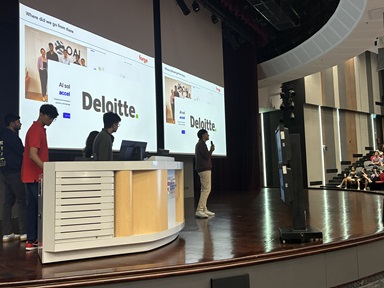
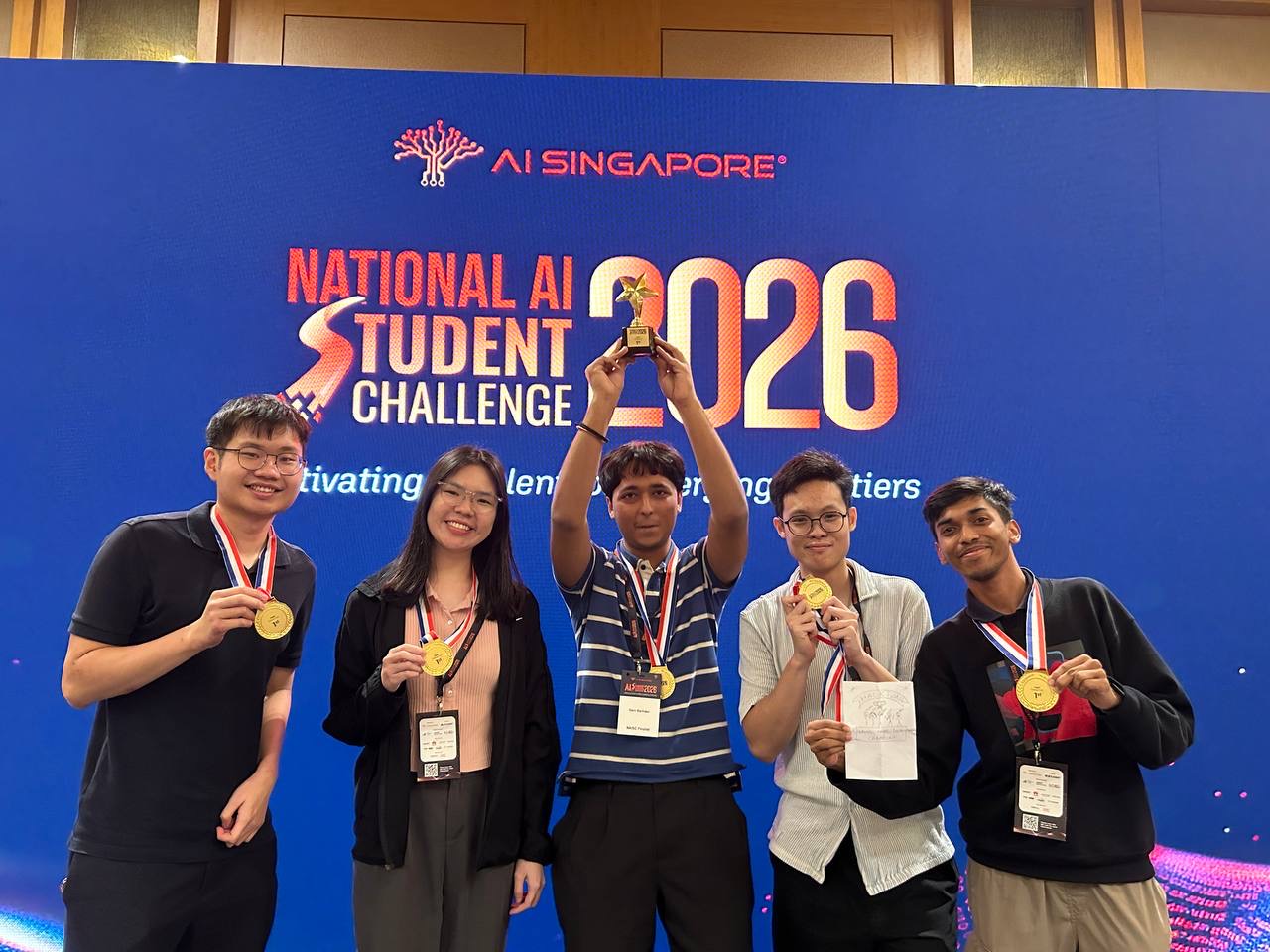
It was this problem that the Singtel track at the National AI Student Challenge (NAISC) 2026 put in front of competing teams. And it was this problem that five third-year CCDS undergraduates – Garv Sachdev (Computer Engineering), Glynis Looi Xin Lin (Computer Engineering), Yoong Hong Jun Nicholas (Business and Computing), Jan Chen Jie (Computer Science) and Ronav Pattanaik (Computer Engineering) – tackled well enough to win first place at the challenge, held during the AI Student Developer Conference (AISDC) at Marina Bay Sands.
A demanding brief
Teams were challenged to build an adaptive AI system that detects, visualises, and corrects data drift without modifying the underlying model. The constraints were stiff: column names on the hidden evaluation dataset were unknown, the solution had to scale to 500 features and 10 million rows, and every run had to finish within a 10-minute runtime budget.
Every improvement had to come from how the data was handled, not the model itself. Solutions were evaluated on Area Under the Precision-Recall Curve (AUPRC), a measure of prediction accuracy particularly suited to imbalanced datasets like churn prediction.
An approach built on diagnosis
Competing under the name "Hack Tuah" (a riff on a viral internet phrase from 2024) with a fitting slogan "We will Hack Tuah (to a) Victory together!", the team's insight was that drift is not one problem but many. Different features in a dataset can drift in different ways; some shift gradually, others abruptly. Some change distribution, while others lose meaning altogether.
So they built a pipeline that diagnoses, feature by feature, what kind of drift is occurring, and applies a targeted fix to each. It then uses the test data itself to keep improving performance, iteratively, without ever touching the underlying model. An interactive dashboard makes the diagnostics visible.
The result was a 23.5% improvement in prediction accuracy over the baseline, with a runtime of under 30 seconds.
This outcome was shaped as much by how the team worked as by what they built. Each member was occupied with their Professional Internship – a full-time industry placement that CCDS students undertake as part of their degree – so time management was key.
They divided the work amongst themselves, with each person tackling different types of drift to improve. Their best findings were then combined into one final solution. Dividing the challenge into isolated tasks was a gamble, but this modular approach allowed them to maximise their limited time on an ambitious objective, relying on constant coordination to ensure their independent findings successfully united into a cohesive outcome.
As data drift becomes a defining challenge of operational AI, solutions that don't require touching the model will only grow more valuable. This is exactly the kind of work CCDS's programmes are designed to enable: rigorous technical foundations, sustained exposure to real industry problems, and the room for students to take on hard challenges before graduation.
Congratulations to Garv, Glynis, Nicholas, Jan and Ronav!