Some Lessons Can't Be Timetabled
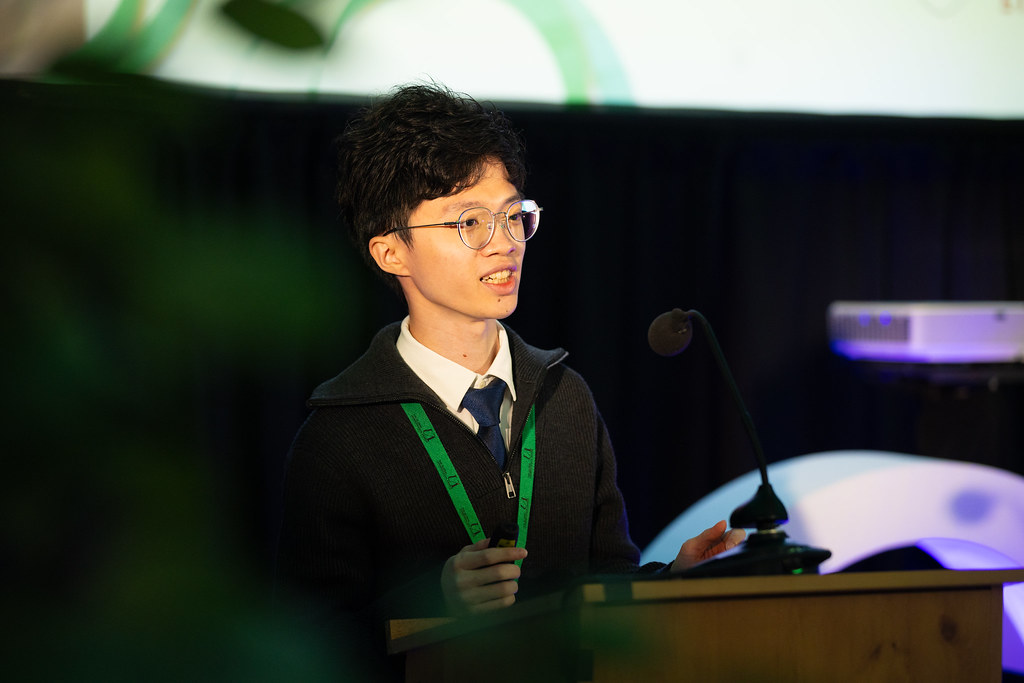
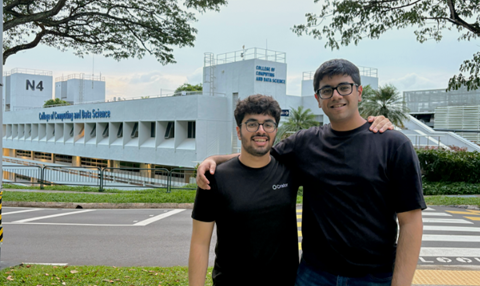
When Ng Yong Jian enrolled in NTU's College of Computing and Data Science (CCDS), he knew one thing almost immediately.
One degree wouldn't be enough.
Despite having little programming experience before university, he chose to study Computer Science alongside Economics. It wasn't because the combination led to a particular career. He simply didn't want to limit himself to a single discipline.
Computer Science intrigued him. Economics appealed for a different reason.
"Economics reminded me of Physics," he says. "Using maths and models to explain how things work in the real world."
That instinct – to keep exploring rather than settling for the obvious path – would come to define his entire university experience.
While many students focused on completing their coursework, Yong Jian kept looking beyond it. He sought out research opportunities across different laboratories, worked on projects that applied machine learning to completely different fields, and gradually built an education that extended well beyond the curriculum itself.
"I am most proud of the whole experience as a collective," he reflects. "I learnt a lot about advanced models and techniques, and how machine learning applies across various domains."
Each opportunity built on the last.
One of those opportunities took him to CCDS's Deep NeuroCognition Lab. For his final-year project, Yong Jian applied machine learning to study Caenorhabditis elegans – a tiny worm with a fully mapped nervous system, making it one of neuroscience's most valuable model organisms.
His work revealed fresh insights into how neural activity drives behaviour, earning him the 2025 Global Undergraduate Award for Computer Science.
Yet that was only one chapter of a much broader journey.
Across his time at NTU, Yong Jian also contributed to research at Baby-LINC in the School of Social Sciences, the Air Traffic Management Research Institute (ATMRI), and Temasek Laboratories @ NTU. Each project challenged him to apply the same computing principles in entirely different contexts – from computer vision and machine learning to interdisciplinary research problems that demanded both technical rigour and intellectual curiosity.
One project eventually led to a paper presented at an Institute of Electrical and Electronics Engineers (IEEE) regional conference, giving him his first experience of publishing and presenting research.
Looking back, Yong Jian believes these experiences mattered for reasons that extended far beyond awards or publications.
"I believe these experiences helped me stand out during my internship applications," he says. "Companies appreciate students who explore beyond the curriculum and actively build skills alongside their normal studies."
By the time he interviewed for a summer internship at Jane Street in late 2024, he wasn't relying solely on classroom assignments to demonstrate his abilities. He could draw on research spanning neuroscience, computer vision and applied machine learning, alongside the adaptability that came from working across multiple disciplines.
After progressing through several rounds of online interviews, he travelled to the firm's Hong Kong office for the final stage – a demanding series of brainteasers, coding challenges and technical interviews. He secured the internship, spent the summer of 2025 with the company, and later received a return offer for a full-time position as a Trading Desk Operations Engineer.
Today, his role combines engineering with real-time operational support for one of the world's leading quantitative trading firms.
"On the project side, we build and maintain trading infrastructure and perform process optimisation," he explains. "On the operational side, we directly provide support to the trading desk, such as executing data queries and monitoring trading tools."
Regardless of the task, he finds himself relying on the same three qualities every day: strong coding skills, creativity to solve problems without established playbooks, and the focus to make sound decisions where even small mistakes can have significant consequences.
Those same qualities also shape how he thinks about artificial intelligence.
When Yong Jian began university, ChatGPT did not yet exist. AI tools have since become commonplace, but he believes the most valuable lesson from his degree was never learning a particular technology. It was learning how to keep learning.
"My degree gave me a strong foundation in core computer science principles and, more importantly, the ability to learn," he says.
What university could not teach, he adds, is something every computing graduate must now develop for themselves.
"The thing nobody taught us is to judge the extent AI should be used. LLMs are powerful, but they work best as an assistant to speed up learning and increase productivity. We should always understand their limitations and know when to trust our own reasoning over their output."
For students graduating into an uncertain job market, his advice is equally pragmatic.
"I was in that position myself when I was looking for my previous internship," he says. "Keep applying, but make sure you are genuinely prepared for every interview. Once you get rejected, it's often difficult to get another shot at the same company."
He also encourages graduates to stay open to opportunities beyond traditional technology roles and to consider postgraduate study, particularly as AI continues to reshape the profession.
Looking ahead, Yong Jian expects to remain in industry while pursuing part-time postgraduate studies.
It seems a fitting continuation of a journey that has never been defined solely by lectures, examinations or degree requirements.
Some of the most valuable lessons of his university education, after all, were never written into the timetable.