Ready When Opportunity Called: Team Supernova’s Double Podium Finish
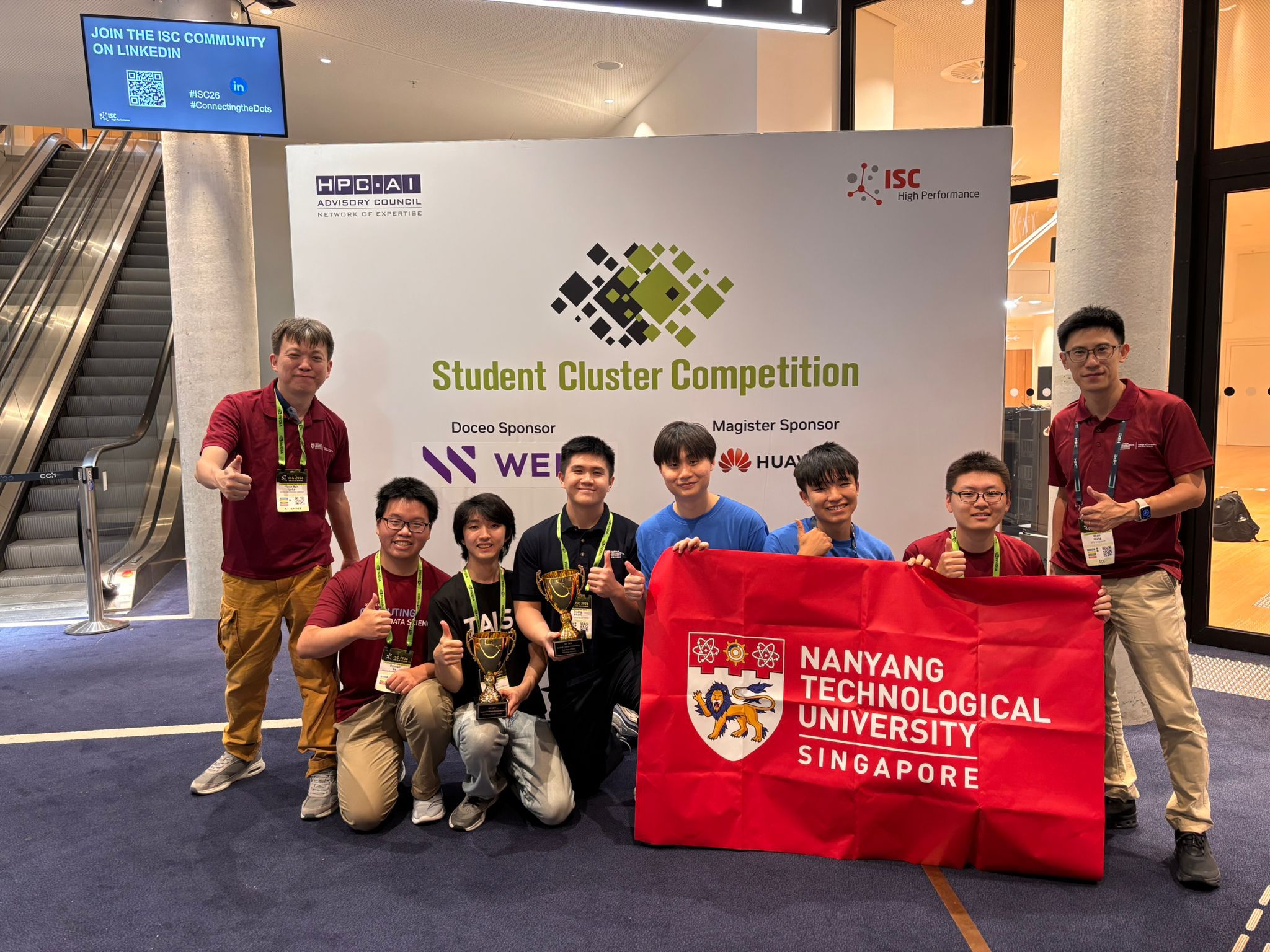
Team Supernova had only days to prepare for Hamburg – but months of preparation behind them.
The Nanyang Technological University (NTU) students had initially entered the online segment of the ISC 2026 Student Cluster Competition. When another university withdrew shortly before the event, Team Supernova was offered a place in the on-site competition.
They accepted – and returned as champions.
The team also placed second in the online competition, making NTU the only university to reach the podium in both tracks at ISC 2026. Their double success reflected months spent developing the technical knowledge, collaborative instincts and composure needed to seize an unexpected opportunity.
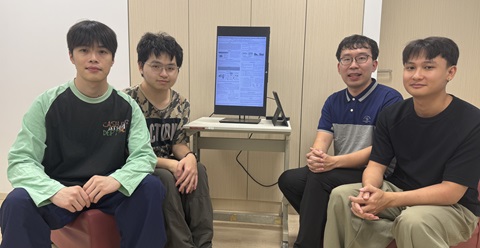
The six-member team comprised five students from NTU’s College of Computing and Data Science (CCDS) and one from the College of Engineering. Team leader Zhu Zhanyan was joined by fellow Computer Science students Cao Yuxuan and Gu Boyuan; Computer Engineering student Wee Zi Hao; Turing AI Scholars Programme student Yuma Ochi; and Electrical and Electronic Engineering student Pham Ngoc Quang.
Building readiness
Held alongside the ISC High Performance conference, the Student Cluster Competition brings together university teams from around the world to solve demanding high-performance computing (HPC) challenges.
HPC uses clusters of powerful computers working together to process vast amounts of data and perform complex calculations. It supports work across fields ranging from climate modelling and engineering to medical research and artificial intelligence.
Preparing for the competition required Team Supernova to learn how to configure computing systems, analyse scientific applications and optimise workloads for performance and efficiency. The students trained using resources from the NTU High Performance Computing Centre and the National Supercomputing Centre Singapore, with fellow members of the NTU HPC Club supporting their systems administration and hardware preparation.
“This year, our students were given the opportunity to compete in the on-site competition only after another team withdrew at the last minute,” says CCDS lecturer Dr Yuan Ren Loke, one of the team’s advisers.
“Had they not spent months strengthening their HPC knowledge and honing their technical skills, they would not have been ready to seize this opportunity.”
Three days under pressure
The on-site competition required teams to design, build and configure their own HPC clusters while operating within a strict six-kilowatt power limit.
Across three days, Team Supernova tackled scientific applications including OpenFOAM, ASCOT5, DFTB+ and HemeLB; performance benchmarks such as HPL, HPCG and FIO; and an artificial intelligence inference challenge using llama.cpp on a 70-billion-parameter large language model. Together, these tasks tested whether the team could optimise its cluster for very different computing demands – from scientific simulations and data movement to large-scale AI – rather than excelling at only one type of workload.
The final day brought an additional test. Teams were given a previously undisclosed application, SOD2D, and just four hours to understand, build and optimise it before completing the required workload. This tested something preparation alone could not guarantee: whether the students could apply what they had learnt to an unfamiliar problem, adapt quickly and deliver under pressure.
Success also depended on how well the students divided responsibilities, troubleshot problems and made decisions as a team.
“Despite a challenging 6 kW power limit, our team pulled together and delivered a strong performance,” says team leader Zhu Zhanyan. “It was a pleasure working with such an exceptional team.”
Team Supernova achieved the highest scores among the on-site teams for HemeLB, FIO and the llama.cpp challenge. The quality of their optimisation work also drew interest from developers involved in the applications – recognition that its value extended beyond the competition scoreboard.
Competing at scale
The online competition presented a different challenge. Instead of building systems within a power limit, teams focused on improving the performance of software running on production-scale supercomputers.
Participants were given access to the ROMEO supercomputer at the University of Reims Champagne-Ardenne and the Iris supercomputer, sponsored by the HPC-AI Advisory Council. Their tasks included optimising scientific applications and a large language model training workload using MaxText.
For second-year Computer Science student Gu Boyuan, the experience offered a view of how quickly the fields of HPC and AI are evolving.
“It was an eye-opening and enriching experience,” he says. “With the widespread adoption of AI agents raising the bar for everyone, the competition motivated us to continuously learn and improve.”
Yuma Ochi, a first-year CCDS student in the Turing AI Scholars Programme, found that tackling the challenges together strengthened the team.
“The competition was very challenging, especially because our team had little prior experience,” he says. “However, by doing our best and overcoming each problem together, we felt our team grow stronger and more united.”
The students were guided by Dr Loke and Dr Chen Wang, with sustained support from the NTU HPC Club, the NTU High Performance Computing Centre and the National Supercomputing Centre Singapore. The competition was supported by ISC High Performance, the HPC-AI Advisory Council, its judges and industry partners AMD, NVIDIA and Supermicro.
For Dr Loke, the trophies are significant – but they are not the ultimate measure of what the students gained.
“Competitions are not the ultimate goal; they are milestones,” he says. “The real goal is to continuously develop our knowledge, skills and character so that we are ready to embrace opportunities whenever they come.”
The double podium finish was an impressive result. More enduring, however, was what made it possible: the discipline to prepare before an opportunity was guaranteed, the courage to accept it when it appeared and the ability to deliver under pressure.