NTU team wins 2025 IEEE Software Best Paper Award for Agentic AI in Code Testing
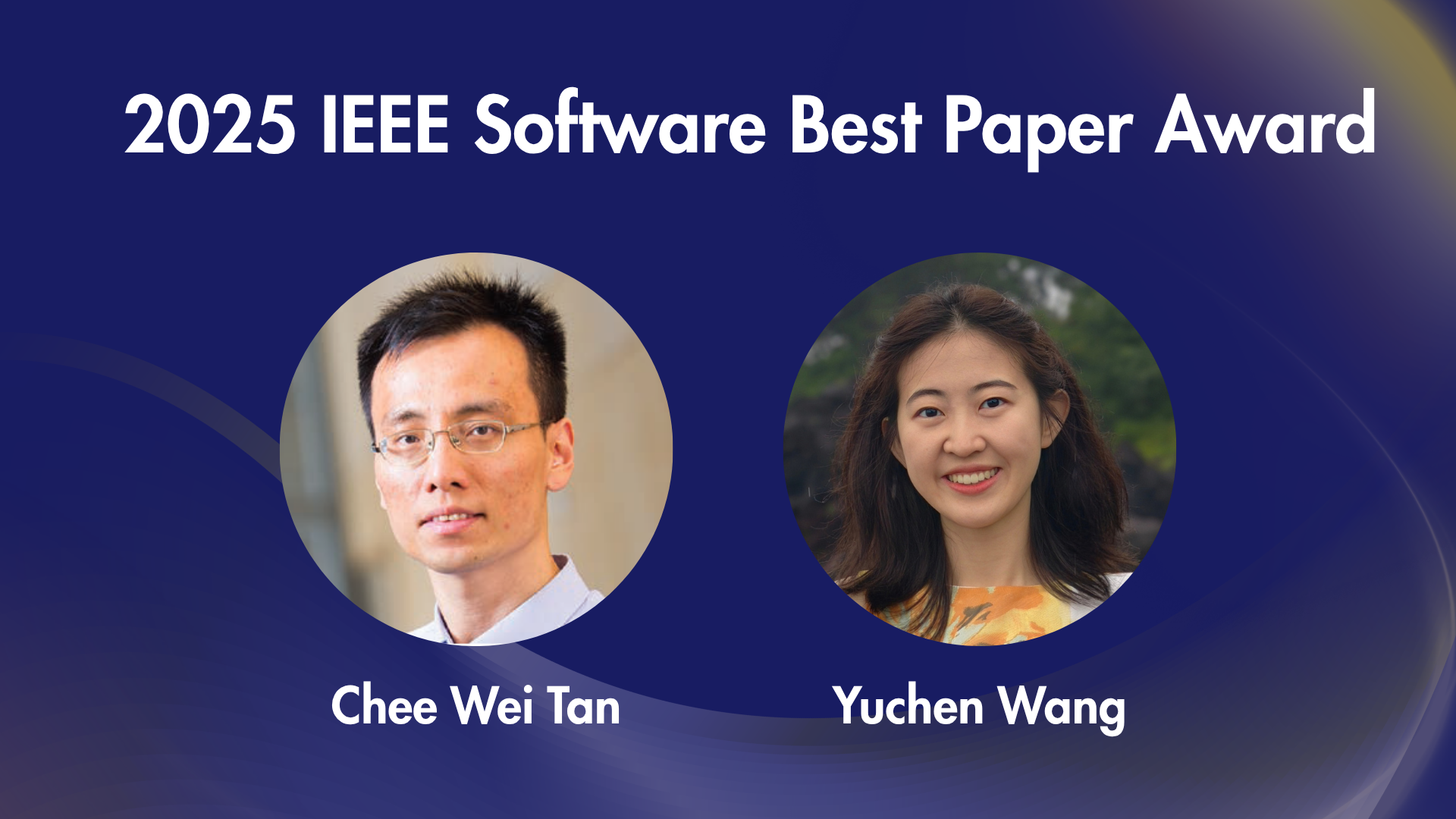
Associate Professor Chee Wei Tan of NTU's College of Computing and Data Science and his team have received a 2025 IEEE Software Best Paper Award for Copilot for Testing, an Agentic AI system for software generation and testing that plugs into a range of coding environments. Debugging is how developers make sure software works as intended, and it is expensive: a 2013 University of Cambridge analysis estimated that developers spend about half their time on it, yet coverage remains thin, with a 2025 security report finding that at least 80% of applications tested over the past year contained at least one security flaw.
Conventional automated checkers test only what they are told to test, and existing AI assistants are often unreliable and hard to maintain. Copilot for Testing instead acts as an agent that works alongside the developer, detecting bugs, suggesting fixes and generating its own testing prompts from what the developer is doing right now. Using retrieval-augmented generation, it supplements the language model's training data with live context from the codebase, including file architecture, logs of previous bugs and the user's cursor position. "This was the motivation behind creating Copilot for Testing," said CCDS PhD student Yuchen Wang, first author of "From Code Generation to Software Testing: AI Copilot with Context-Based RAG," co-authored with Shangxin Guo, a former postgraduate student of Assoc Prof Tan.
The work continues the team's Copilot for Xcode, an AI-assisted programming tool launched in late 2022 that was later assimilated into Microsoft GitHub Copilot and now has thousands of users worldwide. "I see the future of software engineering as a harmonious and dynamic combination of human and AI agents," said Wang. "While AI agents are getting more versatile and capable of writing structured code that follows best practices, human software engineers are spared the repetitive tasks and can focus on high-level directional work: design, research, experiments and iterations."