NTU CCDS Professor Publishes AI Book with Cambridge University Press
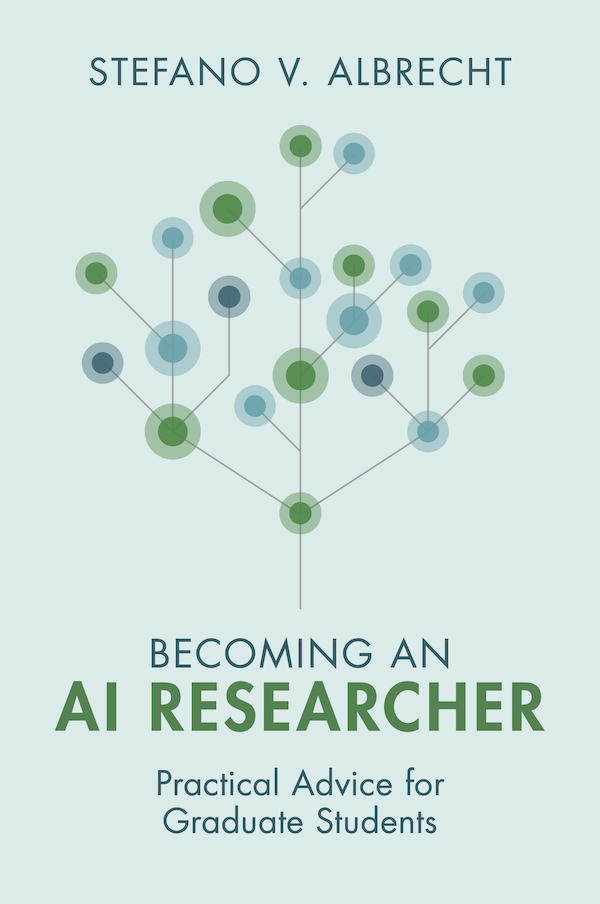
NTU College of Computing and Data Science Associate Professor Stefano Albrecht has drawn upon his years of mentorship experience and written a book for current and aspiring computer science PhD students. Becoming an AI Researcher: Practical Advice for Graduate Students launches on 31 October 2026 from Cambridge University Press.
This is Dr. Albrecht’s second book; his first, Multi-Agent Reinforcement Learning, was published by MIT Press in 2024.
Becoming an AI Researcher is not a textbook; it does not teach the technical side of AI. Instead, it guides students on the practical aspects of a PhD experience such as how to choose research topics, how to conduct research with integrity, how to take feedback, how to present work at a conference, and how to navigate industry as well as academic job markets.
With chapters like “Designing Experiments in AI” and “Using Large Language Models in Your PhD,” this book offers advice for students navigating the present-day landscape of AI permeating every aspect of a computer science education.
Ahead of publication, the book has garnered praise from leading researchers in the AI field.
“This is the guide I wish existed when I started my own PhD in AI: practical, honest, and unafraid to tackle the hard parts, from finding the right problem to surviving peer review to defending your dissertation, while touching on questions students actually face but rarely get real guidance on, like responsible AI research and the use of large language models,” said Kristian Kersting, a professor of computer science at the Technical University of Darmstadt.
The book also presents Dr. Albrecht’s philosophy of how to successfully conduct research, whether one is a student or faculty: starting with the problem, not the method.
“New students often read the latest papers with exciting results from the big AI labs, and they want to build methods and get results of their own, but without understanding what problem they are actually trying to solve,” he explains. “They lose sight of questions like: why are we doing this? To what end are we building these methods?”
He believes that the research—and the associated methods—needs be anchored to a central problem that the scientist is solving.
“The student needs to spend a significant amount of time to explore, identify, and analyse the problem and the root mechanics to really know what’s required to solve it,” Dr. Albrecht said. “That is how they truly become a scientist, and that is the point of doing a PhD.”
Although PhD students working in AI are the central audience for this book, Dr. Albrecht notes that the book can also be useful to post-doctoral scholars by offering advice on searching for jobs. He also hopes that junior professors just starting out in academia could find the book useful as a resource for supervising, training, and generally interacting with their own PhD students.
More broadly speaking, the book is applicable to anyone conducting scientific academic research.
“The advice the book gives about how to interact with your research lab and group, how to find the right kind of lab, how to design your experimental pipelines, how to write your papers, is all generalizable,” Dr. Albrecht said. “Concepts like responsible AI usage and reproducibility in experiments are important in any field.”
Becoming an AI Researcher: Practical Advice for Graduate Students can be pre-ordered at www.phd-in-ai.com. Book updates are announced at https://phdinai.substack.com/.