CCDS’ Alvin Chan Receives AI4Science Grant for AI Drug Discovery Platform
NTU College of Computing and Data Science assistant professor Alvin Chan has received a nearly SG$2 million, 3-year grant from AI4Science to develop GenAgent-Tx, an AI agent that designs RNA-based therapeutics and learns from experiments using its own designs.
RNA, a biological molecule closely related to DNA, exists in every cell in the human body. In 2020, RNA made news as the basis of the Pfizer-BioNTech and Moderna COVID-19 vaccines, but scientists have long understood that RNA has enormous theoretical potential.
For instance, since the 1990s, scientists have been interested in RNA-based vaccines against cancer, but no successful therapeutic has ever been approved for clinical use. One reason that so many candidates fail is the difficulty of delivering therapeutic RNA from outside the body to inside its cells, where RNA must do its work. RNA molecules are large, prone to degradation, and delivering RNA into specific cells has been decade-old challenge.
Undeterred by the challenge, Chan is specifically interested in treating brain cancer.
“One of our objectives is to test out RNA therapy for glioblastoma, the most aggressive brain cancer,” Chan said. “The difficulty is that the brain is protected by a biological firewall, and the drug has to get through it and then reach tumour cells specifically rather than healthy ones.”
To surmount the many physical and chemical barriers that keep RNA out of human cells, Chan uses “carriers”, which are mixtures of different oily nanoparticles that wrap around RNA molecules like a capsule. These capsules can enter human cells, letting the delivered RNA attack its target.
There are nearly infinite possible recipes for carriers, meaning that it is impossible to try them one by one in a laboratory. Computational methods, including AI-based searches, can find or generate many attractive candidates. However, many promising candidates fail in live patients.
For that reason, Chan is developing GenAgent-Tx as a hybrid system that includes an AI as well as an animal.
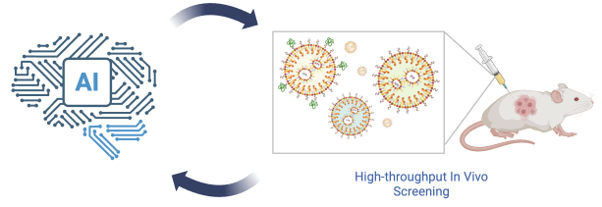
In the GenAgent-Tx workflow, researchers first train the AI to generate candidate molecules. A team of humans and robots synthesize these candidates in the laboratory. Each candidate carrier has a piece of uniquely identifying RNA, called a barcode.
More than 100 candidate carriers are injected into each animal. The researchers then take samples of the animal’s tissues and organs and look for RNA barcodes. This tells the researchers which carrier worked the best, and in what tissues.
Finally, the researchers train the AI model on the results and ask the AI to generate more effective candidates.
This work is a continuation of Chan’s previously published work, Designing lipid nanoparticles using a transformer-based neural network, in which he and his team developed COMET, an AI “experiment simulator” that predicts the most effective formulations for carrier molecules. By identifying optimal designs computationally, COMET could reduce the need for extensive laboratory testing, cutting development timelines from months to weeks.
“Our end goals are both a better AI model with this additional training data, and drug carrier designs from the AI model’s generation,” said Chan.