From lab data to farm-ready decisions: CCDS-led project Agri-TrAIt rethinks how AI reaches the field

iSURF (Israel-Singapore Urban Farm)
Advanced AI models are only useful if the people who need them can actually use them. In agriculture, a persistent gap exists between what is achievable inside a highly instrumented research facility – where sensors capture plant behaviour every few seconds and datasets run into terabytes – and what is realistic for a commercial farm operating under tight resource, infrastructure, and manpower constraints.
AI Model-as-a-Service for Data-to-Decision Agriculture, also known as Agri-TrAIt, is designed to bridge that gap. Rather than expecting farms to build and maintain sophisticated AI systems in-house, the project aims to deliver advanced AI-driven insights as a service layer, making capabilities like adaptive growing strategies and crop trait estimation accessible without requiring heavy infrastructure investment.
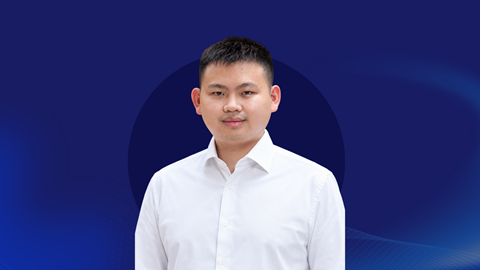
Led by Assistant Professor Lim Wei Yang Bryan from the College of Computing and Data Science (CCDS), the three-year project recently secured a $2 million National Research Foundation AI for Science (AI4S) Catalytic Grant. A potential game-changer for AI-enabled agriculture, the evaluation panel cited the project’s exceptionally rich datasets and a foundation strong enough to bridge AI and domain science into meaningful outcomes.
"Most farms do not have the resources or infrastructure to build and maintain sophisticated AI systems themselves, so a useful service model is one that aims to make the technology more practical," said Prof Lim.
Why a service model matters
The Model-as-a-Service approach is central to Agri-TrAIt's design. The project develops AI capabilities in three areas: identifying low-cost proxy measurements that can estimate key crop traits without expensive sensors; learning adaptive intervention strategies that help improve yield and nutritional quality; and enabling knowledge transfer across farms through techniques like federated learning, which allows farms to benefit from shared AI insights without exposing private data.
Critically, these capabilities are designed to be deployable – not as bespoke systems requiring dedicated AI teams, but as accessible services that farms can plug into. The distinction matters. The bottleneck in AI-enabled agriculture is often not the sophistication of the models, but the practicality of deploying them at scale under real-world constraints.
Built on a solid foundation
Agri-TrAIt builds on the Phase 1 iSURF (Israel-Singapore Urban Farm) programme, co-led by Professor Ng Kee Woei, Chair of NTU's School of Materials Science and Engineering (MSE), together with collaborators from the Hebrew University of Jerusalem.
iSURF established an advanced phenotyping facility, a greenhouse fitted with sensors and cameras that continuously track how plants grow and respond to their environment, capturing signals like leaf colour, temperature, size, and water intake, with some measurements recorded as frequently as every four seconds. The facility generated several terabytes of real crop data, described as "gold mines" for meaningful model development and validation.
"What we established in Phase 1 was the scientific backbone to meaningfully measure, validate, and translate every physiological response into controllable interventions," said Prof Ng who is the Science Principal Investigator of Agri-TrAIt.
"This next phase now opens an exciting frontier where materials science, sensing, and AI converge to strengthen Singapore’s food resilience while shaping scalable solutions with global relevance."
Phase 2 pairs CCDS's strengths in AI and data-driven learning with MSE's expertise in sensing, nutrient delivery, and biological validation, ensuring the AI models are built on reliable crop signals. MSE's work in statistical modelling also helps translate complex plant measurements into simpler, low-cost proxies suited for real-world deployment.
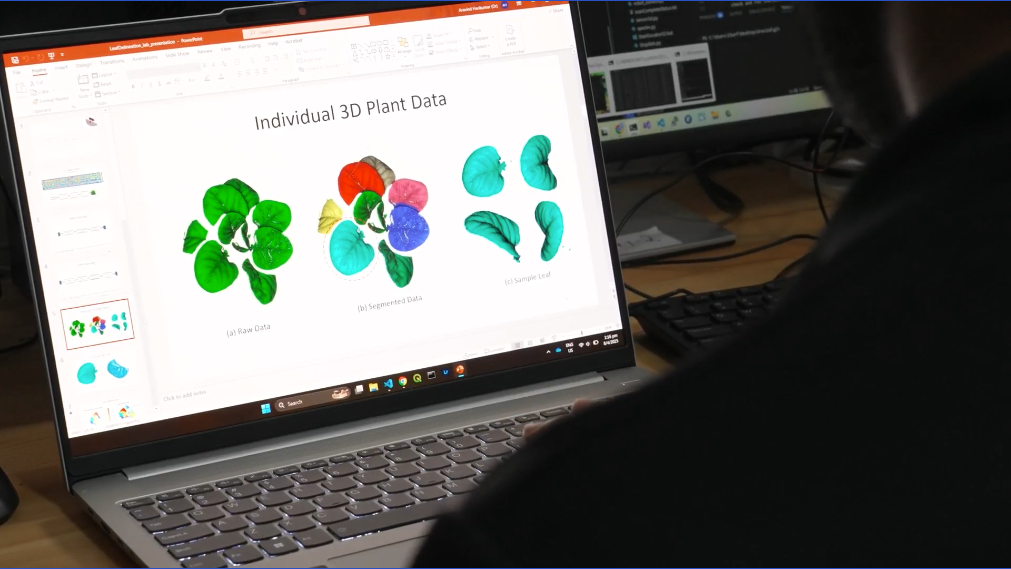
Prof Lim noted that the collaboration has reshaped how he thinks about AI performance. In typical AI research, success is measured by a clean numerical score. In agriculture, things are less straightforward.
"A larger plant does not necessarily mean a better product. It may be less nutritious, or it may not taste as good," he said. "Defining the right ground truth is itself a major challenge."
"Having such a sophisticated dataset does not automatically solve the real-world problem. In fact, it makes the translational challenge even clearer. One of the biggest challenges is to bridge the gap between what is possible in a highly instrumented experimental facility and what is practical under real farm constraints."
It is this complexity that underscores why the project is cross-disciplinary from the start; each side brings strengths the other does not have. The team also includes CCDS Associate Professors Kwoh Chee Keong and Lin Guosheng; Professor Menachem Moshelion, a plant science researcher from the Hebrew University of Jerusalem; and industrial collaborator David Tan, founder and CEO of Netatech, a company specialising in high-tech cross-border agricultural technologies.
Through discussions with Mr Tan, for instance, Prof Lim came to appreciate that maximising yield alone may not be the right objective from a market perspective.
"From the AI side, we are used to working with data, models, and algorithms, but we do not always have the domain knowledge needed to fully interpret the data or design the most meaningful experiments," he said. "That is why collaboration with the science team was so important. Their expertise helped ground the project in real biological and agricultural questions."
For CCDS, the project also opens doors for students. Prof Lim is exploring final-year projects in AI-enabled agriculture, reflecting what he sees as a broader shift. "AI is not just a discipline on its own, but a tool for catalysing progress in other fields," he said, underscoring CCDS's growing role in cross-disciplinary research. By pairing AI expertise with domain scientists and industry practitioners, Agri-TrAIt demonstrates how computing can deliver tangible impact beyond the lab.