Stronger reforms will be required to unleash Tanzania’s huge economic potential
Tanzania is a key attraction of prospective Singapore-East African Community free trade agreement
By Rafiq Raji

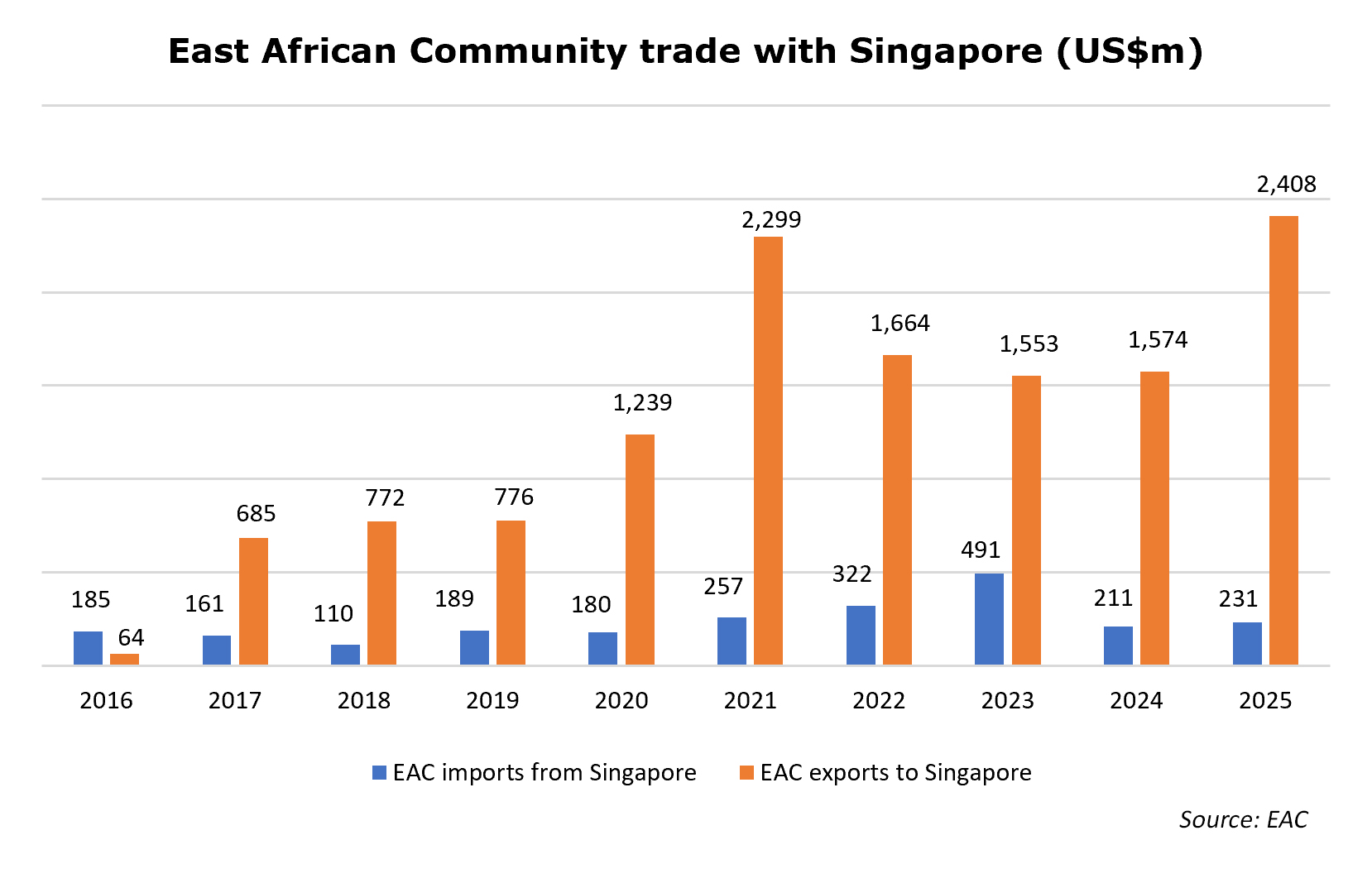
Having covered Kenya and Ethiopia in recent notes, we extend our East African coverage to Tanzania, as Singaporean investors take greater interest in the country, especially its agro-processing, energy, technology, and tourism sectors.[1],[2],[3],[4] Tanzania is also one of the leading African countries attracting startup investment.[5] During a state visit to Tanzania in June 2026, Singaporean president Tharman Shanmugaratnam announced Singapore will start negotiations on its first African free trade agreement with the East African Community (EAC), which will also be the first for the regional trade bloc with a non-African trading partner.[6] The 8-member EAC consists of Kenya, Tanzania, Uganda, Rwanda, Burundi, Somalia, South Sudan, and the Democratic Republic of Congo. In late July 2026, EAC central bank governors reaffirmed their commitment to a single regional currency by 2031, although historical deviations from EAC agreements by respective member-countries for domestic priorities suggest an East African Monetary Union (EAMU) might take much longer to achieve.[7] Singapore’s latest attempt at deepening trade relations with East Africa is partly a response to rising global trade uncertainties, especially from the US-China trade war.[8] While Singaporean firms have well-established trading, manufacturing, shipping and logistics operations across Africa, especially in West Africa, there had hitherto not been comparable interest in East Africa, although there are notable examples (see endnote).[9],[10]
 Liquefied natural gas, critical minerals, and East African railway links to Dar es Salaam port underpin investment attractiveness
A key prospect of the Tanzanian economy is its natural gas wealth, with 47.13trn cubic feet in proven reserves. International oil and gas companies Shell and Equinor are leading the exploration of the US$42bn liquefied natural gas project expected to come on stream by 2030, although ongoing negotiations were already behind schedule as at July 2026, when construction was originally planned to have already begun.[11],[12],[13] When completed, the LNG project, which will primarily target the Asian market, will produce 15m metric tonnes of liquefied natural gas per annum over 30 years. The LNG project is expected to boost the Tanzanian economy by 2% of GDP each year and generate US$2bn-4bn in annual revenue for the government.[14] In the much-followed Fraser Institute Annual Survey of Mining Companies for 2025, Tanzania is ranked the 4th most attractive mining investment destination in Africa, and 34th out of 68 mining jurisdictions globally, showing a consistent improvement in its ranking since 2023, when it ranked 53rd out of 86 mining jurisdictions.[15],[16] Tanzania’s rich prospects in battery minerals (graphite and nickel), rare earth minerals (neodymium and praseodymium), liquefied natural gas, fertiliser, and tourism, as well as an East African international trade and logistics gateway, are opportunities that local and foreign investors are keen to tap.[17],[18],[19],[20] According to one estimate, Tanzania will require US$3.7trn in investment over the next 25 years to achieve its US$1trn of GDP ambition by 2050.[21] In its 2026/27 budget, the government highlighted a strategic redirection for its mining sector, especially critical minerals, towards more value addition before export, a departure from a hitherto extractive mindset for mineral-based industrialisation.[22],[23]
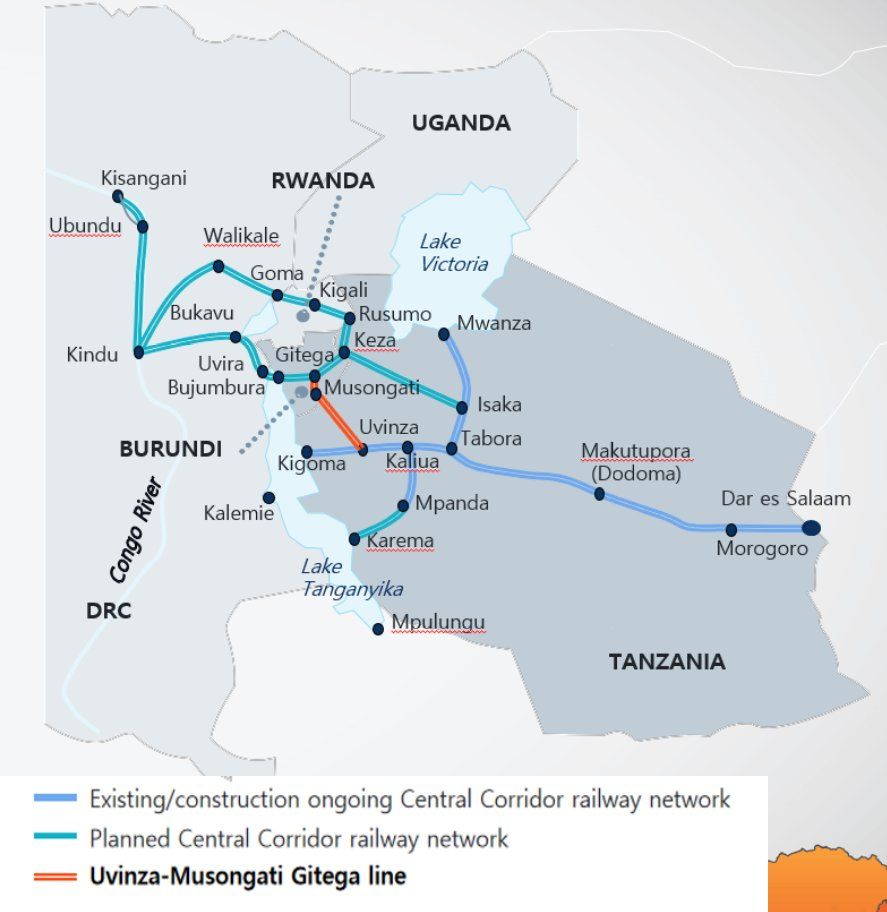
Map of standard gauge railways under construction to link East African neighbours with Dar es Salaam port
Source: African Development Bank
The East African standard gauge railway project, which will span several EAC member countries, as well as the rehabilitation of old railway links to neighbouring countries by the respective governments, constitute a key pillar of the region’s infrastructural and logistical integration effort, with an eventually region-wide railway-linked Dar es Salaam port increasingly positioning as a strategic artery to rival the Kenyan Mombasa port.[24],[25],[26] China is helping to construct and upgrade various internal railways in Tanzania, which form part of a network linking the Dar es Salaam port with neighbouring resource-rich but landlocked Zambia, Democratic Republic of Congo, Uganda, and Burundi.[27],[28] Financing for the standard gauge railway linking commercial capital and port city Dar es Salaam with northwestern lakeside city of Mwanza was arranged in April 2026.[29] The rehabilitation and upgrade of the Tanzania-Zambia railway is also advancing.[30],[31],[32] Uganda plans to extend a new standard gauge railway it is constructing to enable speedier access to the Kenyan Mombasa port, through which it currently exports most of its commodities, towards Tanzania as well, which will enable it use the Dar es Salaam port as an alternative shipping route.[33] As at July 2026, the 506km Tabora-Kigoma standard gauge railway, which will effectively link the Dar es Salaam port with Lake Tanganyika, had advanced beyond more than a tenth of planned works, which upon completion will enable quicker and safer transportation of seaborne goods from Burundi, the Democratic Republic of Congo, and Zambia, to the Dar es Salaam port.[34] The construction of the 240km Uvinza-Musongati standard gauge railway connecting Tanzania with Burundi, which is also advancing, is expected to be completed by 2030.[35]
Tough business environment is a significant drawback
In the Tanzania Development Vision 2050 plan, the authorities are targeting a US$1trn economy by 2050, upper middle-income status of US$7,000 GDP per capita from lower middle-income status of about US$1,300 GDP per capita achieved under Vision 2025 (although the US$3,000 GDP per capita target was missed), which will require an annual real GDP growth rate of at least 10% in 2026-50.[36] Structural constraints, ranging from an excessive regulatory burden, limited financial inclusion, infrastructural deficits, to aggressive and irregular taxation continue to weigh on the economy, although IMF-backed reforms are ongoing to ease some of them.[37] Despite EAC constraints, there is some economic protectionism in Tanzania, especially of small businesses in the informal sector, which the government prevents foreigners from participating in.[38] In late July 2025, the authorities banned foreigners from engaging in specific retail and wholesale trade, to protect the business interests of locals.[39] A frustrating and time-consuming regulatory environment, tasking taxation compliance regime, and low access to finance are significant binding constraints on firms operating in Tanzania.[40]
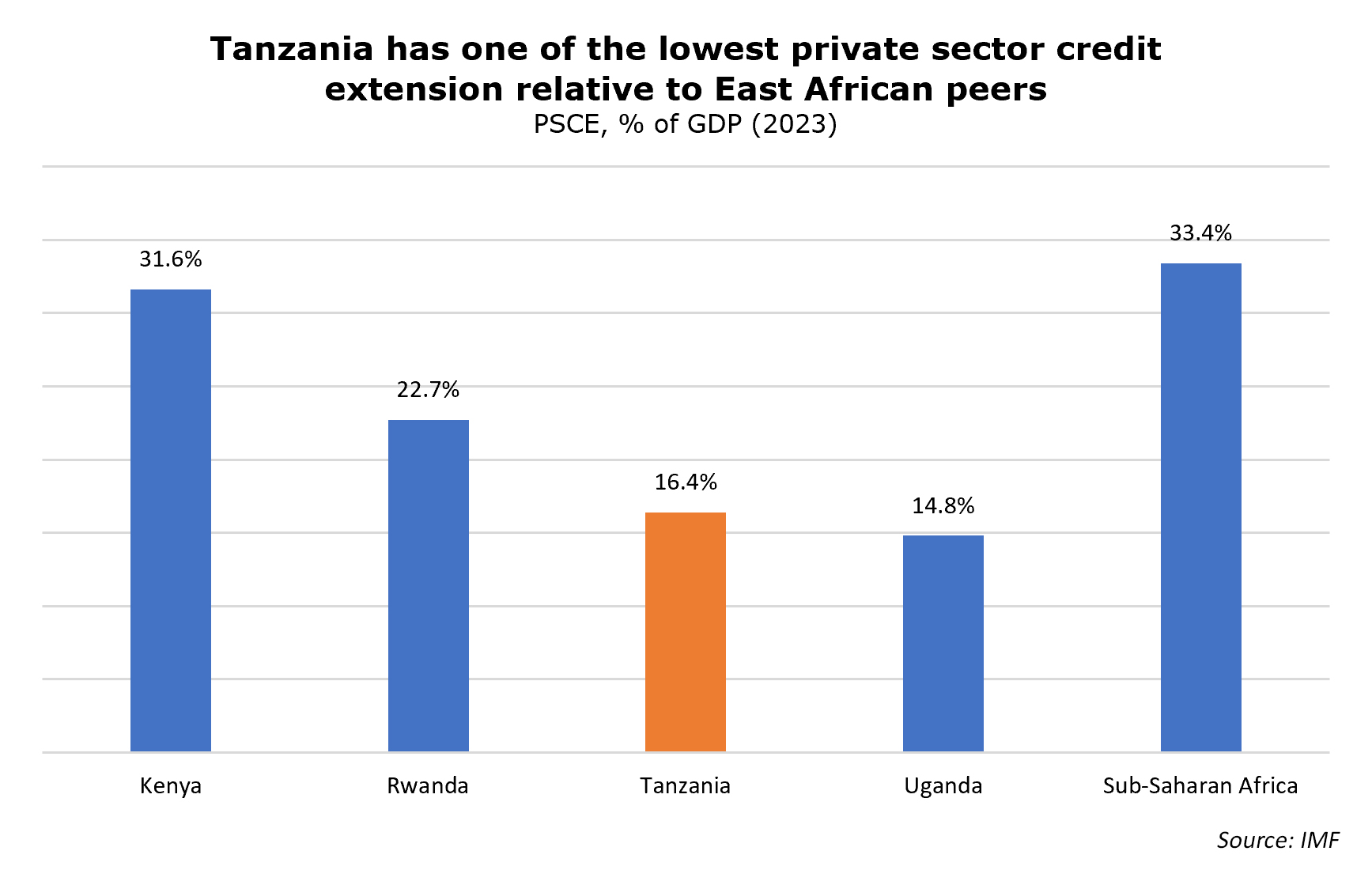
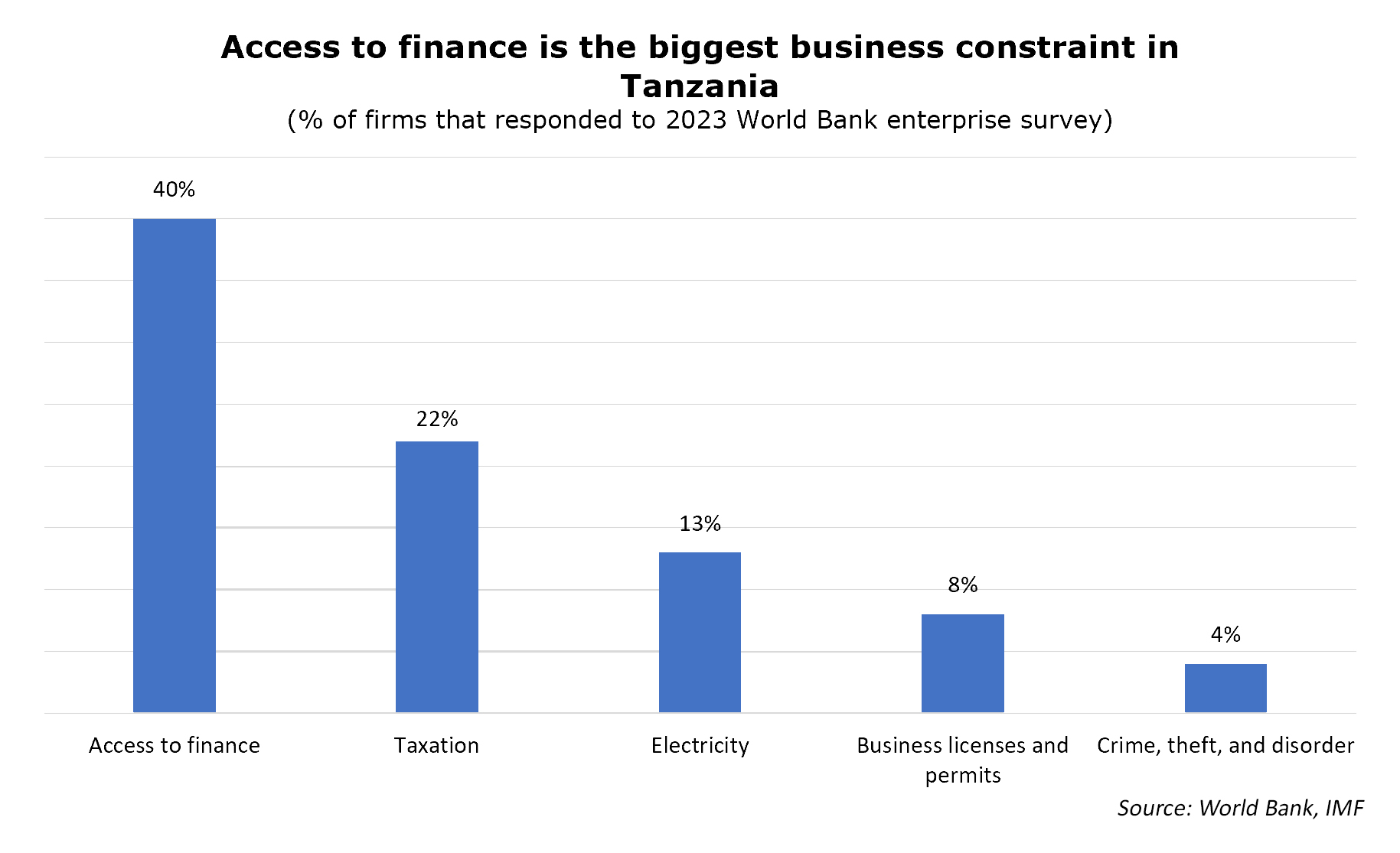 A 2023 World Bank enterprise survey found business executives spent relatively more time dealing with regulators than the African average or similar lower middle-income economies. Taxation requirements are not only onerous, changed frequently, but also aggressively enforced. In March 2026, a presidential commission proposed numerous reforms to the tax laws and their administration, to make them more business-friendly.[41] More than 80% of firms doing business in Tanzania rely on owners’ equity for capital expenditure, the survey also found. Tanzania’s capital markets are also budding, with a concentrated few banks dominating the still shallow financial sector. Private sector credit extension in Tanzania is also one of the lowest relative to peers in the EAC, and significantly underwhelms the Sub-Saharan Africa average. Key reforms to improve the business environment will require easing the regulatory burden, improving infrastructure, instituting a more accommodative taxation regime and administration, and enabling greater and easier access to finance.
Predatory and irregular taxation, corruption, inconclusive and longwinding negotiations with authorities to start a business, significant constraints on employing expatriates, distrust between the public and private sectors, holdups on investment incentives, a compulsory local bourse listing requirement, as well as a prohibition on acquisition of land by foreigners, characterise the business environment in Tanzania.[42] While Tanzania’s Vision 2050 ambition of transforming into a US$1trn economy (more than 10 times the size of the economy in 2025) by 2050 is ambitious, the government has begun to take steps to improve the business environment and encourage investment.[43],[44] To reduce red tape and attract foreign investor interest, the government has consolidated the administration of special economic zones and investment promotion into the Tanzania Investment and Special Economic Zones Authority (TISEZA) created in 2025. Despite highly attractive fiscal incentives, a predominantly government-managed SEZ system is in serious need of private participation to beat longrunning inefficiencies, which have weighed on private and foreign manufacturing investment. The Bagamoyo Special Economic Zone is the major flagship SEZ-based industrialisation project that the authorities are using to drive Vision 2050, which they hope will be a successful departure from an underwhelming SEZ regime thus far.[45],[46],[47] The construction of the US$11bn Bagomoyo port project, a key component of the SEZ, was underway in mid-2026, after protracted negotiation delays that eventually concluded in late 2025.[48],[49]
High growth, low inflation, sustainable debt, but declining private investment
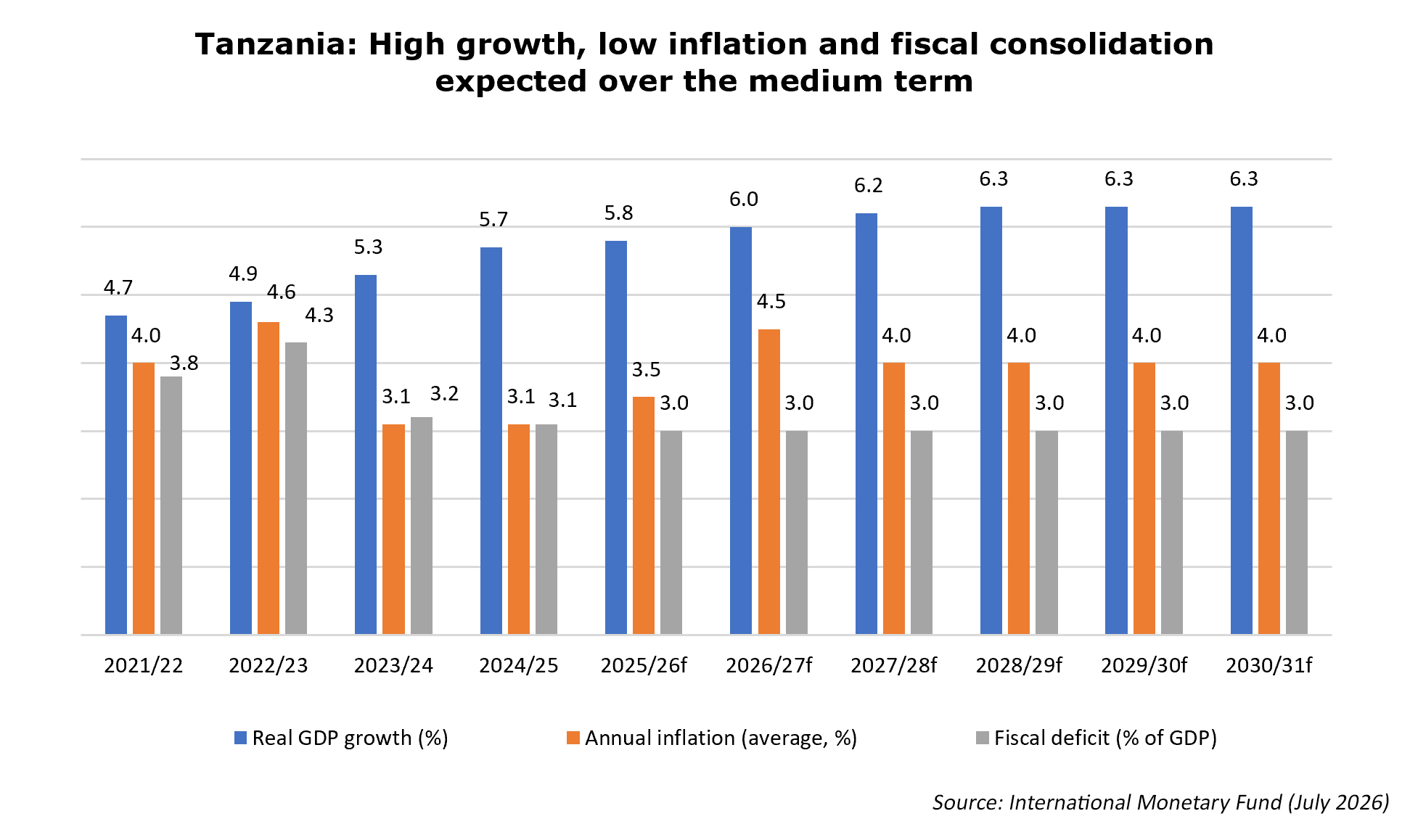
High economic growth and low inflation have historically characterised the Tanzanian economy. The US$93bn Tanzanian economy (projected to become a US$100bn economy in 2026/27) has been growing by about 6% on average over the past two decades, which though relatively high, was below the government’s 8% target in its Vision 2025 development blueprint. At 40% of economic output, Tanzania is a services-led economy, although agriculture, which constitutes a quarter of the economy, employs 57% of the workforce. A largely agro-processing and light manufacturing industrial sector makes up about 28% of GDP, with a gold-dominated mining sector accounting for a tenth of the overall economy. Investment more than doubled to about 40% of GDP in 2000-23, driven largely by private investment, although this has begun to decline in recent years, with foreign direct investment falling from 5.7% of GDP in 2010 to 2% of GDP in 2023. Gold makes up a fifth to just under a third of total exports, which together with travel services and transport services constitute about two-thirds of total exports. Petroleum products make up about a tenth of total imports, with industrial supplies constituting the bulk of imports at just under a third, together accounting for about two-fifths of value of goods and services bought from countries abroad.
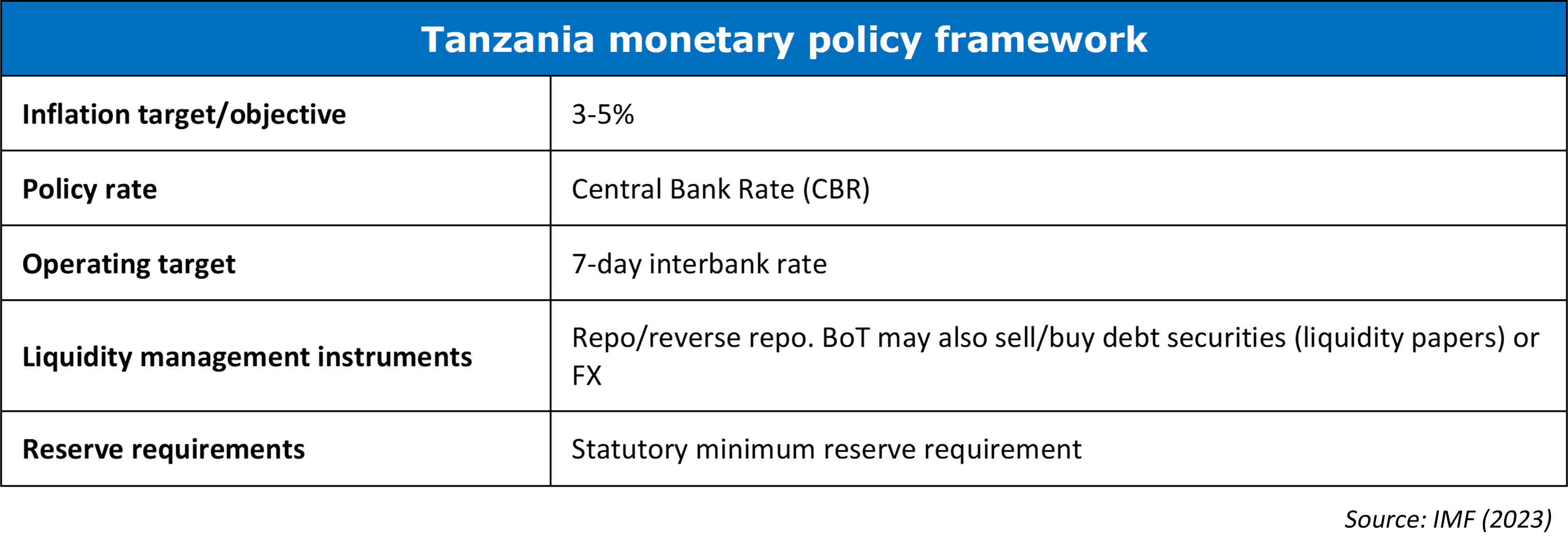
In the 2026/27 budget delivered by finance minister Khamis Omar in June 2026, the government highlighted its immediate macroeconomic targets are to quicken real GDP growth to 6.3% in 2026 from 5.9% in 2025, keep inflation in the low single-digit within the 3-5% target range, sustain fiscal consolidation by keeping the budget deficit no higher than 3% of GDP, and accrete hard currency reserves to cover at least 4 months of imports. Public debt of US$44.8bn (48% of GDP) at end-April 2026 is expected to remain at about 50% of GDP or less over the medium term, sufficiently below the debt sustainability threshold of 55%. To stabilise prices, and in line with its earlier policy tightening signal, the Bank of Tanzania (BoT, the central bank), which targets an inflation rate band of 3-5%, raised its monetary policy rate in July 2026 by 50 basis points to 6.25% from 5.75%.[50] Sustained imported fuel and food inflation (from fertiliser imports) due to a longer-than-expected US-Iran war, which started in late February 2026, will be moderated by ample farm harvests in 2025/26, a fuel subsidy as the need arises (in May-June 2026, for instance), as well as a relatively stable exchange rate.[51],[52] Headline inflation increased from 3.2% year on year in February 2026, the month preceding the Middle East conflict, to 4% in June, thus forcing the BoT to hike interest rates in early July 2026 to anchor inflation expectations. Inflation is expected to peak at 4% on average for the remainder of the current decade, although the ongoing liberalisation of the foreign exchange market and transition to an interest rate-based monetary policy framework that targets inflation instead of the growth of monetary aggregates will create some initial and recurring volatility, but this should stabilise over the medium to long term.[53]
 After more than a decade since its last external debt issuance, Tanzania is testing the waters in the international debt markets again with a prospective US$500m-US$1bn eurobond in 2026.[54] With the support of the International Finance Corporation (a subsidiary of the World Bank), Tanzania listed its first locally-denominated offshore bond on the London Stock Exchange in July 2026.[55] The IMF is currently finalising two financing programmes worth about US$1.8bn with Tanzania; a US$1bn Extended Credit Facility and a US$786m Resilience and Sustainability Facility, lately approving a total of US$443.8m in disbursements in July 2026.[56] In the 2026/27 budget, the first under Vision 2050, the government highlighted a strategic redirection of the mining sector towards minerals-based industrialisation.[57] Proposed amendments to the Bank of Tanzania Act in the 2026/27 budget will reduce the amount of monetary financing the central bank can provide to the government to 14% of the previous year’s fiscal revenue from 18% currently, as well as specify the conditions under which such money printing can take place, although there are concerns about repayment safeguards.[58] Amendments to relevant tax laws were also proposed in the 2026/27 budget to enable the government honour tax exemptions and incentives offered to mining investors, which the authorities have not historically honoured in practice, owing to bureaucratic bottlenecks over absent laws, procedures, and standards, which hitherto weighed on the smooth execution of joint venture mining projects.[59],[60]
Political repression will be recurring
After a highly violent presidential election in 2025, which caused the deaths of more than 500 people, the Tanzanian authorities have been cracking down on an especially youth-led political opposition, banning all political rallies in June 2026.[61],[62],[63] The effect of the October 2025 election violence on the economy, especially its tourism sector, is mixed, although historically such disturbances have weighed on the key tourism sector, but it is not likely to be a major factor in the medium-term economic outlook. Russia clearly senses an opportunity in the tensions between the Tanzanian and Western governments over the 2025 election violence and continued political repression since, and the Hassan administration appears keen to tap it.[64] Even so, Tanzania’s strategic significance, from its key ports infrastructure, natural gas reserves, to its critical minerals endowments, will continue to engender a mutually beneficial relationship with the West.[65] Still, the illiberal political environment will continue to prevent Tanzania from reaching its full economic potential if not addressed.[66]
The long-ruling Chama Cha Mapinduzi (CCM) party managed to remain in power following the highly contentious October 2025 general election, which the incumbent Samia Hassan effectively won unopposed, after her most popular challenger Tundu Lissu of the main opposition Chama cha Demokrasia na Maendeleo (CHADEMA) party, was imprisoned for treason and his party barred from contesting the poll. As part of the ongoing constitutional review process, the Hassan administration has announced plans to establish a reconciliation commission, although it is doubtful the ruling CCM party will ease its longrunning firm grip on power and allow healthy political competition.[67] The political repression that instigated the protests leading to the polls, which have continued in the aftermath of the election, will be recurring over the medium term. While relations with the United States were strained over the October 2025 general elections violence, US interests in key investment deals worth more than US$42bn for the Tanzania liquefied natural gas, Kapanga nickel and Mahenge graphite projects are likely to remain unchanged, although continued delays in ongoing and protracted negotiations are highly probable.[68],[69] The final investment decision for the Kapanga Nickel Project is now expected in the first quarter of 2027, for instance.[70] Even so, foreign investors remain keen on Tanzanian opportunities.[71]
 Endnote – Evolving Singaporean B2B and G2G interest in East Africa
Singaporean insurtech unicorn Bolttech acquired Kenyan digital insurer mTeck in 2025, targeting not just Kenya but the wider East African region.[72] Singaporean tech firm Trident is helping to execute a blockchain-based digital national identification system for the Democratic Republic of Congo (DRC).[73],[74] Project 54, an evolving financial technology initiative between the central banks of Singapore, Ghana and Rwanda, aims to lower the costs of intra-African cross-border financial transactions as well as Asia-Africa ones, by digitally integrating payment, identity and licensing systems across the African continent. Singaporean investors are also showing increasing interest in Ethiopia’s e-commerce sector.[75] Launched in September 2024, the Rwanda-Singapore “AI Playbook for Small States” is another example of a thriving Singaporean technological partnership with an EAC-member country, tech governance in this case, enabling smaller countries to make the best use of artificial intelligence, while limiting its costs.[76],[77]
In June 2025, Singapore pioneered a voluntary carbon market government alliance with Kenya and the United Kingdom, whereby Singaporean firms will be able to buy high-integrity carbon credits from climate-action projects in Kenya, an alliance that should ultimately include other EAC-member countries, as well as other African countries.[78] In early 2026, Singaporean and Rwandan authorities started accepting applications for carbon credit purchases from Rwandan projects, after the two countries agreed a pact allowing the arrangement in May 2025 (Singapore has a similar pact with Ghana).[79],[80] In June 2026, the Singaporean government signed a memorandum of understanding with Tanzania on carbon markets cooperation, as it expands the sources of carbon credits for Singaporean firms, which like in the Rwandan case, should advance to an implementation agreement in due course.[81],[82] Singapore and Ghana are building Africa’s first finternet, which will digitally enable government-to-citizen and government-to-business financial transactions, with potential replications in East Africa and broader African continent over time.[83] Singaporean fintech firm Liquid Group facilitates Asia-Africa cross-border payments in Rwanda, from where it covers the broader East Africa region, and Ghana for the West Africa region.[84] Singapore’s zero-commission ride-hailing service TADA is looking at expanding to Kenya in 2026, and thereafter to Tanzania and Ethiopia, where it also plans to introduce its battery-swapping electric tuk-tuks.[85]
References
[1] Raji, R. (2026, May 21). Major Sub-Saharan African economies will continue recovery despite Iran war. NTU-SBF Centre for African Studies. https://www.ntu.edu.sg/cas/news-events/news/detail/major-sub-saharan-african-economies-will-continue-recovery-despite-iran-war
[2] Raji, R. (2026, July 6). Assessing Ethiopia’s economic reforms and outlook. NTU-SBF Centre for African Studies. https://www.ntu.edu.sg/cas/news-events/news/detail/assessing-ethiopia-s-economic-reforms-and-outlook
[3] Daily News (2025, August 27). Tanzania lures Singapore to invest in energy, agro-processing, fisheries. https://dailynews.co.tz/tanzania-lures-singapore-to-invest-in-energy-agro-processing-fisheries/
[4] Takwa, E. (2026, June 9). Singapore FDI in Tanzania hits US$535M from 36 projects. Daily News. https://dailynews.co.tz/singapore-fdi-in-tanzania-hits-us535m-from-36-projects/
[5] The Citizen (2026, July 29). Tanzania back as fifth-largest startup funding destination on the continent. https://www.thecitizen.co.tz/tanzania/news/national/tanzania-back-as-fifth-largest-startup-funding-destination-on-the-continent-5539382
[6] Fang, C.S (2026, June 9). Singapore to negotiate FTA with regional bloc of 8 East African countries. The Straits Times. https://www.straitstimes.com/singapore/politics/singapore-to-negotiate-fta-with-regional-bloc-of-8-east-african-countries
[7] Nyanje, P. (2026, July 30). EAC reaffirms 2031 single currency target as regional economies outperform Africa. Business Insider. https://businessinsider.co.tz/eac-reaffirms-2031-single-currency-target-as-regional-economies-outperform-africa/
[8] Ng, J. (2026, June 12). Singapore’s outreach to East Africa: Navigating uncertainty with new partnerships. Nanyang Technological University. https://rsis.edu.sg/rsis-publication/rsis/singapores-outreach-to-east-africa-navigating-uncertainty-with-new-partnerships/
[9] Payton, B. (2025, August 19). Singapore cements trade and manufacturing links with Africa. African Business. https://african.business/2025/08/trade-investment/singapore-cements-trade-and-manufacturing-links-with-africa
[10] Zaidi, N. (2025, August 28). Singapore firms continuing to expand in Africa, expect high returns. Channel News Asia. https://www.channelnewsasia.com/singapore/sg-africa-business-forum-smes-expansion-economy-ties-5319501
[11] International Monetary Fund (2023). United Republic of Tanzania: Selected issues. https://www.imf.org/-/media/files/publications/cr/2023/english/1tzaea2023002.pdf
[12] Reuters (2026, January 26). Tanzania expects to sign $42 billion mega LNG project before June, minister says. https://www.reuters.com/business/energy/tanzania-expects-sign-42-billion-mega-lng-project-before-june-minister-says-2026-01-26/
[13] The Guardian (2026, July 28). Investors inquire on LNG project pace in UK forum. https://ippmedia.co.tz/the-guardian/news/local-news/read/investors-inquire-on-lng-project-pace-in-uk-forum-2026-07-24-115249
[14] Temba, C. (2026, May 18). Tanzania’s LNG project: A USD 42bn guest in a world going green? PwC. https://www.pwc.co.tz/press-room/tanzania-lng-project.html
[15] Adeyemi, S. (2026, March 10). Global investors placed on alert as Tanzania becomes Africa’s fastest-growing mining investment hotspot. Business Insider. https://africa.businessinsider.com/markets/global-investors-placed-on-alert-as-tanzania-becomes-africas-fastest-growing-mining/gcm77k5
[16] Mejia, J. and Aliakbari, E. (2026). Annual Survey of Mining Companies, 2025. Fraser Institute. https://www.fraserinstitute.org/sites/default/files/2026-02/annual-survey-of-mining-companies-2025.pdf
[17] Mutinda, J. (2026, July 10). Dewji to build graphite factory in Tanzania. The East African. https://www.theeastafrican.co.ke/tea/business-tech/dewji-to-build-graphite-factory-in-tanzania-5523554
[18] Adegboyega, A. (2026, July 10). Tanzania’s richest man makes $275m bet on battery minerals as EV race accelerates. Business Insider. https://africa.businessinsider.com/local/markets/tanzanias-richest-man-makes-dollar275m-bet-on-battery-minerals-as-ev-race-accelerates/q7gvenk
[19] Adegboyega, A. (2026, July 1). Africa’s richest man picks Tanzania for next wave of power, fertiliser and transport investments. Business Insider. https://africa.businessinsider.com/local/markets/africas-richest-man-picks-tanzania-for-next-wave-of-power-fertiliser-and-transport/tp4hdrk
[20] African Mining Market (2026, May 20). Rare earth discovery in Tanzania signal a new era of economic growth. https://africanminingmarket.com/rare-earth-discovery-in-tanzania-signal-a-new-era-of-economic-growth/25731/
[21] Papadavid, P., Willem te Velde, D., and Kewe, S.L. (2025, June 19). Tanzania’s US$1 trillion economy hinges on a step-up in private sector investment. ODI Global. https://odi.org/en/insights/tanzanias-us1-trillion-economy-hinges-on-a-step-up-in-private-sector-investment/
[22] Shayo, H. (2026, June 19). From rocks to riches: How 2026/27 budget advances mineral processing ambitions. Daily News. https://dailynews.co.tz/from-rocks-to-riches-how-2026-27-budget-advances-mineral-processing-ambitions/
[23] Onyango, G. (2026, June 25). Digging deeper: Tanzania’s bid to become a critical minerals leader. Business Insider. https://africa.businessinsider.com/local/markets/digging-deeper-tanzanias-bid-to-become-a-critical-minerals-leader/q8lt4pr
[24] Omondi, D. (2026, February 24). Pressure on Mombasa port as Uganda eyes new SGR link to Tanzania. Business Daily. https://www.businessdailyafrica.com/bd/economy/uganda-eyes-new-sgr-link-to-tanzania-5370416
[25] Wamala, D. (2026, May 22). East Africa’s $20b infrastructure push ties six economies together. Daily Monitor. https://www.monitor.co.ug/uganda/news/national/east-africa-s-20b-infrastructure-push-ties-six-economies-together-5470154
[26] Mutabasi, R. (2026, July 19). Kenya-Tanzania rail link moves closer as Voi-Taveta project hits 70 per cent. The Eastleigh Voice. https://eastleighvoice.co.ke/news/380977/kenya-tanzania-rail-link-moves-closer-as-voi-taveta-project-hits-70-per-cent
[27] Ng’Wanakilala, F. (2026, July 20). Chinese firm wins $2.7 billion deal to build railway in Tanzania. Bloomberg. https://www.bloomberg.com/news/articles/2026-07-20/chinese-firm-wins-2-7-billion-deal-to-build-railway-in-tanzania
[28] Agbetiloye, A. (2025, November 21). China kicks off $1.4bn upgrade of Tanzania-Zambia railway. Business Insider. https://africa.businessinsider.com/local/lifestyle/china-kicks-off-dollar14b-upgrade-of-tanzaniazambia-railway/rgeymyc
[29] Reuters (2026, April 28). Standard Chartered arranges $2.33 billion of funding for Tanzania railway. https://www.reuters.com/world/africa/standard-chartered-arranges-233-billion-funding-tanzania-railway-2026-04-28/
[30] Kunda, J. (2025, November 21). China, Zambia, Tanzania sign $1.4B agreement to modernize 5-decade old railway line. Anadolu Agency. https://www.aa.com.tr/en/africa/china-zambia-tanzania-sign-14b-agreement-to-modernize-5-decade-old-railway-line/3749778
[31] Xinhua (2026, July 18). Groundbreaking of key facilities marks new progress in TAZARA revitalization. https://english.news.cn/africa/20260718/e3961c5e5650471a9347c91d2fa51700/c.html
[32] Agbetiloye, A. (2026, April 2). Chinese copper firms join $1.2 billion upgrade of critical African railway to boost critical minerals exports. Business Insider. https://africa.businessinsider.com/local/markets/chinese-copper-firms-join-dollar12-billion-upgrade-of-critical-african-railway-to/lfg6vcc
[33] Reuters (2026, February 23). Uganda wants to link new railway line to Tanzania, opening up new export route. https://www.reuters.com/world/africa/uganda-wants-link-new-railway-line-tanzania-opening-up-new-export-route-2026-02-23/
[34] Chubwa, G. (2026, July 17). Tanzania to launch construction of Sh6.31 trillion SGR lot linking Tabora and Kigoma. The Citizen. https://www.thecitizen.co.tz/tanzania/news/national/tanzania-to-launch-construction-of-sh6-31-trillion-sgr-lot-linking-tabora-and-kigoma-5529930
[35] Xinhua (2025, August 17). Tanzania, Burundi launch 2.15 bln USD cross-border railway project. https://english.news.cn/africa/20250817/07b4736b810e42209b12bcf2f1925059/c.html
[36] United Republic of Tanzania (2025). Tanzania Development Vision 2050. https://www.planning.go.tz/uploads/documents/en-1752762713-THE%20TANZANIA%20DEVELOPMENT%20VISION%202050.pdf
[37] International Monetary Fund (2026). United Republic of Tanzania. https://www.imf.org/-/media/files/publications/cr/2026/english/1tzaea2026001.pdf
[38] Rukanga, B. (2025, July 30). Tanzania's ban on foreigners operating small businesses sparks Kenyan backlash. BBC News. https://www.bbc.com/news/articles/cdxyvzjpxe2o
[39] Dentons (2025, July 29). Tanzania issues the Business Licensing (Prohibition of Business Activities for Non-Citizens) Order, 2025 restricting business activities by non-citizens. https://www.dentons.com/en/insights/alerts/2025/july/29/tanzania-issues-the-business-licensing-prohibition-of-business-activities-for-non-citizens
[40] Tashu, M.M. (2025). The business environment and productivity in Tanzania: Evidence from firm level data. International Monetary Fund. https://www.imf.org/-/media/files/publications/selected-issues-papers/2025/english/sipea2025098.pdf
[41] Christopher, J. (2026, March 18). Tax commission proposes 284 changes to reform Tanzania’s tax system. The Citizen. https://www.thecitizen.co.tz/tanzania/business/tax-commission-proposes-284-changes-to-reform-tanzania-s-tax-system-5395010
[42] U.S. Department of State (2025). 2025 Investment Climate Statements: Tanzania. https://www.state.gov/reports/2025-investment-climate-statements/tanzania
[43] The Guardian (2026, July 7). Tanzania’s $1trn dream facing 2058-2062 delay, TICGL warns. https://ippmedia.co.tz/the-guardian/business/read/tanzanias-1trn-dream-facing-2058-2062-delay-ticgl-warns-2026-07-07-123347
[44] Daily News (2026, June 14). Tanzania clears 370 hurdles as private sector takes bigger role in economy. https://dailynews.co.tz/tanzania-clears-370-hurdles-as-private-sector-takes-bigger-role-in-economy/
[45] Adeyemi, S. (2026, June 6). Why Tanzania is betting on a mega coastal project to challenge East Africa’s investment giants. Business Insider. https://africa.businessinsider.com/local/markets/why-tanzania-is-betting-on-a-mega-coastal-project-to-challenge-east-africas/3yevkr2
[46] Mayala, A. (2026, May 31). Industrial journey gathers pace in Bagamoyo. Daily News. https://dailynews.co.tz/industrial-journey-gathers-pace-in-bagamoyo/
[47] Takwa, E. (2026, June 6). Tanzania invites Russian firms to invest in BSEZ project, it is open for global investors. Daily News. https://dailynews.co.tz/tanzania-invites-russian-firms-to-invest-in-bsez-project-it-is-open-for-global-investors/
[48] Reuters (2025, November 24). Tanzania to start constructing new port in December, official says. https://www.reuters.com/world/africa/tanzania-start-constructing-new-port-december-official-says-2025-11-24/
[49] Avila, D. (2026, June 3). Tanzania’s $11 billion Bagamoyo port project to transform East African trade with major dredging works. Dredgewire. https://dredgewire.com/tanzanias-11-billion-bagamoyo-port-project-to-transform-east-african-trade-with-major-dredging-works/
[50] Bank of Tanzania (2026). Monetary policy report July 2026. https://www.bot.go.tz/Publications/Regular/Monetary%20policy%20report/en/2026070908295109.pdf
[51] Mirondo, R. (2026, July 3). Bank of Tanzania raises benchmark rate to 6.25 percent as Middle East conflict heightens inflation risks. The Citizen. https://www.thecitizen.co.tz/tanzania/business/bank-of-tanzania-raises-benchmark-rate-to-6-25-percent-as-middle-east-conflict-heightens-inflation-risks-5517036
[52] Bank of Tanzania (2026). Monetary policy statement June 2026. https://www.bot.go.tz/Publications/Regular/Monetary%20Policy%20Statement/en/2026061512070105.pdf
[53] Central Banking (2024, January 24). Tanzania switches to interest rate-based monetary policy. https://www.centralbanking.com/central-banks/monetary-policy/7960711/tanzania-switches-to-interest-rate-based-monetary-policy
[54] Henderson, R. and Karakaya, K. (2026, July 22). Tanzania explores Eurobond sale with investor roadshow in London. Bloomberg. https://www.bloomberg.com/news/articles/2026-07-22/tanzania-explores-eurobond-sale-with-investor-roadshow-in-london
[55] The Citizen (2026, July 27). Tanzania raises Sh263 billion through first offshore bond in London. https://www.thecitizen.co.tz/tanzania/news/national/tanzania-raises-sh263-billion-through-first-offshore-bond-listed-in-london-5537360
[56] The Citizen (2026, July 11). IMF approves $443.8 million for Tanzania after final programme reviews. https://www.thecitizen.co.tz/tanzania/news/national/imf-approves-443-8-million-for-tanzania-after-final-programme-reviews-5524538
[57] Msangi, A. (2026, June 8). Tanzania’s Budget 2026/27: A new era of value addition and economic transformation. Deloitte. https://www.deloitte.com/tz/en/services/tax/perspectives/budget-2026-a-new-era-of-value-addition-and-economic-transformation.html
[58] Issihaka, J. (2026, June 23). Finance Act changes on Bank of Tanzania borrowing spark repayment debate. The Citizen. https://www.thecitizen.co.tz/tanzania/news/national/finance-act-changes-on-bank-of-tanzania-borrowing-spark-repayment-debate-5505946
[59] United Republic of Tanzania (2026, June 11). Speech by the minister for finance, Hon. Ambassador Khamis Mussa Omar (MP), presenting to the National Assembly, the estimates of government revenue and expenditure for 2026/27. https://www.mof.go.tz/uploads/documents/en-1781186595-GOVERNMENT%20BUDGET%20%20SPEECH---ENGLISH%20VERSION.pdf
[60] Mmasi, C., Prosper, E., and Pius, J. (2026, June 19). Tanzania budget 2026 reshapes extractive sector fiscal framework. African Mining Market. https://africanminingmarket.com/tanzania-budget-2026-reshapes-extractive-sector-fiscal-framework/26050/
[61] Reuters (2026, July 9). Tanzania arrests 130 people as government cracks down on dissent. https://www.reuters.com/world/africa/tanzania-arrests-130-people-government-cracks-down-dissent-2026-07-09/
[62] ACLED (2025, October 14). The last of the hegemonic liberation parties: Tanzania’s CCM clings to power as elections loom. https://acleddata.com/report/last-hegemonic-liberation-parties-tanzanias-ccm-clings-power-elections-loom
[63] Mugabi, I. (2026, April 24). Tanzania’s opposition criticizes ‘whitewashing’ of violence. DW. https://www.dw.com/en/tanzanias-opposition-criticizes-whitewashing-of-post-election-violence/a-76919885
[64] Fabricius, P. (2026, July 31). Is Tanzania’s president ‘Looking East’? Institute for Security Studies. https://issafrica.org/iss-today/is-tanzania-s-president-looking-east
[65] The Chanzo Reporter (2026, August 3). U.S. House Representatives meet with Tanzanian defence officials. https://thechanzo.com/2026/08/03/u-s-house-representatives-meet-with-tanzanian-defence-officials/
[66] Kell, F. (2025, October 23). Tanzania election: Erosion of democracy will also come at the cost of economic potential. Chatham House. https://www.chathamhouse.org/2025/10/tanzania-election-erosion-democracy-will-also-come-cost-economic-potential
[67] Daily News (2026, July 31). New Constitution: Samia unveils roadmap. https://dailynews.co.tz/new-constitution-samia-unveils-roadmap/
[68] Business Insider (2026, February 25). Tanzania’s shift from steady recovery to economic boom. https://africa.businessinsider.com/local/markets/tanzanias-shift-from-steady-recovery-to-economic-boom/82cch8n
[69] St John, A. (2025, December 3). Tanzania is an African linchpin. Its success is crucial. Business Insider. https://africa.businessinsider.com/local/lifestyle/tanzania-is-an-african-linchpin-its-success-is-crucial/xw7e1y9
[70] Mbani, M. (2026, August 1). Talks delay Tanzania’s Kabanga Nickel investment decision to 2027. Mail & Guardian. https://mg.co.za/thought-leader/2026-08-02-talks-delay-tanzania-s-kabanga-nickel-investment-decision-to-2027/
[71] Mayala, A. (2026, June 12). TZ attracts record 29tri/- investments. Daily News. https://dailynews.co.tz/tz-attracts-record-29tri-investments/
[72] NTU-Centre for African Studies (2025, December 23). Singapore unicorn acquires Kenyan insurance platform. https://www.ntu.edu.sg/cas/news-events/news/detail/singapore-unicorn-acquires-kenyan-insurance-platform
[73] NTU-SBF Centre for African Studies (2025, July 30). DRC Congo gives Singapore firm exclusive rights to roll out digital ID system. https://www.ntu.edu.sg/cas/news-events/news/detail/drc-congo-gives-singapore-firm-exclusive-rights-to-roll-out-digital-id-system
[74] Kavanagh, M.J. (2025, June 25). Congo signs digital identification deal with Singapore’s Trident. Bloomberg. https://www.bloomberg.com/news/articles/2025-06-25/singapore-s-trident-signs-digital-identification-deal-with-congo
[75] NTU-SBF Centre for African Studies (2025, May 26). Singapore firm backs Ethiopian e-commerce startup. https://www.ntu.edu.sg/cas/news-events/news/detail/singapore-firm-backs-ethiopian-e-commerce-startup
[76] Kaberia, J. (2024, September 30). Rwanda and Singapore unite in an AI alliance. CIO Africa. https://cioafrica.co/rwanda-and-singapore-unite-in-an-ai-alliance/
[77] Ashimwe, E. (2024, September 23). Rwanda, Singapore launch world’s first AI “Playbook” at UN summit. The New Times. https://www.newtimes.co.rw/article/20347/news/technology/rwanda-singapore-launch-worlds-first-ai-playbook-at-un-summit
[78] Singapore Economic Development Board (2025, June 24). Singapore, UK, Kenya launch first government alliance to restore confidence in voluntary carbon market. https://www.edb.gov.sg/en/business-insights/insights/singapore-uk-kenya-launch-first-government-alliance-to-restore-confidence-in-voluntary-carbon-market.html
[79] NTU-SBF Centre for African Studies (2026, February 23). Singapore and Rwanda begin accepting carbon credit project proposals. https://www.ntu.edu.sg/cas/news-events/news/detail/singapore-and-rwanda-begin-accepting-carbon-credit-project-proposals
[80] NTU-SBF Centre for African Studies (2025, May 23). Singapore strikes carbon credit deal with Rwanda. https://www.ntu.edu.sg/cas/news-events/news/detail/singapore-strikes-carbon-credit-deal-with-rwanda
[81] Singapore Business Review (2026, June 10). Singapore expands Article 6 carbon market with Tanzania deal. https://sbr.com.sg/news/singapore-expands-article-6-carbon-market-tanzania-deal
[82] Suedi, A. (2026, June 18). What the Tanzania-Singapore carbon deal actually requires. The Citizen. https://www.thecitizen.co.tz/tanzania/oped/what-the-tanzania-singapore-carbon-deal-actually-requires-5500500
[83] PR Newswire (2025, October 29). Ghana’s DACF and Singapore’s EFGH launch joint venture to build Africa’s first finternet. https://www.prnewswire.com/news-releases/ghanas-dacf-and-singapores-efgh-launch-joint-venture-to-build-africas-first-finternet-302598102.html
[84] Chiang, S. (2025, March 17). Two Singapore fintech firms have a head start as Africa makes digital payment push. The Straits Times. https://www.straitstimes.com/business/two-singapore-fintech-firms-have-a-headstart-as-africa-makes-digital-payments-push
[85] NTU-SBF Centre for African Studies (2026, February 23). Singapore ride hailing service eyes African market. https://www.ntu.edu.sg/cas/news-events/news/detail/singapore-ride-hailing-service-eyes-african-market