The impact of CBAM on Africa
How Europe’s carbon border tax could reshape Africa’s industrial and export landscape
By Ronak Gopaldas

The European Union’s (EU) Carbon Border Adjustment Mechanism (CBAM) entered full implementation phase at the beginning of this year after a two-year soft launch (transition period) in late 2023. From January 2026[i], importers of certain carbon-intensive goods to the EU must pay a tax proportionate to the greenhouse gases (GHG) emitted in the manufacture of those products.(1)
The rationale is that the EU’s stringent emissions framework makes local production more costly, and local producers less competitive. By imposing a tax on imports from low cost, high carbon-emission producers, the playing field is levelled for EU producers, and it is intended to encourage producers in lower cost / higher emission nations to pursue cleaner, more environmentally sustainable production processes. Noble in theory, but complex and onerous in practice.
While it’s too early to definitively measure the impact and effectiveness of CBAM within the EU and on the producing nations that export these goods, likely outcomes can be inferred from the two-year transition period. Here we examine the likely impact of CBAM on African producers and states, the potential unintended consequences, as well as unpack what it means for the continent more broadly when CBAM is expanded to a wider industry set and adopted by more countries.
The backdrop: What is CBAM, how does it work and who does it apply to?
The EU has the strictest and most rigorously enforced emissions standards in the world(2) and European manufacturers have invested billions in introducing the green technologies, renewable energy systems and production efficiencies that allow them to meet EU emissions standards and avoid financial penalties for non-compliance. Being a global emissions reduction leader has come at a cost to EU manufacturers, eroding their competitiveness, leaving the door open to cheaper, more carbon intensive imports, and seen the system prone to carbon leakage - the shifting of production outside EU borders where climate policy is less expensive and more loosely enforced.[ii]
The OECD (Organisation for Economic Co-operation and Development) and IMF (International Monetary Fund) estimate carbon leakage(3) to be as high as 13% and 25% respectively.(4) This means that a reduction of 100 tons of CO2 emissions in one region (the UE) was found to lead to an increase of between 13 and 25 tons in another producing region.[iii] (5) CBAM closes this loophole by placing a carbon price on certain imported goods that matches the carbon cost paid by EU manufacturers.(6) CBAM tariffs are incurred once import volumes exceed 50 tonnes in a 12-month period.[iv]
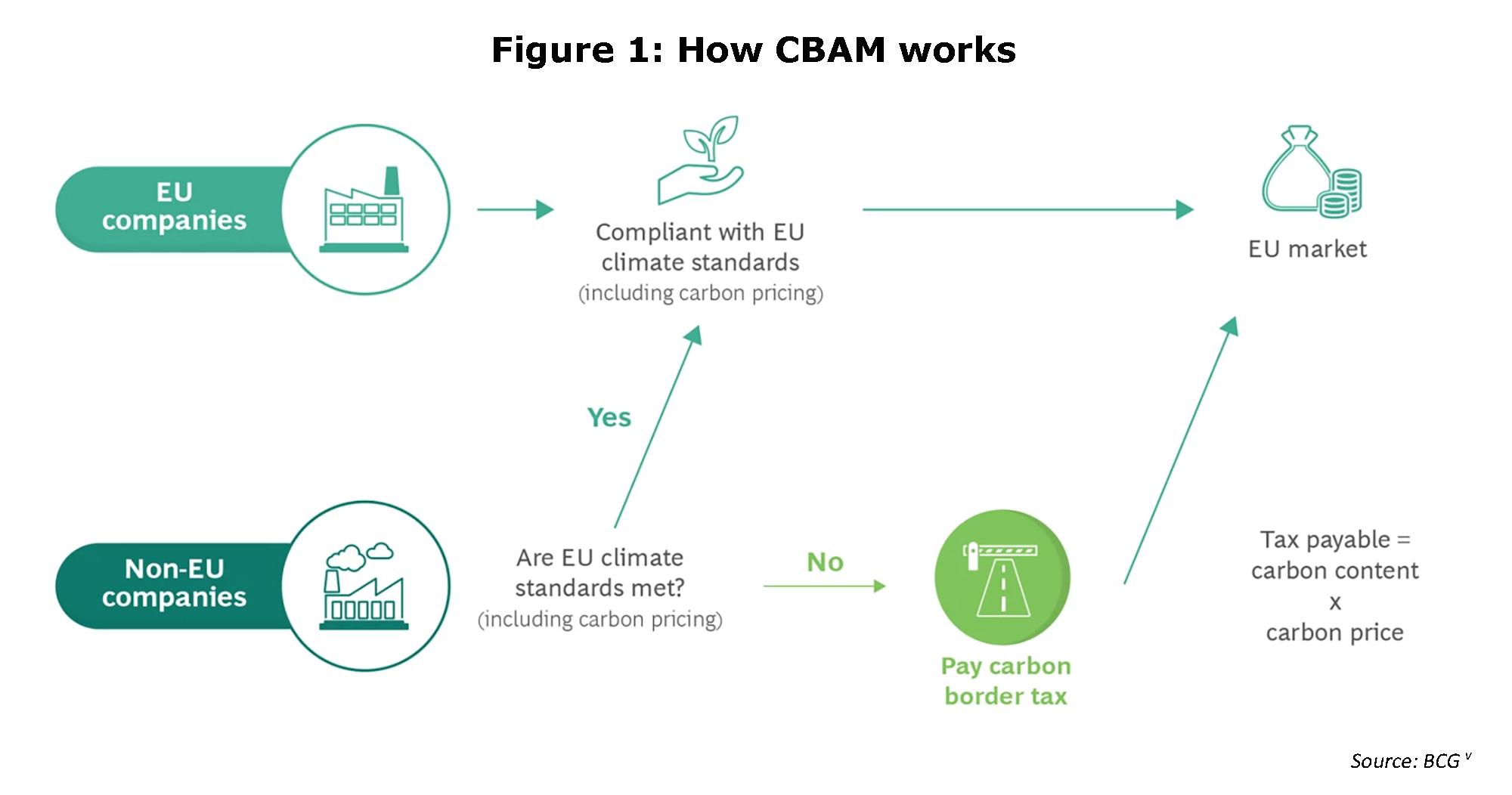
In simple terms, the EU’s CBAM is a tariff to prevent the circumventing of EU carbon emission standards and ensure that all manufactured goods entering the EU pay a comparable carbon price to those that EU manufacturers are subject to . It reduces the cost advantage of foreign exporters who typically pay far lower carbon taxes, if any, and who are not subject to the same emissions scrutiny and penalties in their country of origin (figure 1).
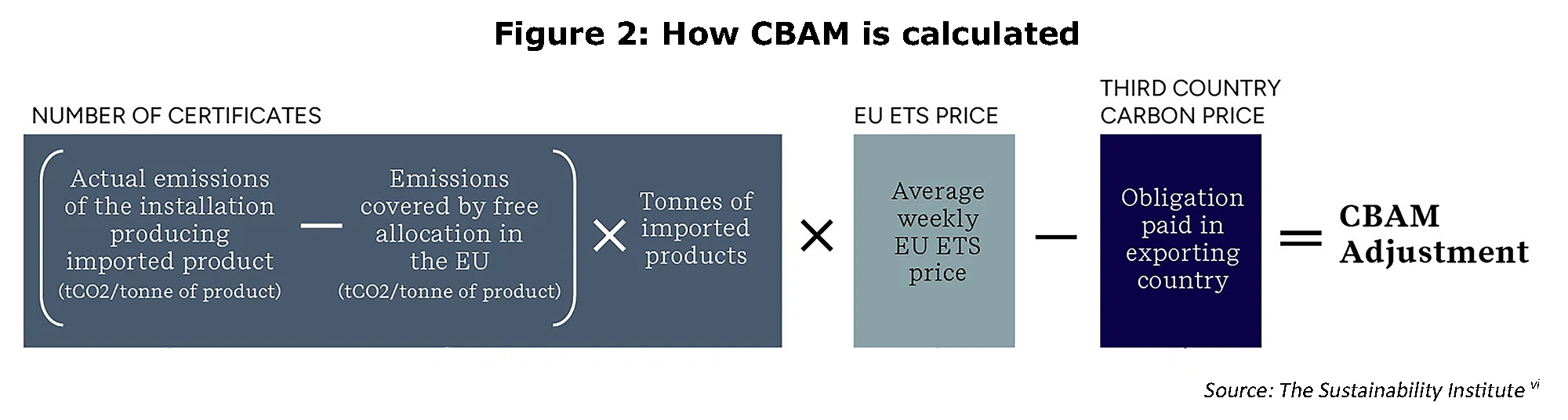
 Calculating the applicable tariff is complex and requires both EU importers and the manufacturing counterparty to maintain and submit verifiable embedded emissions (CO2 emitted per tonne of product produced) data. These emission volumes form the basis of the CBAM adjustment calculation and determines the number of CBAM certificates the importer will need to purchase to allow the passage of goods into the EU. The prices of these certificates are linked to the EU’s Emissions Trading System (ETS) carbon price to determine the final applicable tariff (figure 2).
 The tax specifically targets electricity intensive production, with large, embedded carbon emissions, and which have been susceptible to carbon leakage.(8) From January of this year, imports of iron and steel, aluminium, cement, fertilisers, electricity and hydrogen attract this additional tariff.(9)
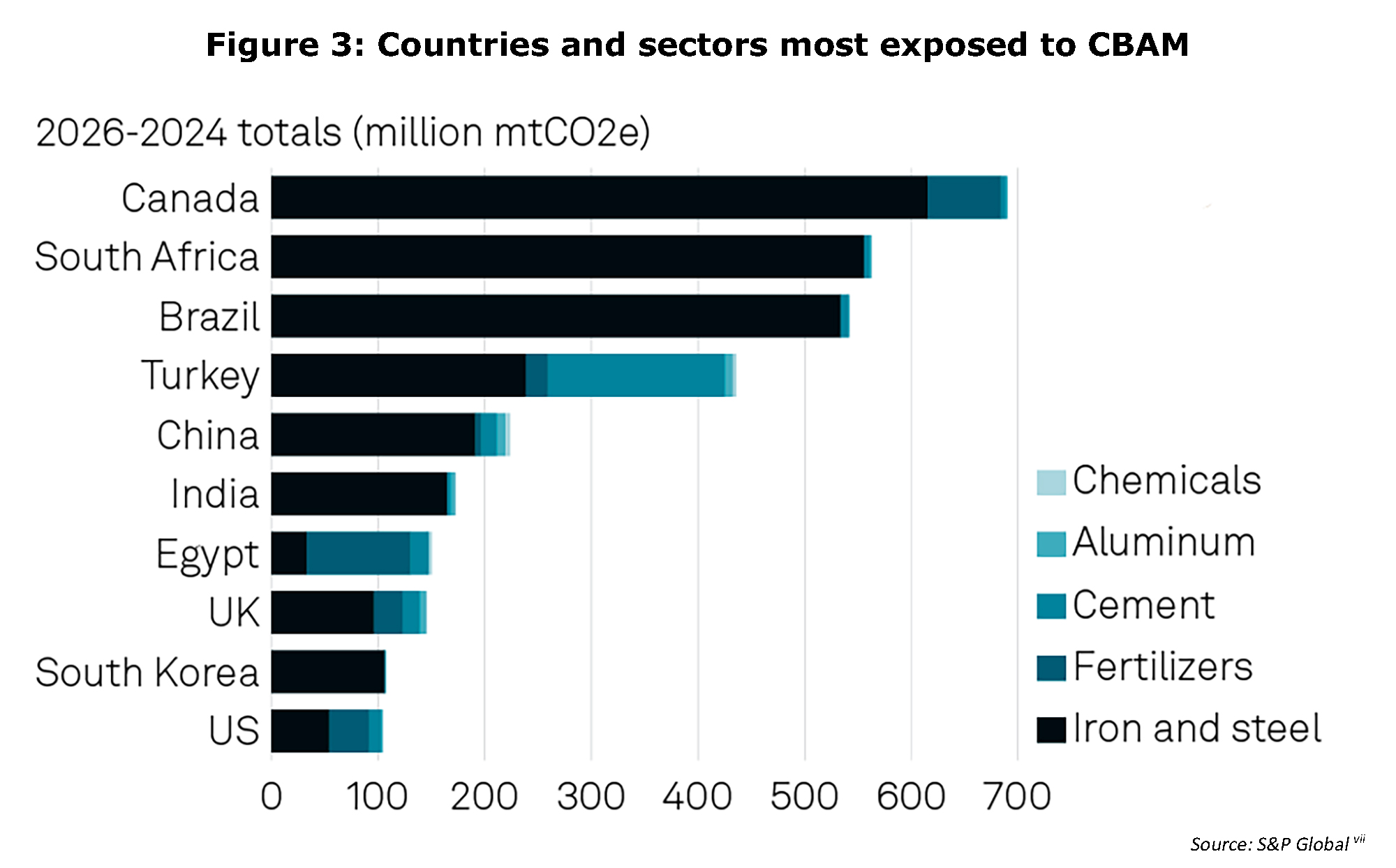
Big exporters of these commodities to the EU such as Canada, Brazil, China, India and even the US are expected to be the most impacted (figure 3).
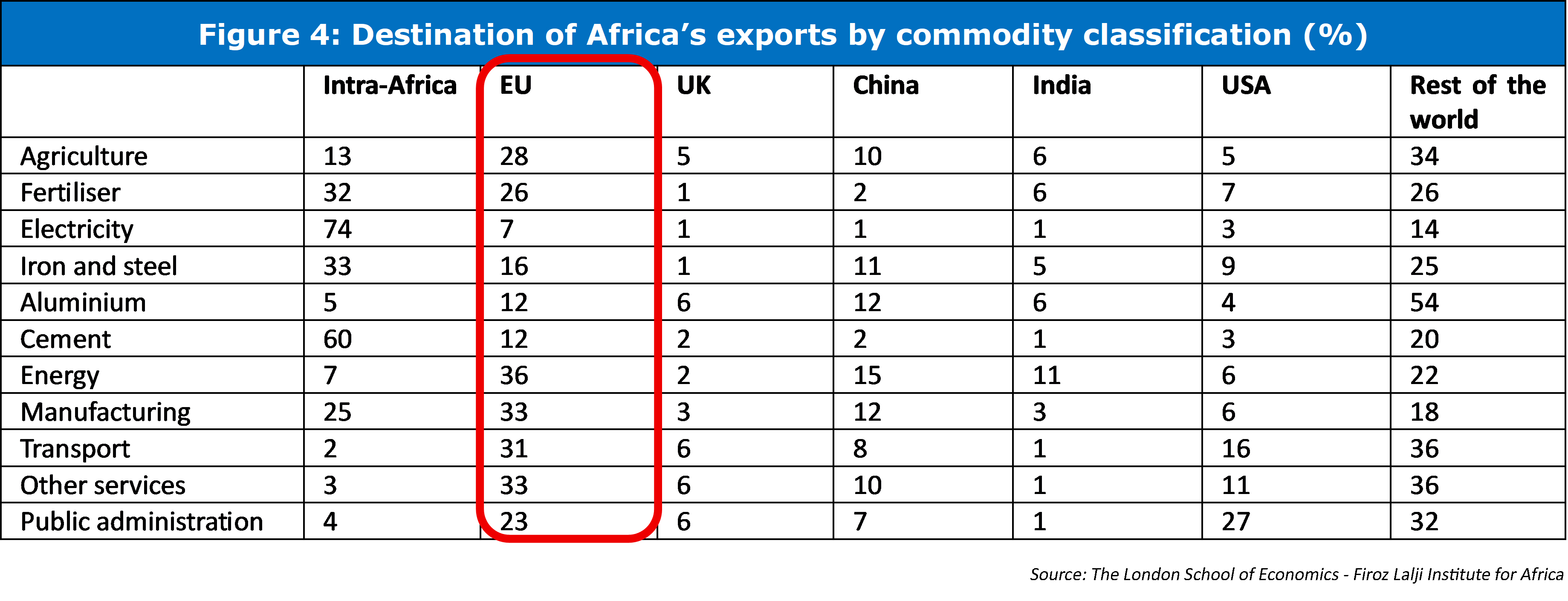
While Africa is by no means the biggest exporter of these commodities to the EU, the EU is a critical market for African producers of these goods, and there are notable pockets of production that are likely to come under threat from the higher end-price European importers will be forced to pay and who may opt to switch sourcing to lower carbon producers (figure 4).
Not only that, but African manufacturers now face additional levels of emissions measuring and reporting to comply(10) which will require substantial investment, expertise and time. The response by African nations to the implementation of CBAM has understandably been one of disappointment and frustration.
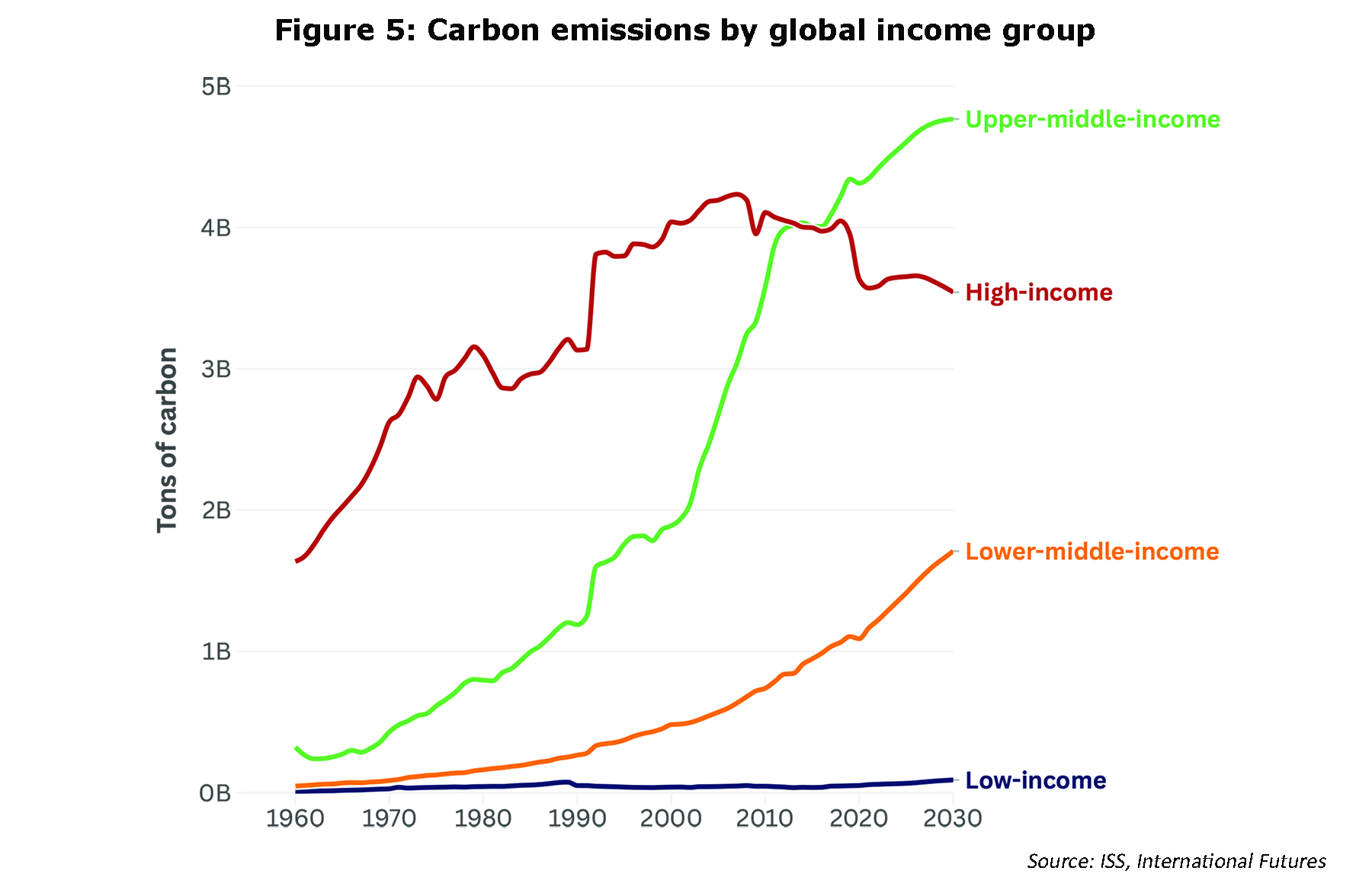
African countries feel that they are being unfairly made to carry the burden of industrial de-carbonisation, something they have contributed very little to historically due to their relatively low levels of industrialisation (just 4% of global emissions)(11), right at a time when their industrial growth, which was promoted by developed nations, is gaining traction[viii] (figure 5).
They further contend that Europe themselves advanced economically on the back of high-emission industrial growth and the burning of fossil fuels and then went on to embrace the outsourcing of pollution to Africa. Now that this outsourcing has become a threat to the EU’s manufacturing sector, CBAM once again moves the goal posts.(9) They have gone so far as to label it green protectionism implying CBAM is an economic trade measure cloaked as environmental concern.(12)
African states argue that CBAM violates international trade law(13) – The World Trade Organisation’s (WTO) explicitly prohibits discrimination of like products between WTO members, and CBAM effectively grants most-favoured-nation status based on carbon intensity.(13) Much of Africa’s displeasure with CBAM has been voiced through diplomatic channels and while they have voiced their concerns to the WTO, a formal lodging of a joint dispute is still in discussion.
While many African countries are moving toward greener production and support global carbon emission reduction measures, they argue that for them to do so is both costly and time consuming. They want the EU to provide both financial and technical support for the green transition they are imposing, or at the very least, exempt some industries and countries until such time as progress has been made on greener production and allow a greater transition period. The EU is not budging.
The winners, losers and unintended consequences
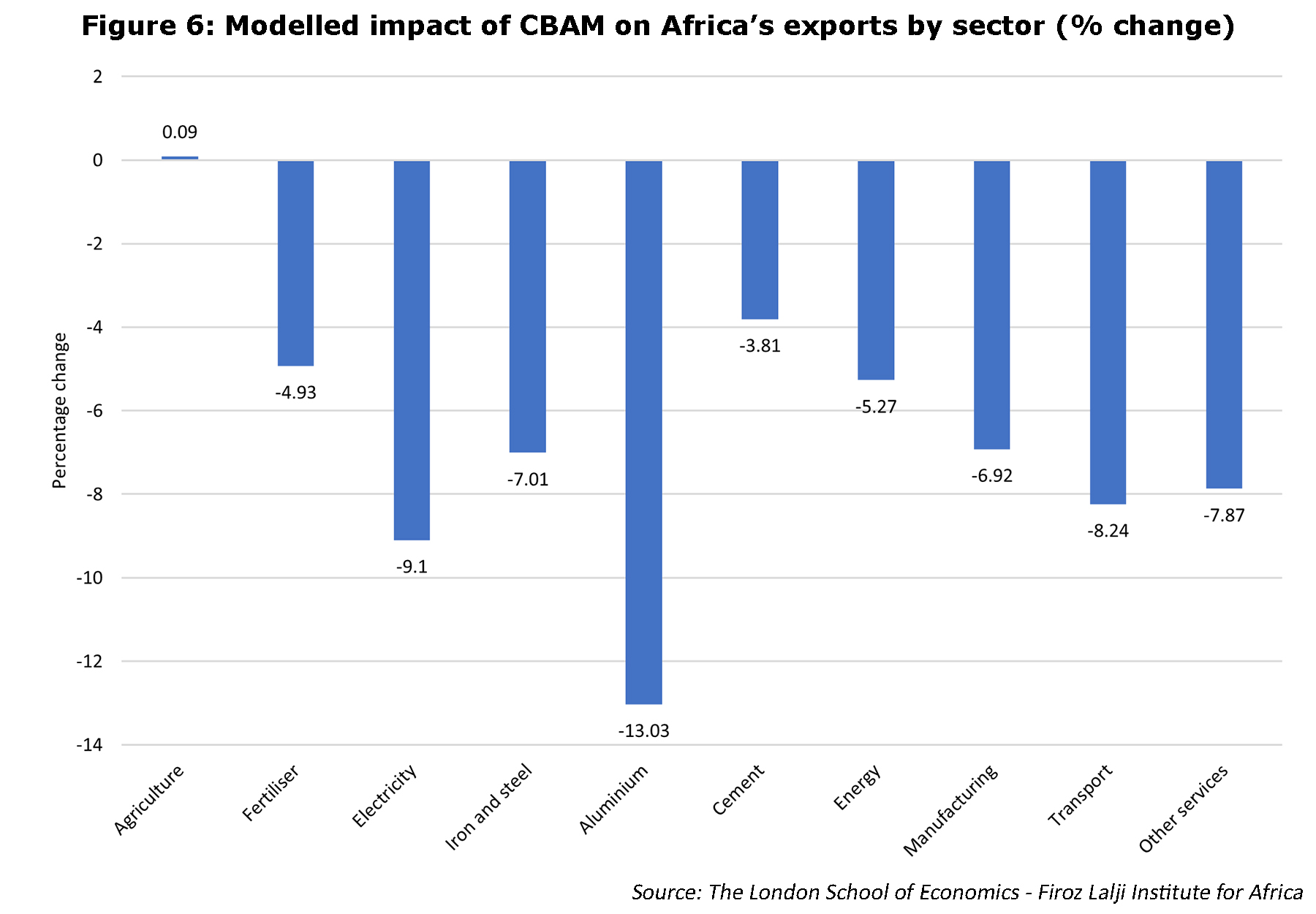
That there will be an impact on African exporters of targeted products to the EU is undeniable. The European Commission’s own research suggests that CBAM could reduce exports from African countries by as much as US$2.3bn[ix] annually(13), while a study by the London School of Economics and the Firoz Lalji Institute for Africa concluded that in a worst case scenario, CBAM could see African exports to the EU decline by nearly 6% and shave nearly a full percentage point off the continents GDP(14) (figure 6).
Some African countries are more vulnerable than others based on:
- the carbon intensity of their national electricity production
- investment in renewables and progress wheeling clean energy into the grid
- the level advancement of heavy industry
- trade intensity with the EU and product concentration risk
- and their ability to potentially diversify export markets.
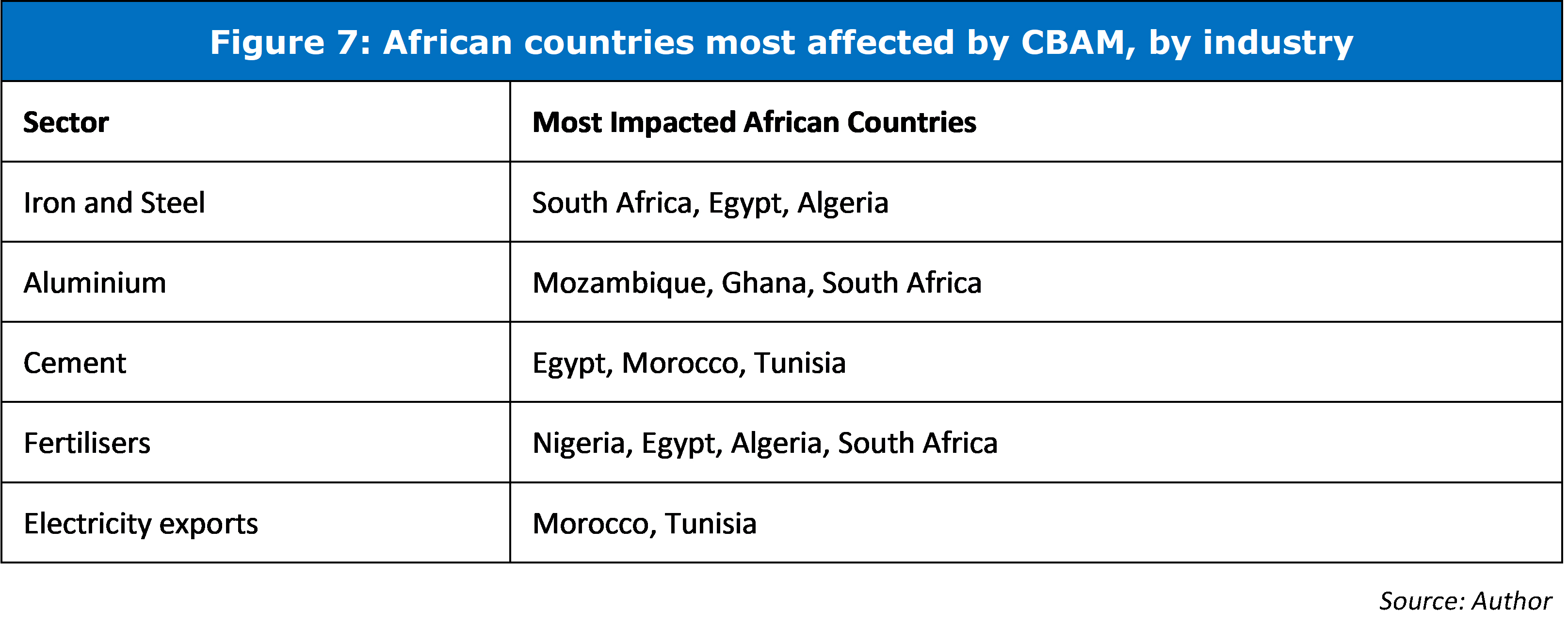
Based on these criteria, the three African countries expected to face the biggest trade and economic impact of CBAM are South Africa, Egypt and Mozambique (figure 7).
- South Africa
Despite the country having invested nearly US$20bn in 15GW of renewable (primarily solar and wind) energy production since 2011(15), still roughly 80% of its available electricity is coal-based, contributing to a large chunk of the country’s embedded carbon in manufactured goods.
The biggest bottlenecks to releasing more of this renewable energy into the grid for manufacturers to use is a lack of transmission infrastructure to “wheel” the green energy to industrial end-users – an estimated 14,000km is required. The problem is both financial and existential. Eskom, the country’s national electricity utility is deep in debt and simply can’t afford to invest in the necessary transmission infrastructure. Even if it could, doing so would threaten demand from its fleet of coal fired power plants (some almost brand new) and further endanger the utility’s viability.
Historically, Eskom’s cheap (but dirty) coal-based electricity allowed it to attract substantial foreign investment and build large, power-hungry iron, steel (ArcelorMittal) and aluminium (Hillside) plants for whom the EU has become a key export market. FDI for downstream sectors like vehicles and parts production followed and are all now under threat from CBAM.
In 2024, the EU imported US$700m worth of iron and steel from South Africa and the country was the EU’s eighth largest aluminium supplier.(16) Nearly 60% of the country’s steel and 45% of its aluminium exports are to Europe and a total of nearly US$3bn of the country’s exports are at risk. South Africa has one of the lowest effective carbon tax rates in the world with a carbon price of EUR8 per carbon equivalent tonne while the price in Europe is ten times that. With importers being liable for this difference, they will require commensurate discounts from the exporter or look at sourcing from alternative jurisdictions.
- Mozambique
Mozal Aluminium in Mozambique is one of the continent’s largest aluminium producers with an annual capacity of 580,000 tonnes. In 2025 more than 450,000 tonnes was exported to Europe. It accounts for almost 30% of Mozambique’s export revenue. Aluminium production is extremely energy intensive, and with drought conditions threatening its hydro-electricity supply from the Cahora Bassa Hydroelectric Scheme, and Mozal initially being unable to secure an economically viable electricity supply contract from South Africa’s Eskom, the facility was destined for care and maintenance in March 2026[x].
A 12th hour agreement to supply electricity from South Africa is in the works, but places Mozal in the same predicament as South African exporters to the EU – a high embedded carbon cost. Mozal’s future is very much still in the balance. The Mozambican case is an example of how the implementation of CBAM has knock-on effects throughout the supply chain(17), so much so that it threatens the continued viability of a country’s primary export earner.[xi] A mooted expansion of CBAM for greater accounting throughout the value chain could ultimately be the final nail in the coffin for many African producers like Mozal.
- Egypt
Like South Africa, Egypt has a well-diversified industrial sector and is a large producer of iron and steel, cement and fertilizers for export to the EU. Its electricity supply has also been very narrowly focused, with approximately 80% of electricity coming from the burning of natural gas, which like coal, carries a heavy carbon footprint.
The production of cement and manufacture of fertilisers are both very carbon intensive (high CO2 emissions released in production), which when coupled with the embedded emissions of electricity from natural gas(18), exposes these Egyptian exports to large tariffs under CBAM, eroding their cost advantage. Potential loss estimates to the Egyptian economy range from US$1.2bn to US$1.8bn. After negotiations with the EU, Egypt has been granted a two-year exemption (to end 2027) from CBAM tariffs to develop its own carbon tax framework[xii] which could be a blueprint for other African countries looking for temporary relief from CBAM.
There are far fewer African winners under CBAM than there are losers. One potential bright spot is Morocco, which invested heavily in green electricity through the Noor Ouarzazate Solar complex, and which allows producers to leverage the green energy to drive down their total CO2 liability under CBAM.
Morocco’s investment is a clear example of the benefits of having been an early mover on the clean energy transition and serves as an example to other African states beginning their decarbonisation journey.
In its current format, the real winners under CBAM are the EU (additional taxes they will collect) and EU domiciled manufacturers, who are more price competitive once carbon tariffs are imposed on their offshore competition. A balance must be struck to encourage a truly just transition.
CBAM: More carrot, less stick
An inflexible and overly ambitious CBAM carries several risks not only for African states, but for the European Union too. It potentially disincentivizes beneficiation on the African continent. African producers may ultimately decide its less onerous and punitive to simply produce and export raw materials rather than pursue value added processing which would be a hammer blow to the continent’s industrial and economic growth and potentially shift carbon emissions back to the EU.
It also carries the risk of becoming a regressive instrument which may lead to retaliation by African producers on goods critical to Europe (e.g. the importance of African agriculture for EU food security). Some African countries who don’t already have a domestic carbon tax are floating the idea of implementing their own emissions trading systems for local producers so that they can receive the tax rather than those funds effectively going to the EU – if an exporting country already receives carbon taxes, that amount is offset in the CBAM calculation (see figure 2). These funds could be used to offset some of the losses incurred by African manufacturers under CBAM or help fund the energy transition.
What is needed is more dialogue and consultation, coupled with both financial and technical assistance in guiding African states toward a lower carbon future for the greater good of the planet.
What is certain though, is that CBAM is not going away. If anything, it is set to expand to more products by 2030 and require far more rigorous carbon accounting. Simply diverting exports to non-EU markets is neither practical nor feasible in the long term either, as more countries look to roll out similar legislation (UK, US, Canada, Japan). African states and their producers need to tackle their carbon emissions head on, and with help from the rest of the world, but do so in a measured and realistic timeframe.
Works Cited
1. Asuene. CBAM in 2026: What Changes Now That Enforcement Has Started. Asuene. [Online] 19 January 2026. https://asuene.com/us/blog/cbam-in-2026-what-changes-now-that-enforcement-has-started#:~:text=their%20compliance%20approach.-,What%20Changed%20in%20CBAM%20Enforcement%20in%202026,Emissions%20data.
2. ICCT. European Stage V Non-Road Emission Standards. International Council on Clean Transportation. [Online] November 2016. https://theicct.org/wp-content/uploads/2021/06/EU-Stage-V_policy-update_ICCT_nov2016.pdf.
3. Tabaré Arroyo-Currás, Nico Bauer, Elmar Kriegler, Valeria Jana Schwanitz, Gunnar Luderer, Tino Aboumahboub, Anastasis Giannousakis, Jérôme Hilaire. Carbon leakage in a fragmented climate regime: The dynamic response of global energy markets. Science Direct. [Online] January 2015. https://www.sciencedirect.com/science/article/pii/S0040162513002606.
4. European Commission. EU advances towards 2030 climate targets with continued emissions cuts. European Commission. [Online] 6 November 2025. https://climate.ec.europa.eu/news-other-reads/news/eu-advances-towards-2030-climate-targets-continued-emissions-cuts-2025-11-06_en.
5. Antoine Bonnet, Aaron Cosbey. Addressing Carbon Leakage: A toolkit. International Institute for Sustainable Development. [Online] 5 December 2024. https://www.iisd.org/articles/deep-dive/addressing-carbon-leakage-toolkit.
6. Haramboure, Antoine Dechezlepretre and Antton. EU Carbon Border Adjustment Mechanism: What is it, how does it work and what are the effects? OECD. [Online] 21 March 2025. https://www.oecd.org/en/blogs/2025/03/eu-carbon-border-adjustment-mechanism-what-is-it-how-does-it-work-and-what-are-the-effects.html.
7. Anthesis. What is the EU Carbon Border Adjustment Mechanism? Anthesis. [Online] 2025. https://www.anthesisgroup.com/za/regulations/carbon-border-adjustment-mechanism-regulations-cbam/.
8. Charluet, Camille. Which goods are covered under CBAM? (Sector breakdown guide). Coolset. [Online] 24 February 2026. https://www.coolset.com/academy/goods-covered-under-cbam-sector-breakdown-guide#:~:text=As%20of%20January%202026%2C%20CBAM,materials%20and%20selected%20downstream%20products..
9. Wessel, Sam Boocker and David. What is a Carbon Border Adjustment Mechanism? Brookings Institute. [Online] 3 October 2025. https://www.brookings.edu/articles/what-is-a-carbon-border-adjustment-mechanism/.
10. Gupte, Eklavya. Infographic: EU's CBAM spurs industry to hone emissions reporting. S&P Global. [Online] 29 July 2024. https://www.spglobal.com/energy/en/news-research/latest-news/energy-transition/072924-infographic-cbam-eu-carbon-emission-pricing-iron-steel-aluminum-ammonia.
11. Roux, Alize le. Africa’s decarbonisation dilemma. Institute for Security Studies. [Online] 12 June 2025. https://issafrica.org/iss-today/africa-s-decarbonisation-dilemma.
12. Anderson, Kara. Green protectionism: principles, examples and concerns. Greenly. [Online] 18 December 2023. https://greenly.earth/en-gb/blog/ecology-news/green-protectionism-principles-examples-and-concerns.
13. Rumble, Andrew Gilder and Olivia. The Impact of the CBAM on African Economies and the Role of the AfCFTA. South African Institute for International Affairs. [Online] 23 April 2024. https://saiia.org.za/research/the-impact-of-the-cbam-on-african-economies-and-the-role-of-the-afcfta/.
14. Africa, The London School of Economics - Firoz Lalji Institute for. Implicatons for African Countries of a Carbon Border Adjustment Mechanism In the EU. The African Climate Foundation. [Online] May 2023. https://africanclimatefoundation.org/wp-content/uploads/2023/05/800756-AFC-Implications-for-Africa-of-a-CBAM-in-the-EU-06A-FINAL.pdf.
15. BDO. South Africa's Renewable Energy Sector Poised for Rapid Expansion. BDO. [Online] 1 December 2025. https://www.bdo.co.za/en-za/insights/2025/advisory/south-africa-s-renewable-energy-sector-poised-for-rapid-expansion.
16. Michael. Michael Lengahan. Anthesis. [Online] 30 July 2025. CBAM and South Africa’s Metals Sector.
17. Sustaira. Navigating CBAM: Carbon Pricing and Supply Chain Implications. Sustaira. [Online] September 2025. https://www.sustaira.com/blog/cbam-guide-carbon-border-adjustment-mechanism-eu.
18. Egypt Daily News. International Consultant Mohamed El-Lethey Proposes 9 Comprehensive Strategies for Egypt to Navigate EU CBAM and Boost Export Competitiveness in 2026. Egypt Daily News. [Online] 8 January 2026. https://www.dailynewsegypt.com/2026/01/08/international-consultant-mohamed-el-lethey-proposes-9-comprehensive-strategies-for-egypt-to-navigate-eu-cbam-and-boost-export-competitiveness-in-2026/#:~:text=The%20European%20Union's%20Carbon%20Border,chains%2C%2.
References
[v] https://www.bcg.com/publications/2021/eu-carbon-border-tax