From Green Finance to Transition Finance: What Does Credible Decarbonisation Financing Really Look Like?
As economies across Asia grapple with the twin pressures of decarbonisation and continued growth, one question keeps returning to the table: what does credible transition finance actually look like in practice?
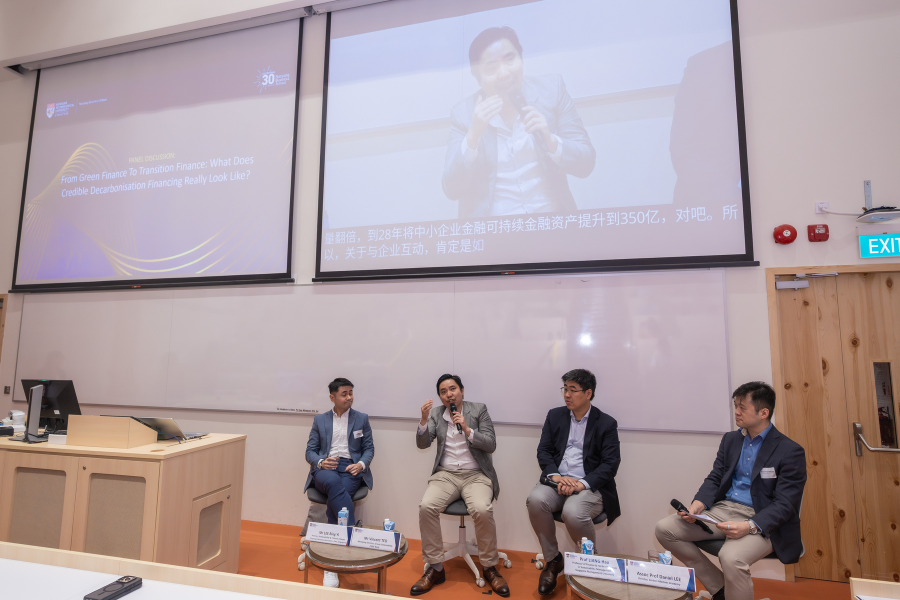
At the NBS30 Finale panel discussion hosted by Nanyang Business School, four voices from academia, banking and assurance came together to explore this question. Moderated by Associate Professor Daniel Lee, Director of the Carbon Markets Academy at Nanyang Business School, the panel brought together Prof Liang Hao, President’s Chair Professor in Finance at NBS; Mr Vincent Teo, Managing Director of Group Sustainability at OCBC Bank; and Mr Lee Bing Yi, Partner for Sustainability and Climate Change, Financial Services Assurance, at PwC Singapore.
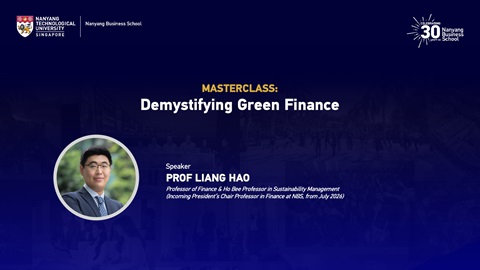
Their conversation picked up from an earlier masterclass on demystifying green finance, and moved the discussion into more difficult territory. Not whether capital should flow to greener activities, but how it should flow to the sectors that remain vital to economic growth yet carbon intensive by design.
From green finance to transition finance
The distinction matters. Green finance channels capital to activities that are already low carbon. Transition finance concerns itself with the harder question of how to fund the shift of carbon intensive sectors, from shipping and aviation to steel and power, towards lower emissions futures.
For Mr Teo, this is where the real work sits.
OCBC has committed to transitioning its portfolio to net zero across six sectors that represent forty two percent of its loan book, and has set a target to double its SME sustainable finance engagement to twenty five billion dollars by 2028. But the approach, he explained, depends on the sector. In areas such as sustainable aviation fuel, where the economics do not yet work, the bank participates in Singapore's central procurement pilot to to support industry adoption. In sectors where bankability exists, it lends directly. OCBC recently invested in what he described as Southeast Asia's largest low carbon steel plant in Sabah, Malaysia.
"Capital often is not the constaint," Mr Teo observed. "It is bankability.
What separates credible transition from cosmetic effort
If capital is willing, the harder question is how to tell real decarbonisation apart from something that merely looks like it.
Mr Lee offered a principle-based answer, since standardised definitions of credible transition finance remain unsettled. Companies cannot decarbonise credibly without first knowing precisely where their emissions come from. Baseline measurement, at sufficient granularity, is the foundation. Beyond that, ambition needs to connect to concrete plans, not just distant net zero commitments but specific actions in the next two to three years.
Governance, he argued, is the strongest signal of seriousness.
"When I read a sustainability report, the first thing I look at is not the glossy pictures," Mr Lee explained. "I look at the governance structure, because that tells me how seriously the company is taking this."
The final signal is candour. Reports that describe only awards and achievements, and say nothing about limitations, uncertainties or constraints, tend to invite scepticism. A credible transition plan acknowledges what is not working as clearly as what is.
Why regulation differs across jurisdictions
Prof Liang offered a broader view of how different economies are approaching the same challenge.
The European Union has taken a top down path, with the EU Green Deal and the Corporate Sustainability Reporting Directive mandating extensive disclosure, including the demanding concept of double materiality. The pushback has been substantial. The recent EU Omnibus package aims to exempt around eighty percent of European companies from CSRD requirements.
The United States sits at the other extreme. It remains, in Prof Liang's description, probably the only major economy without mandatory ESG disclosure requirements. A previous SEC proposal on carbon emissions met significant resistance, reflecting a preference for market driven signals over government mandates.
Asia is charting a third path.
Singapore and China have collaborated on a green finance taxonomy through the Monetary Authority of Singapore and the People's Bank of China. Crucially, the Singapore-Asia Taxonomy includes an "amber" category, sitting between green and brown, for activities on credible transition pathways. This category makes transition finance workable in a region where many economies still depend heavily on carbon intensive energy.
Prof Liang also pointed to a quieter development: a common ground taxonomy being sought across China, the EU and now Singapore, seeking shared language across trade partners.
The laws of physics meet the laws of finance
Asked what prevents more transition projects from becoming bankable, Mr Teo offered a memorable framing.
"It is really a confluence between the laws of physics and the laws of finance," he said.
The laws of physics show up in hard to abate sectors such as shipping and aviation, where a viable alternative fuel that is transportable, non-toxic and cost competitive does not yet exist at scale. The laws of finance show up in structural mismatches. For instance, the bankability of a 20-year renewable power project cannot be underpinned by regulatory or structural components that do not at least meet the same tenor.
Unlike software, where a venture capitalist can spread it risks across many small bets, hard tech transition projects often require hundreds of millions of dollars per project. Spray and pray do not work.
He also offered a reminder of scale. If the green economy represents only ten to twenty percent of the overall economy today, telling the other eighty percent that they have no route forward is not a credible transition strategy. Singapore remains ninety five percent dependent on natural gas. Indonesia remains around sixty percent reliant on coal. Retiring a single coal fired power plant fifteen years early, for instance, hundreds of millions of US dollars.
Greenwashing, and why imperfection beats inaction
The panel returned repeatedly to the risk of greenwashing.
Prof Liang framed it as a form of friction familiar from other areas of corporate governance. The response is not to abandon transition finance, but to reduce the risk through clearer taxonomies, credible transition pathways and technology roadmaps that specify what facilities should be in place after five, ten or thirty years.
"There are always greenwashing risks, but we should do it," he said. "What we should do is to reduce the greenwashing risk by designing clear taxonomy, pathway and technological roadmap."
He summed up the argument in a single line: "Imperfection is better than inaction."
How taxonomies actually work in practice
Taxonomies are often discussed as categorisation systems. In practice, they function more like conversation starters between banks and their clients.
Mr Teo described the process as a back and forth. It starts with the client's ambition, then uses the taxonomy to shape expectations of what would count as credible. For a client developing a BCA Platinum certified office building, the green pathway is direct. For a company earlier in its transition, the amber criteria in the Singapore Asia Taxonomy offer a framework for how emissions should reduce and by when.
Mr Lee added that the taxonomy is only one piece of the puzzle. Structuring an activity into a bankable transaction, and then tracking the technical KPIs over the life of the financing, is where the real difficulty sits. Banks often struggle to obtain the granular technical information required to demonstrate alignment, and sometimes need to commission full lifecycle assessments.
One change each
Asked what single change would make transition finance work better in Asia, each panellist gave a different answer.
For Mr Teo, it is innovation. The technologies that shift cost curves, from solar panels to batteries, have historically done more to drive transition than any framework.
For Prof Liang, it is education. Cross disciplinary knowledge, from finance to ecology, is what allows the field to move beyond high level discussions into detailed practice.
For Mr Lee, it is a willingness to act despite uncertainty.
"Take that leap of faith," he said. "You may fail, and you may discover that a particular approach does not work. But that is still better than doing nothing."
A quieter conclusion
Transition finance sits in an uncomfortable middle. It is neither the clean story of pure green investment nor the abandonment of sectors that remain central to Asian economies. It requires taxonomies that acknowledge shades between green and brown, governance that goes beyond compliance, and a tolerance for imperfect progress.
What emerged from the panel was not a single answer but a shared disposition. Credible transition finance is patient, technical and honest about its limits. It resists the two extremes of doing nothing and demanding purity.
As technology, regulation and capital continue to evolve, those qualities may prove to be the ones that matter most.