The good food revolution
Meet three entrepreneurs turning food challenges into delicious solutions – from raw honey infused with superfoods to snacks made from “ugly” vegetables and fish farmed just off our coast.
Text: Derek Rodriguez and Vivien Yap | Photos: Betty Lu, Joelle Goh, Malcolm Ong
Doing good with bees
Joelle Goh, who graduated from the School of Electrical & Electronic Engineering in 2005 and later returned to NTU to earn her MBA, never planned to build a honey business. It started with a simple question: why does honey taste so different depending on where it comes from?
That curiosity took her and her husband, whom she met at NTU, straight to the source: bee farms, where she tasted raw honey straight off the comb for the first time.
“It wasn't just sweeter or richer. It had a freshness and complexity that surprised me,” she says.
That first taste grew to become Hives Keeper, which now sources honey from beekeepers in Western Australia and Northern Thailand, chosen for their pristine environments and long tradition of careful beekeeping.
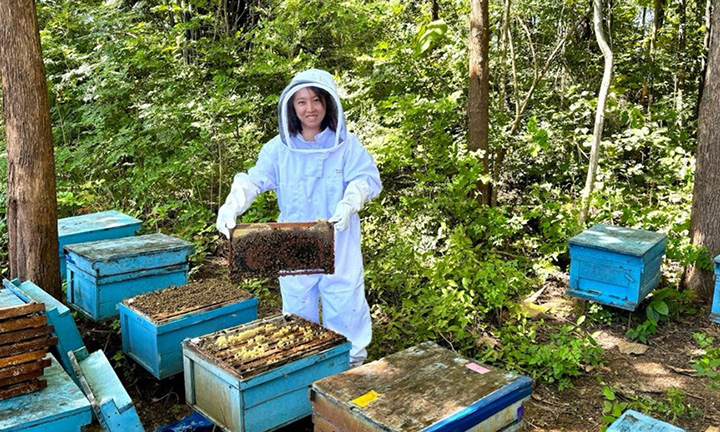 Joelle harvesting honey from the bees at the Hives Keeper bee farm in Thailand.
For Joelle, bees always come first.
“Sustainable beekeeping means harvesting responsibly, leaving enough honey for the bees, and working with beekeepers who care about the long-term health of their colonies,” she says.
Putting "ugly" vegetables into the Michelin Guide
Betty Lu, a business graduate from the Class of 2012, also found her inspiration abroad. Looking for tasty and nutritious snacks to bring on her frequent hiking trips, she decided to make her own.
That impulse grew into Confetti Snacks, now a global brand transforming “ugly” vegetables into vibrantly flavoured chips.
“We throw away 2.9 trillion pounds of fruit and veggies annually, often due to aesthetic reasons or crop surplus, even though they’re still nutritious,” says Betty, who rescues these foods before they are discarded.
Her company then uses a dehydration and gentle cooking process that preserves nutrients and adds crunch. Today, its colourful chips are sold across Asia, the Americas and Europe, in outlets ranging from supermarkets and corporate pantries to luxury hotels. The award-winning snacks have also been featured in the Michelin Guide.
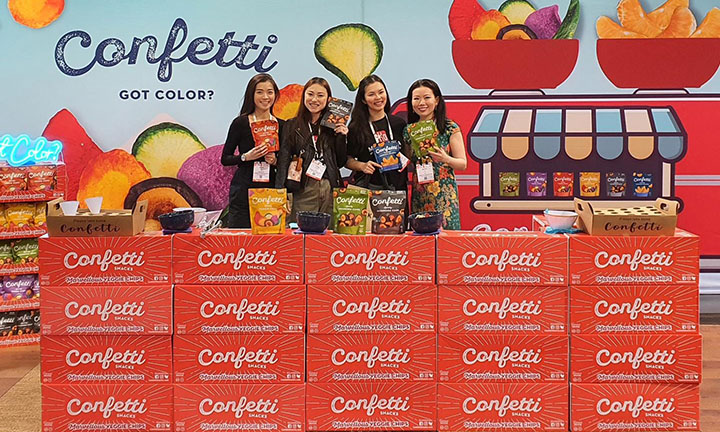 Betty (far right) and her team at a tradeshow showcasing her company's products.
“Many people don’t get enough vegetables in their diet because they don’t have time to prepare nutritious meals. My aim is to elevate vegetables into a crunchy and delicious form,” says Betty, who moved to California to grow her business.
Casting a wider net
Malcolm Ong, who graduated from the School of Electrical & Electronic Engineering in 1988, found his calling on the water.
A software and aerospace veteran of over three decades, he spent his weekends boating along Singapore’s coast, where conversations with local fish farmers slowly turned into something more.
That curiosity, paired with news reports on dwindling wild fish stocks, led him to leave the corporate world at 45 and start farming fish himself.
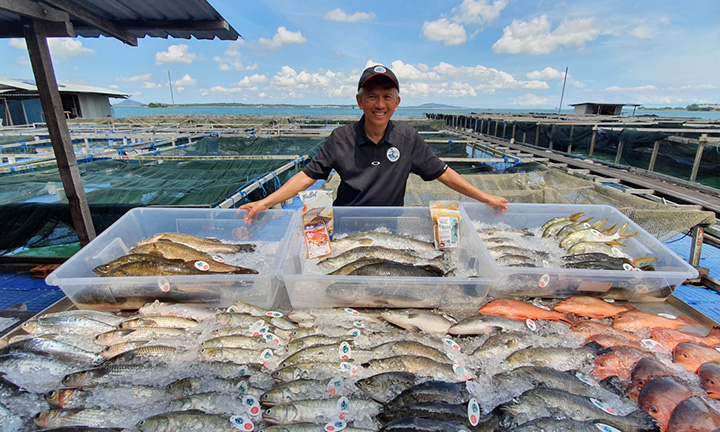 Malcolm’s farm produces a wide range of products – from fresh fish to pre-seasoned fillets designed to be a convenient source of fish for people who are uncomfortable cooking whole fish.
“I noticed that fish that used to be large were getting smaller, and less varied. So, I was drawn to aquaculture as a more sustainable, renewable source of food,” says Malcolm, who built his farm’s systems, from book-keeping to compliance, from scratch.
His farm has since grown into a serious commercial operation, competing against producers in larger countries with cheaper land, electricity and transport. To stay ahead, Malcolm’s team developed pre-portioned fish products with sauce that go straight from fridge to air fryer, making sustainable seafood as convenient as any ready meal.
“Farming in Singapore is tough, but if we can make sustainable seafood easy for people to cook, that’s how we stay relevant,” says Malcolm, who also supports other local farmers as president of the Kranji Countryside Association.
Purpose beyond profit
Bees, vegetables and fish could not be more different businesses, but all three founders are chasing something bigger than the bottom line.
Betty’s “Robin Hood approach” sees Confetti partnering with food banks and UNICEF to send nutrient-dense snacks to communities facing hunger and malnutrition. Malcolm is passionate about building a more resilient and sustainable food supply by backing local farms rather than relying entirely on imports.
At Hives Keeper, doing right by the bees is simply non-negotiable.
“Being attentive to the bees’ wellbeing directly affects honey quality,” says Joelle. “Practices like pesticide-free foraging zones and chemical-free extraction make sure our honey is pure and responsibly produced.”
Where the seeds were planted
Each founder points to a different part of their NTU experience as an influence on the path they eventually took, from entrepreneurial ambition and peer support to the confidence to keep questioning conventional ideas.
Betty, who minored in entrepreneurship, still remembers a professor’s parting challenge.
“His final assignment to us was to create billion-dollar companies and then, using what we made, give back to society.”
For Malcolm, the relationships he built at NTU proved just as important. Although he admits he was not academically talented, he recalls relying on his batchmates and peers for help with notes and exams. Those relationships gave him confidence and continued to support him beyond university.
For Joelle, the lasting lesson was curiosity.
“My time at NTU gave me the curiosity and confidence to pursue ventures that are meaningful and purposeful,” she says. “The one skill that has carried me through my journey is the curiosity to never stop asking why.”
Today, those lessons have taken them in very different directions. But whether they are keeping bees, rescuing surplus vegetables or farming fish, all three are asking the same question in their own way: How can we do things better?
This article first appeared in issue 8 of U, the NTU alumni magazine.