From lab to startup
Pursuing their PhDs at NTU empowered these Nanyang Outstanding Young Alumni Award recipients to transform research concepts into real-world solutions as CTOs of their own startups.
Text: Dr Daphne Ng | Photos: George-Cristian Potrivitu, Rex Tan & Pham Tien Hung
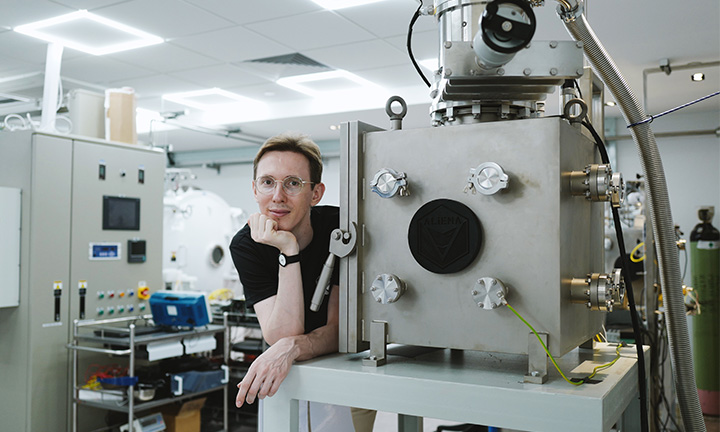 With NTU’s support, Aliena has secured multimillion-dollar funding to propel its next phase of growth.
As a boy, Dr George-Cristian Potrivitu’s fascination with space was ignited as he watched the passing of the comet Hale-Bopp from the backyard of his home in Romania.
This spark, further fanned by his father’s interest in astronomy, led him to do a PhD at NTU’s National Institute of Education, where he worked on the physics and engineering of devices that produce electrons to power electric propulsion systems in spacecraft.
George-Cristian’s research gave him the idea of developing a novel energy-efficient satellite plasma thruster, a type of propulsion system for satellites. The technology consumes 100 times less power than conventional plasma thrusters and fits into small satellites.
Realising the technology’s potential to power satellites flying close to Earth, George-Cristian joined forces with fellow PhD student Mark Lim to launch a startup to build next-generation plasma thrusters.
“My research at NTU laid the groundwork for us to launch a wide range of propulsion devices that have been leased or sold to customers globally for ground testing and onboarding future flight missions,” the 2023 graduate says. “Being a co-founder of my deep-tech startup, Aliena, is highly rewarding and I feel that I am living my dream every day.”
Like George-Cristian, Dr Pham Tien Hung has a lifelong passion for robotics and furthered this interest when he embarked on his doctorate at the School of Mechanical & Aerospace Engineering.
A 2020 graduate, Tien Hung co-founded Eureka Robotics with his PhD supervisor, Assoc Prof Pham Quang Cuong. He says: “Like doing a PhD, being an entrepreneur is about finding good problems to solve.”
During his PhD studies, he developed algorithms to help robots navigate their environments safely, without colliding with other objects or people. These algorithms became the foundation of the company’s flagship product, which connects robot arms, cameras and other industrial devices to perform complex tasks such as precision handling, assembly and inspection.
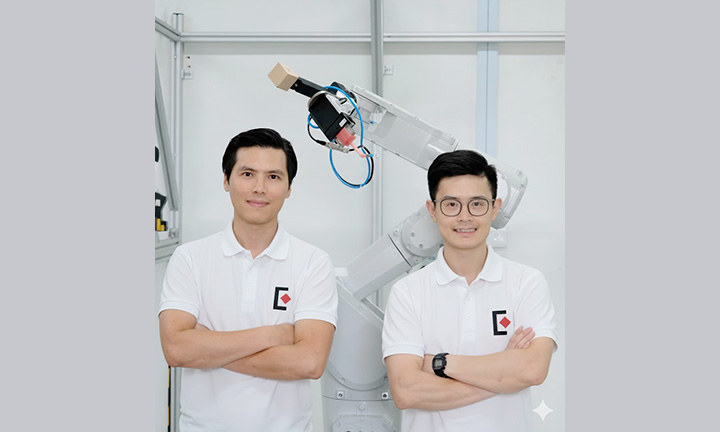 Tien Hung (right) and Assoc Prof Pham’s innovation could revolutionise industries.
Using the system, a robot picker can be programmed to pick up tiny objects precisely like a human hand. This level of dexterity is useful in the automotive, manufacturing and logistics industries.
“Robotics is a fascinating intersection between computer programming and physics, and I am grateful for the opportunity to turn my interest in this area into solutions that have real-world impact,” says Tien Hung.
Similarly, Dr Rex Tan’s rigorous PhD training at the School of Electrical & Electronic Engineering prepared him to set up his own startup after graduating in 2020. He reconnected with his fellow Minor in Entrepreneurship course mates, Adrian Ang and Edmund Shao, to start Aevice Health, which developed one of the world’s smallest wearable stethoscopes to help individuals with respiratory conditions monitor their health at home.
The coin-sized device, based on research by Adrian’s former NTU supervisor, Emeritus Assoc Prof Ser Wee, was among the first wearable stethoscope systems in Singapore to be approved by the Health Sciences Authority and cleared by the US Food and Drug Administration.
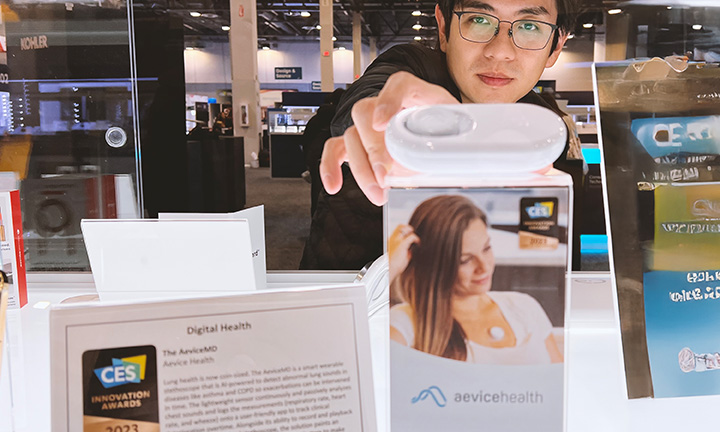 Rex and his company’s award winning wearable stethoscope that is redefining respiratory care.
“NTU provided an interdisciplinary
approach and a collaborative ecosystem
where scientists and engineers with
different expertise work side-by-side
with the common goal of transforming
healthcare with technology,” Rex
says. “This taught me how innovation
in healthcare is rarely achieved in
isolation, and that the most meaningful
breakthroughs often come from
combining disciplines and perspectives.”
Staying connected
Eureka Robotics continues to have close ties with NTU – more than half its employees and interns are current or former NTU students.
George-Cristian acknowledges the support provided by NTUitive, NTU’s innovation and enterprise arm, which helps incubated companies make use of the University’s state-of-the-art facilities for technical work and testing. For instance, the Satellite Research Centre at NTU allowed Aliena to test their plasma thrusters when the company was seeking its first investors.
To share his passion for space tech with young minds, George-Cristian supervises industry-sponsored final-year projects at NTU. His startup helps to train the next generation of space systems engineers in Singapore by offering internships to NTU students.
Rex, meanwhile, contributes his expertise to the Lee Kong Chian School of Medicine as a content expert. He also mentors NTU students pursuing entrepreneurship and innovation projects. To anyone considering the leap into entrepreneurship, he offers this advice: “Stay curious and surround yourself with people who believe in your vision.”
This article first appeared in issue 7 of U, the NTU alumni magazine.