Across borders, across disciplines: NTU alumni chart global health's next chapter
Over 200 alumni gathered in Bangkok at the regional conference to explore how AI, medicine and enterprise can work in step to meet the region’s healthcare challenges.
Text: Sadia Roohi
NTU Wee Kim Wee School of Communication and Information lecturer Ian Tan built a working app in half an hour. It cost him about two Singapore dollars. Standing on stage in Bangkok, he scanned a QR code, pulled up a Mandarin flashcard tool he'd made himself, and let a room full of alumni try it on their phones. The demonstration made a bigger point: you no longer need to know how to code to build your own tools with AI.
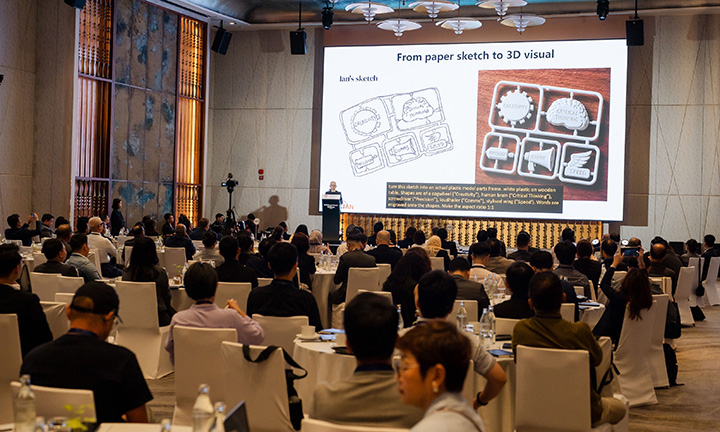 Participants attended the faculty masterclass by Ian Tan, held for the first time at the alumni regional conference.
That spirit of hands-on experimentation ran through this year's NTU Alumni Regional Conference, held in Bangkok on 11 July under the theme "Transforming Global Health: AI, Biomedicine, and the Power of Entrepreneurship." Alumni from across the region spent the day moving between panels, masterclasses and a keynote address from H.E. Ms Catherine Wong, Singapore's Ambassador to Thailand, all circling the same question from different angles: how do AI, biomedicine and entrepreneurship support one another as the region's healthcare needs evolve?
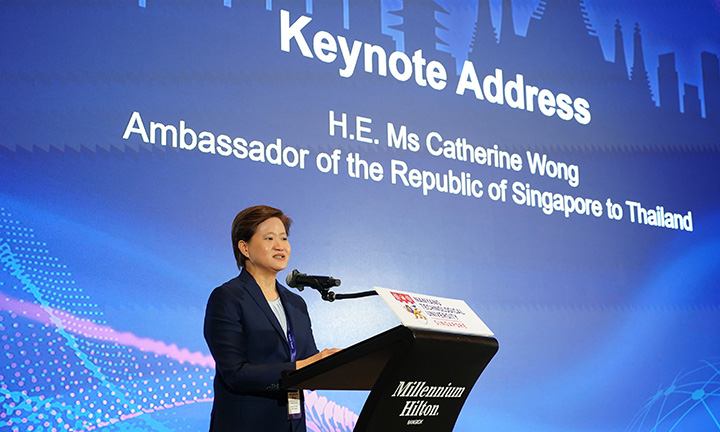 H.E. Ms Catherine Wong, Singapore's Ambassador to Thailand, delivered the keynote address at the conference.
Why the disciplines need each other now
Professor Christian Wolfrum, NTU's Deputy President and Provost, put it plainly in his opening address. He described the region's healthcare challenges – rising costs, ageing populations, gaps in drug design and prevention – as fundamentally cross-disciplinary problems.
He tied this to NTU2030, the university's strategy that places renewed emphasis on preparing students to work across disciplinary lines. From August 2026, every NTU student will be required to build agentic AI solutions as part of their education, a first Prof Wolfrum said no other university has attempted at this scale. He also encouraged alumni to stay engaged with the university, whether by supporting current students or returning to NTU themselves for continuing education.
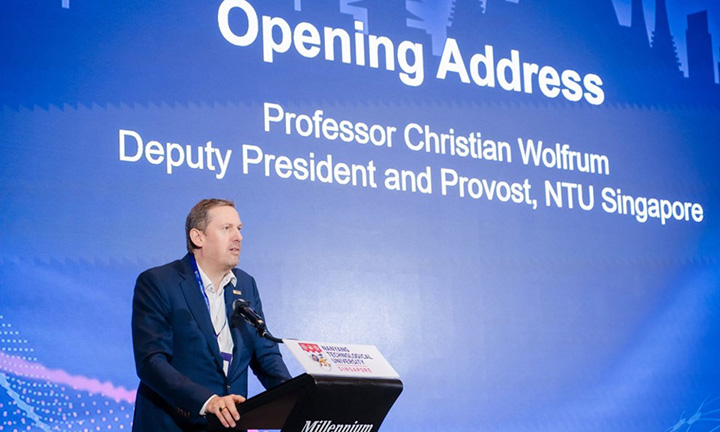 NTU Deputy President and Provost Prof Christian Wolfrum spoke about NTU2030 and how alumni can support the university and return to their alma mater for continuing education.
The day's two faculty masterclasses carried that intent into practice from opposite ends of the spectrum. Ian Tan opened his session on AI and the future of intelligent workplaces by addressing a fear he hears constantly from students and professionals alike: that AI adoption comes at the cost of skilled work. His answer was direct: "The best coders will not lose their jobs. And the best in any field will not lose their jobs. But now that we have this new skill open to us, we're able to create this sort of application."
Assistant Professor Wilson Goh of the Lee Kong Chian School of Medicine, picked up the same thread from a clinical angle. NTU's own Centre for AI in Medicine, set up in 2024, brings doctors, engineers, social scientists and regulators into the same room, because implementing AI in healthcare well takes far more than good algorithms.
 Asst Prof Wilson Goh delivered the faculty masterclass on “AI in Asia’s Healthcare: Opportunities and Challenges”.
The harder questions
The conference did not shy away from difficulty. During the panel "Southeast Asia's AI Ecosystem: Opportunities and Challenges," moderator Professor Boh Wai Fong, NTU's Vice President for Lifelong Learning and Alumni Engagement, pressed the alumni panellists on why AI adoption still lags the hype around it. Their answers point to unclear workflows, uncodified institutional knowledge, and organisations still working out how to handle data confidentially as the technology moves faster than governance can keep up.
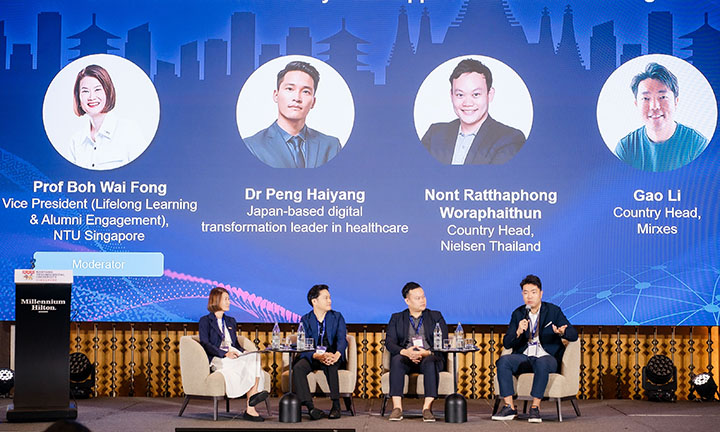 The first panel explored whether Southeast Asia can become a globally competitive AI hub and what it will take to get there.
Panellist Gao Li, Country Head at Mirxes, answered with a story about where AI had already fallen short. A construction-planning tool his team once sourced from Stanford could not solve a client's real problem: it couldn’t replace the institutional knowledge held by an 83-year-old master planner. That failure shaped his longer-term view of where the technology is headed: "What if AI is the operating system in the future, where all the agents and your coworkers are sitting right in your interface? It makes adopting AI much easier, and of course you'll be able to extract the values of AI a lot better."
Prof Wilson Goh returned to the stage that afternoon with a starker picture from healthcare, describing how patients increasingly turn to AI chatbots before, or instead of, their own doctors: "When you already have your own pocket doctor in the form of an AI tool, and you confront your doctor with these issues, it creates a lot of conflicts. They may feel like they are being made redundant, or they are being challenged."
His second panel, "AI Meets Biotech: Innovation from Lab to Market," pushed the discussion into where AI's promise runs into practical limits. Alumnus Paul Arriyavat, founder of Kasikorn X and a long-time AI investor, offered the panel's most direct assessment: "It's almost like Iron Man with Jarvis, where you have a real goal of what you're trying to achieve, and it's going to help amplify that. But the accountability and trust are not actually with AI. It's with all of us that are actually trying to solve some kind of problem."
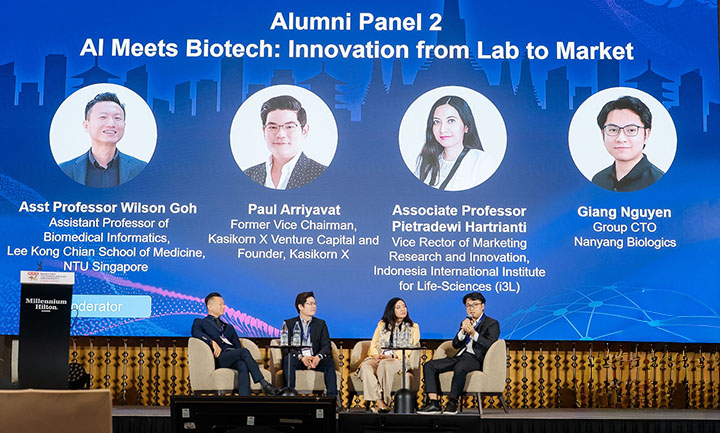 The second panel explored how AI is transforming biotech and accelerating innovation from lab to market.
Associate Professor Pietradewi Hartrianti of Indonesia's i3L institute traced a related difficulty back to something more structural: regulation that has not caught up with the technology it is meant to govern. "Without regulatory guidelines, even if you have the technology, if the regulation does not allow you to use this technology, it's useless. That's why this synergy is important,” explains the NTU alumna.
Two new alliances, one shared direction
The conference also marked the launch of two new NTU Alumni Alliances, extending the university's alumni network into entrepreneurship and global collaboration specifically.
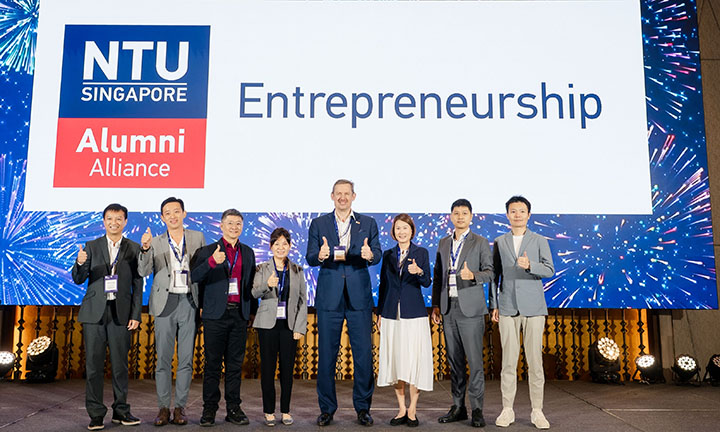
Chairperson, Susan Teh (pictured above, 4th from left), introduced NTU Alumni Alliance (Entrepreneurship), or NAAE, framing it as a natural extension of NTU's own founding belief in entrepreneurship: "NTU has long believed that entrepreneurship is not just about creating companies. It is about creating possibilities through education, research, innovation and collaboration. We want to create a community where no entrepreneur builds alone." In under two months since its pre-launch event in May, NAAE has welcomed over 100 associate members.
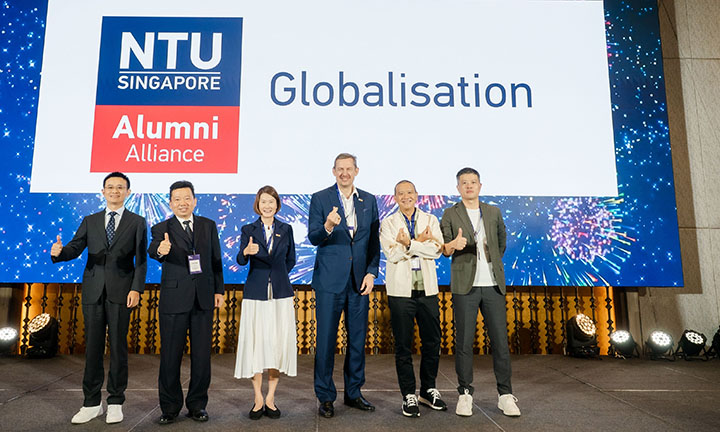
The NTU Alumni Alliance (Globalisation) followed, co-chaired by Dato Andy Zhao and Xu Min (pictured below, 2nd and 1st from left respectively), with a mandate to connect alumni across countries and industries through five professional committees spanning technology, business, talent development, advisory and sustainability.
Interested in getting involved? Find out how to join NAAE or the Globalisation Alliance here.