Phonon Character and Anharmonicity in Complex Crystals by Assistant Professor Matthias Agne
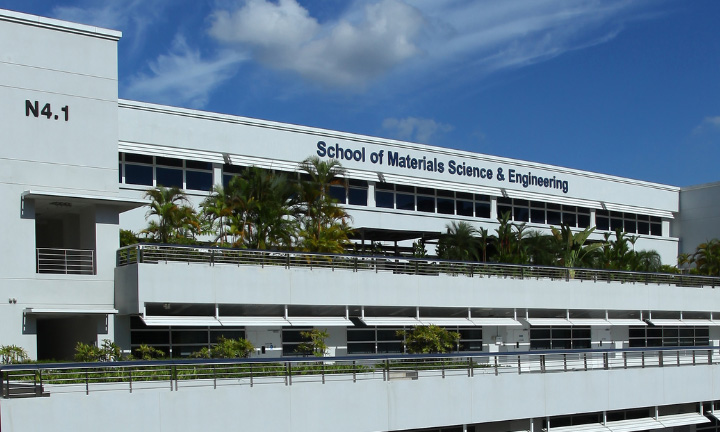
NTU MSE Seminar Hosted by Associate Professor Kedar Hippalgaonkar
Abstract
Effective control over thermal transport is often a limiting factor in the development of energy efficient technologies, especially semiconductor and electrochemical devices. In the classic theory of thermal transport by atomic vibrations (phonons) in crystalline materials, heat moves in a manner analogous to a gas, described by a velocity and by scattering events. This is known as the phonon gas model. Thermal transport in amorphous materials is fundamentally different, where heat moves in a manner analogous to an atomic-scale random walk. These phonons can be called diffusons. Only recently have these two perspectives been unified within one theoretical framework, which subsequently shows that phonons in complex crystalline materials can exhibit both gas-like and diffuson-like character. Effective tuning of thermal conductivity thus requires an understanding of both transport “channels.” This talk will discuss materials design strategies in the context of two-channel thermal transport and the role of phonon-phonon interactions. In particular, new results demonstrating an underlying structural dependence on phonon mode anharmonicity suggest that phonon mode shape (eigenvectors) may provide a key insight to identifying new materials for thermal applications.
Biography

Assistant Professor Matthias Agne
University of Oregon
Dr. Matthias T. Agne is an Assistant Professor of Chemistry and Biochemistry at the University of Oregon. He received his Bachelor and Master degrees in Materials Science and Engineering from Drexel University in 2015. While at Drexel, Matthias spent 4 years researching MAX phase ceramic composites under Professor Michel Barsoum. He completed his Ph.D under the advisory of Professor Jeffrey Snyder and graduated from Northwestern University in 2020. There, his research was concentrated in thermodynamics and materials physics with applications to solid-state transport phenomena, thermoelectric materials and measurements. From 2020-2023, Matthias studied solid-state ionics as an Alexander von Humboldt Postdoctoral Fellow in the Chemistry Department at the University of Münster in the group of Professor Wolfgang Zeier. Since 2023, his group in Oregon investigates the mechanisms of thermal and ionic transport and electrochemical degradation in energy conversion/storage devices, as well as machine learning for new materials discovery.