
Perovskite Multijunction Solar Cell Research at the University of Sydney by Professor Anita Ho-Baillie
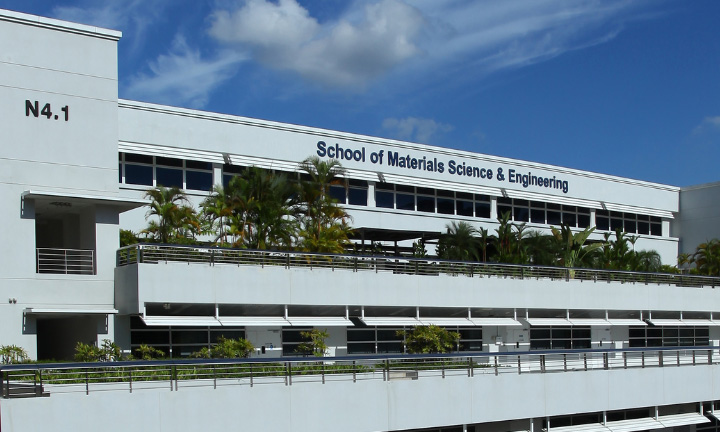
NTU MSE Seminar Hosted by Assistant Professor Leonard Ng Wei Tat
Abstract
Crystalline silicon solar cells dominate the photovoltaic market. The technology is mature, reliable and low cost, which has driven widespread global adoption over the past decade. Its power conversion efficiency, however, is limited to below 30% because of sub-bandgap losses when low-energy photons are not absorbed and thermalisation losses when excess photon energy is dissipated as heat.
Multi-junction tandem cells overcome these losses by stacking absorber layers with different bandgaps, each optimised for a portion of the solar spectrum. The efficiency limit rises with the number of junctions, to roughly 45% for two junctions and 51% for three. Such designs have long been used in III–V solar cells for space applications, where performance outweighs cost considerations.
Recently, organic–inorganic metal halide perovskites have emerged as promising, low-cost candidates for next-generation tandems, thanks to their rapid efficiency gains. At the University of Sydney, we explore perovskite tandem technologies, contributing to recent advances in efficiency and stability, and to applications in both terrestrial and space environments.
Biography

Professor Anita Ho-Baillie
John Hooke Chair of Nanoscience
The University of Sydney
Professor Anita Ho-Baillie is the John Hooke Chair of Nanoscience at the University of Sydney, a 2020 Australian Research Council Future Fellow, and was an Adjunct Professor at the University of New South Wales (UNSW) until 2025. She completed her PhD at UNSW in 2005. Her research interests include the integration of materials at the nanoscale for clean solar energy generation. She has been a Highly Cited Researcher every year from 2019 to 2025. In 2021 she was named the Top Australian Sustainable-Energy Researcher by The Australian newspaper’s annual Research Magazine, and in 2022 she won the Royal Society of NSW Warren Prize. In 2024 she received the Nancy Millis Medal from the Australian Academy of Science, and in 2024 and 2025 she was named Scientist of the Year and Academic of the Year respectively by the Australian Space Awards. In 2025 she won the Australian Museum Eureka Prize for Sustainability Research and the NSW Premier’s Prize for Excellence in Mathematics, Earth Sciences, Chemistry or Physics. She is an Associate Editor of ACS Nano and a Fellow of the Australian Institute of Physics, the Royal Society of New South Wales and the Royal Society of Chemistry.