Tracing How an AI Designs a Car
NTU researchers have built a system that lets a design team see exactly how customer feedback turns into a car concept.
 A concept generated by AutoGen-Insight for an urban-commuter buyer. Source: Wang et al., International Journal of AI for Materials and Design (2026).
Carmakers have never had more customer feedback to work with. Every new model launches into a flood of online reviews, praising a roomy cabin, complaining about a stiff ride, admiring a bold front end.
That feedback is a goldmine for deciding what the next car should look like. Yet turning it into actual design decisions still comes down to a short summary and a designer’s judgement.
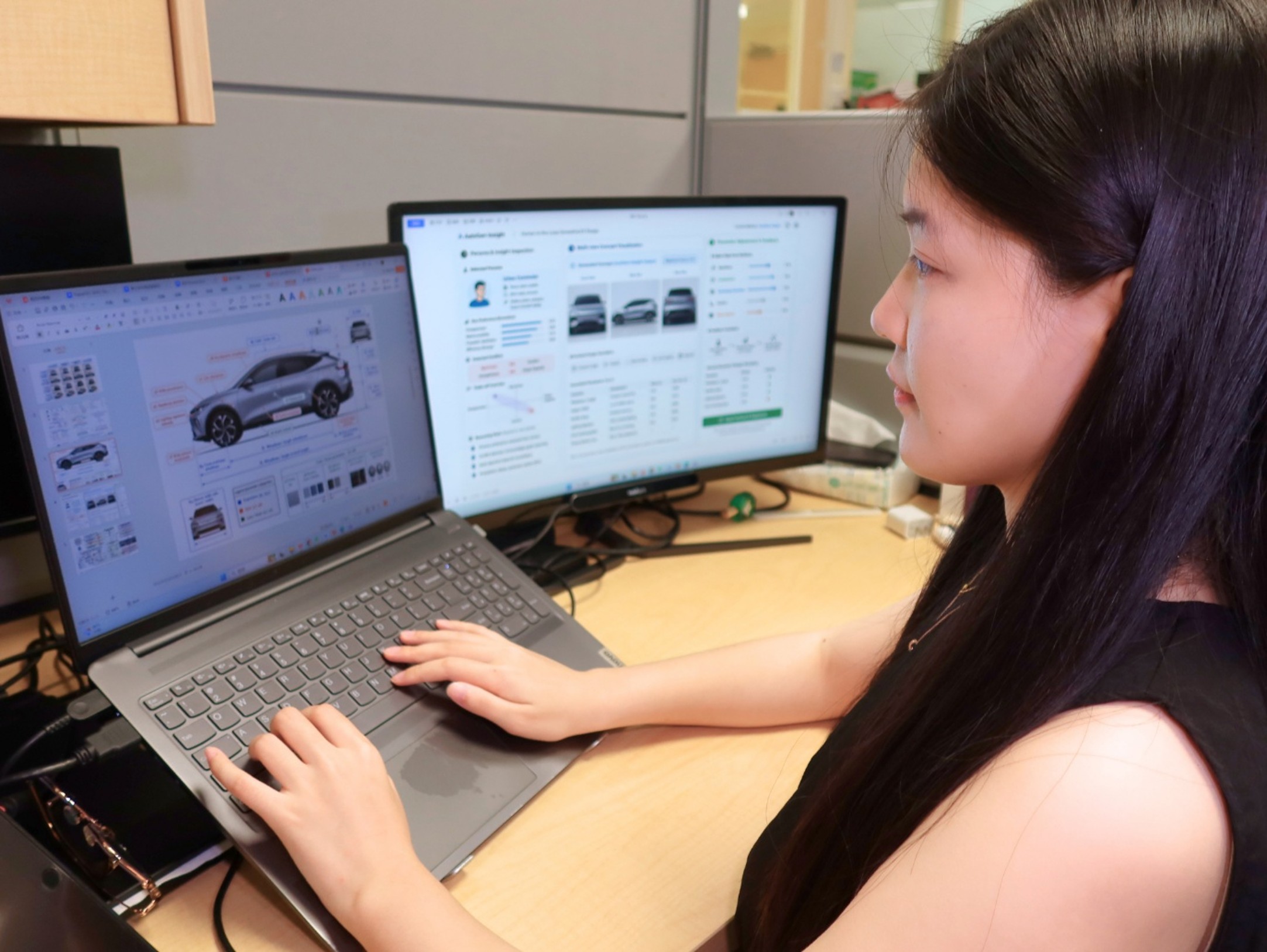 Luyao Wang, first author of the study and a PhD candidate at NTU in a joint programme with Shanghai Jiao Tong University, researching human-computer interaction and AI-driven design.
Luyao Wang, the first author of this article, kept coming back to that paradox. There is more customer data than ever, she noticed, yet the first design decisions often still rest on a small summary or a quick read of a limited sample.
During her PhD at NTU’s School of Mechanical and Aerospace Engineering, she built a system to close that gap, opening up the steps between customer feedback and the finished concept. The team named it AutoGen-Insight.
“The missing piece was an inspectable middle layer between language and images,” Wang says.
The gap between feedback and form
Customer research is good at producing a list of needs. AI image generators are good at producing striking pictures. Both already exist.
The catch is getting from one to the other. Someone has to read the feedback and write a prompt for the generator, based on their own reading of what customers meant.
That handover is where the link breaks. The generator only sees the prompt, not the thousands of reviews behind it, so no one can check whether the concept reflects what customers actually said.
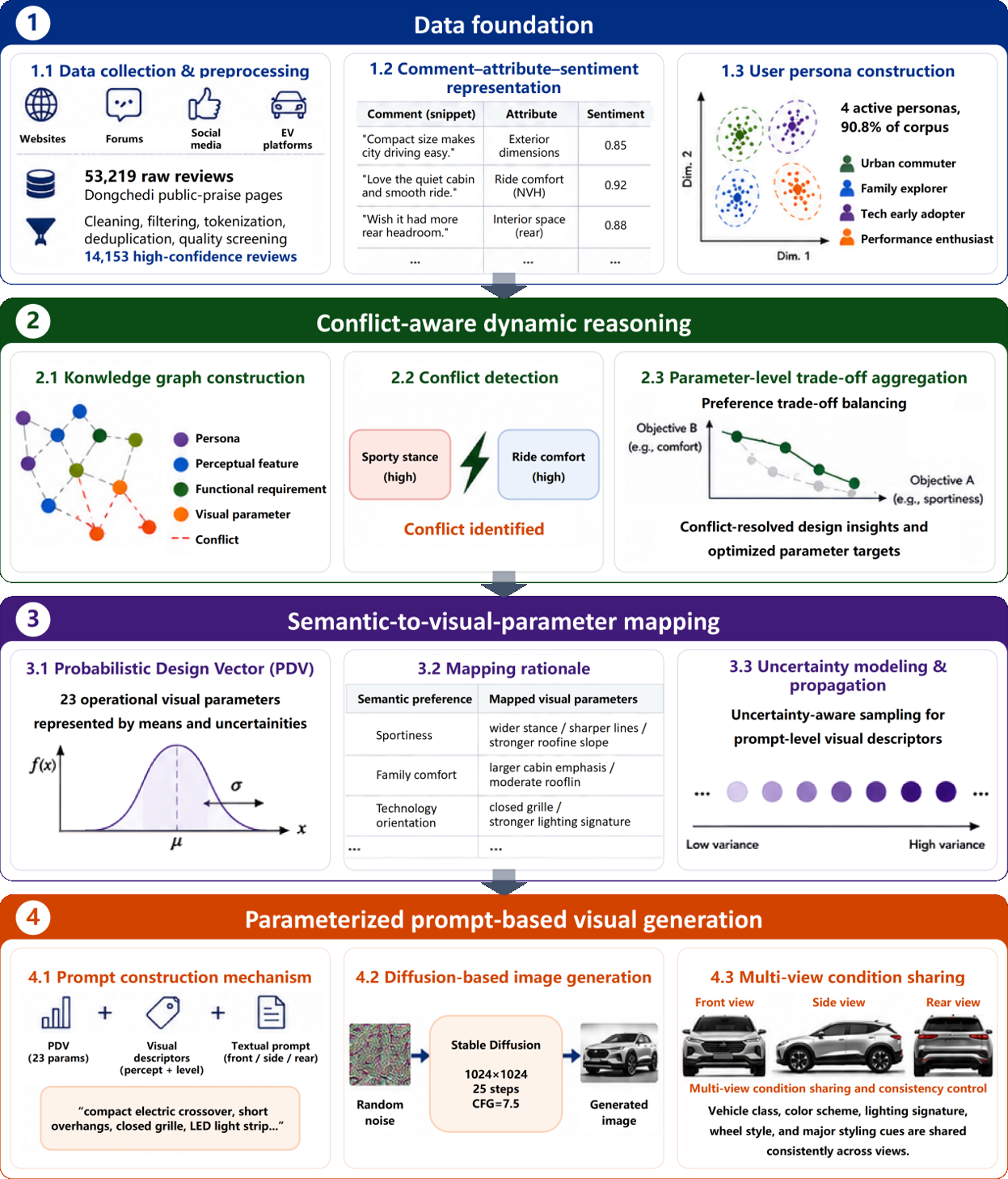 The full path AutoGen-Insight keeps visible, from customer reviews and buyer profiles, through conflict handling and design parameters, to the generated car. Source: Wang et al., International Journal of AI for Materials and Design (2026).
How the system works
The team had already done part of the groundwork. In earlier research, they studied thousands of electric-vehicle reviews and grouped them into a handful of distinct buyer profiles, each with its own set of priorities.
AutoGen-Insight builds on that. It takes what each profile wants and turns it into visual design directions, showing its reasoning at every step.
A designer can follow the chain from a group of buyers to a need, to a decision about roofline or stance, and see where the evidence was strong and where it was thin.
“A design team can see not only what the AI produced, but why particular proportions or styling cues were selected,” Wang says.
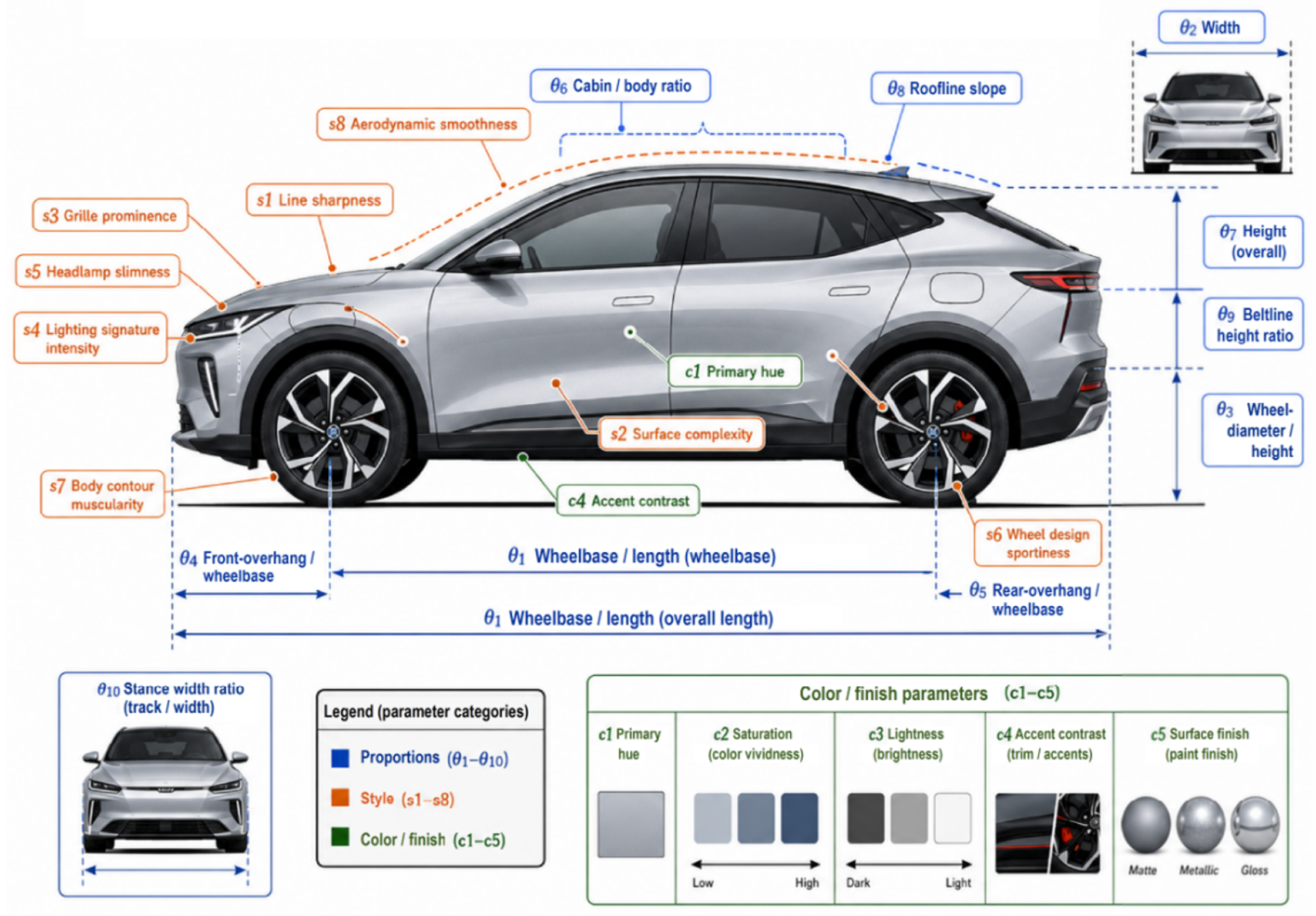 The design features the system works with, from proportions and stance to lighting, colour, and finish, shown on an electric-vehicle concept. Source: Wang et al. (2026).
When customers want opposite things
The system is most useful where buyers disagree.
A sporty look wants a low, aggressive stance. Easy entry wants a taller cabin. Compact size leaves less room for cargo. These wishes pull against each other.
The usual fix is to average them into one description. That gives a car that is faintly sporty, faintly practical, and right for no one.
“The system does not ask AI to design for an average customer who may not exist,” Wang says.
Instead, it marks each conflict and works it through as a clear trade-off. A sporty stance against easy entry might settle into a moderate roofline, short overhangs, and balanced proportions.
Because the reasoning stays visible, a designer can see what was kept, what was changed, and why, then adjust it before the concept is made.
“A contradiction in reviews is not just noise,” Wang says. “It is a design trade-off that should be made visible.”
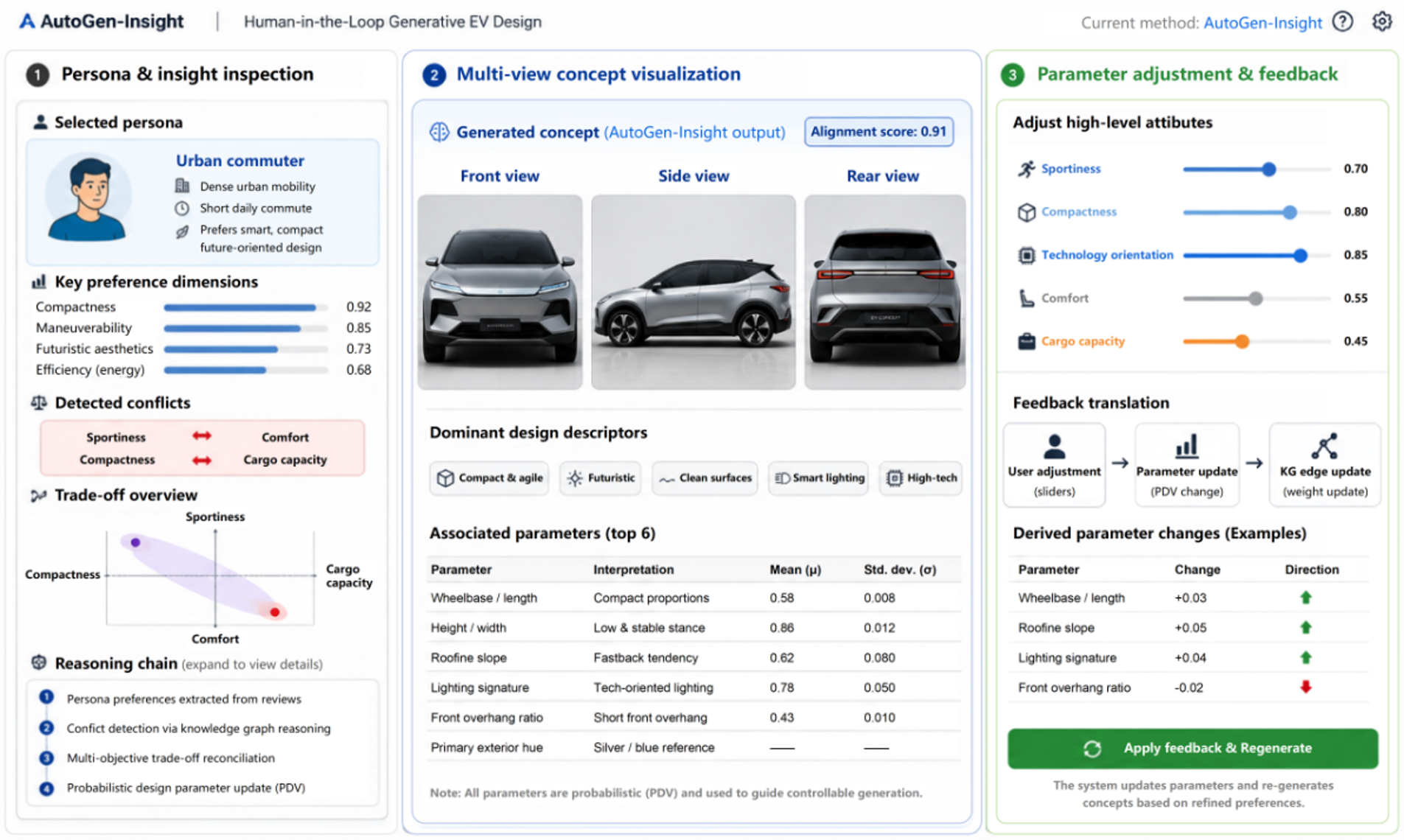 The AutoGen-Insight interface. A designer can see the selected buyer profile, the reasoning behind the concept, the generated car, and the controls to adjust each step. Source: Wang et al. (2026).
Why cars
Cars made a good first test because their design carries so many competing demands. The outside of a car has to look sporty, safe, comfortable, and on-brand all at once.
A small change in proportion changes how all of it reads, so cars were a hard place to see whether the system could hold those tensions instead of smoothing them over.
For the reviews themselves, the team turned to Dongchedi, a Chinese car-review platform where owners write openly about the vehicles they drive. It gave them thousands of unfiltered opinions to work from.
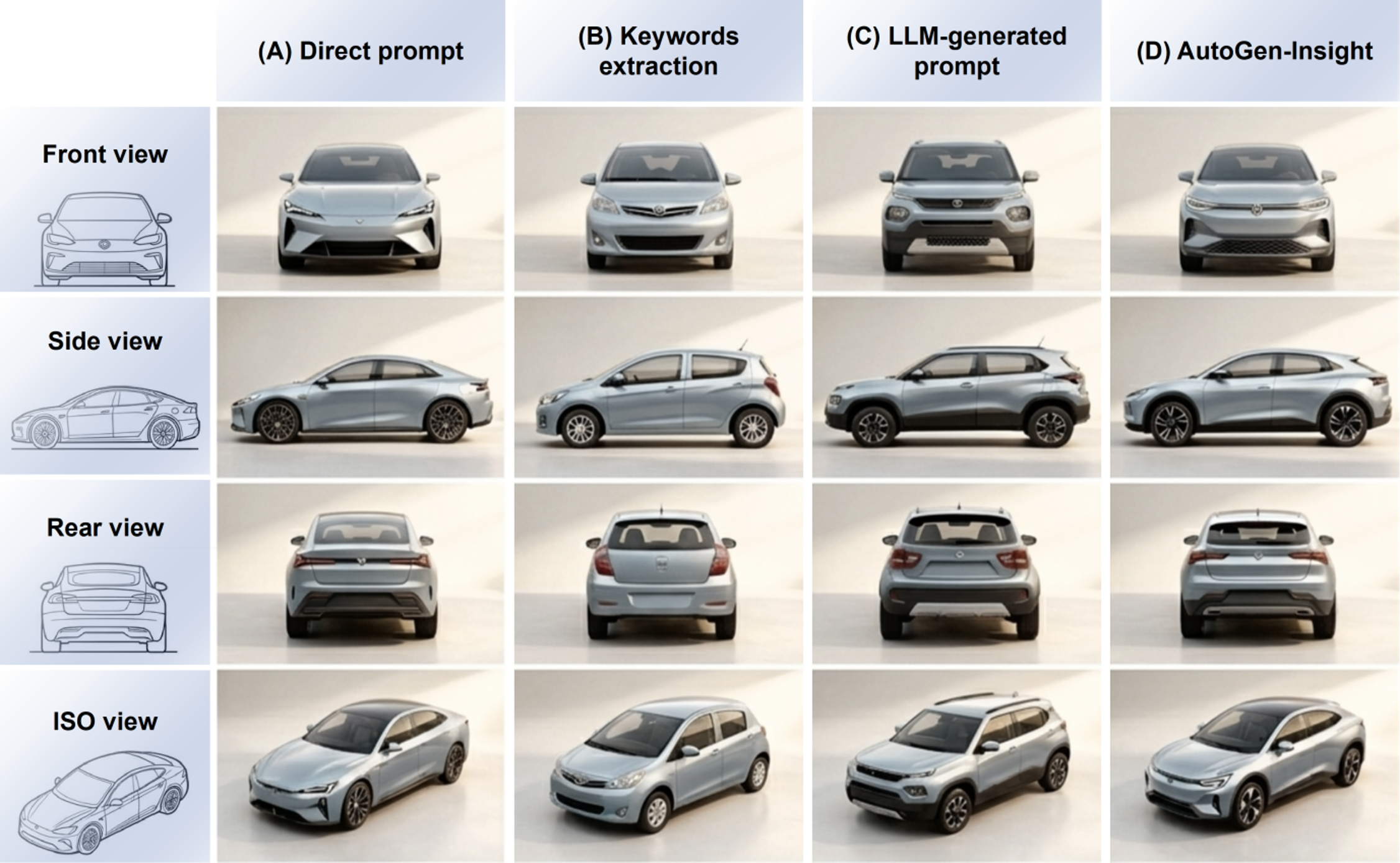 Concepts for the same urban-commuter buyer, generated by three common methods and by AutoGen-Insight (far right). The others lean too sporty or too plain, while AutoGen-Insight balances the competing needs. Source: Wang et al. (2026).
What it changes
The clearest change is in how a car project begins.
Normally, a team opens a new project by boiling thousands of reviews down to a short, general brief, then designing from that.
With this system, those opening weeks could look different: the team examines each buyer profile, sees exactly where customers pull in different directions, and compares several traceable concept directions before committing to detailed modelling.
“This does not remove the first month of work,” she says. “It changes the quality of that work.”
Where it stops
Wang is clear about what the tool is for. It suggests and organises, but it leaves the decisions to the designer.
For Professor Chen, who supervised the work, that boundary is the point. “The goal is not to replace the designer,” he says, “but to move human judgement to the decisions where it matters most.”
The design team still has to weigh brand identity, cultural meaning, manufacturing, and safety, alongside ideas that no past review could have asked for.
The system was also tested on one platform and one market. What works for cars will not transfer wholesale to products like phones or furniture, since every field speaks its own design language. Each would need the same groundwork done again from the start, its own buyer profiles and its own design rules, built up from its own reviews.
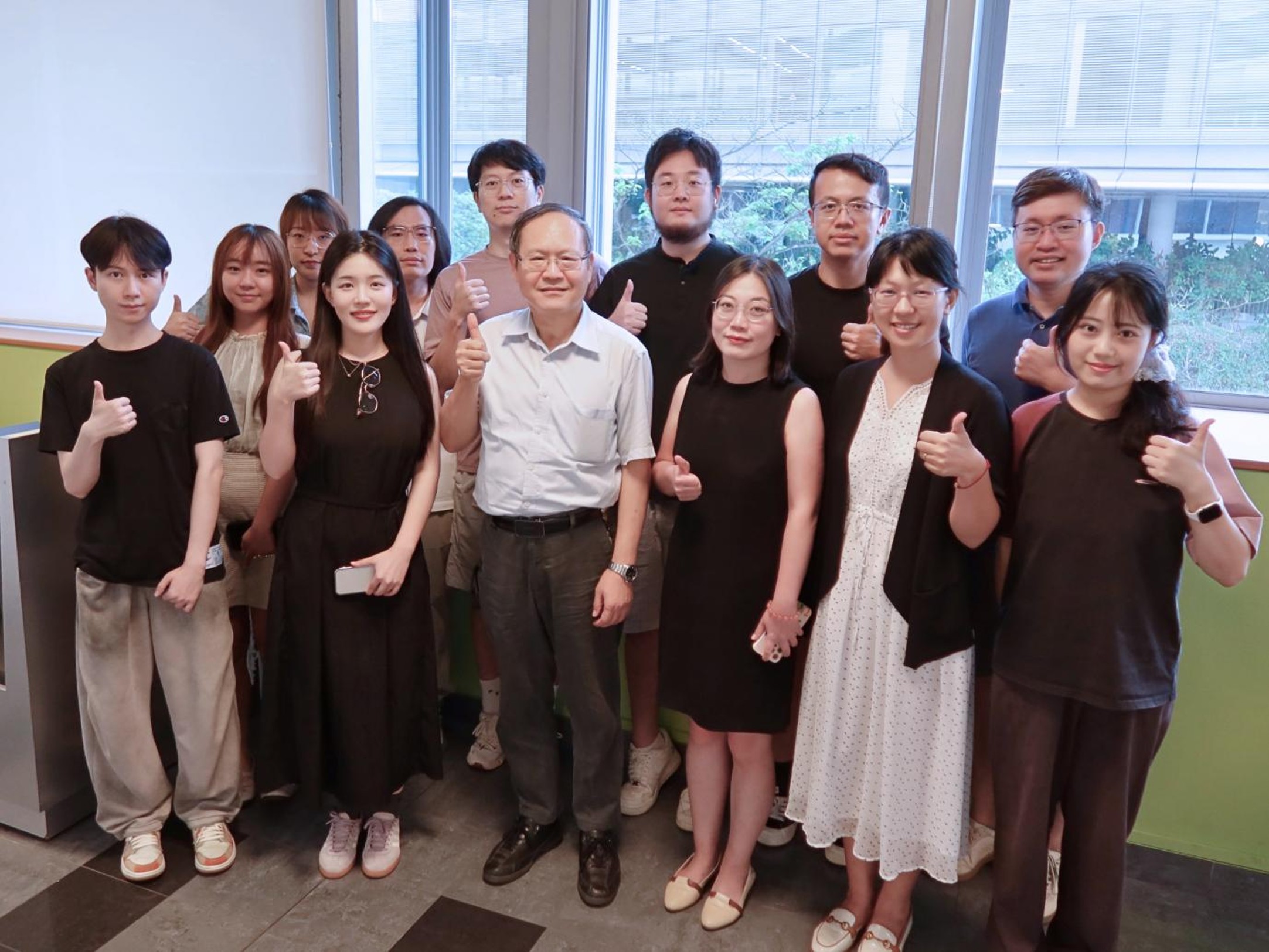 Professor Chun-Hsien Chen, Professor-in-Charge of the Design and Human Factors Lab at NTU's School of Mechanical and Aerospace Engineering, with his research group.
Building it also changed how Wang reads reviews herself. She is now, she says, “much less willing to treat reviews as a vote count or a single market truth.”
A contradiction between two customers, in her view, is no longer a problem to erase but a signal worth keeping.
The work carries a quieter thread of continuity too. It was jointly supervised by Professor Chun-Hsien Chen at NTU and Associate Professor Danni Chang at SJTU, who was herself supervised by Prof Chen during her own doctoral training.
The collaboration, in that sense, spans two generations of researchers working on the same question of how to bring people’s needs into design.
The research was published in the International Journal of AI for Materials and Design under the title “AutoGen-Insight: Translating Consumer Reviews into Probabilistic Visual Design Parameters for Generative Electric Vehicle Concept Generation.” https://doi.org/10.36922/IJAMD026190015
About the researchers
Luyao Wang is a PhD candidate in the Shanghai Jiao Tong University–Nanyang Technological University Joint PhD Programme, currently conducting her research in the Design and Human Factors Lab at NTU’s School of Mechanical and Aerospace Engineering. She led the data curation, analysis, software development, and manuscript drafting for the study, and contributed to its conceptualisation and methodology. |  |
Professor Chun-Hsien Chen is a faculty member in the Design and Human Factors Lab at NTU’s School of Mechanical and Aerospace Engineering. He contributed to the methodology, validation, and manuscript revision, and supervised the work at NTU. |  |
Associate Professor Danni Chang is a faculty member in the Department of Design, School of Design, at Shanghai Jiao Tong University. She contributed to the conceptualisation, project administration, funding, and manuscript revision, and supervised the work at SJTU. |  |
By Karen Chai, NTU MAE Communications