Technologies shaping tomorrow's industries
A glimpse into various technologies developed at NTU that address challenges spanning sustainability, energy, communications and healthcare, open to industry collaboration, licensing and investment partnerships.
At NTU, researchers and engineers across disciplines are developing technologies that respond to global challenges spanning various areas from sustainability and energy to communications and healthcare.
Whether it’s strengthening soil resilience and storing renewable energy, or improving wireless connectivity and advancing medical treatment, these projects illustrate the breadth of translational research emerging from the university. The innovations highlighted here are currently being developed within NTU’s research ecosystem and present opportunities for collaborators to engage through licensing, co-development and investment.
Restoring soil resilience in a changing climate
The world loses roughly 24 billion tonnes of fertile soil every year. Climate change is making matters worse: rising temperatures and prolonged drought degrade soil structure and reduce its capacity to retain water, causing parched earth to repel moisture rather than absorb it. The result — runoff, erosion and nutrient loss — compounds the agricultural pressure already trickling down on food systems worldwide.
Professor Lam Yeng Ming’s team has developed RetenSOL-G, a nanogel platform that restores soil functionality by fundamentally changing how water and nutrients interact with the ground. Introduced into water-repellent terrain, the nanogel transforms the soil into a moisture-retaining growing environment — one that absorbs rainfall and irrigation water gradually rather than shedding it. The platform also serves as a delivery mechanism for water-soluble nutrients, supporting healthier root development and improved crop yields.
With customisable formulations tailored to different soil conditions, RetenSOL-G’s applications extend well beyond conventional agriculture: urban landscaping, land rehabilitation and climate-resilient infrastructure are all within reach. For agri-tech investors and land managers grappling with deteriorating soil quality, the technology offers a scalable, field-ready solution to a problem that is only getting worse.
.jpg?sfvrsn=b9c10feb_1 "retensol_IMG_6008 (1)") | .jpg?sfvrsn=6cd58543_1 "retensol_IMG_6007 (1)") |
RetenSOL-G in action: ground-level planters at NTU’s School of Materials Science and Engineering — untreated plants (left) show bare ground cover and loss of bird’s nest ferns under drought and heat stress, while RetenSOL-treated plots (right) retain intact ground cover and lusher vegetation.
Powering new electricity grids
In 2024, the world added roughly 700 gigawatts of new renewable capacity — the 22nd consecutive year that installation records were broken. The corollary challenge — reliable, large-scale storage — remains largely unsolved. Grid-scale battery systems must be safe, stable and economically viable at a scale that existing technologies struggle to meet without costly trade-offs.
Professor Jason Xu Zhichuan’s team has developed an intermediate-temperature potassium–sulfur battery that sidesteps many of those trade-offs. By combining a potassium–sodium liquid alloy anode with an amide-based polysulfide catholyte, the system achieves an energy density above 150 Wh/kg and stable operation at 60 °C, significantly lower than the 300–350 °C required for conventional sodium–sulphur batteries, reducing both safety risk and infrastructure cost.
Designed for grid-scale applications, the technology is built with practical deployment and system integration in mind from the outset.
With a cost target below SGD$60/kWh, demonstrated stability over 700 days and more than 3,000 cycles, the technology represents a credible candidate for deployment alongside expanding solar and wind infrastructure. As global energy systems increase their focus on storage, the timing for this technology is well-placed.
Opportunities: Grid-scale storage, renewable energy partnerships, battery manufacturing, and energy systems integration.
Intelligent meta-surfaces boost wireless coverage
The proliferation of wireless networks, from 5G rollouts to industrial IoT and connected vehicles, has created a paradox: the more devices that need reliable connectivity, the harder it becomes to deliver it consistently. Physical obstacles scatter signals. Dense spectrum environments create congestion. Conventional antenna systems can direct energy, but only crudely.
Professor Guan Yong Liang, Professor Yuen Chau and their research team are developing a new class of reconfigurable intelligent surfaces that take a more precise approach. Instead of brute-forcing signal strength, the meta-surface platform uses arrays of sub-wavelength elements to manipulate electromagnetic waves with fine-grained directional control, at minimal energy cost. Integrated power amplifiers, as well as frequency- and angle-selective unit cells allow the system to shape signal beams with a degree of accuracy that outperform traditional phased-array antennas.
An intelligent control layer ties it together, optimising network performance in real time.
The applications span telecommunications infrastructure, industrial wireless environments and automotive radar system — each a sector where the demand for reliable, high-density connectivity is growing faster than current solutions can accommodate.
Opportunities: Telecommunications infrastructure, industrial wireless networks, automotive radar and next-generation wireless systems.
Shape-shifting retainers that adapt as teeth do
Clear retainers have made post-treatment orthodontic care more discreet and comfortable than the wire-and-acrylic devices they largely replaced. But the underlying model has a persistent inefficiency: teeth have a natural tendency to drift after alignment treatment, and within six months many patients find their retainers no longer fit — leaving them to choose between costly re-treatment or accepting a suboptimal result.
7761ea3bc5d5487fa8bfb2e300de3272.jpeg?sfvrsn=b4a236_1 "4D Printable Dental Retainers - Shape Memory Effect (1)")
Associate Professor Su Pei-Chen, Dr Ng Chin Siang and their team have developed a shape-memory polymer material that changes this calculus. Using a proprietary formulation with heat-responsive crosslinkers, the retainers — produced via 4D printing — can be reshaped repeatedly when briefly immersed in hot water, allowing a single device to conform to shifted teeth and apply gentle corrective force to guide them back into position.
The implications are practical and commercial. Patients have a single adaptive device that effectively serves as a safeguard built into aftercare. For manufacturers, 4D printing also simplifies production and reduces material costs relative to conventional fabrication methods. For dental device companies and orthodontic treatment platforms exploring scalable, sustainable production models, the technology offers a meaningful structural improvement on the dominant paradigm.
Opportunities: Dental device manufacturing, orthodontic treatment platforms and medtech product development.
.jpg?sfvrsn=9436286_1 "4D Printed Retainers - Comparison with Thermoformed (1)")
Viewing tumours with greater clarity
Fluorescence imaging–guided surgery allows surgeons to see tumours in real time, helping them define tumour boundaries more precisely and detect small or hidden cancerous lesions during an operation. However, most current imaging approaches rely on affinity-based contrast agents that accumulate passively in tissues, which can lead to limited specificity and low imaging contrast. In addition, the depth at which tumours can be visualised is restricted because conventional fluorescent signals use relatively short wavelengths of light (below 700 nm), which cannot penetrate deeply into tissue.
Professor Pu Kanyi and his research team have developed a new class of activity-based fluorescent probes that emit light in the shortwave infrared region (above 900 nm), where imaging can reach deeper into the body. Unlike conventional probes, these molecules remain dark until they are activated by cancer-associated biomarkers, enabling highly specific tumour detection with minimal background signal. The probes can also bind permanently to tumour tissue, allowing surgeons to visualise tiny tumours that are invisible to the naked eye, even deep within tissue, and supporting more complete surgical removal of hidden metastases.
Beyond surgery, this technology has broad potential applications. The probes can be used for wash-free live-cell imaging, tracking cells inside living organisms and evaluating immunotherapy responses. Together, these capabilities position the platform as a versatile imaging tool that could support cancer research, drug development and future clinical care.
Opportunities: Surgical imaging systems, oncology diagnostics, biomedical imaging platforms and drug development research.
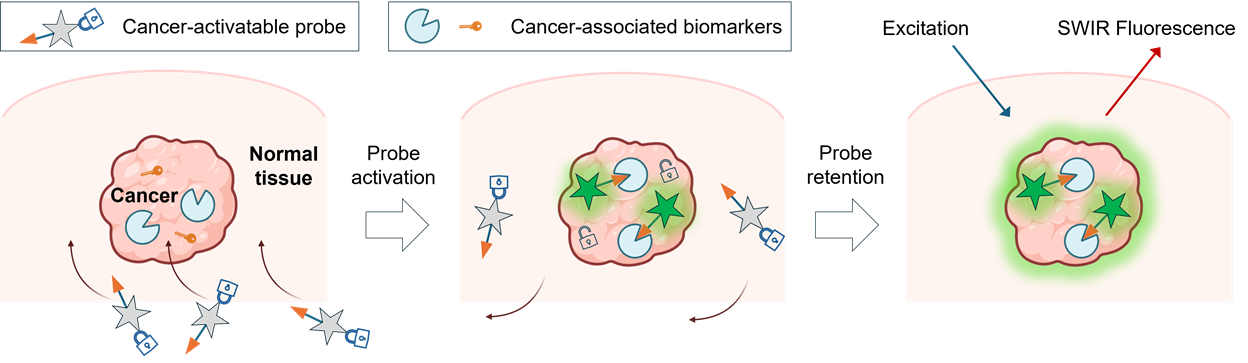
Fluorescence imaging–guided surgery allows surgeons to see tumours in real time, helping them define tumour boundaries more precisely and detect small or hidden cancerous lesions during an operation.
Rewiring recovery after stroke
Stroke is a leading cause of long-term disability worldwide. Around 80% of acute stroke patients experience upper limb motor dysfunction, and for roughly 30%, the deficit extends to fine hand movement: the dexterity required to button a shirt, swipe a phone screen or prepare a meal. Conventional rehabilitation is slow, resource-intensive and often plateaus before patients reach their functional ceiling.
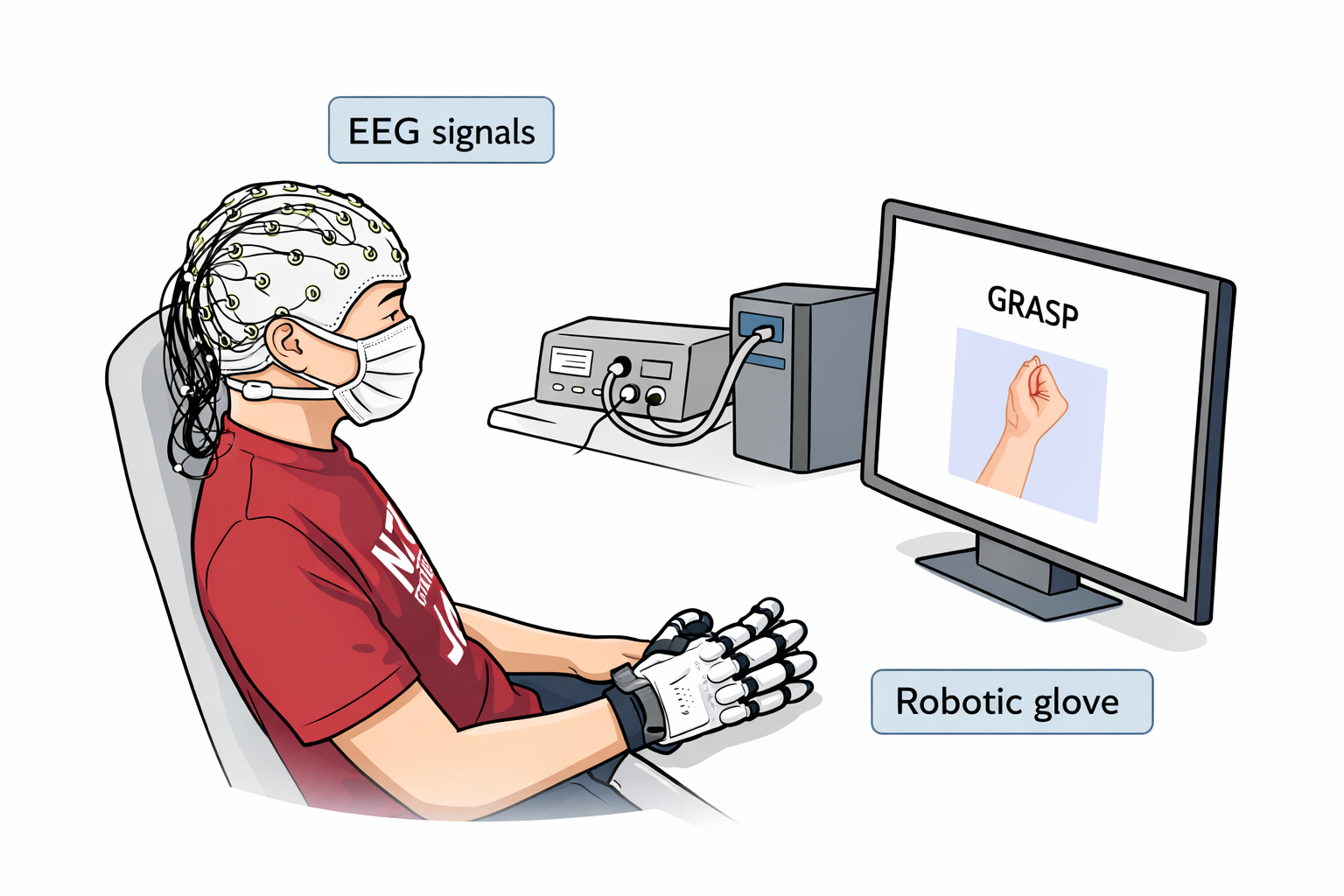
Professor Guan Cuntai and his team have developed an adaptive brain–computer interface (BCI) system designed to push that ceiling higher. The platform decodes a patient’s motor intentions directly from electroencephalography (EEG) signals, enabling real-time reconstruction of hand movements during therapy — bypassing damaged neural pathways to reinforce the brain’s own recovery mechanisms. The underlying architecture integrates spectral and spatial features from neural signals through a multi-view deep-learning model, delivering personalised training that adjusts dynamically to each patient’s progress.
Importantly, the system is designed not merely to assist movement, but to promote neuroplasticity — the brain’s capacity to rewire itself in response to repeated, targeted stimulation. For neurorehabilitation device companies, digital therapeutics platforms and clinical systems developers, it represents a leap in what post-stroke recovery can realistically achieve.
Opportunities: Neurorehabilitation devices, digital therapeutics, assistive technologies and clinical rehabilitation platforms.
Explore the NTU Tech Portal and discover innovations that deliver practical solutions with real-world applications.
Read the full newsletter or subscribe to NTU I&E for the latest updates, events and programmes.