Transforming student ideas into promising ventures
Three student ventures started with very different ideas. Working with the NTU Entrepreneurship Academy (NTUpreneur), each found that moving closer to market meant changing course.
NTUpreneur's Experiential Learning (Student Venture) team helps student founders navigate the process of transforming ideas into ventures, working with them to define their customers, shape minimum viable products, refine business models and find partners along the way.
U-Flow: Leaving the hardware behind
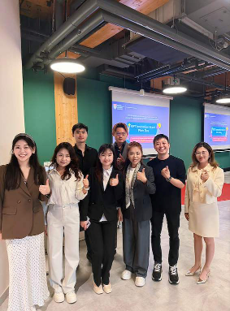 Parking in Singapore may be highly automated, yet arriving at a car park can still involve guesswork. Drivers cannot always tell whether spaces are available, how much they will pay or which location best suits their journey. Master of Science in Technopreneurship and Innovation Programme (MSc TIP) graduate Lian Xiaojuan saw an opportunity for a single mobility platform.
Initially, U-Flow planned to install sensors and equipment at each location. Instead, Xiaojun’s mentor from the Experiential Learning team challenged: did U-Flow need to rebuild the infrastructure at all?
That question prompted U-Flow to instead become an intelligent service layer over existing parking, data and payment systems. Its AI voice interface can recommend parking by availability, price, distance and membership benefits, sparing drivers from searching through screens on the road.
The process pushed Lian’s team to distinguish “what we truly need to build ourselves” from what partners could provide. Its next step is to connect to live data from a car park or commercial property, and put U-Flow into drivers’ hands during an actual journey.
Xiaoqi Teacher: From lecture notes to learning companion
Wang Hebei first built Transnote AI because he struggled to capture every word of long university lectures. The website recorded classes and organised them into notes, drawing positive feedback from early tests at NTU. However, the team found limited room to grow with a university-focused software tool.
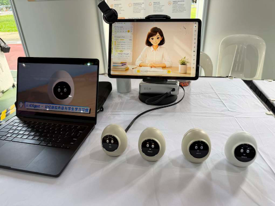
Discussions during MSc TIP and consultations with NTUpreneur’s Experiential Learning team led him towards younger students. Xiaoqi Teacher emerged from this pivot, retaining Transnote AI’s central idea of capturing and organising learning but redesigning it for primary and secondary schools. The product is developed by Transnote Pte Ltd, the company the team incorporated in Singapore.
Hebei describes the long-term ambition as a student version of JARVIS, Tony Stark’s voice-activated AI assistant in the Iron Man films. Its first physical product, the portable “Learning Egg”, records audio, organises notes and homework as well as answers questions.
At a community exhibition in Singapore, parents asked about the product’s price and showed particular interest in its English-to-Chinese contextualisation. The founders are refining its homework explanations and parent portal while working to encourage educators to make room for an AI learning companion.
Coolivate: Deciding where to begin
Coolivate began with a layer of hydrogel sandwiched between two panes of glass. The passive-cooling window, HydroSkin, won a hackathon and gave undergraduate founder Neha Murukesan and her team the confidence to pursue commercialisation.
Conversations with heating, ventilation and air-conditioning specialists soon sent the team in a new direction: a flexible composite phase-change material designed to manage heat passively. It could serve many markets ranging from data centres to battery systems. Where should Coolivate begin?
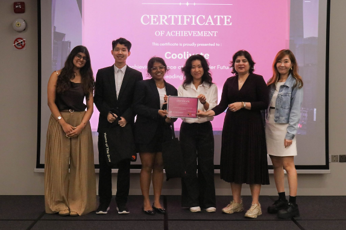
Weekly commercialisation sessions with NTUpreneur encouraged the team to choose a route to market. Interviewing more than 45 companies in Singapore and San Francisco, they compared space constraints, thermal hotspots, sales cycles and economic value.
Ultimately, Coolivate chose compact battery systems used in robotics, drones and power tools, where space is limited and product cycles move faster. Incorporation allowed it to sign a technology-licensing agreement with NTUitive, along with non-disclosure agreements and letters of intent. Coolivate is now seeking hardware manufacturers willing to put the material through its paces in working products.
A pulse on the markets
NTUpreneur’s Experiential Learning team regards venture building as a process of progressively turning assumptions into evidence. Founders may begin by asking whether an idea can be built and deployed, but as the venture develops, the questions become more commercial: Does it solve a real problem? Who will adopt it? Can it work in practice? Is there real commitment from stakeholders, partners or investors? For incorporated ventures, answering these questions means moving beyond the comfort zone of a university environment and becoming real-world entrepreneurs.
“The next stage is about proving that a venture can work beyond the university environment. For our incorporated ventures, success means demonstrating technical performance in real business conditions, validating demand through customers and pilots, and ultimately showing that someone is prepared to fund or commit resources. This is where the participation of industry partners is critical, not simply in providing advice and feedback, but in giving young ventures access to real-world environments where their remaining assumptions can be tested. The journey is from incorporation to pilot, to customer evidence, to commercial commitment and, ultimately, to scale.” says Dennis Low, Manager, Experiential Learning, NTUpreneur.
Read the full newsletter or subscribe to NTU I&E for the latest updates, events and programmes.