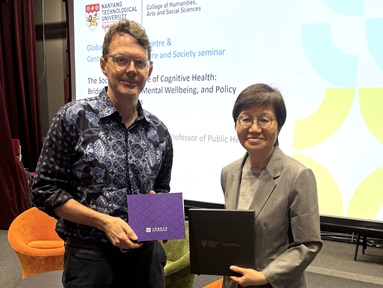
Global Asia Research Centre (GARC) Seminar by Dr Annina Lattu
The Global Asia Research Centre continued its Event Series on 5 February 2026 with a seminar on “Open Science, Research Security, and Epistemic Pluralities: China in a Changing Global Knowledge Order” by Dr Annina Lattu, Visiting Postdoctoral Fellow at the Max Planck Institute for the History of Science, Visiting Scholar at Fudan University, and Postdoctoral Researcher at Tampere University.
The seminar examined how Open Science is evolving in China and beyond amid intensifying geopolitical tensions and research securitization. Beginning with the normative foundations of Open Science — often linked to Mertonian ideals of communalism and disinterestedness — Dr Lattu outlined how digital technologies have transformed the scale and practice of scientific openness. She emphasized that, as the world’s largest producer of scientific publications, China’s interpretation and governance of Open Science have significant implications for the global circulation of knowledge.
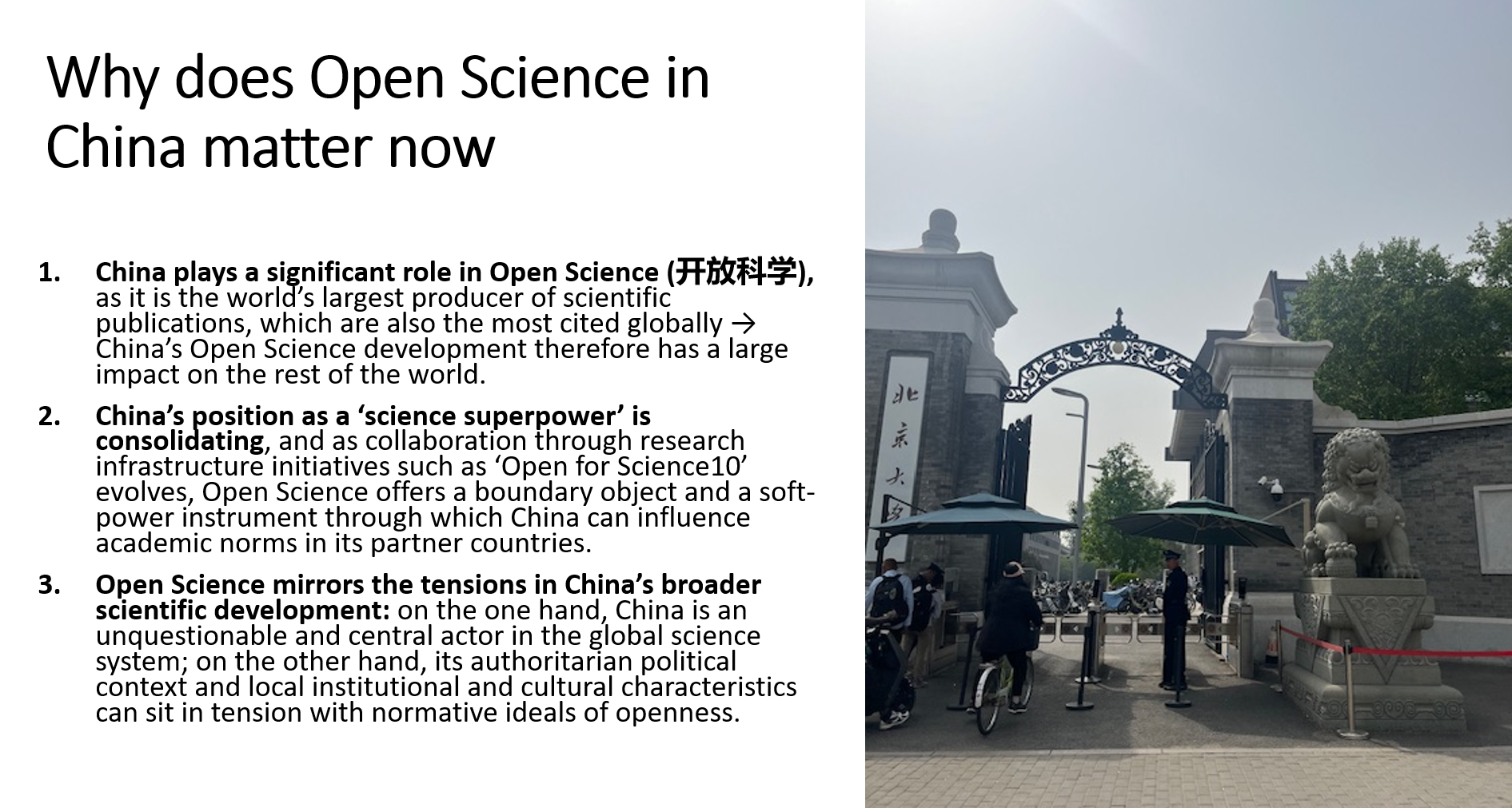
Drawing on bibliometric data and ongoing empirical research, the presentation showed that while China produces the largest absolute number of open access (OA) publications, the overall share of OA research remains lower than in many Western countries. Although Open Science practices are widely recognized and institutionally legitimized — notably through the revised 2021 Science and Technology Progress Law — China has not adopted a comprehensive Open Science implementation policy.
Instead, Dr Lattu argued that China’s approach can be understood as “strategic, nationally bounded openness.” Open Science is encouraged but carefully calibrated in relation to national economic development, domestic publishing capacity, and broader state objectives. High OA-related article processing charges paid to foreign publishers, alongside investments in domestic journals and initiatives such as Open for Science 10 (OS10), illustrate how Open Science is embedded within China’s science, technology and innovation objectives, promoting domestic innovation, while also positioning China as an actor leading knowledge infrastructure development and Open Science cooperation in the Global South.
The seminar then turned to research securitization. Rather than presenting research security as an external constraint, Dr Lattu demonstrated how security-related measures — including data laws, cross-border data regulations, and global database restrictions (e.g., recent NIH-related access restrictions), form part of the same strategic governance logic. In this framework, securitization can both limit certain forms of international openness and simultaneously stimulate domestic Open Science capacity.
Comparing the European Union and China, the presentation introduced a paradox lens developed in joint work with Dr Cristina Pinna. In the EU, Open Science and research security are often framed as competing policy domains. In China, however, these domains are largely co-aligned within broader Party-state objectives, particularly in relation to the national innovation system and economic development. The paradox emerges externally when China’s model of state-bounded openness is evaluated against global Open Science norms, for instance the norms promoted by UNESCO (e.g., in UNESCO Recommendation on Open Science).
To contextualize contemporary caution toward openness in China, the talk historicized the so- called ‘opening-up wound’ through the case of the First Opium War and nineteenth-century Shanghai, illustrating how openness is remembered in China, in relation to asymmetrical power and epistemic hierarchies.
The presentation concluded by introducing the concept of epistemic pluralities as a way of understanding current tensions in knowledge governance in an increasingly multipolar world. A lively discussion followed on the future of Open Science and the governance of global scientific collaboration, fostering connections between Dr Lattu and NTU GARC for future research.
Stay tuned for more seminars, workshops, and conferences throughout the year in the Global Asia Research Centre Event Series.
/assoc-prof-lin-jingxia_websitebanner.tmb-listing.png?sfvrsn=88a9cef8_1)