
NTU Joins Global AI Network — Bringing the Humanities and Social Sciences into the Conversation
NTU Singapore has joined the International Computation and AI Network (ICAIN) — a global partnership linking leading AI research groups and supercomputing centres, including ETH Zurich, the Swiss National Supercomputing Centre, Data Science Africa, the multilingual Indian project Bhashini and CSC- IT Center for Science from Finland
ICAIN focuses on expanding access to AI infrastructure and strengthening global collaboration in the development of artificial intelligence.
The involvement of NTU, and COHASS brings humanities and social science perspectives into the conversation.
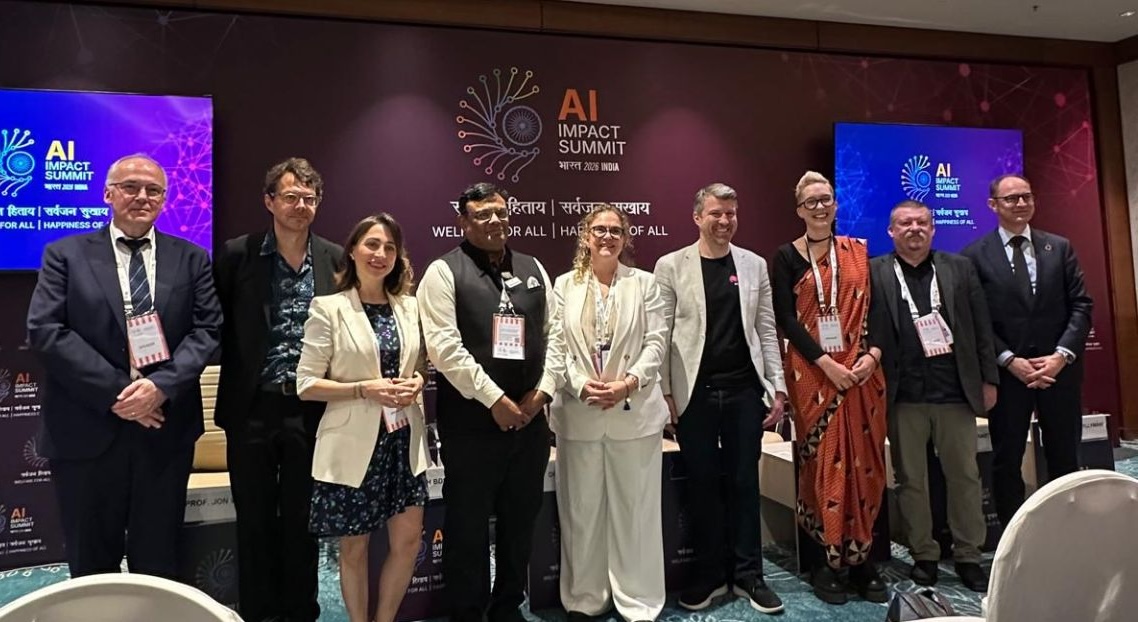
In February, Jon Wilson, Dean of CoHASS, joined a panel on multilingual AI at the AI Impact Summit in Delhi. The discussion centred on the need to train AI on languages from across the world’s diverse societies, and to develop mechanisms to connect with cultural differences. Participants, from Asia, Europe and Africa agreed that AI systems trained primarily on a narrow set of languages and contexts will struggle to serve a diverse global society.
That is where humanities and social science research matters. “AI is not just a technological system — it is a social one,” said Professor Wilson. “If we want AI to work across different societies and languages, and if we want to understand its impact across the world, we need the insights of historians, linguists, sociologists, communication experts and other scholars who study how people communicate, govern and live together.”
By joining ICAIN, NTU researchers will collaborate with partners globally — helping ensure that AI conversations include perspectives from Asia and from multilingual societies like Singapore, and far beyond.
The ICAIN membership occurs as part of a growing focus on AI and multicultural, multilinguistic societies at NTU; which includes NTU computer scientists and linguistics’ involvement in SEA-LION, and the nascent Asian Centre for Digital Cultures based within CoHASS.
As AI becomes more powerful, the challenge is no longer just building the technology. It is understanding how it can reflect and how it does reshape societies. That is a conversation where the humanities and social sciences have a vital role to play.
/assoc-prof-lin-jingxia_websitebanner.tmb-listing.png?sfvrsn=88a9cef8_1)
/ug-town-hall-(header-pic)_updated1.tmb-listing.png?sfvrsn=a0936bc_1)
749334c4-4609-4705-a4c3-e3100c93f512.tmb-listing.jpg?sfvrsn=a26bd855_1)
/58.tmb-listing.jpg?sfvrsn=c98bb35a_1)