A baby’s gaze may hold the key to how they learn - New study uncovers how babies learn through eye contact
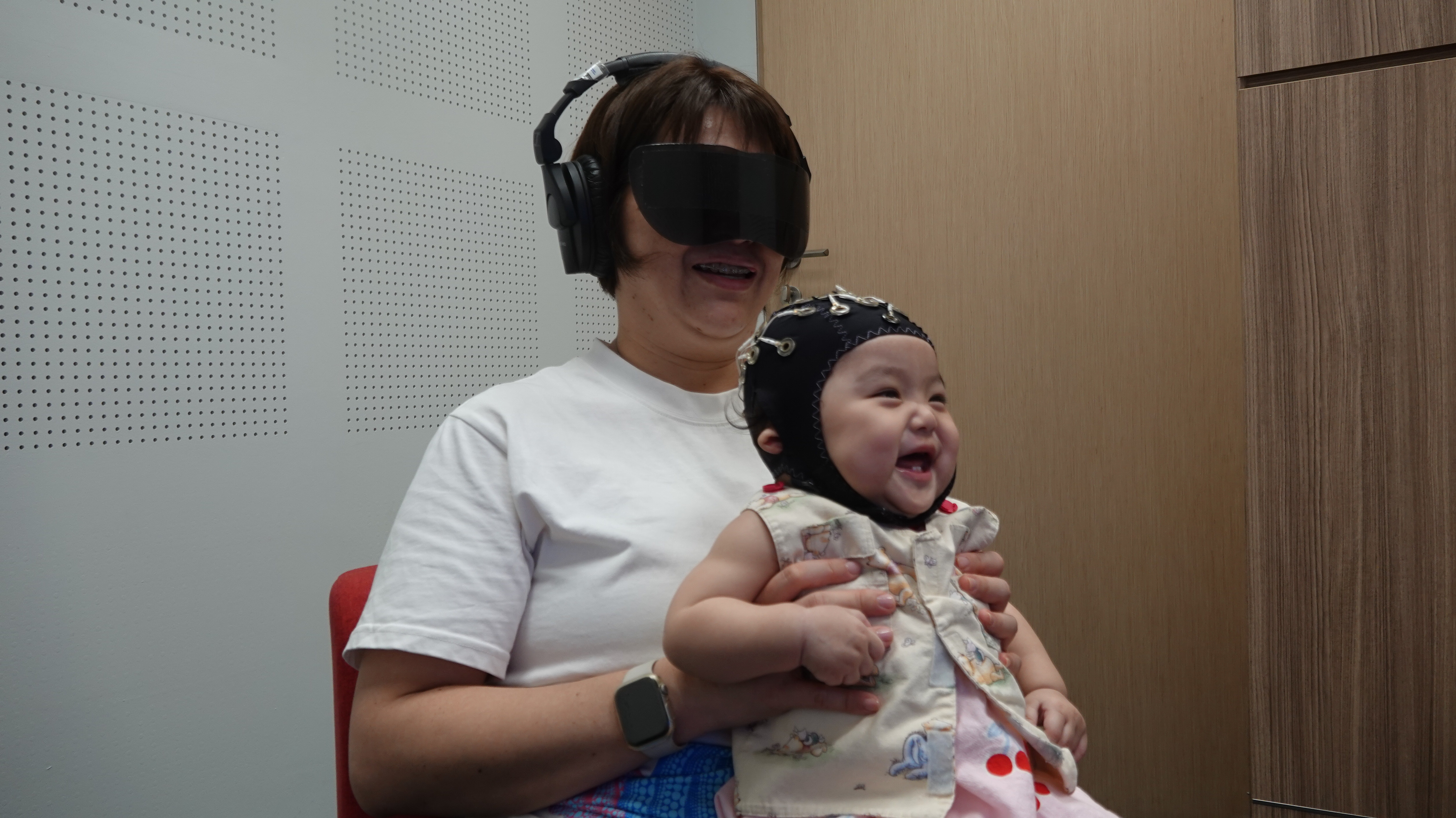
A fleeting moment of eye contact between a baby and a caregiver may be more powerful than we realise. A new study led by Professor Victoria Leong from NTU Singapore's School of Social Sciences (SSS), with lead author and Research Fellow Dr Zhang Wei, in collaboration with researchers from the University of Cambridge, has found that eye contact helps infants tune in to important information by aligning their brain activity with that of a speaker—laying the foundations for early language learning.
The study, involving infants in Singapore and the UK, reveals that babies are not simply passive recipients of information. Instead, they actively use social cues to decide what deserves their attention. When infants could clearly see a speaker’s eyes, their brain activity became more closely connected with the speaker’s, helping them identify and learn from meaningful sounds. The findings suggest that this ability is shared across cultures, highlighting the universal role of human connection in early development.
Published in Nature Communications, the research offers a glimpse into the remarkable ways young minds learn through interaction. Beyond the science, it carries a timely reminder for parents, educators and caregivers: meaningful engagement—whether through eye contact, a familiar voice or simply being present—can help create the conditions for children to learn, connect and thrive.
/ug-town-hall-(header-pic)_updated1.tmb-listing.png?sfvrsn=a0936bc_1)
/58.tmb-listing.jpg?sfvrsn=c98bb35a_1)
749334c4-4609-4705-a4c3-e3100c93f512.tmb-listing.jpg?sfvrsn=a26bd855_1)
-(1200-x-720-px).tmb-listing.png?sfvrsn=cd745b16_1)