
Global Asia Research Centre Seminar by Sayaka Chatani, moderated by Charles Schencking
Rethinking Decolonisation through the Zainichi Korean Experience
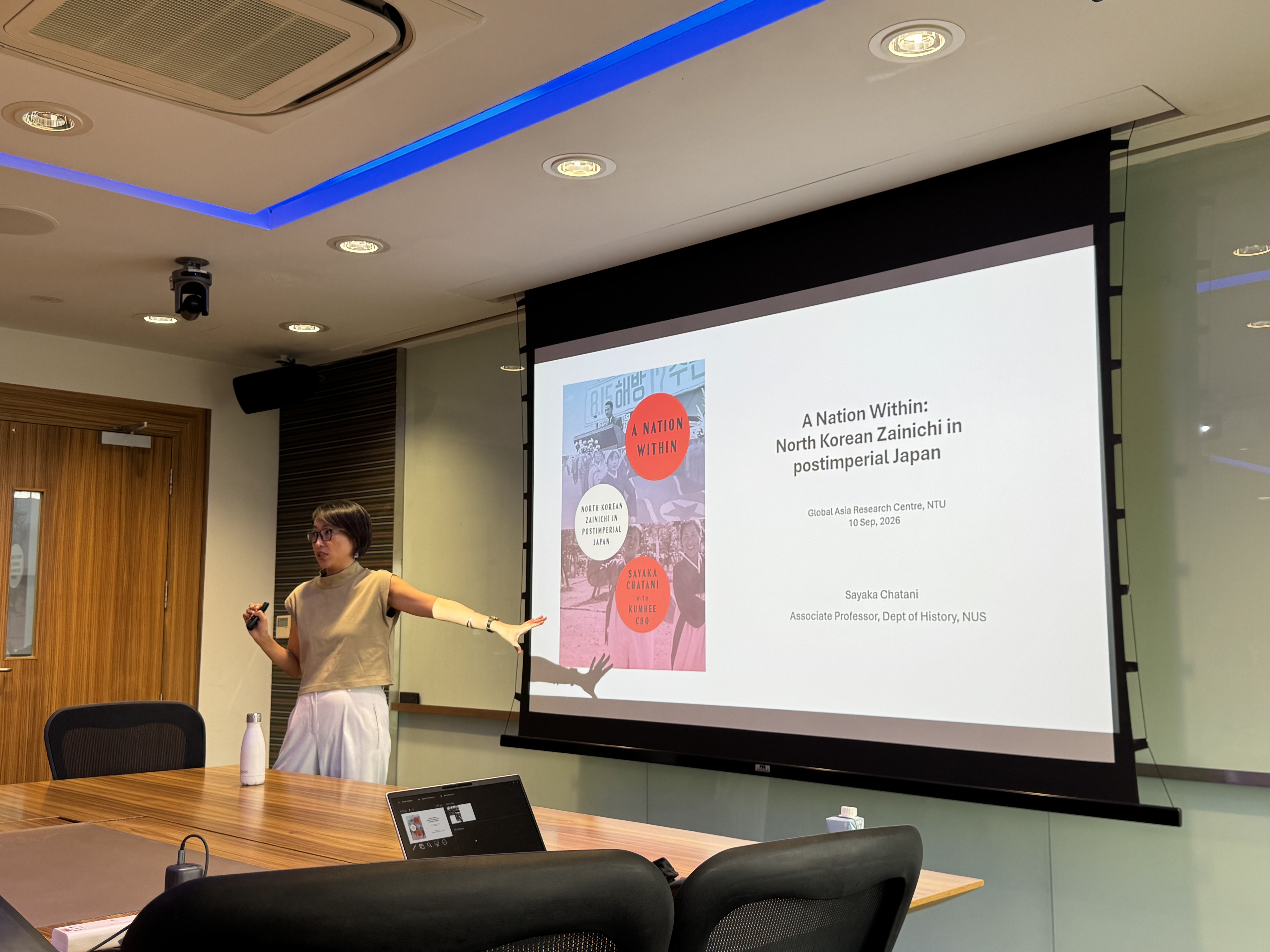
On 10 September 2026, the Global Asia Research Centre (GARC) at NTU College of Humanities, Arts and Social Sciences hosted Dr. Sayaka Chatani, Associate Professor and Deputy Head of the Department of History at the National University of Singapore, for a talk titled A Nation Within: North Korean Zainichi in Postimperial Japan. The session was moderated by Prof. Charles Schencking, of NTU History.
Drawing on hundreds of interviews and archival research, Professor Chatani examined how Korean residents in Japan navigated the complex political and social landscape following the end of the Japanese Empire in 1945. Her talk explored how leftist Koreans pursued decolonisation while remaining in the territory of their former coloniser, and how this process contributed to the formation of a highly organised, state-like community within postwar Japan.
Dr. Chatani began by tracing the experiences of Korean migrants under imperial Japan. Korean residents faced a range of structural challenges, including the consequences of the colonial land survey, famines, restricted access to higher education, discrimination, the massacre of Korean residents following the 1923 Great Kantō Earthquake, assimilationist education and wartime forced labour. These experiences shaped the circumstances in which Korean residents entered the postwar period.
The postwar occupation also brought new tensions. Korean schools were closed amid ideological concerns, while Japanese authorities continued to associate Koreans with notions of danger and backwardness inherited from the colonial period. Against this backdrop, Korean residents began organising themselves politically and socially.
Dr. Chatani examined the emergence of mass organisations within zainichi Korean society, which became important vehicles through which Korean residents articulated political identities and responded to the conditions they faced in postwar Japan. A central argument of the talk was that this represented more than political organisation. Leftist Koreans engaged in what Dr. Chatani described as a massive decolonisation movement, seeking to transform their position from a marginalised minority in Japan into a community with its own collective identity and political aspirations.
Dr. Chatani also turned to the tensions that emerged among the second generation of zainichi Koreans, particularly during the 1960s. These tensions unfolded alongside major developments on the Korean Peninsula and within Chongryon. The period from the late 1960s into the early 1970s saw intense political mobilisation and turmoil across zainichi society, including what Dr. Chatani characterised as a “Cultural Revolution” within Chongryon.
In concluding the talk, Dr. Chatani brought together these different strands to demonstrate how the history of North Korean zainichi Koreans offers a broader perspective on postwar Japan and East Asia. Dr. Chatani’s talk ultimately demonstrated the value of placing the experiences of Korean residents at the centre of discussions about postwar Japan. By examining community formation, political mobilisation, identity and mental geographies, A Nation Within offers a new way of understanding the enduring consequences of Empire and the complex processes of decolonisation in East Asia.
.jpg?sfvrsn=3fd1cfa1_1 "Sayaka Chatani (Group)")
/ug-town-hall-(header-pic)_updated1.tmb-listing.png?sfvrsn=a0936bc_1)
/58.tmb-listing.jpg?sfvrsn=c98bb35a_1)
-(1200-x-720-px).tmb-listing.png?sfvrsn=cd745b16_1)
.tmb-listing.jpeg?sfvrsn=90daddd3_1)