Building resilient cities with safe AI
A €2 million gift from Nemetschek Innovation Foundation will support eight PhD scholarships under NTU's Safe AI in the Built Environment Research Programme, advancing human-centric AI research for more sustainable and socially responsible construction.
Text: Jesmine Ong
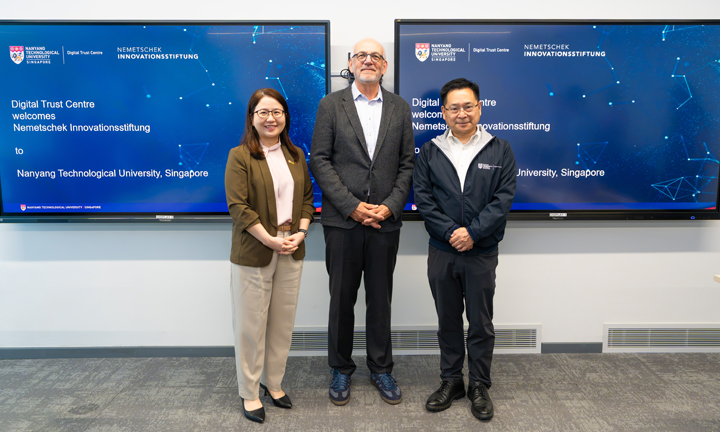 (From left): NTU Chief Development Officer Ms See E’jin, Dr Josef Böck, Member of the Board of the Nemetschek Innovationsstiftung, and Prof Lam Kwok Yan, Associate Vice President (Strategy & Partnerships), NTU, during a visit to Digital Trust Centre.
Imagine a construction project where AI agents work together across design, cost, scheduling and site safety – identifying clashes, resolving issues and coordinating decisions across the project lifecycle.
This future is becoming possible with the rise of agentic AI: systems that can reason, make decisions and act with increasing autonomy. In construction, where AI is already being integrated into Building Information Modelling (BIM) and other digital workflows, agentic AI could improve productivity, reduce costs and enhance safety.
But as AI becomes more autonomous, it also raises new questions around transparency, accountability and data privacy.
At NTU, researchers are exploring how to develop trustworthy agentic AI for construction, ensuring that AI systems can work together effectively while remaining explainable, auditable and aligned with industry standards.
This research is part of the Safe AI in the Built Environment Research Programme, hosted by NTU’s Digital Trust Centre (DTC). The programme focuses on developing AI systems that are explainable, privacy-preserving and robust – enabling safer, more sustainable and more trustworthy use of AI across the construction sector while managing the risks that come with increasingly complex and connected digital systems.
The programme is supported by a €2 million (S$2.9 million) gift from Nemetschek Innovationsstiftung (Nemetschek Innovation Foundation), which will fund eight PhD scholarships and advance scientific research at the intersection of AI, digital trust and the built environment.
“The built environment is one of the most complex systems that AI can be applied to. It involves physics, engineering, human behaviour and the environment, all interacting with one another,” says Professor Lam Kwok Yan, Lead Principal Investigator of the research programme.
“Our goal is to develop AI that is not only powerful, but also reliable, transparent and human-centric. By improving how we design, build and manage our built environment, AI has the potential to enhance construction safety and productivity, reduce project risks and waste, and support better regulatory compliance. Ultimately, we hope to develop solutions that benefit not just industry, but also workers, communities and the environment.”

From AI safety to sustainability
The Agentic AI for Construction project is one of three research areas under the programme. Researchers will develop benchmarks and governance frameworks to ensure that AI agents can coordinate effectively across construction workflows without compromising transparency or accountability.
Another research area explores how AI can reduce embodied carbon in buildings by optimising structural design and tracking emissions throughout a building's lifecycle. Researchers will also apply AI and large language models to prefabricated construction, improving BIM, design optimisation and manufacturing workflows.
A third research area will focus on creating more climate-resilient cities by using physics-informed AI to model urban heat and identify strategies to reduce the urban heat island effect, energy consumption and carbon emissions.
Together, the research projects aim to move AI from the realm of possibility towards practical tools that can improve the way buildings are designed, constructed and operated.
Investing in the people behind the possibilities
The partnership brings together Nemetschek Innovation Foundation's mission to advance digital intelligence for the built environment with NTU's strengths in AI, engineering and sustainability.
“The future of the built environment will be shaped by how we harness digital intelligence to address real-world challenges,” explains Dr Josef Böck, Member of the Board of Nemetschek Innovation Foundation. “We believe that collaboration between academia and industry can make an important contribution to advancing research and innovation, ensuring that new technologies are developed responsibly and translated into solutions that benefit people, society, and the environment.”
The gift marks the Foundation’s first university partnership in Singapore, expanding its network of academic collaboration in Asia and creating opportunities for the exchange of talent and knowledge among Germany, Singapore, and the region.
The future of the built environment will depend on AI that is not only intelligent, but also accountable and designed to serve people. With the support of the Foundation, NTU researchers are advancing the science and developing the talent needed to create more sustainable and liveable cities.