From Vietnam to NTU Singapore: two scholars chasing breakthroughs in diabetes and air travel
With the support of the Vingroup Graduate Scholarship, NTU graduate students Phuong Nam and Nhat Hoang are tackling two different problems: an insulin implant for diabetes and smarter air traffic systems.
Tran Minh Phuong Nam always envisioned himself as an educator, which meant having a PhD was a must to teach at a university level. He wanted to learn from one of the world’s leading universities and experience first-hand what excellence in research looked like.
That aspiration led him to pursue a PhD in Bioengineering at Nanyang Technological University (NTU) Singapore’s School of Chemistry, Chemical Engineering and Biotechnology (CCEB).
The degree is fully funded by the Vingroup Graduate Scholarship, a programme set up in 2019 through a $5 million gift from Vietnamese conglomerate Vingroup Joint Stock Company to support outstanding Vietnamese students pursuing full-time Master's or PhD degrees in Singapore. The scholarship covers tuition, stipends, and other allowances.
Fellow Vietnamese scholar Nguyen Phan Nhat Hoang was awarded the same Scholarship in 2023 and is now pursuing postgraduate studies at NTU’s School of Mechanical and Aerospace Engineering.
“Before receiving the scholarship, studying at a world-class university felt like a distant dream,” says Nhat Hoang, whose research focuses on air traffic management and transportation. “Now, I see myself differently. I feel more confident that someone from a small hometown can stand in an international research environment and contribute to solving meaningful global problems.”
Access to STEM research resources beyond reach back home
The scholarship opened doors to opportunities that deepened Phuong Nam’s technical expertise and expanded his perspective on the role research can play in society.
During his postgraduate studies, he gained access to a wide range of research resources, including biological reagents, that he says marked a noticeable difference from what was available back home. “Some fields and topics are just prohibitively expensive,” he explains.
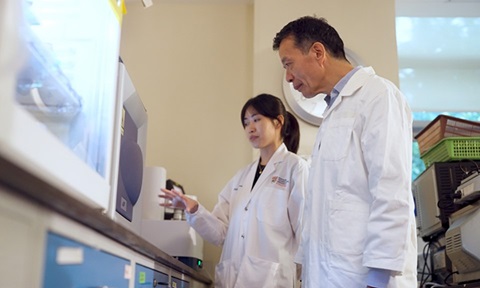
His PhD also brought him into the world of innovation and entrepreneurship through Formacyte Therapeutics, a startup team led by Professor Dang Thuy Tram. The team developed an implant that automatically detects blood glucose levels and releases insulin in response, simplifying the way patients manage diabetes.
Formacyte Therapeutics went on to win multiple innovation and entrepreneurship competitions in Singapore and around the world. Through these experiences, Phuong Nam learned from mentors and gained a deeper appreciation of how ideas move from the laboratory into solutions that benefit society.
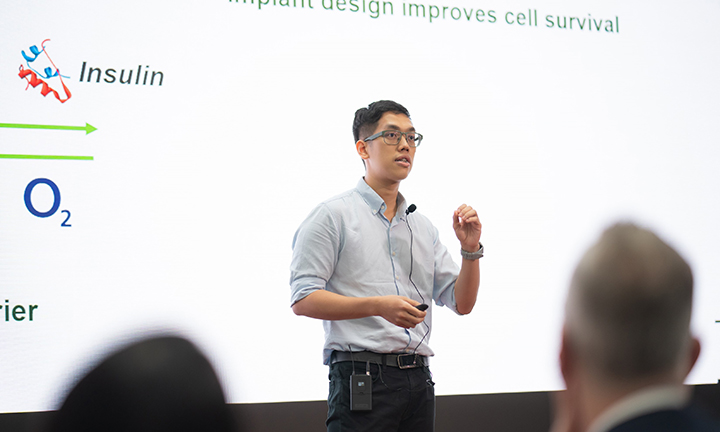 Tran Minh Phuong Nam presenting breakthroughs in diabetes management at the Falling Walls Lab Singapore 2024, a competition for early-career researchers to pitch scientific ideas, hosted by SGInnovate. (Photo: Tran Minh Phuong Nam)
For Nhat Hoang, the scholarship similarly expanded the possibilities of his research. His PhD focuses on integrating AI-assisted systems for better air traffic flow management. Through access to supercomputing facilities, large-scale datasets and collaborations with international researchers, he has taken on more ambitious research problems and explored solutions to increasingly complex transportation challenges.
Nhat Hoang also contributed as a core member of a lab project aimed at improving air traffic management across Asia. “The project helped me see how my research could connect to real-world systems,” he says.
One of his proudest achievements was presenting his research at the Autonomous Agents and Multiagent Systems (AAMAS) 2026 conference. His research explores how collaborative AI systems can better balance the competing needs of stakeholders, including airlines, pilots and airport operators, to address real-world industry challenges.
Today, Nhat Hoang is collaborating with the Civil Aviation Authority of Singapore to apply these findings in developing automated systems for a safer, smarter and more efficient Asia-Pacific airspace.
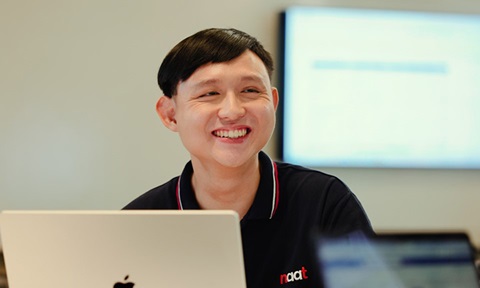
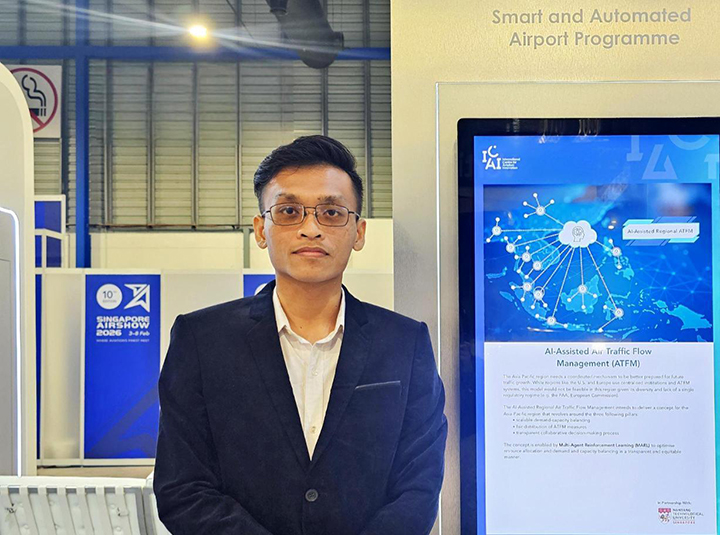 Nguyen Phan Nhat Hoang at Airshow 2026, Asia's largest aerospace and defence exhibition, where he represented NTU as a core member of the University’s project team. (Photo: Nguyen Phan Nhat Hoang)
Empowering young Vietnamese talent
Having completed his PhD at NTU, Phuong Nam has since returned to Vietnam with a renewed sense of purpose: to nurture future innovators and researchers.
Today, he serves as a lecturer at Vietnam National University in Ho Chi Minh City, where he teaches and mentors young scientists.
“My role reminds me of myself a decade ago,” he shares. “I believe a strong nation is built on its people. Teaching is my way of investing in the future of Vietnam, one student at a time.”
Looking ahead, Phuong Nam hopes to advance research in biomaterials and tissue engineering, a field he believes holds tremendous potential to transform healthcare. “The vision and promise of tissue engineering, where we can one day fabricate a human organ or tissue from scratch in the lab, can literally be a cure for many diseases. It can help us eradicate the need to wait for organ transplants, save many lives, and lift a heavy burden. It sounds like science fiction at first, but humanity is getting there, and that future amazes me,” he explains.
Nhat Hoang similarly hopes that his research into intelligent systems for transportation will one day create a tangible and lasting impact. “I realised that AI is most meaningful when it is applied to real-world problems that affect people’s lives,” he says. “Hopefully, my research can help make future transportation systems more efficient, sustainable, and accessible, and eventually contribute to building smarter infrastructure for society.”
He also hopes to contribute to Vietnam’s future development. “I hope to bring back knowledge, experience, and international connections that can support Vietnam’s development and inspire more young Vietnamese students to pursue ambitious dreams,” Nhat Hoang says.