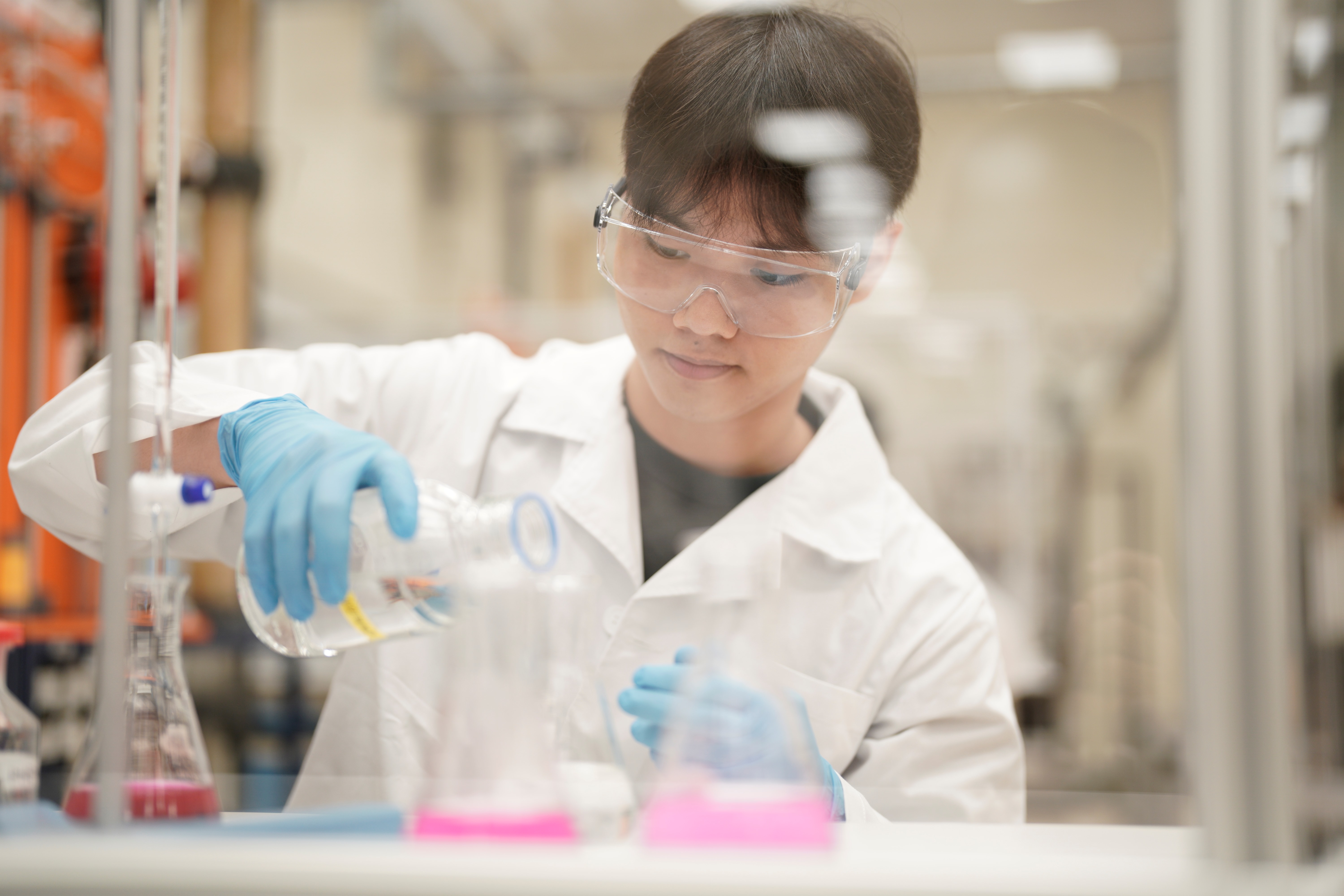
This interdisciplinary programme merges Synthetic Chemistry and Process Engineering, offering students a comprehensive grasp of chemical processes from molecular to industrial scales. It equips them to address complex challenges and foster innovation in manufacturing sectors like pharmaceuticals, petrochemicals, energy, and materials, preparing them for leadership in a dynamic industrial landscape.
In this four-year degree programme, undergraduate students will read both Chemical and Biomolecular Engineering and Chemistry and Biological Chemistry majors. Each major in this programme represents approximately 40% of the overall degree, with the remaining reserved for Interdisciplinary Collaborative Core (ICC). Students will be admitted to this double major programme at the point of admission to NTU. Upon completion, graduates can pursue careers either in chemical manufacturing, such as pharmaceuticals, petrochemicals, energy, and material manufacturing, or in research and development, involving the formulation of novel products and process enhancement, optimisation, as well as exploration of cutting-edge materials within laboratory or research institutions. The curriculum culminates in the practical application of acquired concepts during a Professional Internship and a Final Year Research Project or a Final Year Design Project. Students can also acquire knowledge in areas such as Artificial Intelligence, Big Data, Project Management, and Intellectual Property by taking courses offered within the curriculum.
This is the first interdisciplinary programme in Singapore that combines Synthetic Chemistry and Chemical Engineering, leading to a Bachelor's degree in Engineering Science. The curriculum is carefully designed to bridge scientific understanding and analytical skills with practical engineering applications that focus on sustainability, thus positioning students for leadership roles where they can oversee multidisciplinary projects and remain relevant in the rapidly evolving industrial landscape.
Minimum Subject Requirements
| Qualification | Minimum Subject Requirements |
| Singapore-Cambridge GCE A-Level | H2 Level Pass in Mathematics and H2 Level pass in Chemistry |
| Polytechnic Diploma | Relevant diploma. Click here for more information. |
| International Baccalaureate Diploma | Mathematics at higher level and Chemistry at higher level |
| NUS High School Diploma | Major CAP of 2.0 in Mathematics and Major CAP 2.0 in Chemistry |
| International & Other qualifications | Mathematics at Senior High School level and Chemistry at Senior High School Level |
Please visit the Office of Admission website for more details.
Admission enquiries for local students:
Tel: (65) 6790 5055 or (65) 6790 5972
Email: [email protected]
Admission enquiries for international students:
Tel: (65) 6790 5806 or 6790 5807
Email: [email protected]
The period of study for the Bachelor of Engineering Science in Process Engineering and Synthetic Chemistry (PESC) is four academic years, with the total number of AU required to qualify for graduation is 142/143 AUs.
There are four course types in the curriculum:
Major Requirement - Core Courses (Core)
Core courses are offered throughout the programme of study. They are foundation courses designed to provide essential training in the fundamental of process engineering and synthetic chemistry. In the final year (year 4), students are to choose to do either final year research project (10 AUs) or final year plant design project (8 AUs).
Major Requirement - Major Prescribed Elective Courses (Major PE)
Major PE courses provide students with opportunities to explore specialized areas of process engineering and/or synthetic chemistry in more depth and intensity. The students may select their courses of study according to their own interests and career goals.
Interdisciplinary Collaborative Core (ICC) Requirement
The Common Core courses are specified by the University as being essential to train today's Engineering graduates, covering areas such as communication and environmental sustainability, as well as professional internship (20 weeks).
Broadening and Deepening Electives (BDE)
The BDE requirement is an extended version of the Unrestricted Electives (UE) which accommodates greater diversity of choices that better align with the graduate attributes through more varied forms of curricular, co-curricular as well as experiential learning. Those who choose to do final year research project may take up to 3 BDE modules (8AUs), and those who choose to do final year design project may take up to 4 BDE modules (10 AUs).
Click here for more information on our curriculum:
Curricula | School of Chemistry, Chemical Engineering and Biotechnology (CCEB) | NTU Singapore
With this unique programme combining Chemical Engineering and Chemistry in the Singapore IHL landscape, graduates will have opportunities to choose a wide range of career options in sectors such as but not limited to:
- Pharmaceuticals
- Petrochemicals and Speciality Chemicals
- Materials Development
- Research and Development
- Biotechnology
- Energy and Sustainability
- Consulting
Students can earn minors during their course of study. Minor programmes equip students with multiple skills and broader knowledge, beyond what their major disciplines may provide.
Over 40 subjects are available for Minors. Click here for more information.
71c552b9-56d0-4df7-a4b1-8ea31da180b9.png?sfvrsn=71e9d4da_3)