Two CCDS Students Forge a Path in AI Research at AAAI-26 Undergraduate Consortium
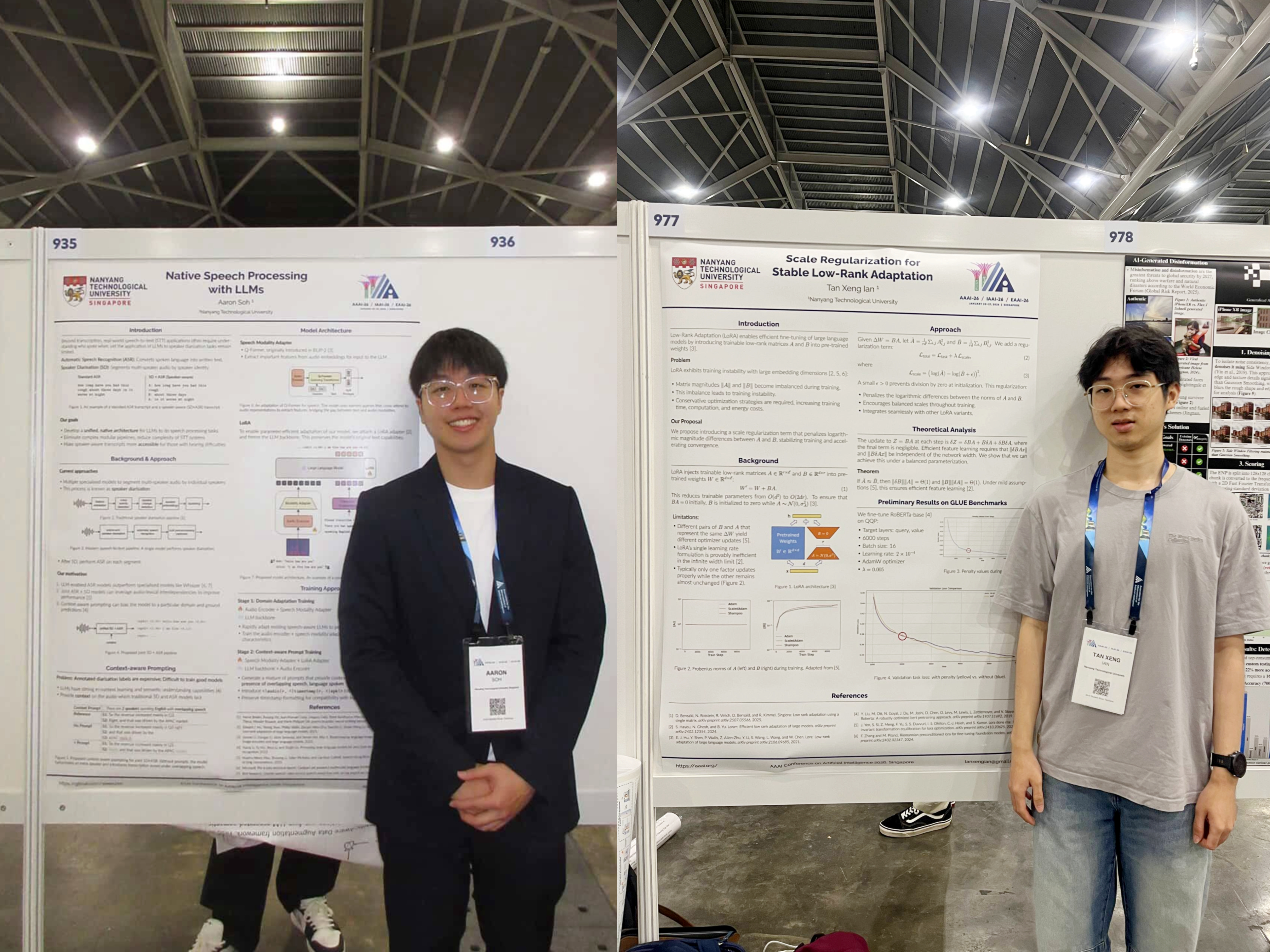
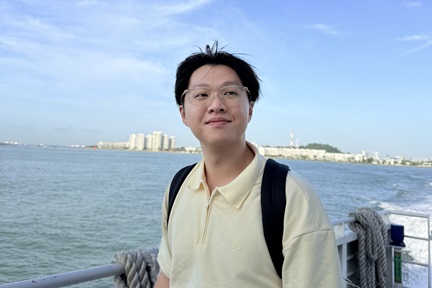
CCDS students Aaron Soh Jun Qi and Tan Xeng Ian with their research posters at the AAAI-26 Undergraduate Consortium
For most university freshmen, the first year is a time for navigating campus life and foundational modules. Not for Aaron Soh Jun Qi and Tan Xeng Ian – their interest in AI research has already propelled them onto the global stage.
The two CCDS Data Science and Artificial Intelligence students were among 22 undergraduates selected worldwide for the 2026 AAAI Conference on Artificial Intelligence (AAAI-26) Undergraduate Consortium, also known as AAAI-UG.
AAAI-UG is a two-day programme where undergraduates have the opportunity to present their research and receive mentorship from senior AI researchers. Like previous years, this year’s programme was held in conjunction with the main conference which took place from 20 to 27 January.
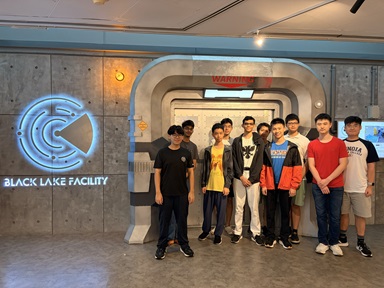
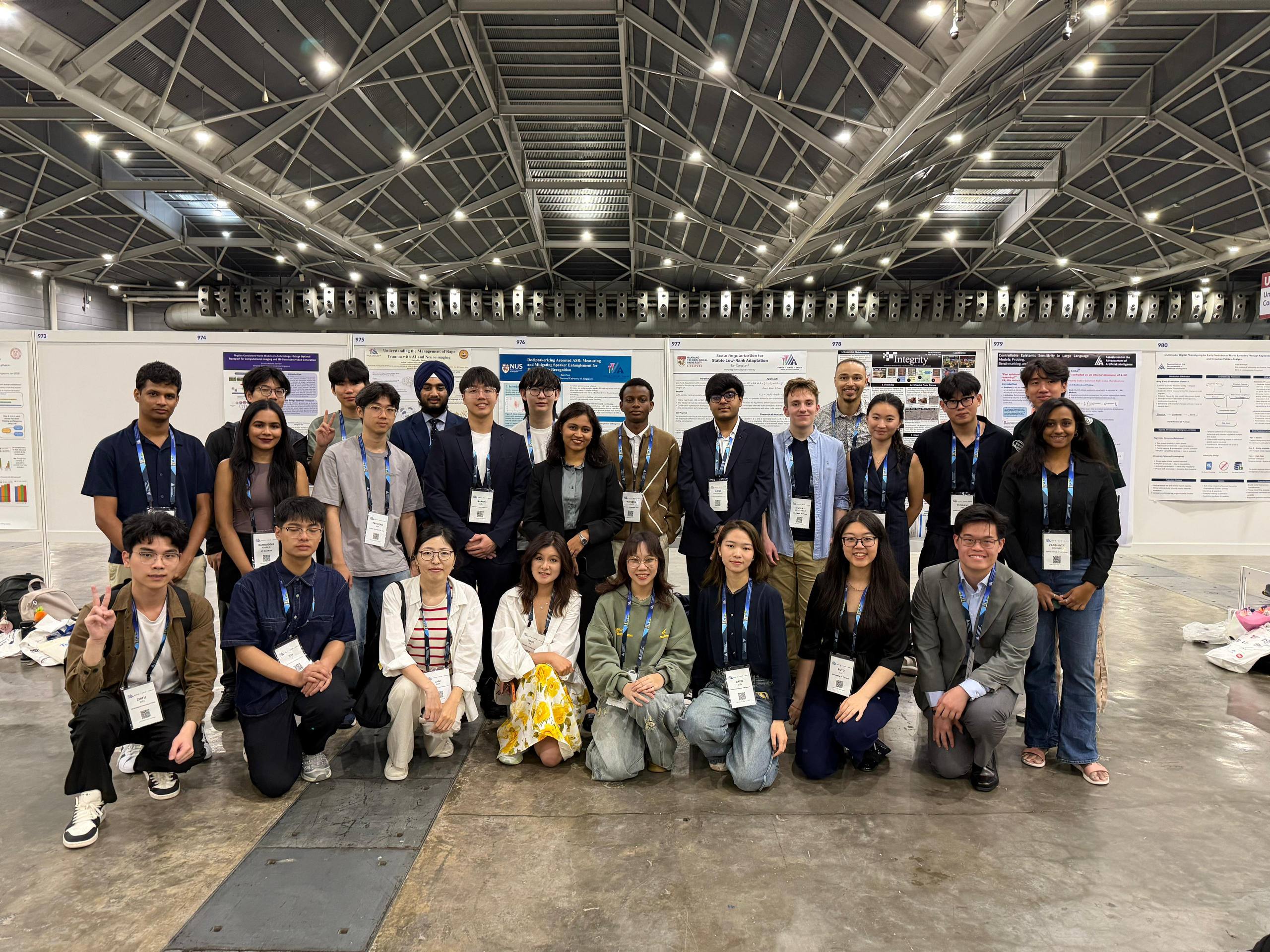 AAAI-UC scholars at the two-day programme
Breaking into AI research
Aaron and Ian knew that the conference would be an important launchpad into high-level AI research, a field they hope to pursue while at NTU. This was why, despite knowing about AAAI-UC only one day before the deadline, they each submitted a two-page research proposal to participate in the programme. This was a platform where they could immerse themselves in the global research community, share their ideas and refine their methodologies.
Aaron’s research proposal focused on integrating speech processing technology with the textual capabilities of large language models, which has potential applications for assistive technology, meeting/lecture transcriptions, and more. Ian’s research proposal focused on investigating methods for stabilising the training of Low-Rank Adapters (LoRA) to enable more efficient model fine-tuning in resource-constrained environments.
Producing the papers were not easy as there were many considerations, according to Aaron and Ian. “I was surprised by how much time, compute, and resources are required to actually conduct research,” said Ian. He shared that his assigned mentor Professor Kai Dong Feng from Yanshan University provided valuable support for his initial submission, after which he still had to make refinements, including the experimental results and revisions to the theoretical justification.
Aaron encountered technical limitations in his research and had to change his paper's focus later, “to be less on the model architecture but more on the approach and how to handle the lack of annotated data, which is expensive to obtain.”
He credited his assigned mentor Wei Tianjun, a research fellow at NTU, for his advice. “My biggest takeaway under his guidance is that before we even begin running experiments, it is important to have a convincing abstract, background and introduction to justify and motivate your reasons for proposing something new in research,” he said.
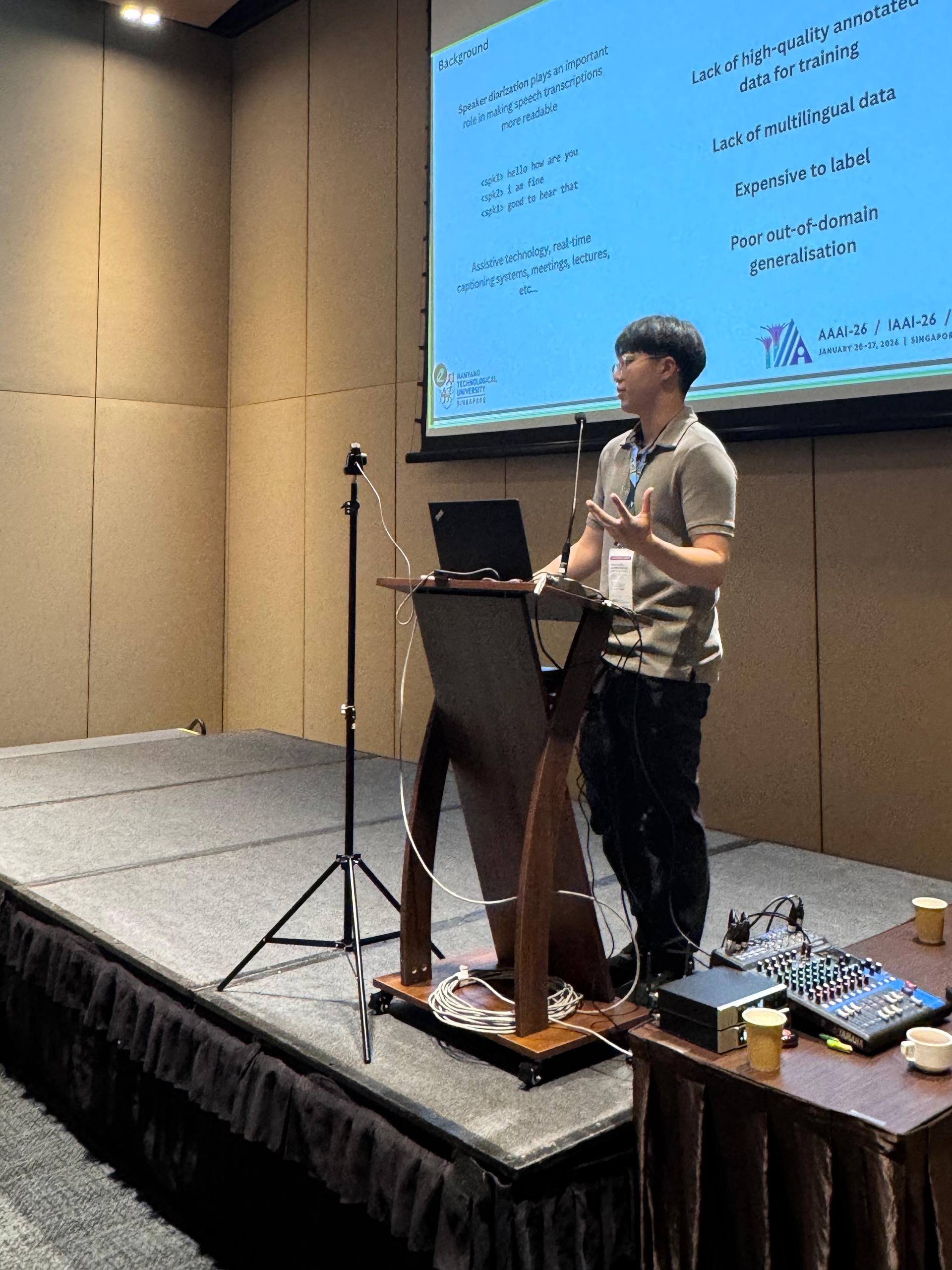
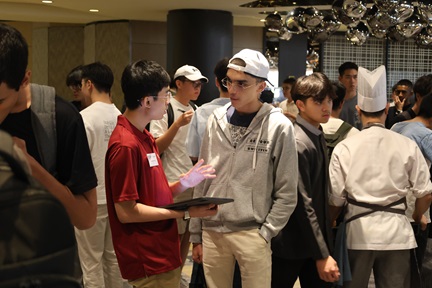
Aaron Soh Jun Qi presenting his research proposal
Room for feedback and improvement
When it came to the presentation, each student was given five minutes to present their research proposal, and one minute for Q&A. Standing as young undergraduates amongst a sea of veteran academics was a profound experience for both of them. Aaron admitted the setting was "pretty scary” but found it rewarding to know that his contributions held weight even among leading experts.
He also received feedback from both academia and industry leaders during the poster session. “Some mentioned that my idea wouldn't work, because they tried something similar before, but they gave advice on what they tried and what they are trying next, which helped me realise a few flaws in my paper,” he said.
Still, he shared that he is now more motivated to continue exploring other fields of AI and expand his knowledge. “Through this conference, I have gained a better understanding on how to conduct research, how to approach a research question and improve my technical writing skills. I also got to meet and share ideas with many other undergraduates from all over the world.”
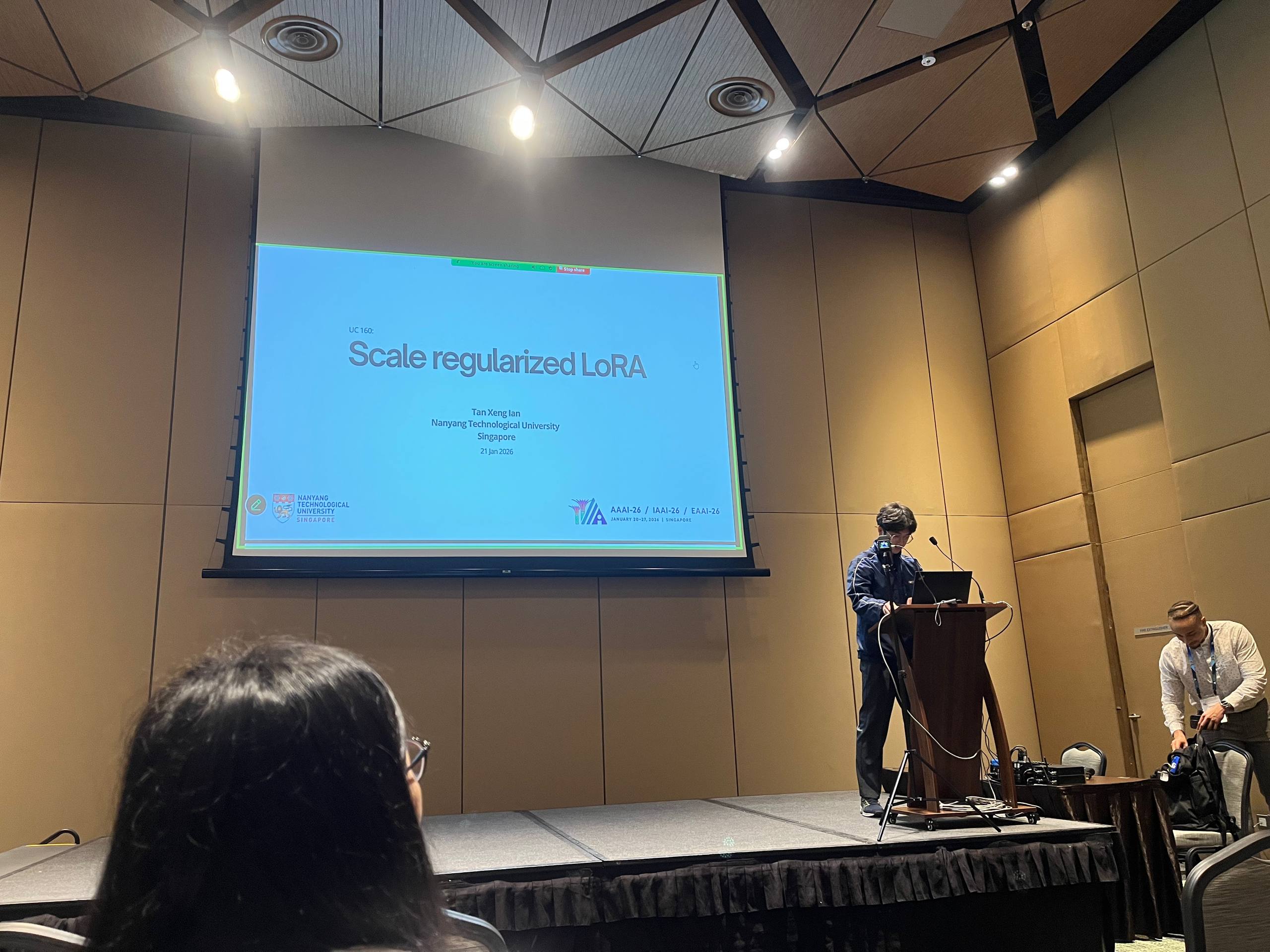
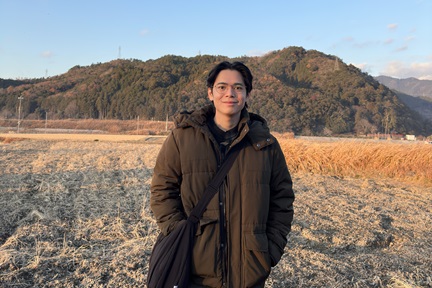
Tan Xeng Ian presenting his research proposal
Ian said that sharing his proposal to an international audience helped reinforce his understanding of his own research. Encountering similar studies even challenged his own assumptions regarding the initialisation of LoRA and prompted him to reconsider aspects of his approach.
“This experience showed me how vital connections are in academia and research,” said Ian. “The enjoyment I found at the conference motivated me to keep learning and to actively seek out new areas of research to explore.”
Looking Ahead
The journey for Aaron and Ian is far from over. They hope to continue their research at NTU, be it in a lab or as part of a team for a project . With a better understanding of the global research landscape, grounded by the supportive ecosystem at CCDS and their mentors, these students have transformed early research ambitions into a promising foundation for future discovery. This engagement reflects CCDS’ ongoing commitment to advancing foundational research and shaping conversations at the forefront of artificial intelligence.