Active Learning in Action: 5 CCDS Projects Bridging the Gap Between Theory and Real-World Application
From Pixels to Path: Autonomous Navigation & Object Recognition
From a gamified sign language app to an AI-driven multi-agent tutoring platform – it’s more than just code and classrooms at CCDS. Undergraduate students are leading the shift with initiatives that use intelligent tools to solve real-world challenges and foster active, hands-on learning.
These five student-led projects, first showcased at NTU Open House 2026, demonstrate CCDS undergrads’ ability to integrate AI responsibly and innovate to deliver intuitive experiences.
1. AlgoGPT – A personal tutor for data structures and algorithms
Presented by Advika Harvande Sandeep (Y4 Computer Engineering [CE]), Balakrishnan Vaisiya (Y2 Data Science and AI [DSAI]), Eva Faith Jie Ting Wong (Y4 Computer Science [CSC]) and Kway Ler Koon (Y2 Computer Science)
The Data Structures and Algorithms module (SC1007) isn’t the easiest to learn, but AlgoGPT aims to make it easier. Currently used by the thousand-strong cohort this semester, the online tutoring platform delivers a tailored learning experience to help students grasp complex concepts more effectively. It leverages on Large Language Models, Retrieval-Augmented Generation, and Cognitive Load Theory to provide personalised support for each user by helping to set goals, track progress, and reflect on what was learned. Upcoming developments include auto generation of both programming and MCQ questions, with more improvements in the works.
AlgoGPT highlights the shift from traditional classroom instruction to a more adaptive, student-led approach to learning. This project empowers students to take control of their educational journeys, using AI-driven technology to enhance their understanding and mastery of challenging concepts.
2. AIView – Helping students prepare for software engineering interviews
Presented by Dominic Lai (Y4 DSAI) and Manoj Siddhanth (Y2 DSAI)
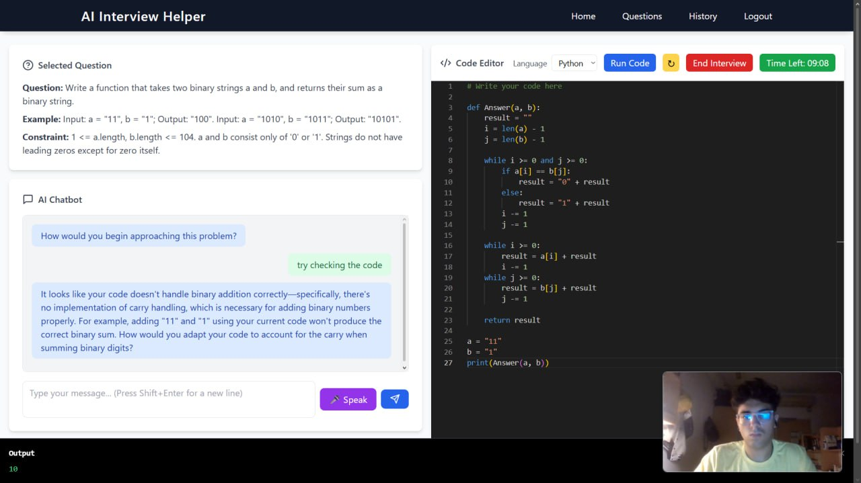
Preparing for job interviews takes time and effort. Browser-based simulator AIView helps software engineering students ace that interview by create a realistic experience that includes voice interaction and personalised question selection.
Built on GPT-4o, LangGraph orchestration, Whisper STT, and Azure Neural TTS, the online tool mimics the fast-paced environment of actual interviews, making it easier for students to practise and improve their skills. As it is voice-enabled and provides feedback, AIView enables students to practise both coding fluency and verbal articulation in a mock interview setting. It adapts the difficulty of questions based on one’s skill level using a curated LeetCode Top Interview 150 list (a collection of most frequently asked technical interview questions).
By offering a hands-on, interactive platform for interview preparation, AIView exemplifies how technology is equipping students with skillsto gain a competitive edge in interviewswithin a dynamic job market. See the demo video here.
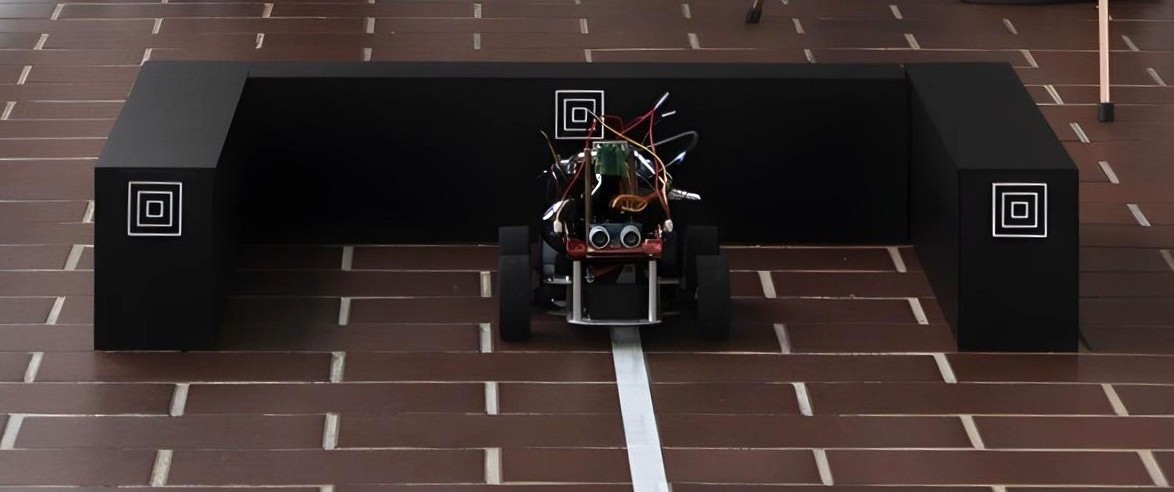
3. From Pixels to Path: Autonomous Navigation & Object Recognition – Integrating hardware, software and AI
Presented by Joshua Tan (Y3 CE), Matthew Tan Yong Han (Y4 CSC), Oh Shuyi (Y4 CSC) and Daniel Koh Xin Shi (Y3 CE)
In the ever-evolving field of AI and robotics, autonomous navigation and object recognition still face many challenges. The "From Pixels to Path" project tackles issues such as wheel slip (which can cause the vehicle to skid or slide), data processing, hardware constraints and real-world noise.
The aim is to navigate unknown terrains and detect visual targets while mapping environments in real-time, all with zero human intervention. The proposed solution utilises advanced pathfinding algorithms like A* and Dijkstra with real-time image recognition. Dynamic decision-making ensures safety through collision avoidance, while the Proportional-Integral-Derivative (PID) controller delivers precise motor adjustments. Sensors give distance and orientation feedback, and efficient energy management powers the system. Fast Wi-Fi enables seamless communication.
More than highlighting engineering problems, the project showcases interdisciplinary learning that allows students to integrate hardware, software, and AI into practical applications.
4. Real-Time Fraud Detection – Improving on traditional fraud/spam detectors
Presented by TAISP scholar Yang Mingchen (Y1 DSAI)
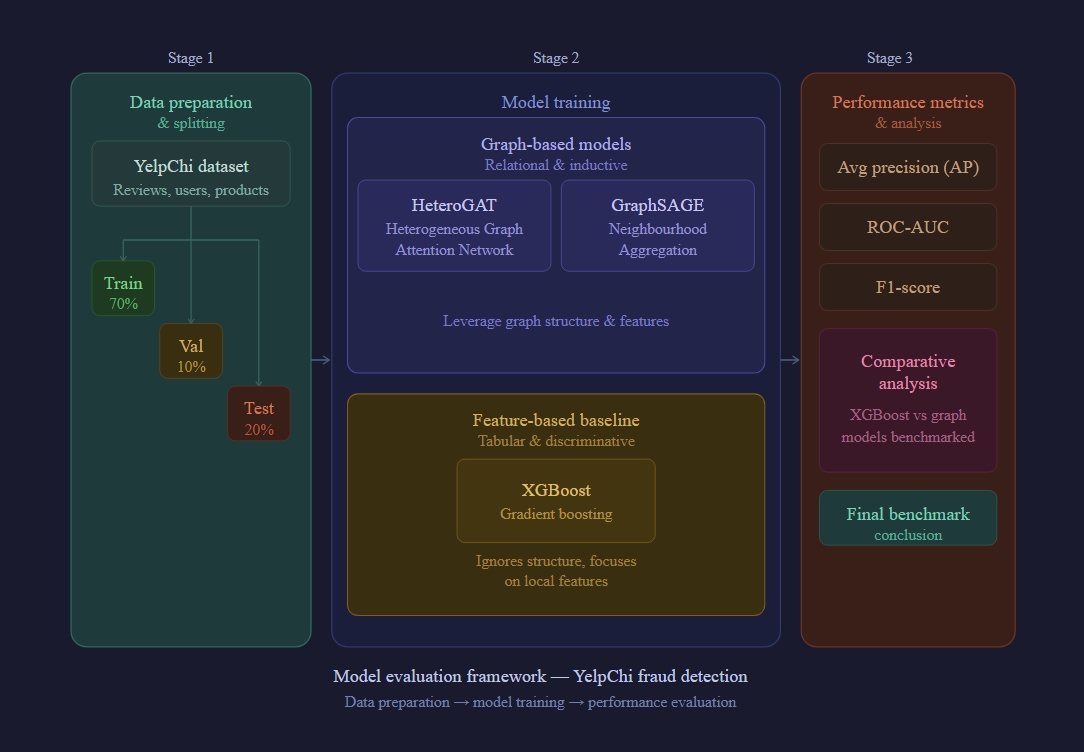
Detecting fake reviews is important for keeping online and offline businesses trustworthy. The Real-Time Fraud Detection project attempts to challenge existing methods to spot fake reviews by investigating if Graph Attention Networks (GATs) – neural network models that analyse complex connections in data – provide a significant advantage over traditional Graph Neural Networks (GNNs).
By mapping relationships and identifying suspicious links between seemingly unrelated accounts, it enhances the detection process. Findings show GNNs are “not a silver bullet for fraud detection” due to certain limitations, and while tools like XGBoost (used in machine learning to make predictions) can achieve high accuracy, future research should focus on combining models and explore new GNN types. While the project is still a proof of concept trained on a single dataset, it opens the door to actionable insights for improving fraud detection system design and solving real-world problems. See the demo here.
5. Signum - Gamified Sign Language Learning
Presented by TAISP scholars Jiang Kai Jie (Y2 DSAI), Chong Su Ying (Y2 DSAI), Lim Kai Lun Axel (Y2 CSC), Tan Dehan (Y2 CSC) and Tan Xue En (Y2 CSC).
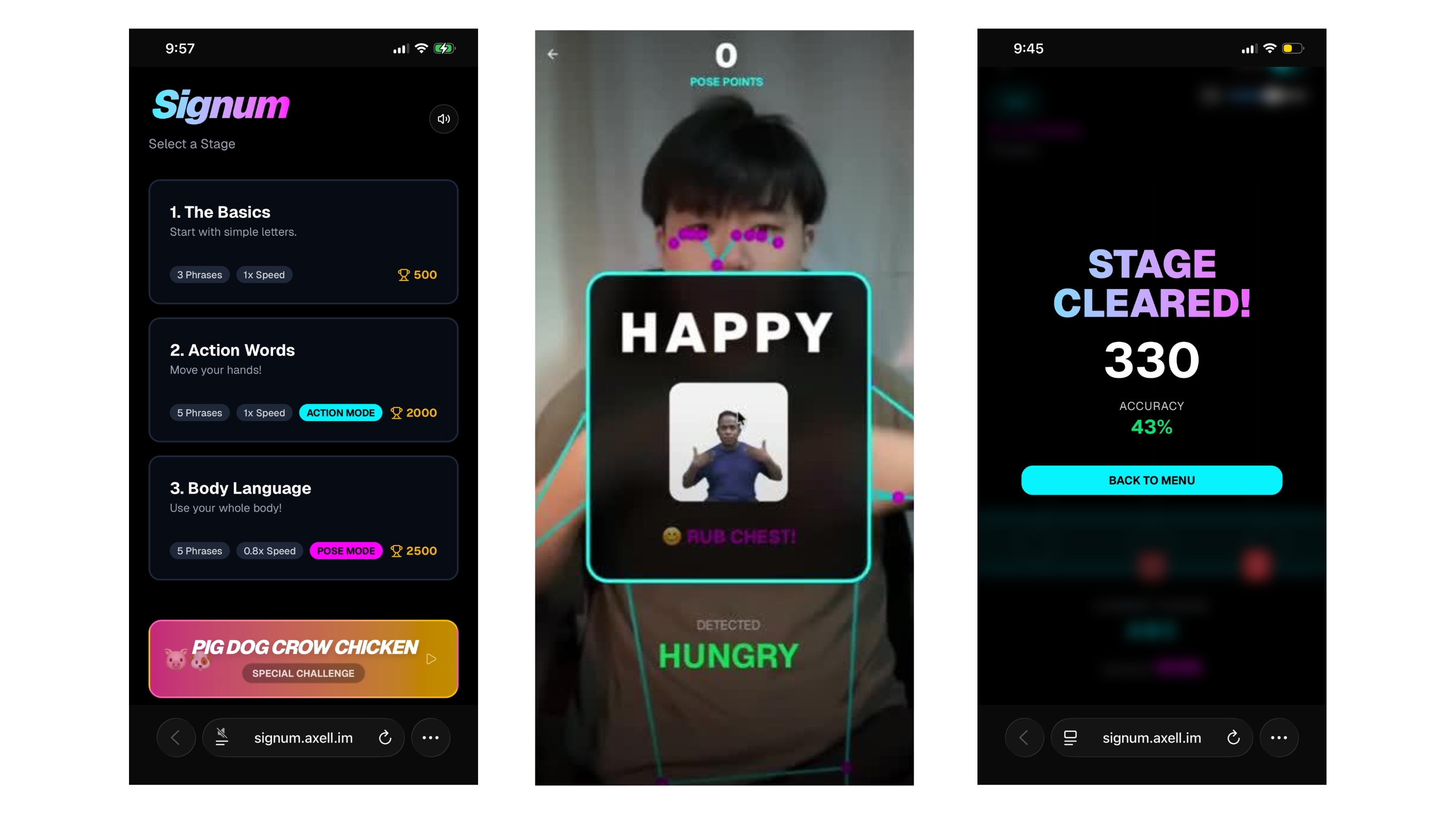
Mobile games like Tap Tap Reborn and Flappy Bird have massive reach, so why not build a game that’s as engaging but with an educational twist? That’s the aim of the team who created Signum, an interactive platform designed to teach basic sign language through gamified mechanics. Developed during the Turing AI Scholar Programme (TAISP) hackathon following the theme “AI For Community”, the tool leverages viral trends, popular games and social media dynamics to make learning sign language accessible and fun for the hearing.
Players advance through various interactive challenges such as making the appropriate hand signs shown on screen within a time limit. Elements such as points and badges motivate players to practice and learn in an enjoyable environment. In an era where engagement is key to effective learning, this project goes beyond teaching sign language by fostering inclusivity and enhancing communication skills through modern digital engagement. Try the game out for yourself here.