China-Africa trade scenarios amid global tariff war
The four possible scenarios
By Rafiq Raji

African countries have been relatively unscathed by unilateral American trade tariffs that US president Donald Trump started imposing since early April 2025. US-Africa trade with Africa is relatively small and has in fact been dwindling.[1] The United States imposed a baseline 10% import tariff in early 2025, with South African exports attracting as much as 30%. In the aftermath, South Africa has chosen a path of engagement with the Trump administration rather than retaliatory tariff measures, with a deal still being negotiated, after the South African president Cyril Ramaphosa met with his American counterpart in May 2025, although net tariffs on its exports to the United States will be higher in sum.[2],[3] There is an African consensus on engagement rather than confrontation with the Trump administration.[4] The future of the African Growth Opportunity Act (AGOA), which allows African countries duty-free access to the US market, is uncertain, even though it comes up for renewal in September 2025.[5],[6]
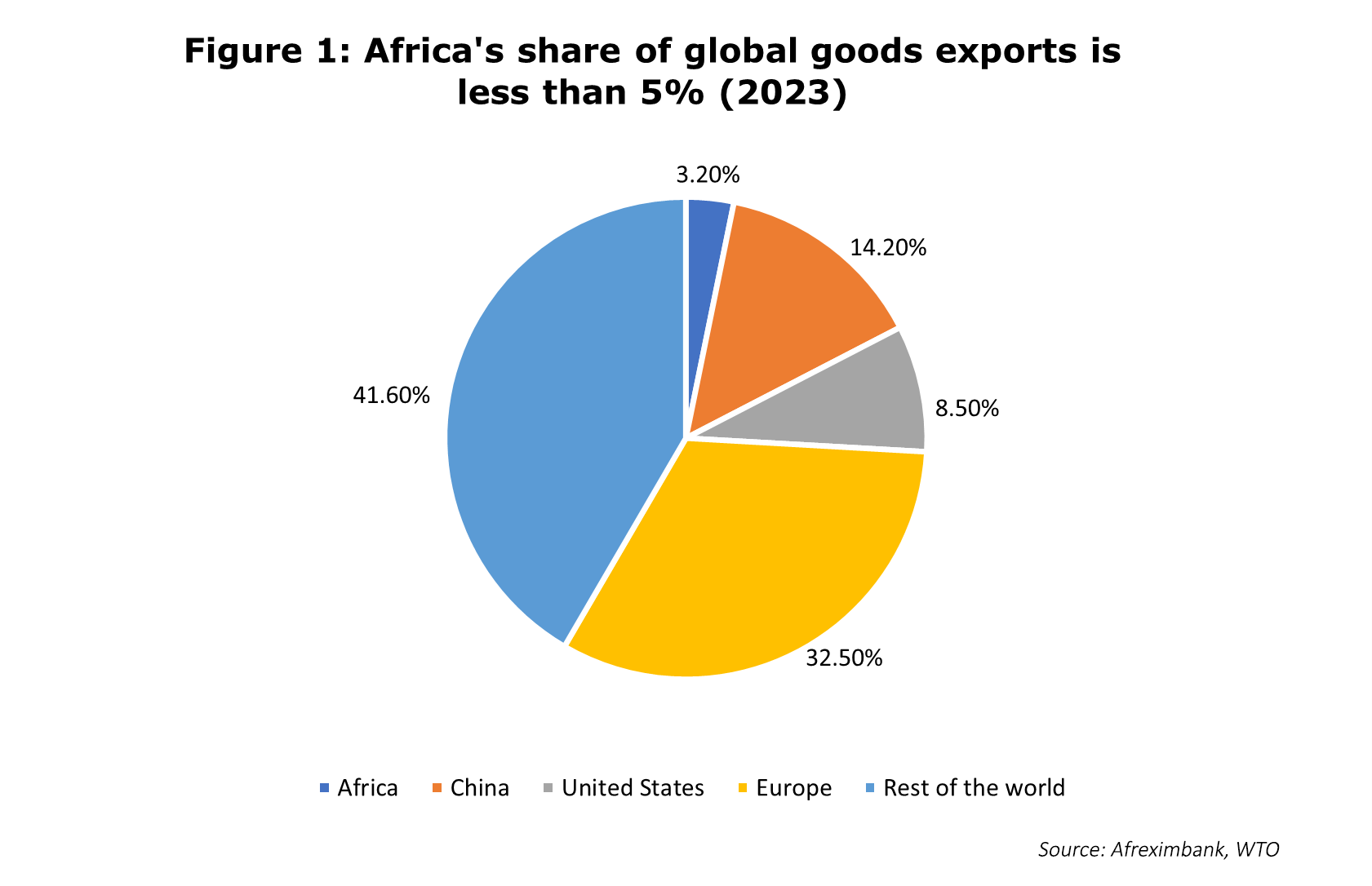 Global trade, which grew by 3.7% year on year to US$33trn in 2024, will face significant turbulence during this rebalancing, with fragmentation in tow.[7] China makes and sells more goods than it buys from the world. The geopolitical implications are beginning to show, as an anxious United States has begun to make desperate and palpably futile attempts to rebalance the global order in its favour.[8],[9],[10] After a 90-day truce was reached in May 2025, trade negotiations between the US and China in early June and subsequent ones will ultimately result in a net increase in tariffs for Chinese goods over pre-April 2025 rates.[11],[12],[13],[14] Chinese manufacturers, which had already started to diversify their portfolios, producing goods in lower cost Asian countries, while also seeking new markets, will broaden and deepen their reach to other markets.[15],[16] African countries could become dumping grounds for Chinese goods. Ideally, they should be manufacturing these goods in the continent. That is, Chinese goods manufactured in Africa for Africans, as well as for exports abroad. Thus, I examine the various scenarios of how China-Africa trade could evolve, in light of continued American disruption to global trade, as well as the imperatives for African governments to ensure imminently deeper Chinese trade relationships are biased in favour of manufactures over commodities.
Africa as a key strategic trading partner for China
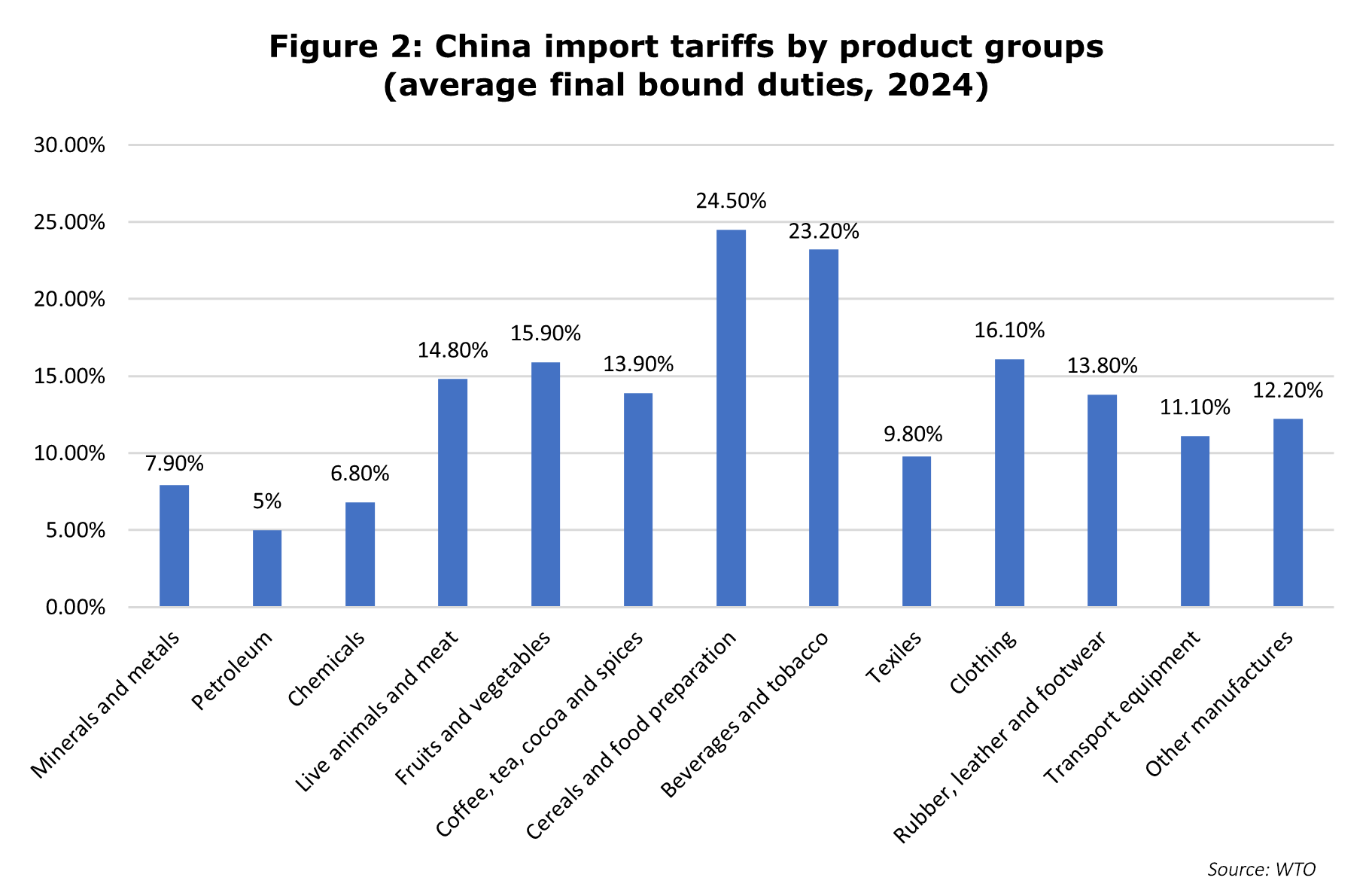
Global trade is effectively being partitioned into two blocs; one led by the United States, and the other by China. Although the economies of both these powers remain intertwined with each other they are starting to peel away. According to the World Trade Organisation (WTO), such bifurcation will result in the shrinking of global GDP by 7%.[17] Africa will be caught in between, with China looking to extract critical minerals and sell manufactured goods, and the US mostly focused on counterbalancing China’s influence. A sweet spot for African countries will be to insist on production over extraction and consumption, one that leads to increased bilateral trade in manufactures. Incidentally, China is already becoming sensitive to its own rising exorbitant privilege, firstly reducing import tariffs on African goods, and has now proposed removing them entirely for all African countries (bar Eswatini, which recognises Taiwan).[18],[19],[20] Naturally, China will expect reciprocity. As Chinese wages rise, China is also ramping up incremental investment in labour-intensive manufacturing in lower cost countries. At home, Chinese firms are moving up the value chain and shifting to high-end manufacturing.
 Exigent circumstances, which have been forced by the Trump administration’s disruption of the global trade system, if backed with policy measures by African governments, will enable more intentional Chinese investment in African manufacturing. Existing mechanisms like the African Continental Free Trade Area (AfCFTA) and Chinese Belt and Road Initiative (BRI) are viable platforms to operationalise a significantly value-adding trade and investment relationship, one where China invests in African manufacturing for onward export to Europe and America, as well as African consumption.[21],[22] Such as in the case of Morocco, Egypt and South Africa. Chinese imports from African countries have also been rising, lately by 6.9% year on year to US$116.8bn in 2024, although these are still mostly unprocessed goods, with the trade deficit remaining stubbornly wide at US$62bn in 2024, from US$64bn in 2023.[23] While Chinese manufacturers have been pivoting to Latin America and Southeast Asia in the face of the American tariff onslaught, some of the surplus have also been drifting towards Europe, a dumping scenario that will also play out in African countries, which have less capacity to pushback.[24]
Africa’s burgeoning population, especially in its youth demographic, offers consumption opportunities for Chinese exporters, who will find using the continent for trans-shipment and dumping hard to resist, with negative implications for the industrialisation ambitions of African countries. An example of the deindustrialisation of African economies from dumping is how cheaper textile imports from China ran Nigerian textile manufacturers out of business.[25] If well-managed, Chinese trans-shipment imperatives could be steered towards enabling African industrialisation ambitions. Chinese manufactures from Africa destined for America and Europe must meet minimum point of origin requirements if they are to avoid the punitive tariffs. There will be net industrialisation gains for the African continent if the incremental Chinese manufacturing investment aim to meet WTO rules, which bar rerouting of goods to cheat on tariffs, but approve cross-border reallocation of manufacturing resources for cost and scale efficiencies, as has been the case for Vietnam and Mexico, which currently serve as transition manufacturing hubs for Chinese exporters.[26] Undoubtedly, African countries are at a potentially positive crossroads of re-globalising trade, and could be key to how China in particular, navigates the likely intractable and sustained tensions with the United States.[27],[28],[29]
The four China Africa trade scenarios
I identify four China-Africa trade scenarios emerging from the ongoing global tariff war. A varying mix of African industrial policy and Chinese manufacturing investment will produce the following scenarios. The first is status quo, a scenario where China continues to sell Africa manufactured goods and buys raw materials resulting in a ever widening trade imbalance. China currently sells US$179bn worth of mostly manufactured goods to Africa, while importing US$117bn worth of raw materials - some of which are used in the making of products that African countries subsequently buy from China. The US$296bn China-Africa trade status quo, which is less than 5% of global Chinese trade of US$6trn, targets African consumption, as well as the extraction of commodities, with investments (via the Belt and Road Initiative, for instance) to support them.
China has excess manufacturing capacity and will be looking to sell its goods to African countries even cheaper. China’s zero-tariff policy may very well enable dumping of Chinese goods if African countries do not push back robustly for a win-win arrangement.[30] Thus, in the consumption scenario, Chinese manufacturing investment remains low despite an enthusiastic African industrial policy push, as exigencies, an imbalance of power in favour of China, and Chinese financial and infrastructural incentives overwhelm subject African countries to allow dumping of cheaper Chinese goods for African consumption. With surplus Chinese manufactured goods in African countries sold cheaply, potential and existing domestic producers will be driven out of business. Indeed, Chinese exports to Africa a full four months before the end of 2025 have exceeded its exports for all of 2020 and are on track to cross US$200bn this year.[31] Chinese automakers have already begun to expand aggressively into African markets, selling both fossil fuel and electric vehicles.[32] At the very least, African governments should push for these vehicles to be assembled on the continent, have a minimum percentage of locally made parts, and these appear to be agreeable to the respective Chinese exporters. What tends to be absent historically is a lack of consistency on the part of African governments, which tend to jump at short-term revenue gains of import-dominant trade liberalisation over long-term economic development benefits of broader export-focused industrialisation.
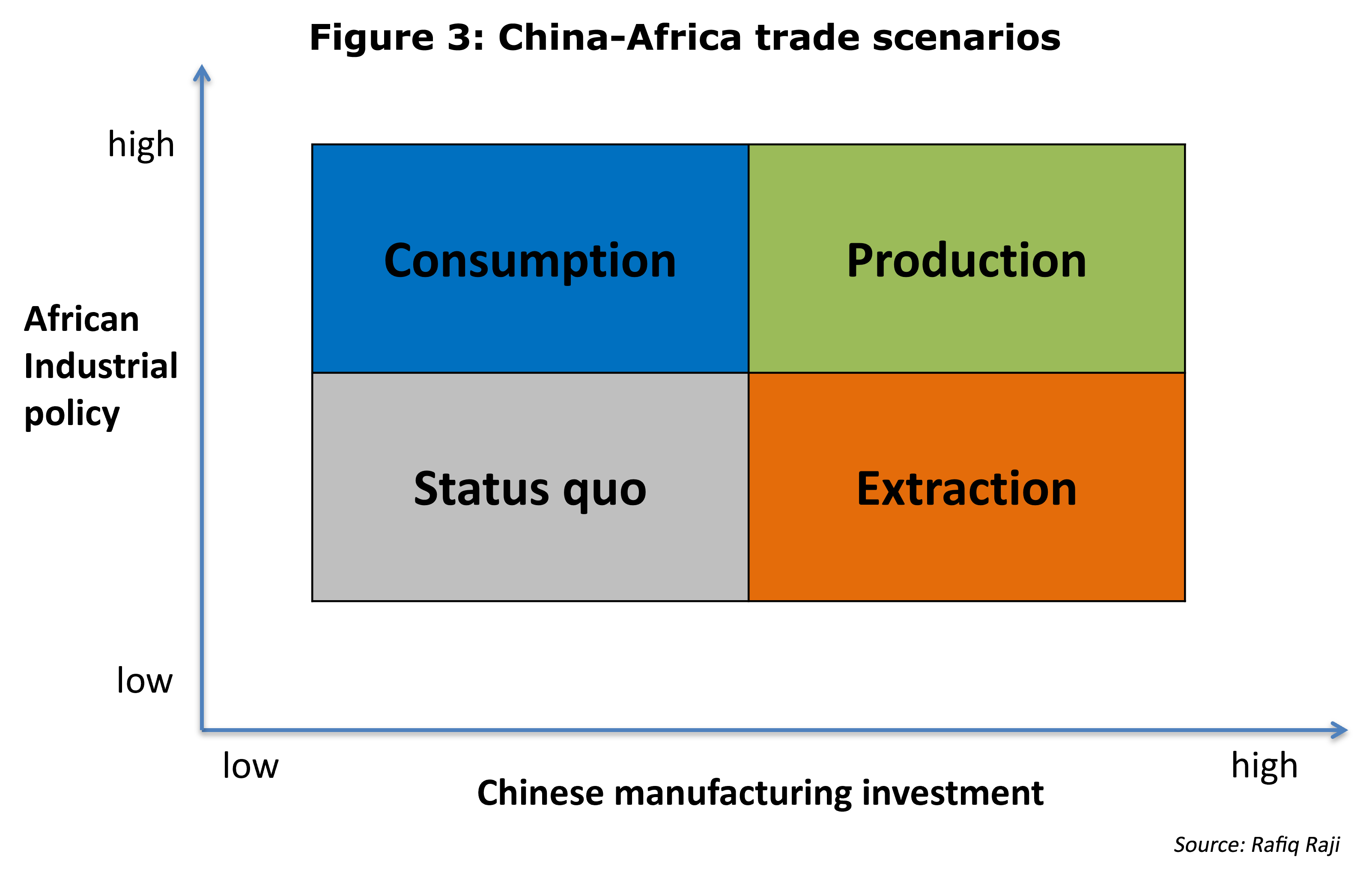 African countries have significant mineral resources crucial to the development of emerging global technologies for climate action and digitalisation - from electric vehicles, solar power infrastructure, to metals for machinery. Continued Chinese investment in African raw materials, which has been rising for a while, and was set to continue growing regardless of the United States’ disruption to global trade, which is partly motivated by Chinese dominance of the African minerals trade, is the extraction scenario, whereby African countries exchange higher Chinese investment in mineral extraction for limited pushback on more local value addition. African manufactures historically face higher tariffs globally, whereas its extracted raw materials are taxed less, thus incentivising extraction over production, which has led to the continent’s gradual deindustrialisation.[33] That some of the key policy-based imbalances in the China-Africa trade dynamic, particularly the disproportionately high tariffs on African manufactures by China, will now be reviewed, since the broadening and deepening of China’s export markets have become a necessity, is a potential upside of the global trade war for Africa’s industrialisation ambitions.
The production scenario, which is the crux of this article, is a confluence of a strong African industrial policy push and Chinese manufacturing investment to match, leading to an incrementally expanding African industrial base that serves the intra-African as well as international trade goals of both China and Africa. In this scenario, Chinese firms invest in the production of manufactured goods from extracted raw materials, both on the continent, establishing assembly plants for midstream goods for onward exports, transshipment, and intra-African trade, as well as upstream processing that plugs into global value chains, especially the budding green industrial complex. Like their southeast Asian counterparts, African countries could be viable so-called “connector economies” for Chinese firms looking for the most cost-effective route to western markets, especially the United States.[34] Vietnam, where Chinese firms are increasingly trans-shipping from, will face 40% American tariffs for goods that the US determines to have been trans-shipped.[35] African countries could benefit from the forced value-add that Chinese firms must invest in to avoid such punitive measures, if and when they compare favourably on all the other benchmarks that make Vietnam and others competitive. The AfCFTA framework, Free Trade Zones (FTZs), BRI, as well as other supporting incentives and institutions, could be effectively synergized to enable this outcome. If implemented in good faith, China’s planned zero-tariff policy is potentially a key enabler, although a likely expectation of reciprocity will be a weighing factor, as African industrial policy measures, which will require some trade restrictions, will be key success factors for African industrialisation goals.
(This piece was inspired from the article What could be the fall out of the US tariffs on Africa? by Amit Jain, Director of the NTU-SBF Centre for African Studies)
References
[1] Jain, A. (2025, April 4). What could be the fall out of the US tariffs on Africa? Nanyang Business School. https://www.ntu.edu.sg/cas/news-events/news/details/what-could-be-the-fall-out-of-the-us-tariffs-on-africa
[2ii] Dludla, N. & Acharya, B. (2025, April 4). South Africa not planning to retaliate over Trump's tariffs. Reuters. Retrieved from https://www.reuters.com/world/africa/south-africa-says-trumps-tariffs-effectively-nullify-agoa-benefits-2025-04-04/
[3] Maclellan, K. et al. (2025, May 21). South Africa’s Ramaphosa and Trump’s testy meeting – as it happened. Reuters. Retrieved from https://www.reuters.com/world/ramaphosa-trump-meeting-live-musk-starlink-deal-afrikaner-refugees-focus-2025-05-21/
[4] Ryder, H., Lwere, T. & Eguegu, O. (2025, April 8). How Should Africa Respond to Trump’s New Tariffs? Center for Strategic and International Studies. Retrieved from https://www.csis.org/analysis/how-should-africa-respond-trumps-new-tariffs
[5] Monteiro, A. & Parker, A. (2025, June 6). Can Africa’s AGOA trade deal survive Trump? Bloomberg. Retrieved from https://www.bloomberg.com/news/newsletters/2025-06-06/next-africa-can-the-agoa-trade-deal-with-the-us-survive-trump
[6] Prinsloo, L. & Hlakudi, M. (2025, April 10). US-Africa Trade Pact Looks Bleak But Talks Due by July, Tau Says. Bloomberg. https://www.bloomberg.com/news/articles/2025-04-10/us-africa-trade-pact-looks-bleak-but-talks-due-by-july-tau-says
[7] UNCTAD (2025, March 14). Global trade in 2025: Resilience under pressure. Retrieved from https://unctad.org/news/global-trade-2025-resilience-under-pressure
[8] Bade, G. & Schwartz, B. (2025, April 15). U.S. Plans to Use Tariff Negotiations to Isolate China. Wall Street Journal. Retrieved from https://www.wsj.com/politics/policy/u-s-plans-to-use-tariff-negotiations-to-isolate-china-177d1528
[9] Leahy, J. (2025, April 21). Beijing warns countries not to act against China in trade deals with US. Financial Times. Retrieved from https://www.ft.com/content/d3b4ec1b-671f-4287-8cf4-4d10028ccdbb
[10] Le, L. (2025, April 18). Why Vietnam is in the middle of the U.S.-China trade war. Rest of World. Retrieved from https://restofworld.org/2025/vietnam-manufacturing-tariffs-china-us-trade-war/
[11] Politi, J. (2025, June 6). Donald Trump says US-China trade talks to be held in London on June 9. Financial Times. Retrieved from https://www.ft.com/content/a7ed9011-cf49-4f11-a0d3-2216835da0be
[12] The White House (2025, May 11). U.S. Announces China Trade Deal in Geneva [Press release]. Retrieved from https://www.whitehouse.gov/articles/2025/05/u-s-announces-china-trade-deal-in-geneva/
[13] Beattie, A. (2025, May 12). Trump’s China deal leaves world exposed to trade policy lottery. Financial Times. Retrieved from https://www.ft.com/content/c8fe61d5-248d-4ea5-a476-ae92e74bd0bc
[14] Jackson, L. (2025, May 12). What's in China-US trade deal? Tariff cuts and key details. Reuters. Retrieved from https://www.reuters.com/world/what-have-china-united-states-agreed-geneva-2025-05-12/
[15] Bicker, L. (2025, May 14). China-US trade: Firms in Guangdong welcome 'ceasefire' but look to diversify. BBC. Retrieved from https://www.bbc.com/news/articles/cy8d9ygd4yqo
[16] Bicker, L. (2025, May 14). China-US trade: Firms in Guangdong welcome 'ceasefire' but look to diversify. BBC. Retrieved from https://www.bbc.com/news/articles/cy8d9ygd4yqo
[17] World Trade Organization (2025, April 9). Statement of the Director-General on escalating trade tensions [Press release]. Retrieved from https://www.wto.org/english/news_e/news25_e/dgno_09apr25_e.htm
[18] Cotterill, J. (2025, April 29). Emerging markets set to become battlegrounds in trade war. Financial Times. Retrieved from https://www.ft.com/content/ff1f35b9-2ccf-4247-9bcd-a9c931b63c5b
[19] Byamungu, C.G. (2025, January 24). The Persistent China-Africa Trade Imbalance — Is It China’s Fault? China Global South Project. Retrieved from https://chinaglobalsouth.com/analysis/the-persistent-china-africa-trade-imbalance-is-it-chinas-fault/
[20] Miriri, D. (2025, June 12). China says it will remove all tariffs on African exports to boost trade. Reuters. Retrieved from https://www.reuters.com/world/africa/china-says-it-will-remove-all-tariffs-african-exports-boost-trade-2025-06-12/
[21] Munyati, C. (2024, June 25). Why strong regional value chains will be vital to the next chapter of China and Africa’s economic relationship. World Economic Forum. Retrieved from https://www.weforum.org/stories/2024/06/why-strong-regional-value-chains-will-be-vital-to-the-next-chapter-of-china-and-africas-economic-relationship/
[22] Calabrese, L. (2024, September 16). African free trade pact gives China a chance to deepen its engagement. ODI Global. Retrieved from https://odi.org/en/insights/african-free-trade-pact-gives-china-a-chance-to-deepen-its-engagement/
[23] Nyabiage, J. (2025, January 17). China’s Africa imports rise, but will 2025 headwinds halt the continent’s trade gains? South China Morning Post. Retrieved from https://www.scmp.com/news/china/diplomacy/article/3295069/chinas-africa-imports-rise-will-2025-headwinds-halt-continents-trade-gains
[24] Mayger, J. & Horobin, W. (2025, May 15). US-China Trade Clash Risks Making Europe Dumping Ground for Cheap Goods. Bloomberg. Retrieved from https://www.bloomberg.com/news/articles/2025-05-15/trump-tariffs-us-china-trade-war-exposes-europe-to-wave-of-cheap-goods
[25] Mohammed, H.S. (2025, March 21). How Nigeria lost its textile market to Chinese imports. DW. Retrieved from https://www.dw.com/en/how-nigeria-lost-its-textile-market-to-chinese-imports/a-72000508
[26] Langley, W., Uddin, R. & Jung-a, S. (2025, May 4). Chinese exporters ‘wash’ products in third countries to avoid Donald Trump’s tariffs. Financial Times. Retrieved from https://www.ft.com/content/147fddbb-7031-4347-9251-4425614e138d
[27] Gopaldas, R. (2025, April 29). African role in shaping new global trade corridors. Nanyang Business School. Retrieved from https://www.ntu.edu.sg/cas/news-events/news/details/african-role-in-shaping-new-global-trade-corridors
[28] Peltier, E. (2025, May 20). U.S. Says It Wants Trade, Not Aid, in Africa. Cuts Threaten Both. New York Times. Retrieved from https://www.nytimes.com/2025/05/20/world/africa/us-africa-foreign-assistance.html
[29] Usman, Z. & Xiaoyang, T. (2024, May 30). How Is China’s Economic Transition Affecting Its Relations With Africa? Carnegie Endowment for International Peace. Retrieved from https://carnegieendowment.org/research/2024/05/how-is-chinas-economic-transition-affecting-its-relations-with-africa?lang=en
[30] Reuters (2025, June 11). China, Africa ask US to return to 'right track' on trade differences. Retrieved from https://www.reuters.com/world/china/china-africa-ask-us-return-right-track-trade-differences-2025-06-11/
[31] Bloomberg (2025, Aug 27). Africa sees surge in China exports shunned by US
[32] Dludla, N. (2025, June 26). Facing global headwinds, Chinese automakers make a play for Africa. Reuters. Retrieved from https://www.reuters.com/business/autos-transportation/facing-global-headwinds-chinese-automakers-make-play-africa-2025-06-26/
[33] UNCTAD (2025). Global Trade Update (March 2025): The role of tariffs in international trade. Retrieved from https://unctad.org/publication/global-trade-update-march-2025
[34] Foster, P., Borrett, A., Reed, J. and Bounds, A. (2025, July 6). China reroutes exports via south-east Asia in bid to dodge Trump’s tariffs. Financial Times. Retrieved from https://www.ft.com/content/d3941234-2eeb-476c-9a8c-249a35c8b7fa
[35] Jiao, C., Heijmans, P., and Dmitrieva, K. (2025, July 3). Trump aims to shut down loopholes China uses to evade tariffs. Bloomberg. Retrieved from https://www.bloomberg.com/news/articles/2025-07-03/trump-aims-to-shut-trade-loopholes-china-uses-to-evade-tariffs