The State of Artificial Intelligence (AI) in Africa
Centre Director Amit Jain lays out the digital landscape of the continent.
By Amit Jain

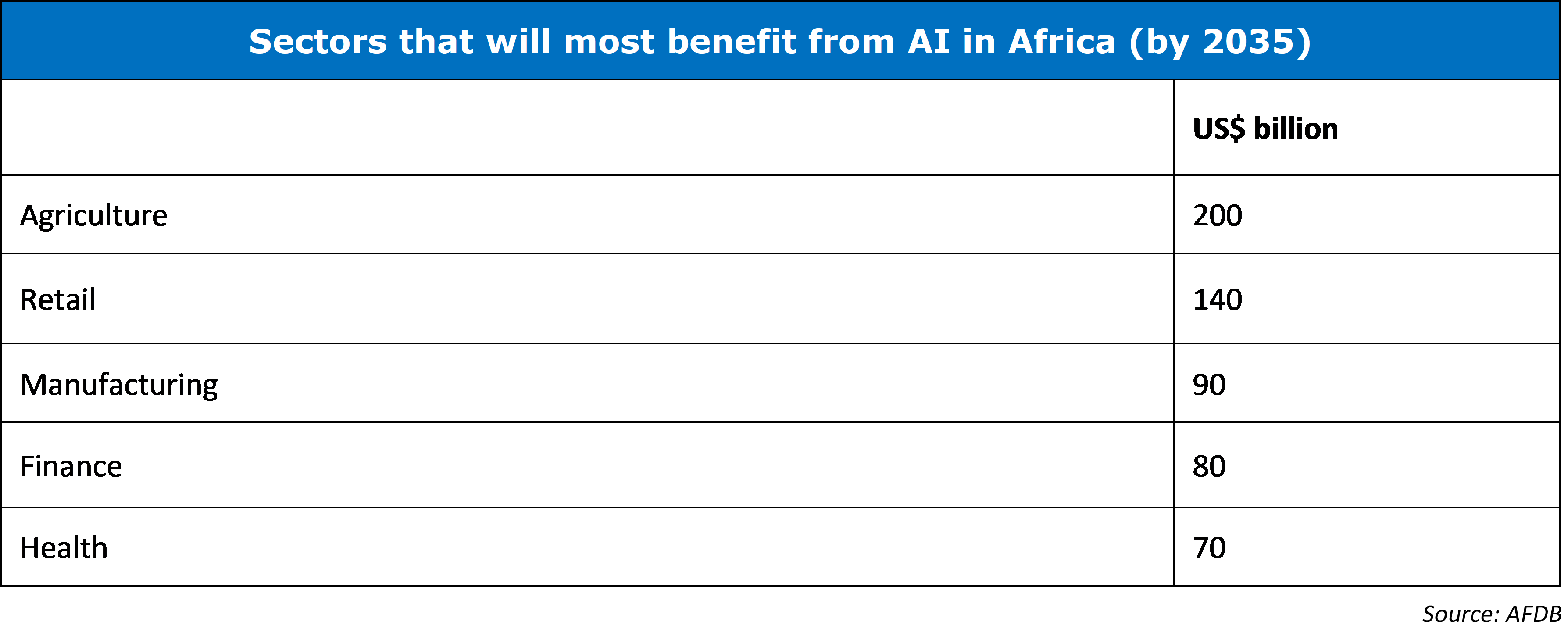
Artificial intelligence (AI) is set to work as a catalytic force in the economic and social transformation of Africa. While the continent is not yet a major global centre of frontier AI model development, AI adoption is accelerating through applied use cases in agriculture, health, finance, logistics, and public services. According to the African Development Bank (AFDB) AI could add up to US$1 trillion to the African GDP and create 40 million jobs by 2035. Even on a less optimistic growth trajectory, the bank predicts, that AI will add at least US$250 billion to the African GDP by 2035. Although starting from a low base Africa is projected to experience the fastest growth in AI spending globally, reaching US$6.4 billion by 2026. Opportunities for business are greatest in Africa, where both the private and public sectors can come together to formulate AI solutions in the sectors below.
 There have been AI innovations coming out of Africa in recent years. It should be noted that over US $500 million has been raised by African AI startups since 2021. In Nigeria, a chatbot called Kudi AI extends financial services to underserved communities. A similar chatbot in South Africa called MomConnect, connects 1.8 million expectant mothers with pre-and post-natal services. Google AI lab has worked with farmers in rural Tanzania to create a machine-learning application Nuru to diagnose early onset of cassava plant diseases. The app works directly on mobile phones even without internet connectivity and prompts them to take early intervention measures by quickly identifying the onset of the disease. In South Africa MySmartFarm, Aerobotics, Drone Clouds, and FarmDrive are using AI-enabled technologies to diagnosis plant disease, make price prediction, and access financial services. Ghanian engineering company Bace Group has developed AI facial recognition software that is good at identifying black African faces. By using a more diverse dataset, their software minimises bias that is common among Western developed AI models. Kenyan startup firm Amini collects and curates farm level environmental data. Zindi, a South African data science competition platform is exploring edge computing to enable AI model training and inference on devices at the edge, reducing reliance on cloud infrastructure. Edge computing can reduce latency and lower bandwidth costs in low connectivity areas, while maintaining the data privacy. Ethiopian startup Gebeya has come up with AI-powered digital agents tailored for African businesses. The technology is designed to automate customer engagement, support operational decision-making and reduce costs for enterprises operating in fast-growing and often fragmented markets. By embedding AI-driven tools into day-to-day operations, Gebeya aims to help businesses transition from informal workflows to structured systems that can support regional expansion and participation in cross-border trade.
 Centre Director Amit Jain discusses the pros and cons of the Indian model of Digital Public Infrastructure and its applicability for African countries at the Observer Research Foundation in the UAE.
When it comes to AI readiness, Africa lags Asia on almost all counts. The 2022 Government AI readiness Index shows that sub-Saharan Africa (SSA) has the lowest average digital skills index score (29.38) in the world. North Africa is much higher (38.59), but collectively the digital skills index scores of Africa was below the world average (44.61). 50 out of the 54 African governments have lower digital use than the global average and 95% of African have less access to e-government services than global average. There are a few African outliers that are moving faster than others to catch up in this technological race.
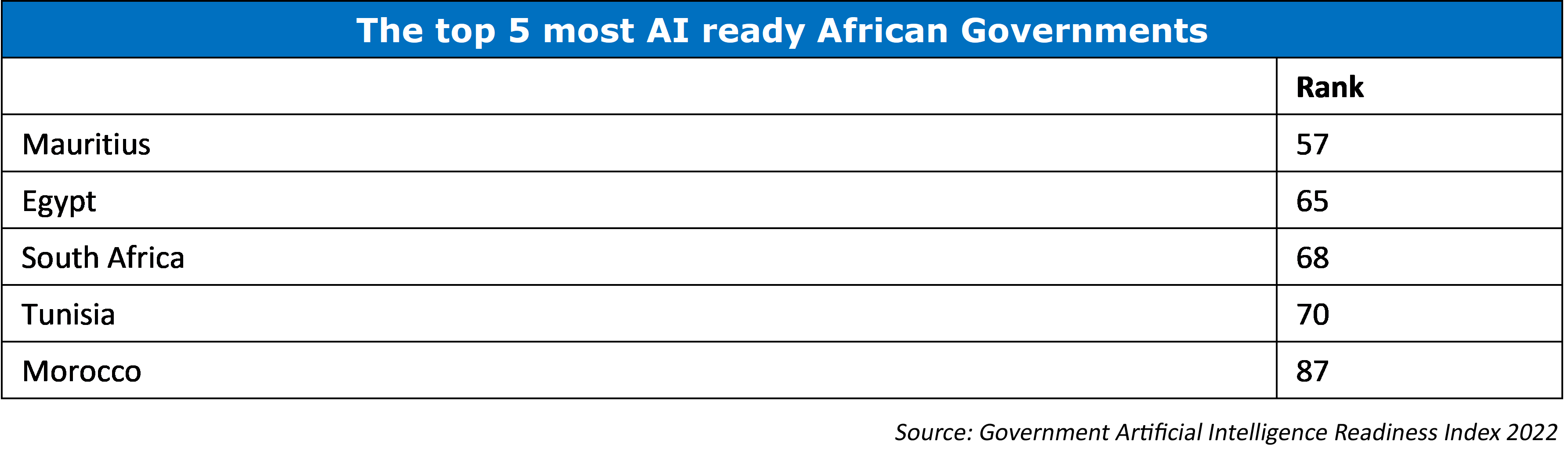 In 2018, Mauritius became the first African country to have formalised a national AI strategy. Egypt has established a National Council for Artificial Intelligence and an African Working Group on AI. South Africa has set up a Presidential Commission on the Fourth Industrial Revolution. Tunisia scored a remarkable success in 2023 when its homegrown AI startup Instadeep secured US$100m in series funding. AI labs and research centres are popping up across Africa. Morocco itself has set up AI Center of Excellence at the Mohammed VI Polytechnic University (UM6P) in Rabat and another one - the House of Artificial Intelligence in Oujda.
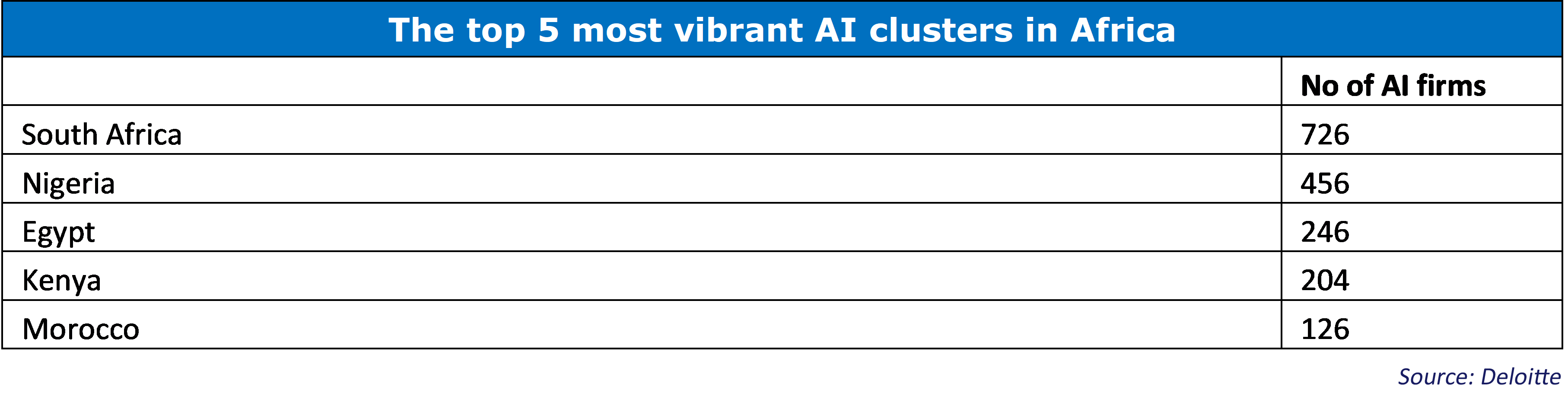 Digital infrastructure is the foundation on which AI adoption rests, and Africa’s infrastructure gaps are a major impediment to faster adoption. Only 36% of sub‑Saharan Africa has access to broadband internet. Data affordability is another constraint. Even basic data plans can cost up to three times more than in regions with more advanced digital infrastructure. Africa possess only 1% of the total data centre capacity and most of that is in one country - South Africa. Data centres and the hardware needed to run AI algorithms, suck massive amounts of power. Reliable plentiful electricity is not something that Africa has in abundance. 77% of the firms in sub-Saharan Africa (SSA) experience electrical outages. Cloud adoption in Africa is only 15% vs 72% in Europe. This global power imbalance has elicited growing concerns about data sovereignty, as African governments and businesses are largely dependent on non-African big tech companies who host and now control much of the personal data of African citizens. AI systems learn from data. But quality up-to-date data in Africa is hard to come by, limiting datasets on which AI can be trained. Compounding this problem is the vast amount of prejudice-laced information and views about Africa in cyberspace. This is where Generative AI often derives its answers. The issue of Dataset bias has therefore become critical when it comes to the use of AI in Africa. Another major barrier is that many AI tools are built and trained primarily in English, Chinese, and European languages, while African languages have limited digital presence. If not checked the increased use of AI could leave millions marginalised. The adoption of AI in Africa faces multiple challenges – not least lack of technical skills, infrastructure, lack of data, and lack of state capacity to protect their citizens’ data privacy. But the most serious risk that AI brings to Africa is the prospect of further widening the existing inequalities that threaten to leave so many millions behind.
References
African Development Bank. (2025, December 12). Africa’s AI revolution: African Development Bank report projects $1 trillion in additional GDP by 2035 with use of AI to enhance productivity. https://www.afdb.org/ [afdb.org]
International Data Corporation (IDC). (2023, April 11). MEA will see world’s fastest AI spending growth through 2026. ITEdgeNews. https://www.itedgenews.africa/ [itedgenews.africa]
The African Exponent. (2025, November 7). Top 10 AI startups in Africa in 2025. https://www.africanexponent.com/ [africanexponent.com]
Oxford Insights. (2023). Government AI Readiness Index 2022. https://oxfordinsights.com/ [ecofinagency.com]
GSMA. (2024, April 8). Despite improvements, Sub‑Saharan Africa has the widest usage and coverage gaps worldwide. https://www.gsma.com/ [gsma.com]
World Economic Forum. (2025, April 9). How shared digital infrastructure can bridge the gap in Africa. https://www.weforum.org/ [weforum.org]
Xalam Analytics. (2024, July). The state of the African data center market. https://xalamanalytics.com/ [xalamanalytics.com]
World Bank. (2026). Firms experiencing electrical outages (% of firms). Enterprise Surveys. https://data.worldbank.org/ [data.worldbank.org]
Eurostat. (2026). Cloud computing – statistics on the use by enterprises. European Commission. https://ec.europa.eu/ [ec.europa.eu]
The author of this article is the Director of the NTU-SBF Centre for African Studies.

We believe in the free flow of information. Republish our articles for free, online or in print, under Creative Commons license.
The State of Artificial Intelligence (AI) in Africa © 2026 by Amit Jain is licensed under Creative Commons Attribution-NoDerivatives 4.0 International