South Africa – Authorities should quicken structural reforms to boost persistent lacklustre growth
Continued central bank independence, fiscal consolidation, and lasting policy measures to increase private sector participation in the South African economy, brighten the outlook
By Rafiq Raji
The South African economy grew by 1.1% in 2025, from less than 1% in 2015-24. In September 2026, the central bank projected real GDP will grow by 1.2% in 2026, and around 2% over the medium term, after the economy contracted by 0.2% in the second quarter of 2026. In August 2026, the government launched the third phase of its already 3-year partnership with the private sector to boost annual real GDP growth to above 3% and create one million new jobs by 2030, after the successful and ongoing structural reforms of the key energy and logistics sectors, as well as financial sector reforms that saw South Africa exit the grey list of the Financial Action Task Force (FATF) in October 2025.[1] Credit rating agencies have begun to recognise South Africa’s reform progress, as the authorities aim to restore the country’s ratings back to investment grade status, after losing it in 2017-20, following ratings downgrades to junk status by S&P Global (2017), Fitch (2017) and Moody’s (2020).[2],[3],[4],[5]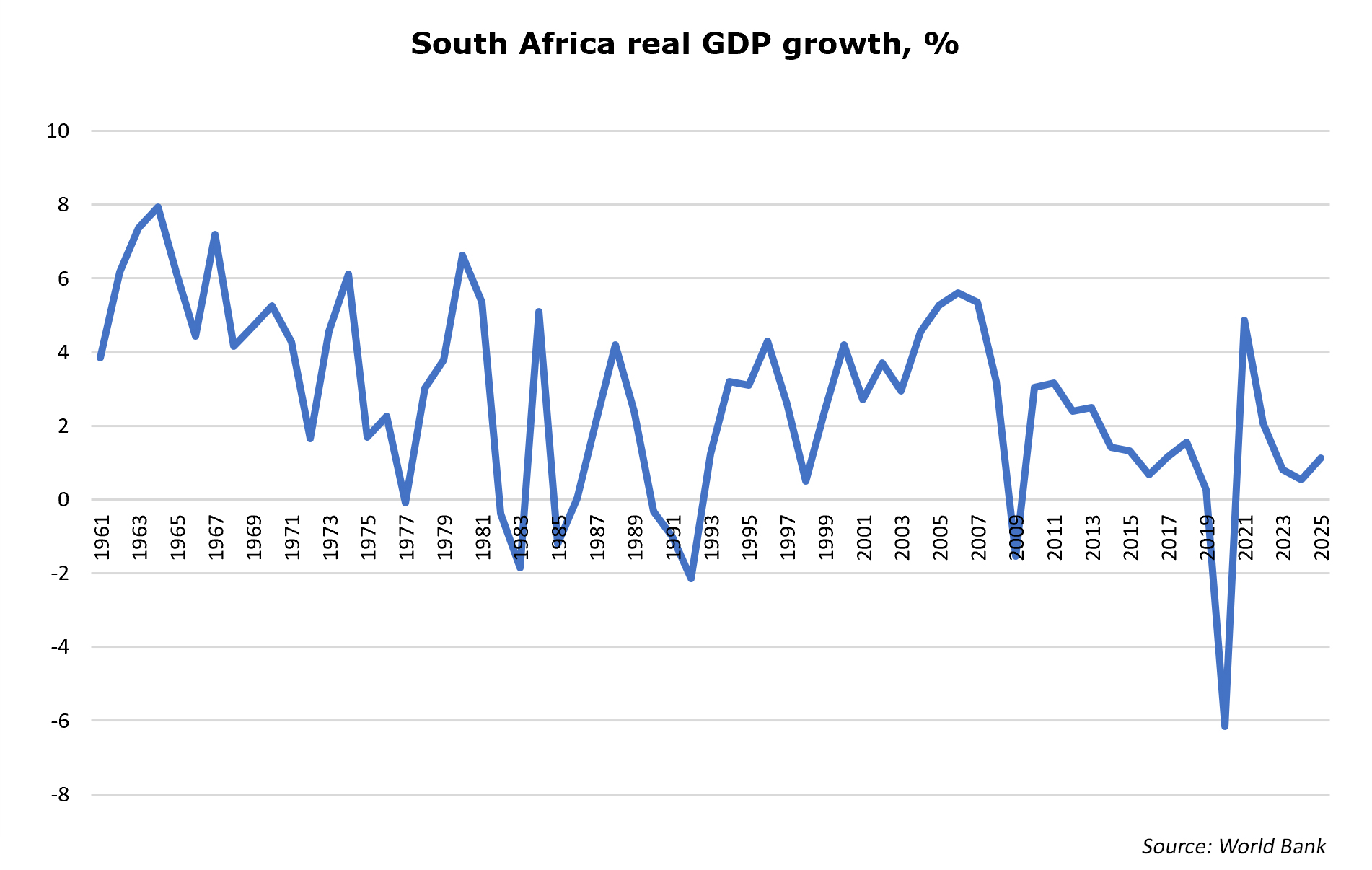 Ongoing reforms of state-owned enterprises (SOEs) continue to be constrained by entrenched political interests. In October 2026, Cyril Ramaphosa, South Africa’s president, decided to set up a commission to manage state-owned enterprises (SOEs), over a previously decided holding company approach, which would have required a lengthy legislative process.[6] SOEs were previously all managed by a single federal ministry, then moved to their respective sectoral ministries (purportedly to reduce inefficiencies), where they have continued to underwhelm. Easing and streamlining the regulatory burden on firms, especially business licensing, as well as continued structural reforms of the electricity and logistics sectors, will be key to improving the business environment and boosting long-running lacklustre growth.[7] Labour rigidities and the dwindling number of skilled labour also remain key constraints for South African firms, especially large ones.[8] Cheap Chinese imports are weighing on South African manufacturing as well, especially automobiles and steel, which will force additional protectionist trade measures over the medium term, although industrial policy measures to enable foreign manufacturing investment will probably be more effective and is increasingly becoming appealing to the authorities.[9],[10]
With much of the Ramaphosa-led economic reforms largely by executive orders, there is a growing need for them to be enshrined in law before Mr Ramaphosa leaves office, to make them difficult to reverse thereafter, although Mr Ramaphosa will increasingly be constrained from doing so, as he faces potential impeachment, presides over a divided and dwindling ruling party, amid growing appeal of economic populism to voters.[11] The risk that ongoing economic reforms might be reversed were already becoming palpable in mid-2026, as institutional entrenchments continue to weigh on momentum.[12] An increasingly underwhelming ruling African National Congress (ANC), which lost its national majority in the 2024 general elections and was forced to form a government of national unity with other political parties thereafter, failed to submit the lists of a substantial number of its candidates for the November 2026 municipal council elections to the Electoral Commission of South Africa (the Electoral Commission) on time, adding to growing evidence of maladministration and internal squabbling within a party whose leader, Cyril Ramaphosa (the president), is facing a parliamentary impeachment inquiry.[13] In July 2026, a South African high court paused the parliamentary impeachment process against Mr Ramaphosa pending the conclusion of his review application of the independent panel report that triggered the proceedings, although the high court ruling is being appealed by interested parties, including the increasingly popular opposition Economic Freedom Fighters (EFF) party.[14],[15]
Completion of ongoing structural reforms of electricity and logistics sectors will be key to reviving economic growth
Aggressive structural reforms will be required to turn the tide on continued tepid growth, high unemployment, and widening inequality in South Africa. “Operation Vulindlela” is the set reforms by the Ramaphosa administration to ease some of the binding constraints weighing on the economy, reduce the regulatory and bureaucratic burden on firms, and improve dwindling state capacity. The authorities aim to reduce state dominance of the South African economy over the medium to long term by enabling greater private sector participation and investment in sectors hitherto dominated by SOE monopolies, especially the electricity and logistics sectors, as well as infrastructure rehabilitation and development. In May 2026, Transnet, the state-owned operator of ports, rail and pipelines in South Africa, opened up its train network to private firms, the first time in a century, as part of ongoing reforms of the floundering logistics sector, which has been weighed down for years by inefficiencies, corruption, vandalism, underinvestment, and maladministration.[16] Transnet will also be relieved of its current regulatory role over ports to an independent entity, with the authorities aiming for the accompanying regulatory and institutional framework to be in place by 2027, although there might be delays that could extend the timeline. In the aftermath, an unbundled Transnet will compete with private operators in liberalised ports and freight rail sectors.
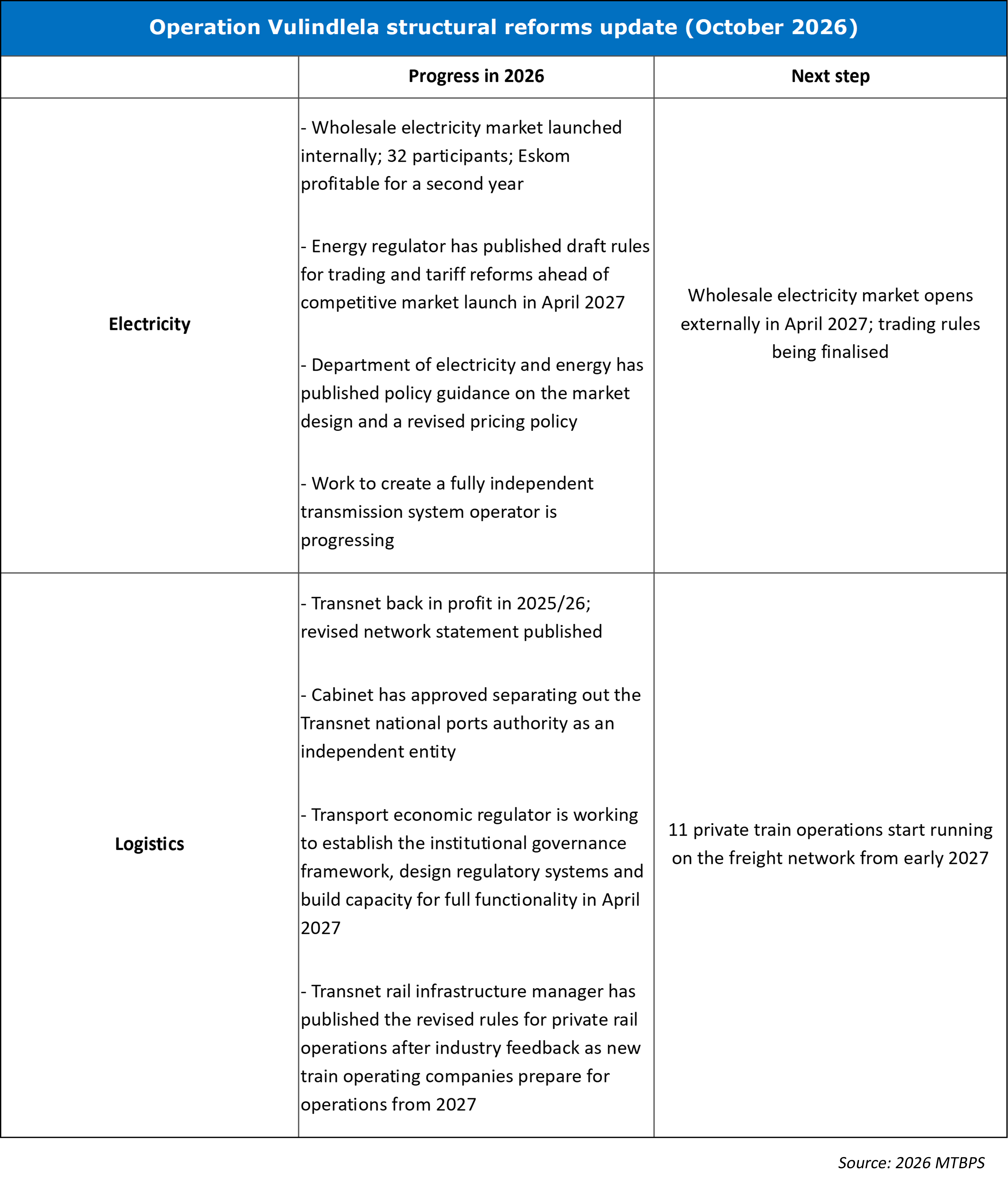
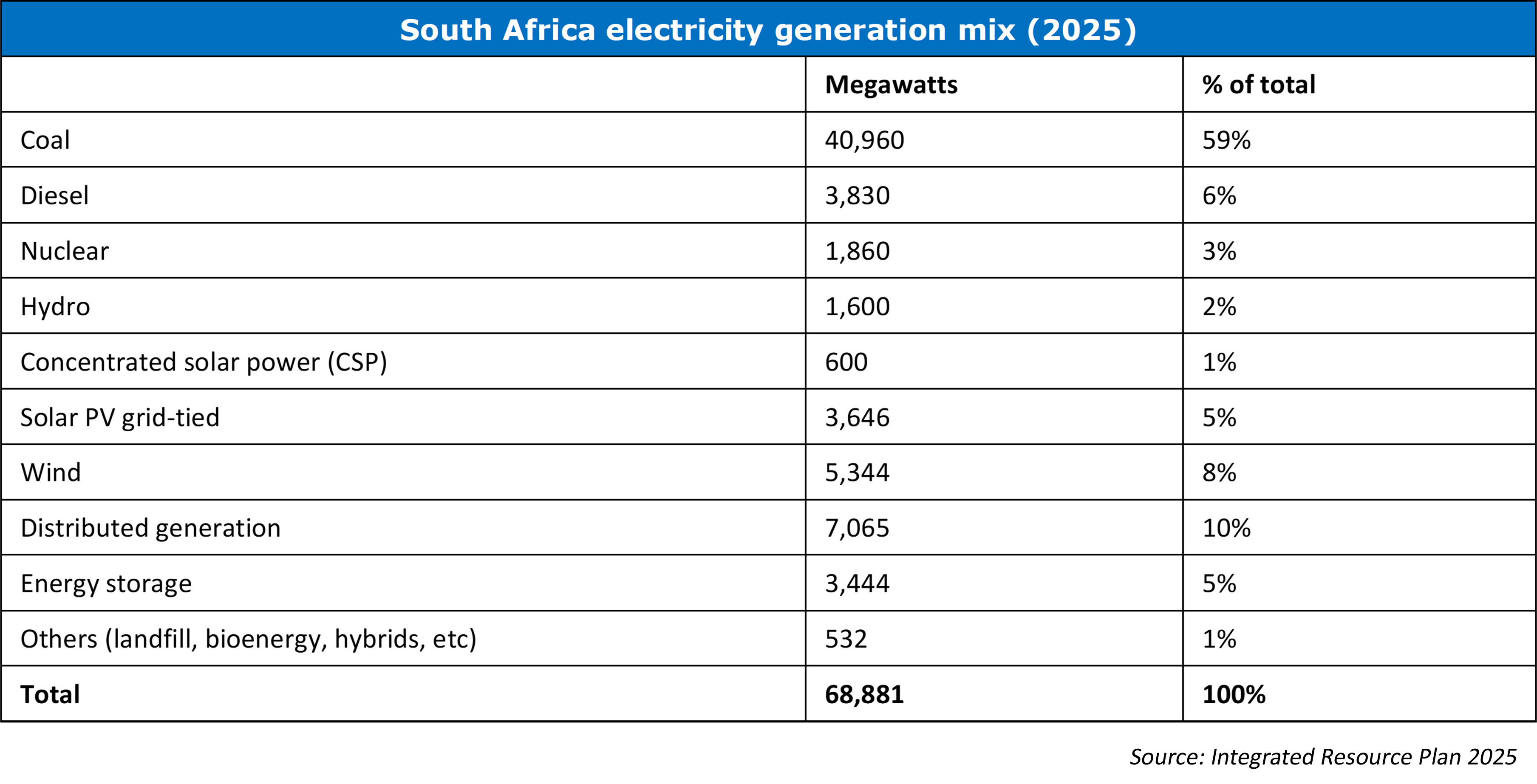
South Africa’s electricity crisis, which required sustained power-rationing (“loadshedding”) for almost two decades in 2007-25, has abated.[17] To prevent a reversion, the authorities will facilitate incremental investments to add more than 100 gigawatts (GW) of electricity generation capacity over the next decade, spread across wind, solar, and gas sources.[18],[19] The authorities have started the process of unbundling state-owned power utility provider Eskom of its electricity transmission business into a separate independent system operator (ISO), which will manage the national grid when it is set up in 2028, and is expected to be able to attract private capital for the estimated investment of US$27bn that will be required to upgrade the grid over the coming decade without recourse to the fiscus.[20] A revised electricity pricing policy was published for public comment in August 2026 by the authorities, to reflect ongoing structural changes in the electricity sector, and replace the outdated pricing regime that was originally approved in 2008.[21],[22]
 Sustained high imported fuel prices will force longer monetary policy tightening stance
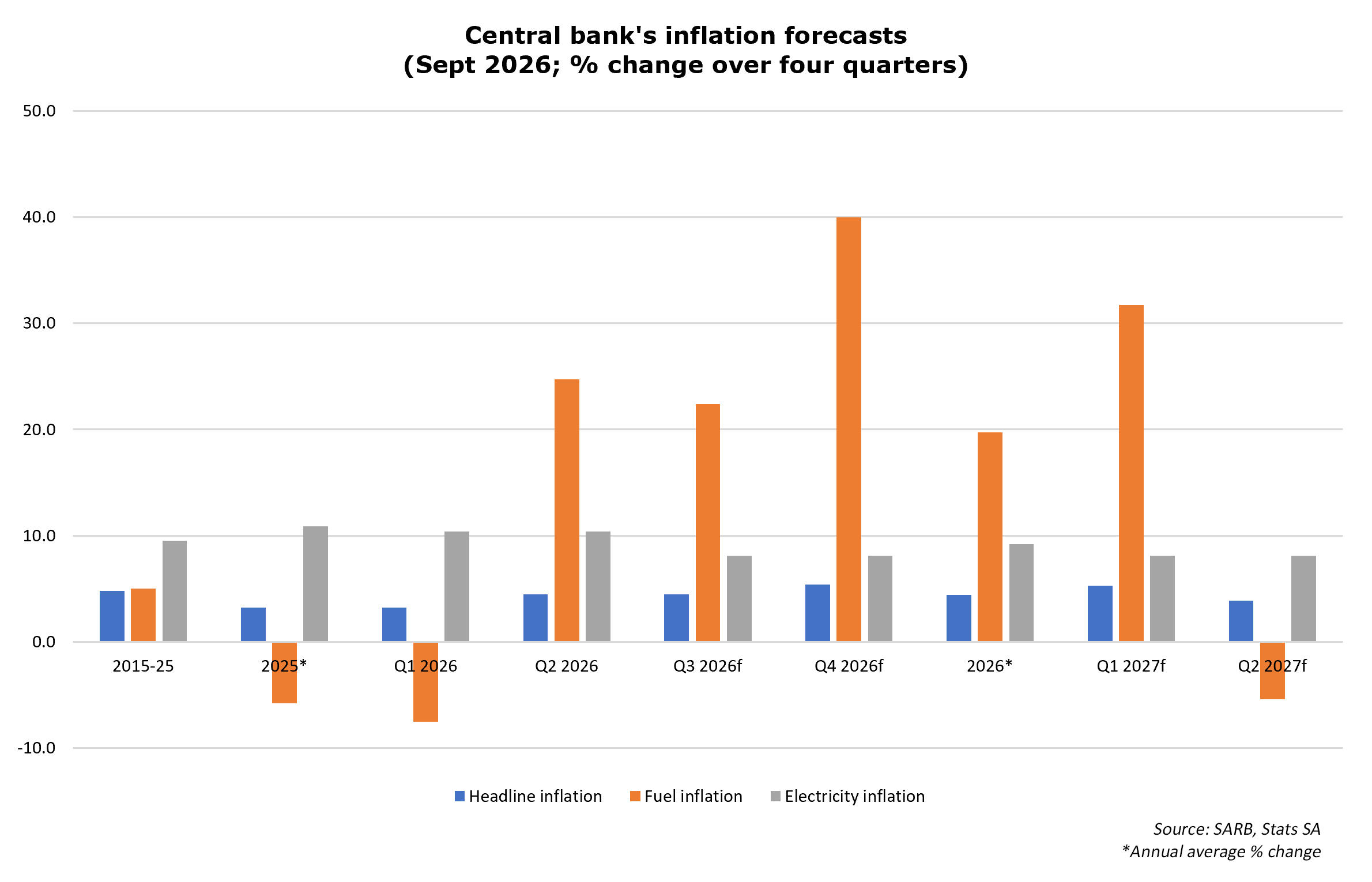
In September 2026, the South African Reserve Bank (SARB, the central bank) raised its monetary policy rate by 25 basis points for the second time in 2026 to 7.25%, necessitated by tightening global financial conditions, following interest rate hikes by the US Federal Reserve, European Central Bank and the Bank of Japan, as well as rising imported energy and food inflation from the ongoing US-Israeli war with Iran and El Nino effects, which already pushed annual consumer inflation outside the upper bound of the 2-4% target band since May 2026, when the headline print was 4.5% year on year, although sustained policy tightening is expected to bring it back to the central bank’s 3% mid-point target over the medium term.[23],[24],[25]The fuel shock from the ongoing 2026 US-Israeli war with Iran will continue to inflame inflation expectations in 2026-27, according to the central bank in October 2026, which expects headline inflation to be above 5% from late 2026, only expecting a return to target of 3% by 2028, although the October 2026 MTBPS reckons it will not be so until 2029.[26],[27] Limited domestic crude oil refining capacity will expose South Africa to rising global prices and increasingly constrained global supply of fuel and other petroleum products, with consequences for inflation and external balances.[28],[29] Without alternatives to gas supplied by Sasol from its fields in Mozambique, new imported gas terminals, as well as domestic exploration of South Africa’s natural gas reserves, firms which contribute almost a tenth to the economy, will also not have enough gas to buy to run their operations in the medium to long term.[30]
 South Africa currently produces about two-fifths of its domestic fuel requirement from Natref crude oil refinery (108,500 b/d), Astron crude oil refinery (100,000 b/d), and Sasol coal-to-liquids refinery (150,000 b/d), after losing the PetroSA gas-to-liquids refinery (45,000 b/d) to gas feedstock shortages; the Engen crude oil refinery (120,000 b/d) to fire in 2020; and the Sapref crude oil refinery (180,000 b/d) to floods in 2022.[31] The remaining 61% of fuel demand is imported from India, the Middle East, United States, and lately from Nigeria, which fully commissioned the 700,000 b/d Dangote crude oil refinery in 2026.[32] South Africa could have saved US$4.7bn it used to import fuel in 2021-24 if it did not lose a substantial part of its domestic refining capacity in the period.[33] The 180,000 barrels/day (b/d) Sapref refinery was acquired by the government’s Central Energy Fund (CEF) from BP and Shell in 2024 for a symbolic 1 rand, after the refinery was damaged by floods. The CEF wants to upgrade Sapref refinery to 400,000 to 650,000 b/d, which it estimates will cost about US$7.2bn, with a final investment decision expected in 2028 at the latest.[34] In the intervening period, South Africa will remain sensitive to volatile global crude oil and refined fuel prices, with persistently high inflation expectations in tow, although policy tightening should keep them relatively anchored on balance.
Tighter rules will be required to enable sustained fiscal consolidation over the medium to longer term
The authorities plan to narrow the fiscal deficit to 2.5% of GDP in 2029/30, from 4.3% in 2025/26, as well as reduce the debt-to-GDP ratio to 76.6% of GDP in 2029/30, from 78.4% in 2025/26, and further down to 66.6% in 2034/35, according to the 2026 medium-term budget policy statement (MTBPS) released in October 2026.[35] A fiscal sustainability framework was also published by the authorities for comment in October 2026, as promised by finance minister Enoch Godongwana in his 2026 budget speech earlier in the year, with cautiously positive reviews by credit rating agencies, as the proposed fiscal rules will not impose numerical caps, leaving successive administrations to decide their own fiscal targets, albeit with parliamentary scrutiny.[36],[37],[38] Every new government will be required to prepare a fiscal plan for its term in office, which will be independently assessed, and parliament will be tasked with scrutinising the plan and its implementation. The principles-based fiscal anchor will be the first legally binding legislation on South African governments to be fiscally responsible, although it does not go far enough to impose numerical limits and bounds for fiscal metrics, leaving open opportunities for overspending and excessive borrowing in the future. The fiscal plan will not require the approval of parliament or the independent assessor, leaving the authorities with significant latitude and legislative oversight that is effectively perfunctory. The relevant sections of the fiscal sustainability proposal will be added to existing budget laws as amendments rather than through a fresh legislation, and is slated for introduction and passage into law in 2027.
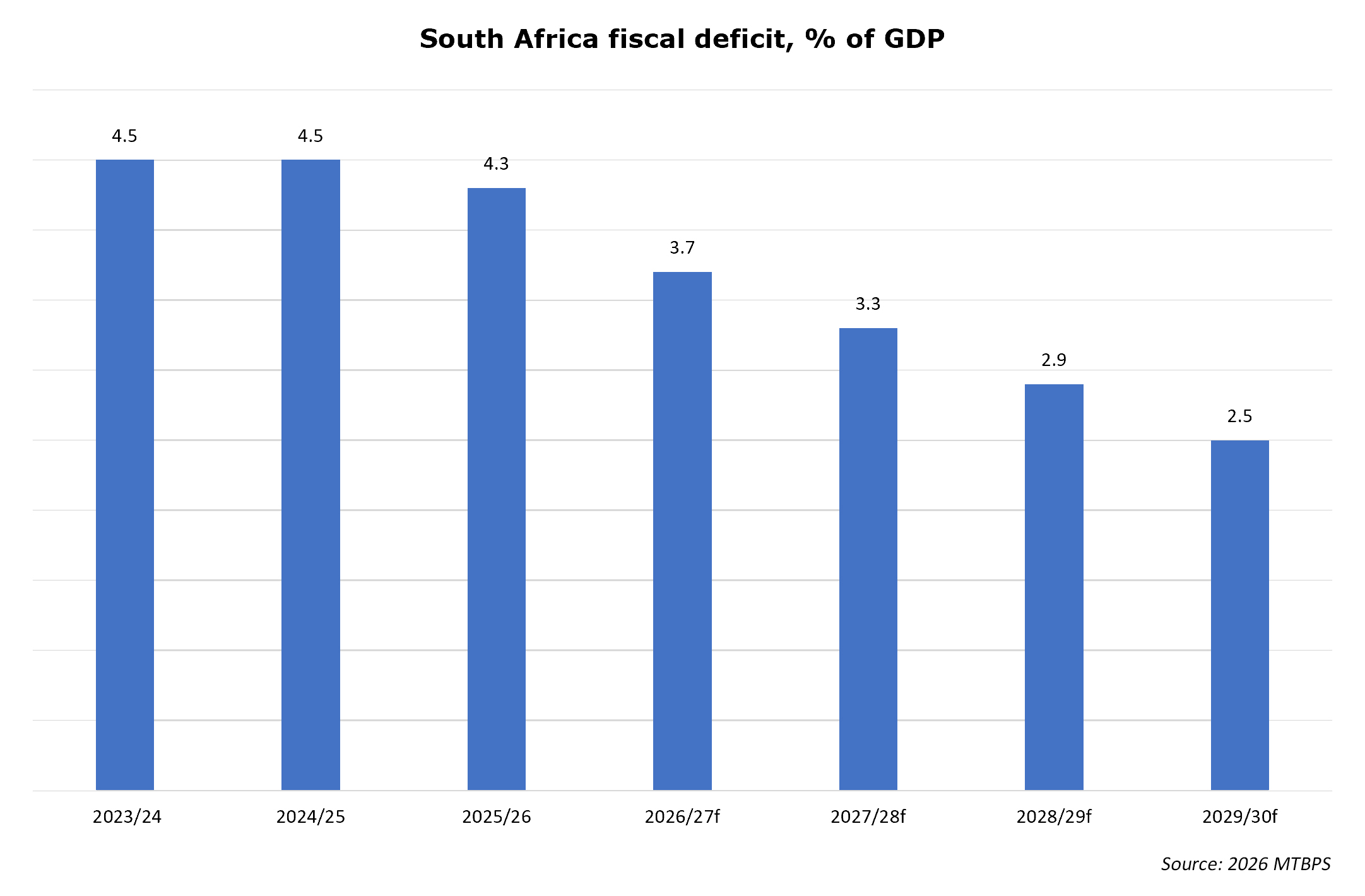
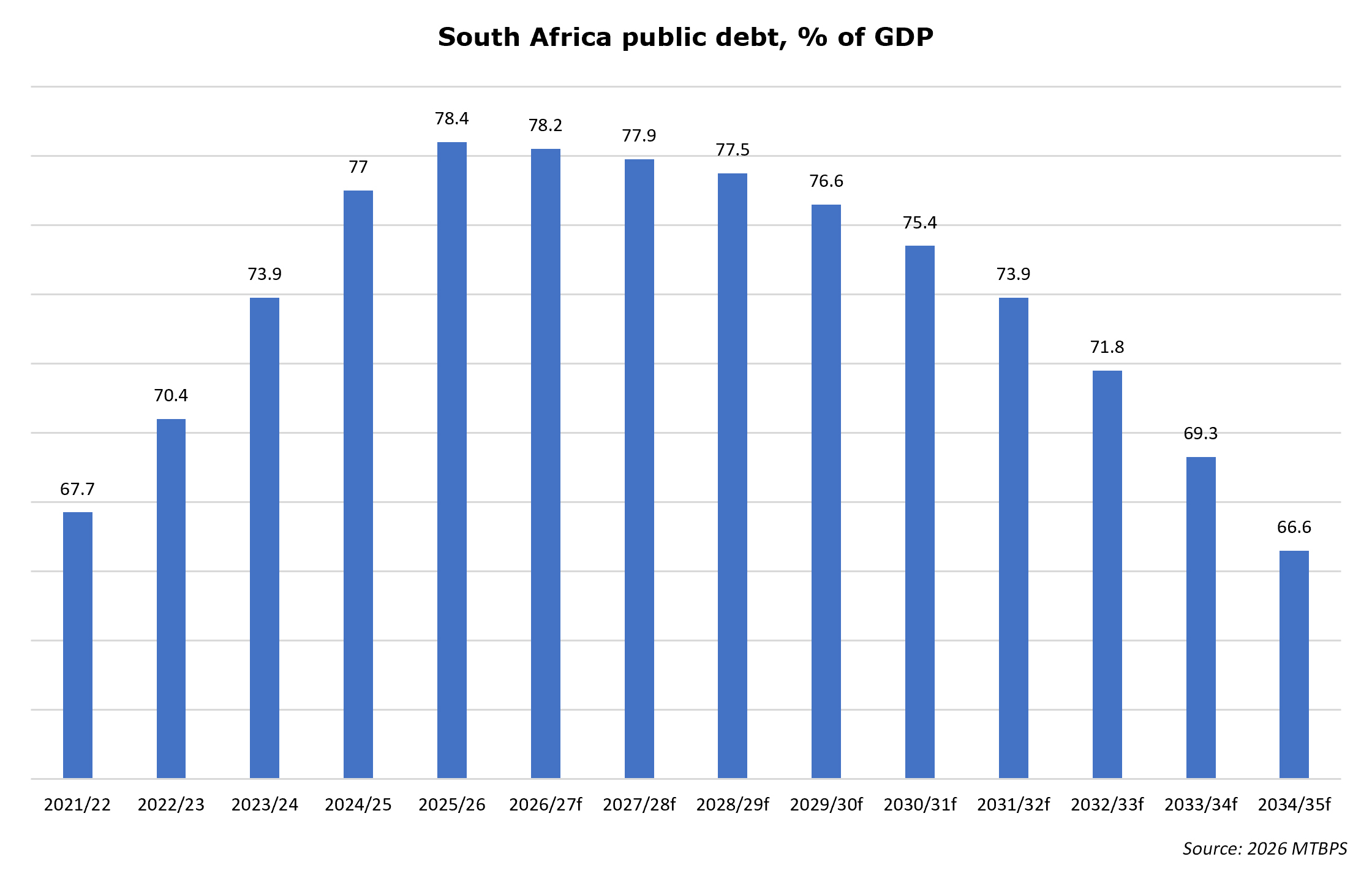 Public debt peaked at 78.4% of GDP in 2025/26, according to the authorities, as they now aim to reduce it to about 67% of GDP over the next decade. Debt servicing costs will largely take about a fifth of revenue in 2026-30, according to the authorities’ forecasts in October 2026. More capital spending in place of wasteful recurrent expenditure, greater efficiencies in governance, especially those that reduce the huge public service wage bill, and higher expected revenue, underpin the authorities’ medium term fiscal consolidation plans. In fact, higher-than-expected revenue in the 2026/27 fiscal year thus far, largely from windfall revenue from rising and high commodity prices, informed the improved fiscal performance projected by the authorities in the MTBPS in October 2026. The authorities also expect borrowing costs to reduce progressively over the medium to long term, as credit rating agencies respond positively to expected fiscal consolidation gains over the period with incremental ratings upgrades towards the restoration of the country’s investment grade status. However, there is some scepticism about the ability of the authorities to consistently maintain fiscal discipline over the medium to long term, raising concerns that the planned progressive reduction of public debt by the government may be short-lived, especially if economic growth underwhelms.[39]
References
[1] Republic of South Africa. (2026, August 20). The presidency on launch of phase 3 of government business partnership for growth and jobs [Press release]. https://www.gov.za/news/media-statements/presidency-launch-phase-3-government-business-partnership-growth-and-jobs-20
[2] Reuters. (2026, November 14). S&P upgrades South Africa for first time in nearly 20 years as reforms gain traction. https://www.reuters.com/world/africa/sp-global-upgrades-south-africas-long-term-foreign-currency-rating-bb-2025-11-14/
[3] Thukwana, N. (2026, June 5). Fitch lifts South Africa rating on fiscal progress, management. Bloomberg. https://www.bloomberg.com/news/articles/2026-06-05/fitch-lifts-south-africa-rating-on-fiscal-progress-management
[4] Bull, A. (2026, June 12). South Africa treasury says upgrades show path to investment grade. Bloomberg. https://www.bloomberg.com/news/articles/2026-06-12/south-africa-credit-upgrades-show-path-to-investment-grade-status-treasury-says
[5] Reuters. (2026, May 22). Moody's lifts South Africa outlook to positive as debt pressures ease. https://www.reuters.com/world/africa/moodys-lifts-south-africa-outlook-positive-debt-pressures-ease-2026-05-22/
[6] Vecchiatto, P. (2026, October 7). South Africa to establish commission to oversee state firms. Bloomberg. https://www.bloomberg.com/news/articles/2026-10-07/south-africa-to-establish-new-commission-to-oversee-state-firms
[7] Kinda, T. & Mavee, N. (2026, March 11). Enhancing South Africa’s business environment to boost growth and create jobs. International Monetary Fund. https://www.imf.org/en/news/articles/2026/03/11/cf-south-africa-enhancing-south-africas-business-environment-to-boost-growth-and-create-jobs
[8] Child, K. (2026, August 31).Large businesses flag labour laws as key constraint. Moneyweb. https://www.moneyweb.co.za/news/economy/large-businesses-flag-labour-legislation-as-key-constraint/
[9] Reuters. (2026, March 20). South Africa imposes steep tariffs on structural steel imports from China, Thailand. https://www.reuters.com/world/asia-pacific/south-africa-imposes-steep-tariffs-structural-steel-imports-china-thailand-2026-03-20/
[10] Cokayne, R. (2026, September 2). SA automakers put more pressure on government to address imports. Moneyweb. https://www.moneyweb.co.za/news/south-africa/sa-automakers-put-more-pressure-on-government-to-address-imports/
[11] Thukwana, N. (2026, September 10). South Africa urged to lock in reforms before Ramaphosa leaves. Bloomberg. https://www.bloomberg.com/news/articles/2026-09-10/south-africa-urged-to-lock-in-reforms-before-ramaphosa-leaves
[12] Goko, C. (2026, July 23). South African reform momentum turns negative, lobby group tracker shows. Reuters. https://www.reuters.com/business/energy/south-african-reform-momentum-turns-negative-lobby-group-tracker-shows-2026-07-23/
[13] Mark, M. (2026, September 19). South Africa’s ANC fails to register 181 local election candidates. Financial Times. https://www.ft.com/content/a82a42a4-8f80-4569-a706-e7278c088d4d
[14] Parakozov, S., Timsina, N., & Madubela, A. (2026, July 24). South African president gets court order halting inquiry into “Farmgate’ scandal. Reuters. https://www.reuters.com/world/south-africas-ramaphosa-wins-court-challenge-halt-farmgate-impeachment-process-2026-07-24/
[15] Groenewald, Z. (2026, July 28). Several parties take impeachment inquiry matter to ConCourt. SABC News. https://www.sabcnews.com/sabcnews/eff-mk-party-uat-take-impeachment-inquiry-matter-to-concourt/
[16] Adegboyega, A. (2026, May 18). South Africa turns to private firms to rescue Africa’s biggest rail freight system. Business Insider Africa. https://africa.businessinsider.com/local/markets/south-africa-opens-africas-largest-rail-freight-network-to-private-firms/3c16169
[17] Eskom. (2026, October 2). More than 500 days without loadshedding, EAF improves to 68.11%, diesel costs fall by R4.79 billion, sustained emissions performance below target levels and load reduction reduced to 202 590 customers [Press release]. https://www.eskom.co.za/more-than-500-days-without-loadshedding-eaf-improves-to-68-11-diesel-costs-fall-by-r4-79-billion-sustained-emissions-performance-below-target-levels-and-load-reduction-reduced-to-202-590-customers/
[18] Reuters. (2026, October 7). South Africa to prioritise battery storage and gas-to-power projects, says energy minister. https://www.reuters.com/business/energy/south-africa-prioritise-battery-storage-gas-to-power-projects-says-energy-2026-10-07/
[19] Republic of South Africa. (2025). Integrated resource plan 2025. https://www.gov.za/sites/default/files/gcis_document/202510/53596gon6767.pdf
[20] Burkhardt, P. (2026, September 7). South Africa seeks advisers for Eskom transmission unit. Bloomberg. https://www.bloomberg.com/news/articles/2026-09-07/south-africa-seeks-advisers-for-eskom-transmission-unit-spin-off
[21] Thukwana, N. (2026, August 18). South Africa proposes sweeping changes to power-price framework. Bloomberg. https://www.bloomberg.com/news/articles/2026-08-18/south-africa-proposes-sweeping-changes-to-power-price-framework
[22] Republic of South Africa. (2026, August 18). Minister of electricity and energy invites public comment on the draft revised electricity pricing policy 2026 [Press release]. https://www.dee.gov.za/media-statement-revised-electricity-pricing-policy/
[23] Gumbi, K. & Parakozov, S. (2026, September 23). South Africa raises interest rate, citing Iran war price shocks. Reuters. https://www.reuters.com/world/africa/south-africas-central-bank-raises-main-interest-rate-725-2026-09-23/
[24] South African Reserve Bank. (2026, September 23). Statement of the monetary policy committee [Press release]. https://www.resbank.co.za/content/dam/sarb/publications/statements/monetary-policy-statements/2026/september/september-statement.pdf
[25] Reuters. (2026, October 6). South Africa central bank says second-round inflation risks rise. https://www.reuters.com/world/africa/south-africa-central-bank-says-second-round-inflation-risks-rise-2026-10-06/
[26] South African Reserve Bank. (2026). Monetary Policy Review. https://www.resbank.co.za/content/dam/sarb/publications/reviews/monetary-policy-review/2026/october.pdf
[27] Wee, R. (2026, October 15). South Africa's central bank governor Kganyago sees upside risks to inflation. Reuters. https://www.reuters.com/world/africa/south-africas-central-bank-governor-kganyago-sees-upside-risks-inflation-2026-10-15/
[28] Ryan, C. (2026, October 7). SA’s fuel import bill surges to highest level since 1994. Moneyweb. https://www.moneyweb.co.za/news/economy/sas-fuel-import-bill-surges-to-highest-level-since-1994/
[29] Reuters. (2026, September 10). South Africa’s current account records Q2 deficit as Iran war drives up import costs. https://www.reuters.com/world/africa/south-africas-current-account-records-q2-deficit-iran-war-drives-up-import-costs-2026-09-10/
[30] Sguazzin, A., Kew, J., & Parker, A. (2026, September 16). South Africa is sleepwalking toward a gas crisis, businesses warn. Bloomberg. https://www.bloomberg.com/news/articles/2026-09-16/south-africa-is-sleepwalking-toward-a-gas-crisis-businesses-warn
[31] Hilliard-Lomas, C. (2026, October 10). South Africa is producing nearly 40% less fuel than it did seven years ago. BusinessTech. https://businesstech.co.za/news/energy/878753/south-africa-is-producing-nearly-40-less-fuel-than-it-did-seven-years-ago/
[32] Ekanem, S. (2026, April 26). South Africa’s fuel imports from the U.S. hit 165,000 tons following Middle East supply disruptions. Business Insider Africa. https://africa.businessinsider.com/local/markets/south-africas-fuel-imports-from-the-us-hit-165000-tons-following-middle-east-supply/9qhk5mj
[33] Jantjies, R. (2026, September 14). South Africa refinery closures added $4.7 billion to oil-import bill. Bloomberg. https://www.bloomberg.com/news/articles/2026-09-14/s-africa-refinery-closures-added-4-7-billion-to-oil-import-bill
[34] Reuters. (2026, September 23). South Africa faces $8 billion bill to revive state-owned refineries. https://www.reuters.com/business/energy/south-africa-faces-8-billion-bill-revive-state-owned-refineries-2026-09-23/
[35] Republic of South Africa. (2026, October 21.). Medium term budget policy statement. https://www.treasury.gov.za/MediumTermBudget/Medium%20Term%20Budget%20Policy%20Statement%20Full%20document.pdf
[36] Republic of South Africa. (2026). A fiscal sustainability framework for South Africa. https://www.treasury.gov.za/MediumTermBudget/A%20fiscal%20sustainability%20framework%20for%20South%20Africa.pdf
[37] Republic of South Africa. (2026, February 25). 2026 budget speech. https://www.treasury.gov.za/documents/national%20budget/2026/speech/speech.pdf
[38] Reuters. (2026, October 26). Moody’s says South Africa’s budget update is credit positive. https://www.reuters.com/world/africa/moodys-says-south-africas-budget-update-is-credit-positive-2026-10-26/
[39] Thukwana, N. (2026, October 26). Fitch diverges from South Africa’s treasury on debt outlook. Bloomberg. https://www.bloomberg.com/news/articles/2026-10-26/fitch-diverges-from-south-africa-s-treasury-on-debt-outlook