Ghana – Economic priorities after debt restructuring
Post-stabilisation growth ambitions will require delicate fiscal balancing act
By Rafiq Raji
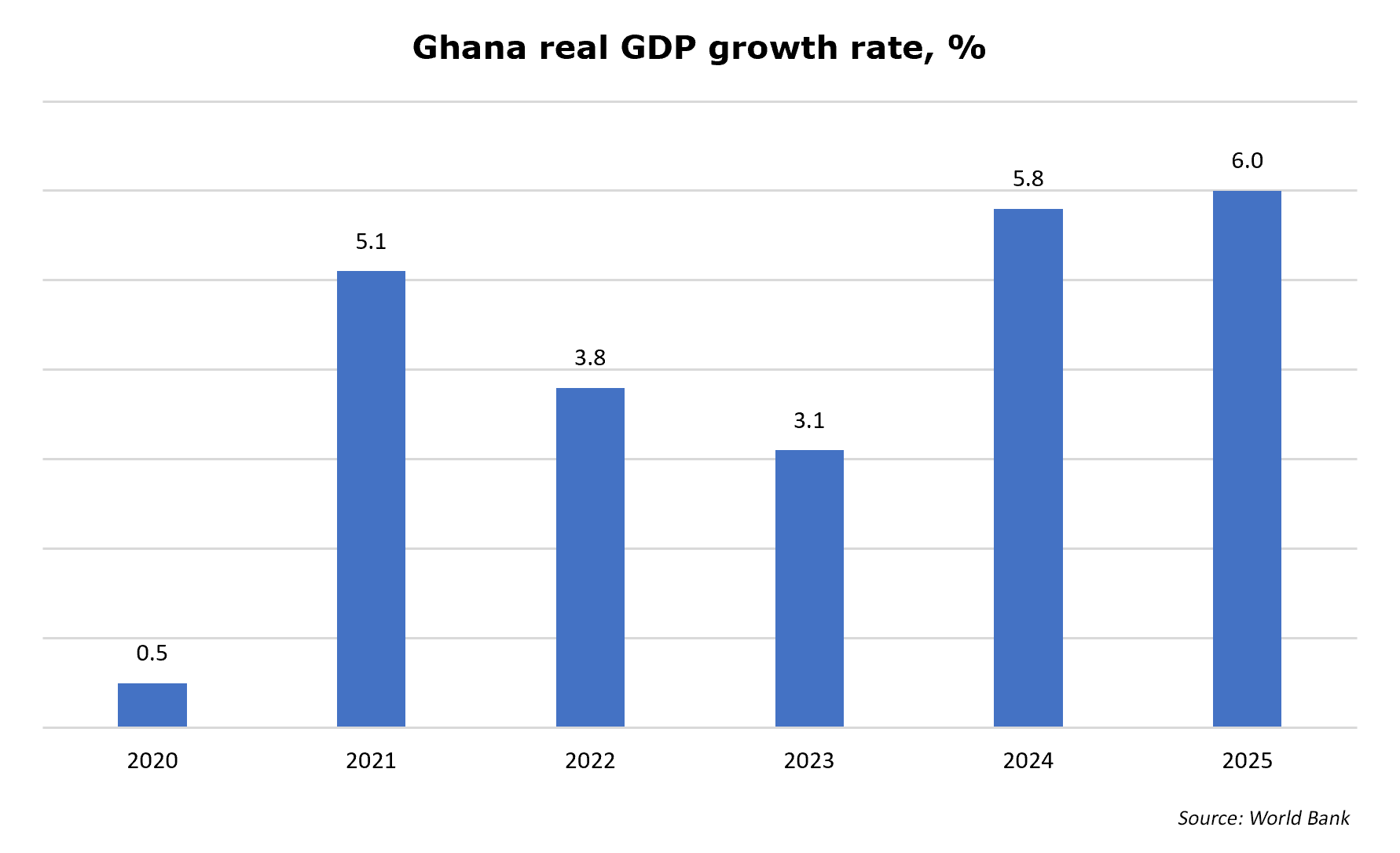
Ghana’s economic recovery from its 2022 debt crisis has been remarkable. A significant reduction in public debt has been accompanied by above-expectation fiscal consolidation, as well as strong real GDP growth, with external surpluses in tow.[1],[2],[3],[4] Most recently, the US$114bn Ghanaian economy grew by 6% year on year in the second quarter of 2026, from 6.4% in the first quarter of the year, driven largely by double-digit growth in the information and communications sector, a trend that has held up in 2024-26.[5] In August 2026, the administration of John Mahama, the president since January 2025, announced a 4-year US$10bn investment initiative targeting seven sectors, with half of the sum going to agriculture and agro-processing.[6] A new investment law since July 2026 has simplified entry requirements for foreign investors, harmonised hitherto fragmented investment-related regulations, and now includes a citizenship-by-investment provision (which though will require additional legislation before coming into force), as well as the terms of the African Continental Free Trade Area (AfCFTA).[7],[8] Following a successful debt restructuring in 2023-26, the authorities have been promptly meeting their debt servicing obligations, paying US$2.1bn to Eurobond creditors since January 2025 (as at early July 2026), for instance.[9] To prevent a regression, especially ramped-up public spending and fiscal deterioration ahead of elections, the authorities agreed a 36-month policy coordination instrument (PCI) with the International Monetary Fund (IMF) to succeed the concluding 39-month US$3bn extended credit facility (ECF) programme, which was completed in July 2026.[10] Thus far, Ghana has been under 17 IMF programmes spanning 40 years of its 69 years of independence.
 Continued credible and data-dependent monetary policy will keep inflation expectations well-anchored
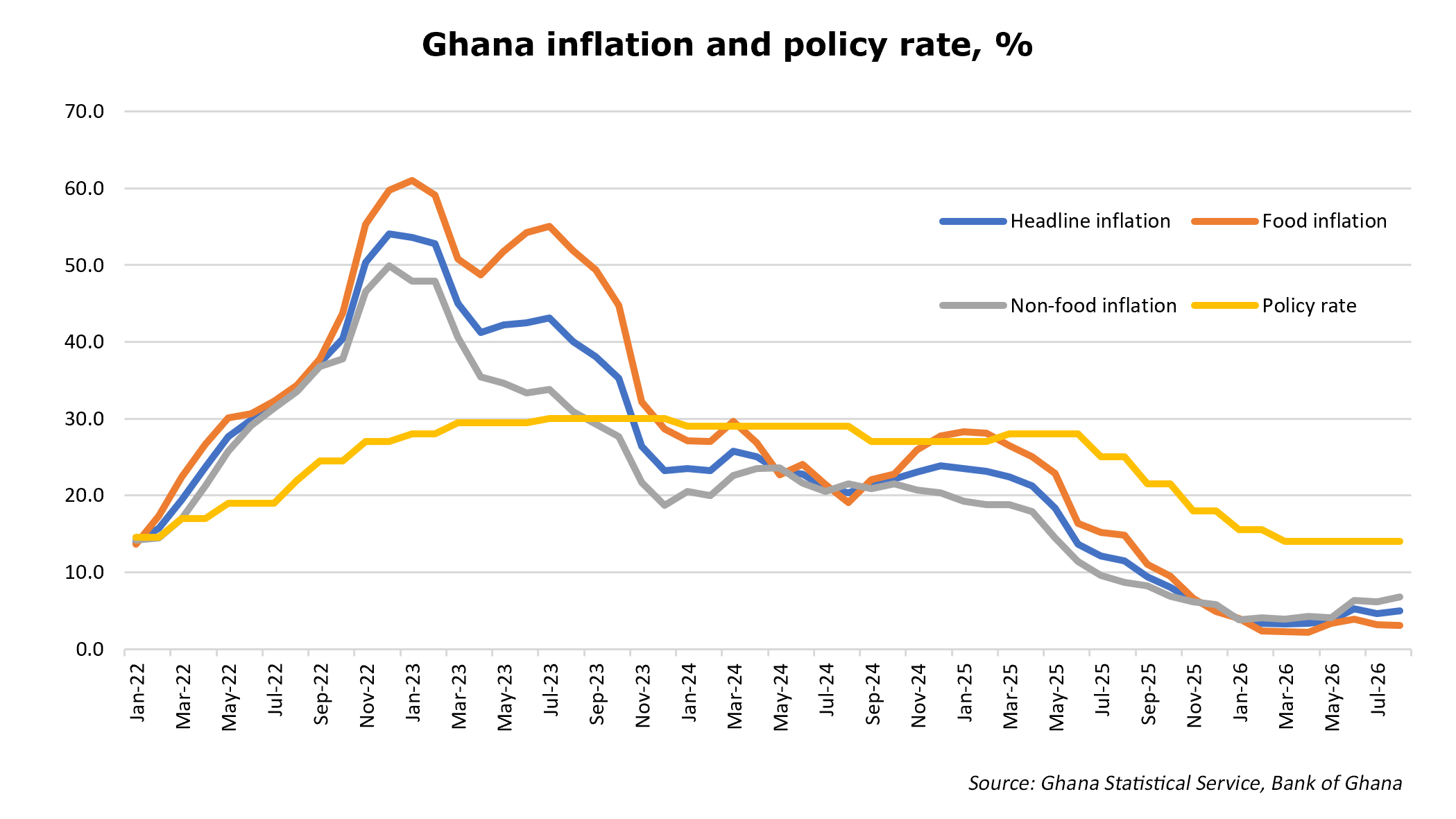
Tight monetary policy in the aftermath of the 2022 debt crisis, when inflation peaked at 54.1% year on year in December 2022, has stabilised prices, with inflation in the single-digits since September 2025, when it slowed to 9.4% from 11.5% in the preceding month. The central bank hiked its policy rate to a peak of 30% in July 2023 from a low of 13.5% in May-October 2021, and thereafter started an aggressive expansionary cycle since January 2024, when it started cutting interest rates, and continued policy easing (bar a one-off 100 basis point hike to 28% in March 2025 from 27% previously) to a new low of 14% by March 2026, where it remained as of September 2026. In June 2026, the Bank of Ghana (BoG, the central bank) stopped its fragmented reserve requirement regime and adopted a common 20% cash reserve ratio for all banks. In September 2026, the BoG continued its pause of policy easing since its last cut of interest rates by 150 basis points to 14% in March 2026, its third consecutive monetary policy committee (MPC) meeting where the policy rate was kept unchanged, as external shocks (especially the prolonged US-Israeli war with Iran) and global tightening financial conditions raise imported inflation expectations, especially for food and fuel, although the latest consumer price index (CPI) print for August 2026 of 5% year on year (from 4.6% in July) remains sufficiently below the 6-10% target inflation band of the central bank. Should monetary policy continue to be data-dependent, price growth is not likely to overshoot the upper-bound of the target over the medium term.[11] The Bank of Ghana has been intervening heavily in the foreign exchange market, selling US$10.6bn (9.2% of GDP) in 2025 alone, a big leap from about US$1bn in 2023. The BoG’s adoption of a new foreign exchange operations framework in November 2025 is expected to reduce the central bank’s dominance of the foreign exchange market and accompanying depletion of hard currency reserves over the medium term. While Ghanaian banks have fully recovered from the 2022 debt crisis, their lending rates are still varied and segmented, with some large firms already enjoying low interest rates in the single-digits and small firms suffering lending rates as high as more than 30% in the first half of 2026, even as inflation and benchmark interest rates have fallen considerably.[12],[13]
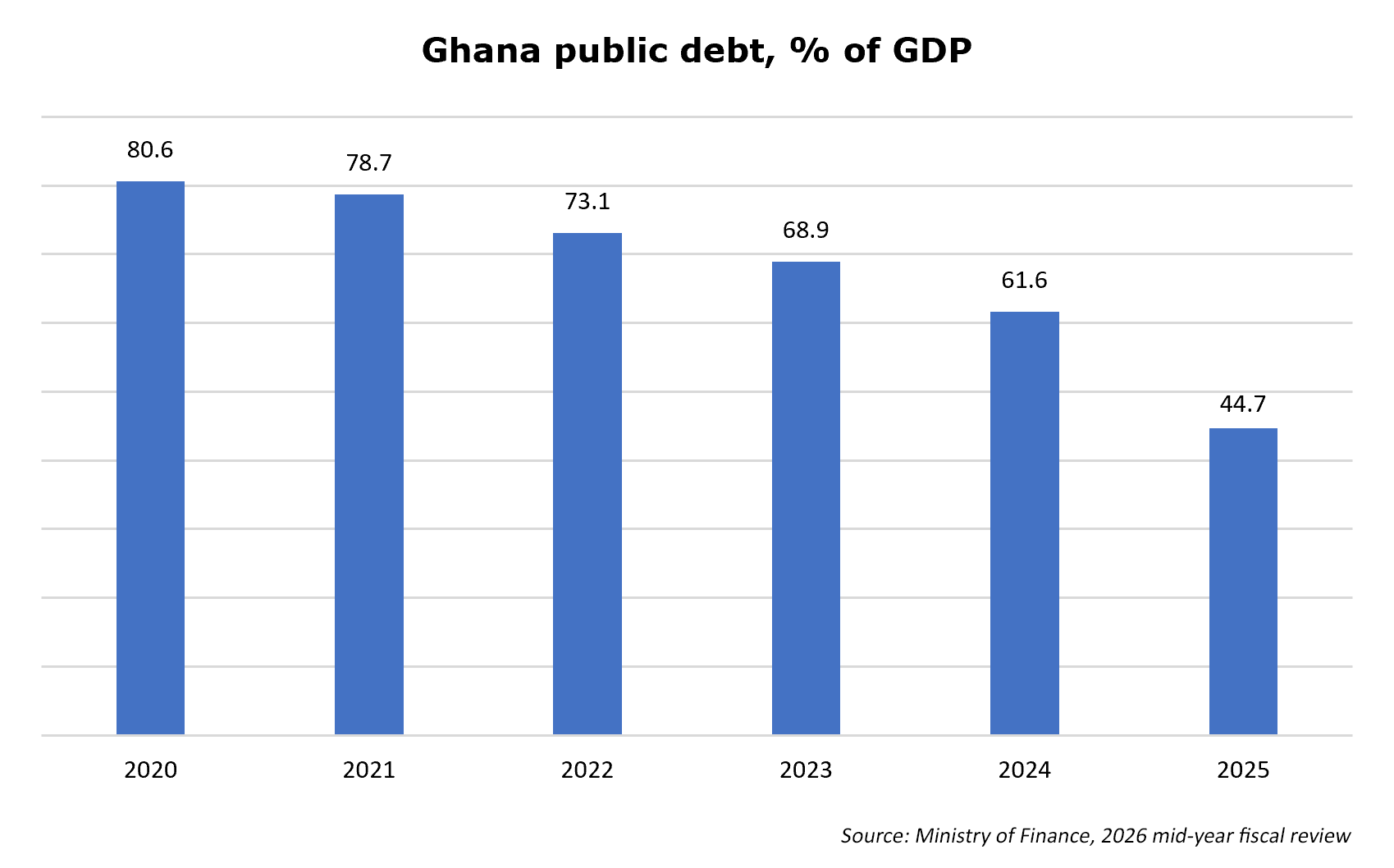
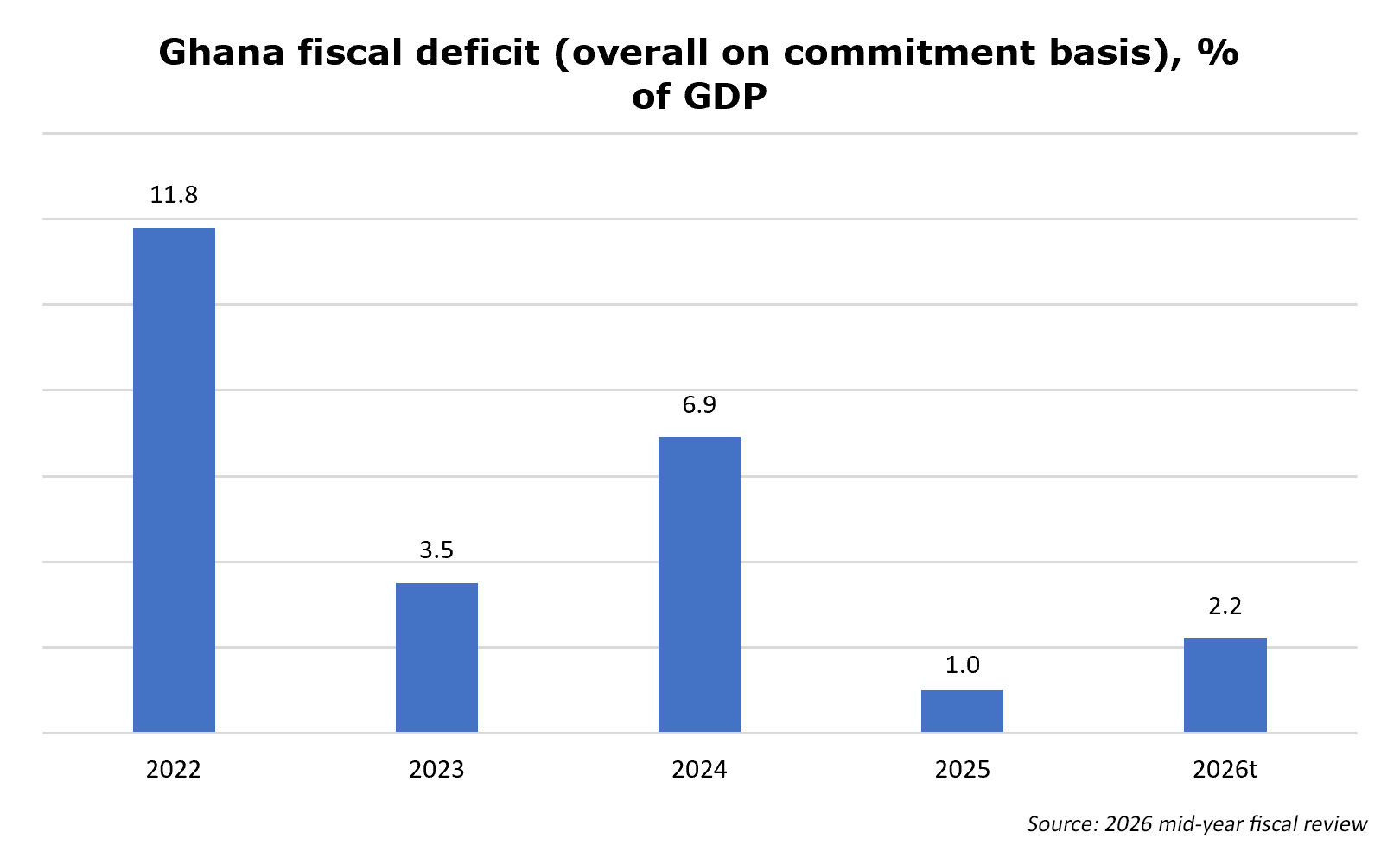
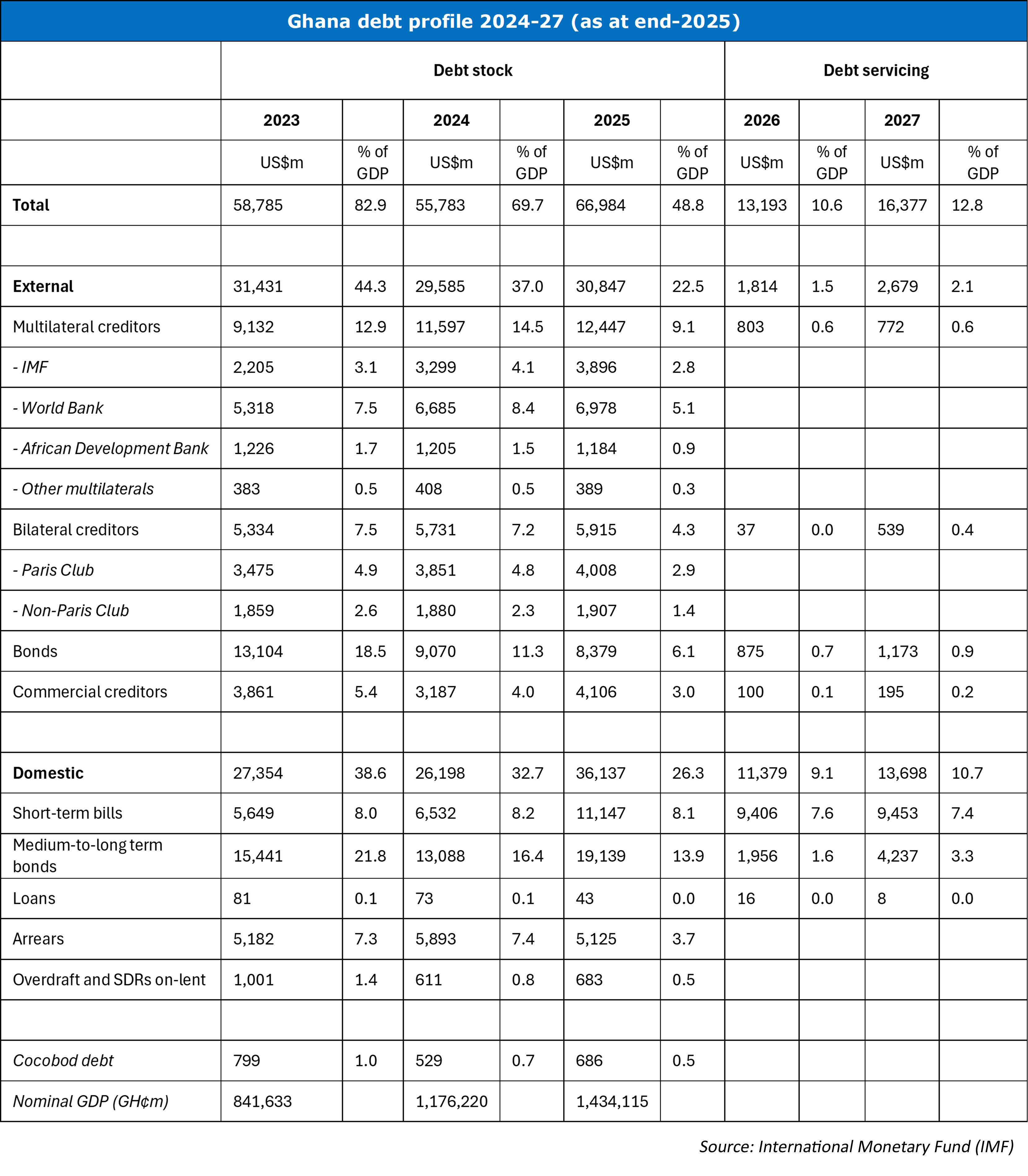
High debt servicing costs and expansionary spending are medium-term fiscal risksThe authorities have been able to achieve fiscal consolidation to an overall budget deficit (on a commitment basis) of 1% of GDP in 2025 from 7% in 2024 by spending less on capital expenditure, an approach it will have to reverse over the immediate to medium term, as the government chases higher economic growth. Public debt has reduced to 45% of GDP as at mid-2026 from 73% in 2022.[14] Following the 2022 external debt default, the authorities restructured US$13bn worth of Eurobonds, US$5.4bn in bilateral debt to official creditors, and talks with the remaining commercial creditors on debt worth US$2bn were advancing in September 2026, and the hitherto holdup in regard of the US$750m debt to the African Export-Import Bank (Afreximbank) had already been resolved and concluded by then; all under the aegis of the G20 Common Framework (see appendix). In December 2022, the authorities launched a domestic debt exchange programme (DDEP), which involved the exchange of GH¢137bn (US$11.8bn) of existing domestic public debt for new ones, with a significant portion of the almost two-thirds eventually accepted due in 2027-28, which will weigh on revenue available for non-financing expenditure in those years.[15],[16] The Bank of Ghana took a capital hit from the 2022 DDEP, raising the need to not only recapitalise it but also relieve it of other quasi-fiscal activities (printing money to finance the Ghana Gold Board, for example) that took a similar toll on its capital adequacy. In December 2025, legislative amendments were made to the central bank law to make it harder to breach the caps and safeguards on monetary financing of the government outside no more than 5% of any prior year’s revenue.[17] The BoG is expected to be fully recapitalised by end-2032, as part of reforms under the IMF’s policy coordination instrument.[18]
 Industrial policy reforms of gold, cocoa, and crude oil value chains to boost output
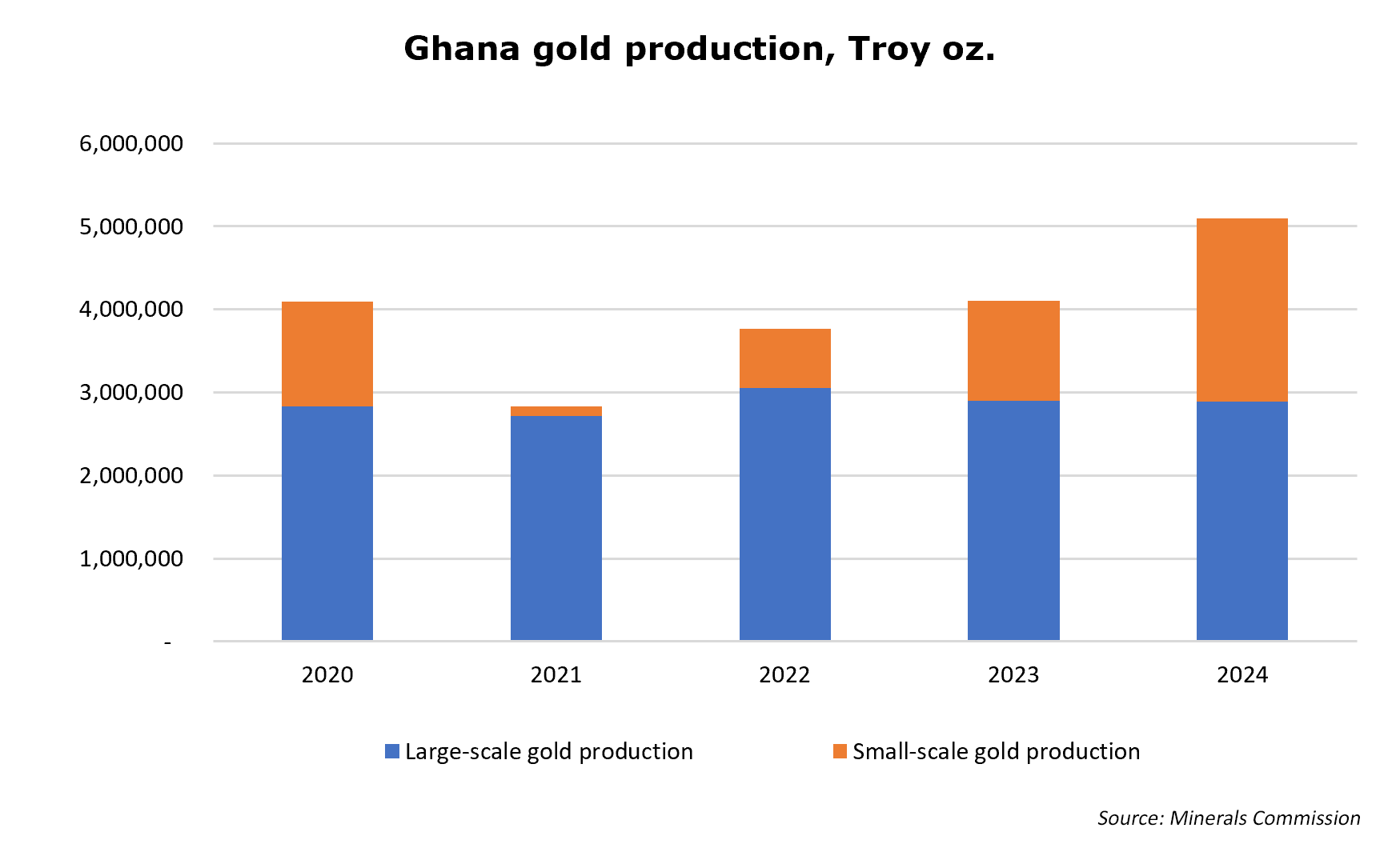
In early 2026, the Mahama administration announced that all minerals and commodities will first be processed locally before exporting by 2030, as the authorities seek greater value addition to commodities for more export revenue and incremental economic growth.[19] Rising commodity prices have also been a key motivation for recent and ongoing revisions to the country’s mining fiscal regimes. Gold prices almost tripled from almost US$1,800/troy oz in January 2022 to a high of close to US$5,300/troy oz in February 2026, although it has since declined most recently in September 2026 by about 19% to US$4,300/troy oz. From September 2026, gold purchased and aggregated from artisanal and small-scale miners (ASM) for export will first be refined locally before being shipped out.[20] In June 2026, the authorities reached an agreement to buy 30% of the gold produced by large miners from the start of the second half of 2026 for GoldBod, from 20% previously agreed for the domestic gold purchase programme.[21] After introducing a sliding-scale gold royalty regime of 5-12% in March 2026, from a previously flat 5% royalty rate, amid pushback by the Ghana Chamber of Mines, the authorities approved additional revisions to the mining law in July 2026, giving more concessions to host communities and the government over mining firms.[22],[23],[24]
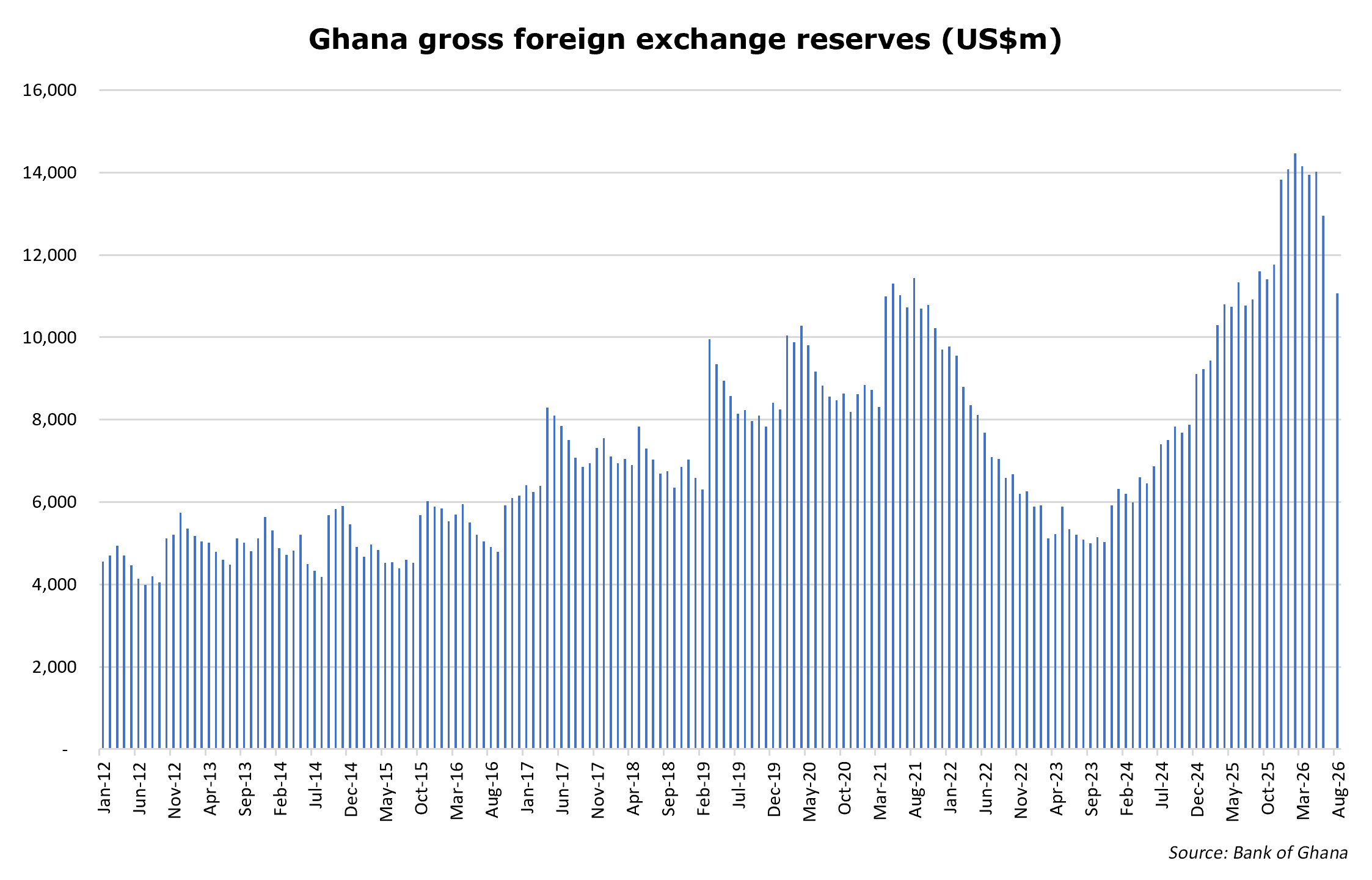
The Ghana Gold Board (GoldBod) successfully raised US$75m from local commercial banks in August 2026, its first major financing after the central bank stopped printing money for its gold purchases, due to previously huge sterilisation losses, transferring the responsibility to the government from the 2026 fiscal year.[25],[26],[27]The fiscal authorities earmarked GH¢5bn (US$427m) for domestic gold purchases in the 2026 mid-year fiscal policy review in July for the 2026-28 Ghana Accelerated National Reserve Accumulation Policy (GANRAP), which aims to boost hard currency reserves to 15 months of import cover by end-2028, from 4 months in August 2026, and targets a minimum of 8.6 months of import cover by end-2026.[28]To achieve this target, GANRAP must add an average of US$9.5bn annually to the central bank’s gross foreign exchange reserves, which stood at US$11.1bn in August 2026, although GoldBod added US$1.2bn to the balance from domestic gold purchases in September 2026.[29],[30]
 In November 2025 to June 2026, the Minerals Commission (Mincom, the regulator of Ghana’s mining sector) conducted a long overdue audit of large gold mining firms to identify the extent of what is believed to be significant under-reporting over the years (US$11bn was reportedly lost to gold smuggling in 2019-23), when routine audits did not take place.[31] Ghana’s lithium reserves will be an additional source of mining export revenue and economic growth, after the first project for US-bound lithium from the country was finally approved by the authorities in March 2026, under a sliding 5-12% sliding royalty arrangement as well.[32] Mincom will also impose minimum wage and tender standards on mining firms imminently, after a 2025 directive ordering mining firms to only contract local firms for surface operations and ensure that underground operations are only done by joint venture firms that have at least 50% Ghanaian ownership.[33]
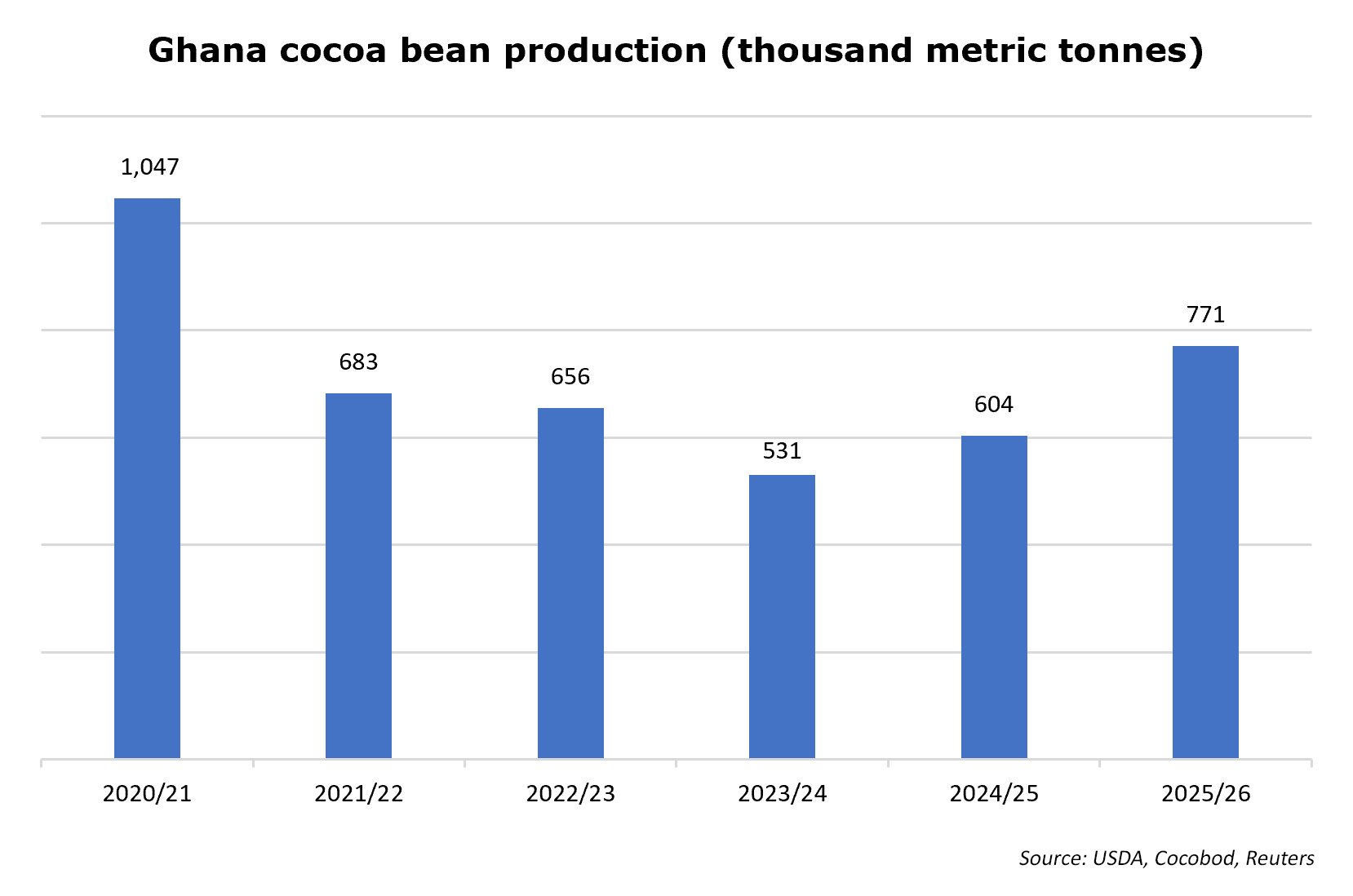 Ageing cocoa trees, which are easily diseased, and unfavourable weather will weigh on cocoa production in the 2026/27 season, with projections of 470,000 tonnes to 620,000 tonnes for the period a significant fall of at least a third from 771,000 tonnes produced in the 2025/26 season.[34],[35] To stem declining cocoa output, a revised Ghana Cocoa Board law in July 2026 has barred farmers (who have been pushing back) from using their lands for other purposes outside cocoa farming, as a rising trend of land conversion to mostly illegal gold mining (“Galamsey”) was beginning to weigh on the prospects of a cocoa industry in dire need of replacing ageing trees.[36], [37] The Ghana Cocoa Board (Cocobod) will rely on domestic financing from the 2026/27 season, after buyer-financed purchases to replace a previously internationally syndicated loan financing arrangement fell through in the 2023/24 season due to a sharp fall in cocoa production and prices, which led to severe financial losses.[38],[39],[40],[41] In August 2024, Cocobod announced that it would not be taking its traditional annual internationally syndicated loan for the 2024/25 cocoa season, the first time it would do so since the first loan for the 1992/93 season.[42] For the 2026/27 season, the authorities plan to increase the farmgate price of cocoa to GH¢2,737 (US$236) per 64kg bag from GH¢2,587 (US$223) in the concluding season, in part to stem smuggling to neighbouring producing country, Cote d’Ivoire.[43]
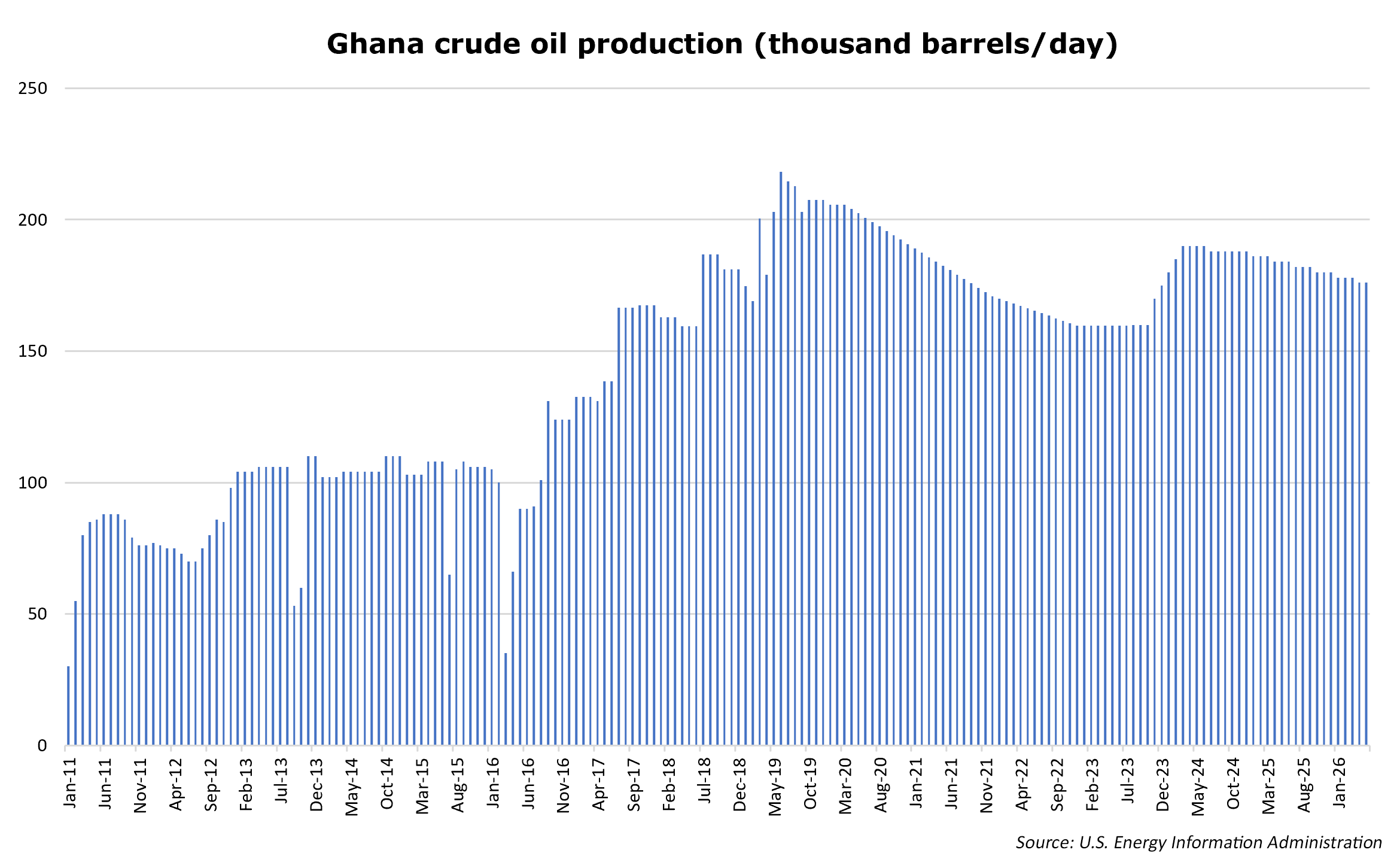
The authorities are also reviewing the regulatory framework for crude oil exploration to reverse tapering output, which peaked at 218,000 barrels/day (b/d) in June 2019, and has largely been declining ever since, most recently to 176,000 b/d in May 2026, but is set to ramp-up over the medium term, as new wells come online.[44],[45] The Chinese-built 40,000 barrels/day (b/d) Sentuo crude oil refinery is being expanded to 100,000 b/d, with plans to expand the recently refurbished state-owned Tema crude oil refinery, which came back on stream in December 2025 after being shutdown for years, although it currently operates at just a little more than half of its 45,000 b/d capacity.[46],[47] Furthermore, the authorities plan to consolidate the fiscal regimes of the mining and petroleum sectors into a proposed Extractive Industry Fiscal Regime Act (EIFRA), with technical assistance from the IMF.
Appendix
References
[1] Fitch Ratings. (2026, May 8). Fitch upgrades Ghana to ‘B’; outlook positive [Press release]. https://www.fitchratings.com/research/sovereigns/fitch-upgrades-ghana-to-b-outlook-positive-08-05-2026
[2] BMI. (2026, September 4). Macro Insight: Ghana to post another large current account surplus in 2027. https://www.fitchsolutions.com/bmi/country-risk/macro-insight-ghana-to-post-another-large-current-account-surplus-in-2027-04-09-2026
[3] S&P Global. (2026, March 27). Ghana ratings affirmed at ‘B-/B’; outlook remains stable. https://www.spglobal.com/ratings/en/regulatory/article/-/view/type/HTML/id/3538073
[4] Reuters. (2026, April 10). Moody's revises Ghana's outlook to 'positive' on improvement in domestic financing. https://www.reuters.com/world/africa/moodys-revises-ghanas-outlook-positive-improvement-domestic-financing-2026-04-10/
[5] Bruce, E. & Akorlie, C. (2026, September 9). Ghana’s economy expands 6% in second quarter, driven by communications sector. Reuters. https://www.reuters.com/world/africa/ghanas-economy-expands-6-second-quarter-driven-by-communications-sector-2026-09-09/
[6] Apubeo, A.A. (2026, August 15). Mahama announces US$10bn ‘new economy’ investment programme. Ghana News Agency. https://gna.org.gh/2026/08/mahama-announces-us10bn-new-economy-investment-programme/
[7] GIPC. (2026, July 15). Ghana Investment Promotion Centre (GIPC) now an Authority [Press release]. https://gipa.gov.gh/wp-content/uploads/2026/07/PRESS-RELEASE-PRESIDENT-PASSES-GIPA-BILL-2026.pdf
[8] Business & Financial Times. (2026, August 14). Parliamentary committee commends GIPA’s investment drive, backs key reforms. https://thebftonline.com/article/parliamentary-committee-commends-gipa-s-investment-drive-backs-key-reforms
[9] Republic of Ghana. (2026, July 6). Government of Ghana settles US$700 million Eurobond obligation [Press release]. https://www.mofep.gov.gh/index.php/news-and-events/2026-07-06/government-of-ghana-settles-us%24700-million-eurobond-obligation
[10] International Monetary Fund. (2026, July 27). IMF executive board completes the sixth review of Ghana’s arrangement under the extended credit facility, concludes the 2026 Article IV consultation, and reviews request of a 36-month policy coordination instrument for Ghana [Press release]. https://www.imf.org/en/news/articles/2026/07/27/pr25260-ghana-imf-exec-board-completes-6th-rev-arr-ecf-concludes-2026-aiv-consult-rev-req-36mo-pci
[11] Dontoh, E. & Dzawu, M.M. (2026, September 24). Ghana still cautious on rates as wars seen stoking inflation. Bloomberg. https://www.bloomberg.com/news/articles/2026-09-24/ghana-holds-rate-for-third-time-in-row-on-inflation-risks
[12] Business & Financial Times. (2026, September 8). SME lending rates nearly three times corporate rates – report. https://thebftonline.com/article/sme-lending-rates-nearly-three-times-corporate-rates-report
[13] Fitch Ratings. (2026, September 1). Ghanaian bank credit profiles improve on stronger operating environment [Press release]. https://www.fitchratings.com/research/banks/ghanaian-bank-credit-profiles-improve-on-stronger-operating-environment-01-09-2026
[14] Republic of Ghana. (2026, July 23). 2026 mid-year fiscal policy review of the 2026 budget statement and economic policy of the Government of Ghana. https://mofep.gov.gh/sites/default/files/budget-statements/2026-Mid-Year-Fiscal-Policy-Review.pdf.pdf
[15] Financial Stability Council. (2022, December 7). Government of Ghana domestic debt exchange: Potential financial sector impacts and mitigating safeguards. https://www.bog.gov.gh/wp-content/uploads/2022/12/PRESS-RELEASE-FSC-GOVERNMENT-OF-GHANA-DOMESTIC-DEBT-EXCHANGE-POTENTIAL-FINANCIAL-SECTOR-IMPACTS-AND-MITIGATING-SAFEGUARDS-7-12-22.pdf
[16] World Bank. (2026). Ghana 10th economic update – Reset for growth: Sustaining macroeconomic recovery and unlocking transport for transformation. https://documents1.worldbank.org/curated/en/099082426193065498/pdf/P513207-0a2917c8-a214-428d-9c39-983ba803af29.pdf
[17] Bruce, E. (2025, December 18). Ghana's parliament approves tighter limits on central bank financing. Reuters. https://www.reuters.com/sustainability/land-use-biodiversity/ghanas-parliament-approves-tighter-limits-central-bank-financing-2025-12-18/
[18] International Monetary Fund. (2026). 2026 Article IV consultation, sixth review under the arrangement under the extended credit facility, request for a waiver of nonobservance of a performance criterion, financing assurances review, and request for a 36-month policy coordination instrument – Press release; staff report; and statement by the executive director for Ghana. https://www.imf.org/-/media/files/publications/cr/2026/english/1ghaea2026001.pdf
[19] Republic of Ghana. (2026, February 15). Ghana to end foreign cocoa financing; process minerals locally by 2030 [Press release]. https://presidency.gov.gh/ghana-to-end-foreign-cocoa-financing-process-minerals-locally-by-2030/
[20] Ghana Gold Board. (2026, August 24). Notice to all self-financing aggregators (SFAs): Mandatory local refining of gold dore prior to export [Press release]. https://goldbod.sfo3.digitaloceanspaces.com/press-releases/N4h23MBMGxRoda7HwLUjETegOeT1p8LVDeKhVhTy.pdf
[21] Bruce, E. (2026, June 25). Ghana to buy 30% of large miners’ gold output from July 1, statement. Reuters. https://www.reuters.com/world/africa/ghana-buy-30-large-miners-gold-output-july-1-statement-2026-06-25/
[22] Bruce, E. (2026, July 15). Ghana approves revised mining law to strengthen oversight. Reuters. https://www.reuters.com/world/africa/ghana-approves-revised-mining-law-strengthen-oversight-2026-07-15/
[23] The Ghana Chamber of Mines. (2026, January 19). Balanced fiscal framework needed to sustain mining growth and national revenue [Press release]. https://ghanachamberofmines.org/news/balanced-fiscal-framework-needed-to-sustain-mining-growth-and-national-revenue/
[24] Adombila, M.A. (2026, March 5). China, US pressure Ghana to halt gold royalty hike, document, sources say. Reuters. https://www.reuters.com/world/africa/china-us-pressure-ghana-halt-gold-royalty-hike-document-sources-say-2026-03-05/
[25] Business & Financial Times. (2026, August 11). GoldBod raises US$75m from banks in test of new gold financing model. https://thebftonline.com/article/goldbod-raises-us-75m-from-banks-in-test-of-new-gold-financing-model
[26] Dzawu, M.M. (2026, August 5). Ghana Made $1.9 Billion Loss on Gold Purchases in 2025, IMF Says. Bloomberg. https://www.bloomberg.com/news/articles/2026-08-05/ghana-made-1-9-billion-loss-on-gold-purchases-in-2025-imf-says
[27] Dzawu, M.M. (2026, July 28). Ghana Earmarks $429 Million to Buy Gold, Shifting Fiscal Risks. Bloomberg. https://www.bloomberg.com/news/articles/2026-07-28/ghana-earmarks-429-million-to-buy-gold-shifting-fiscal-risks
[28] Republic of Ghana. (2026). Ghana Accelerated National Reserve Accumulation Policy (GANRAP) 2026 – 2028. https://mofep.gov.gh/sites/default/files/acts/Ghana%20Accelerated%20National%20Reserve%20Accumulation%20Policy.pdf
[29] Bank of Ghana. (2026, September 23). Summary of economic and financial data. https://www.bog.gov.gh/wp-content/uploads/2026/09/Summary-of-Economic-and-Financial-Data-September-2026.pdf
[30] Ghana Gold Board. (2026, September 30). Goldbod generates $1.8 billion in foreign exchange in September 2026; targets $1.5 billion for October 2026 [Press release]. https://goldbod.gov.gh/news/goldbod-generates-18-billion-in-foreign-exchange-in-september-2026-targets-15-billion-for-october-2026
[31] Adombila, M.A. (2025, October 30). Exclusive: Ghana orders first major audit of mining firms in a decade. Reuters. https://www.reuters.com/world/africa/ghana-orders-first-major-audit-mining-firms-decade-2025-10-30/
[32] Ibukun, Y. & Dontoh, E. (2026, March 20). Ghana Approves Lithium Project That Will Ship Mineral to US. Bloomberg. https://www.bloomberg.com/news/articles/2026-03-20/ghana-approves-lithium-project-that-will-ship-ore-to-the-us
[33] Adombila, M.A. (2026, September 10). Ghana is drafting wage, tender floors for mining contractors, official says. Reuters. https://www.reuters.com/business/world-at-work/ghana-is-drafting-wage-tender-floors-mining-contractors-official-says-2026-09-10/
[34] Parija, P. (2026, September 3). Ghana Cocoa Output May Sink by More Than a Third, Marketer Says. Bloomberg. https://www.bloomberg.com/news/articles/2026-09-03/ghana-cocoa-output-may-sink-by-more-than-a-third-marketer-says
[35] Bior, A.D. (2026, September 23). Ghana cocoa output hits 771,000 tons, exceeding forecast, report says. Reuters. https://www.cnbcafrica.com/2026/ghana-cocoa-output-hits-771000-tons-exceeding-forecast-report-says
[36] Bruce, E. (2026, August 13). Ghana’s cocoa farmers push back against new law on land use. Reuters. https://www.reuters.com/business/environment/ghanas-cocoa-farmers-push-back-against-new-law-land-use-2026-08-13/
[37] Srem, E. (2026, July 21). Ghana’s illegal gold mining crisis: A national security threat with regional implications. Africa Center for Strategic Studies. https://africacenter.org/spotlight/galamsey-ghana-gold-mining-security/
[38] Etefe, J. (2026, February 12). Gov’t reworks cocoa model after US$1bn setback. Business and Financial Times. https://thebftonline.com/2026/02/12/govt-reworks-cocoa-model-after-us1bn-setback/
[39] Bruce, E. & Akorlie, C. (2026, September 23). Ghana’s cocoa regulator pitches $1.4 billion domestic financing plan. Reuters. https://www.reuters.com/world/africa/ghanas-cocoa-regulator-pitches-14-billion-domestic-financing-plan-2026-09-23/
[40] Dogbevi, E.K. (2026, September 14). China Capital: Ghana Cocobod’s multibillion-cedi profit masks a record of financial recklessness. Ghana Business News. https://www.ghanabusinessnews.com/2026/09/14/china-capital-ghana-cocobods-multibillion-cedi-profit-masks-a-record-of-financial-recklessness/
[41] Bruce, E. & Akorlie, C. (2026, February 12). Ghana cuts farmgate cocoa price, introduces new financing model. Reuters. https://www.reuters.com/world/africa/ghana-cuts-farmgate-cocoa-price-introduces-new-financing-model-2026-02-12/
[42] Adombila, M.A. & Akorlie, C. (2024, August 20). Ghana cocoa regulator will not raise a syndicated loan for the 2024/25 season, CEO says. Reuters. https://www.reuters.com/markets/commodities/ghana-cocoa-regulator-will-not-raise-syndicated-loan-202425-season-ceo-says-2024-08-20/
[43] Dontoh, E. (2026, September 9). Ghana Plans 6% Cocoa Price Hike, Risking More Ivorian Smuggling. Bloomberg. https://www.bloomberg.com/news/articles/2026-09-09/ghana-plans-6-cocoa-price-hike-risking-more-ivorian-smuggling
[44] Reuters. (2026, September 3). Chevron, Shell sign preliminary agreement with Ghana as country reviews oil and gas sector. https://www.reuters.com/business/energy/chevron-shell-sign-preliminary-agreement-with-ghana-country-reviews-oil-gas-2026-09-03/
[45] Aklorbortu, D.K. (2026, July 14). Ghana’s oil sector rebounds as 5 of 6 Jubilee wells completed. Daily Graphic. https://www.graphic.com.gh/business/business-news/ghanas-oil-sector-rebounds-as-5-of-6-jubilee-wells-completed.html#google_vignette
[46] Ekanem, S. (2026, July 18). Ghana bets on its first privately owned $1.98 billion refinery in push to produce 70% of its fuel. Business Insider. https://africa.businessinsider.com/local/markets/ghana-bets-on-its-first-privately-owned-dollar198-billion-refinery-in-push-to-produce/q20pcky
[47] Etefe, J. (2025, December 27). Tema Oil Refinery resumes crude refining after years-long shutdown. Business and Financial Times. https://thebftonline.com/2025/12/27/tor-resumes-crude-refining-after-years-long-shutdown/