Replicating the Dangote-India B2B model for African industrialisation
A viable and immediately actionable private sector-led model for African industrialisation
By Rafiq Raji
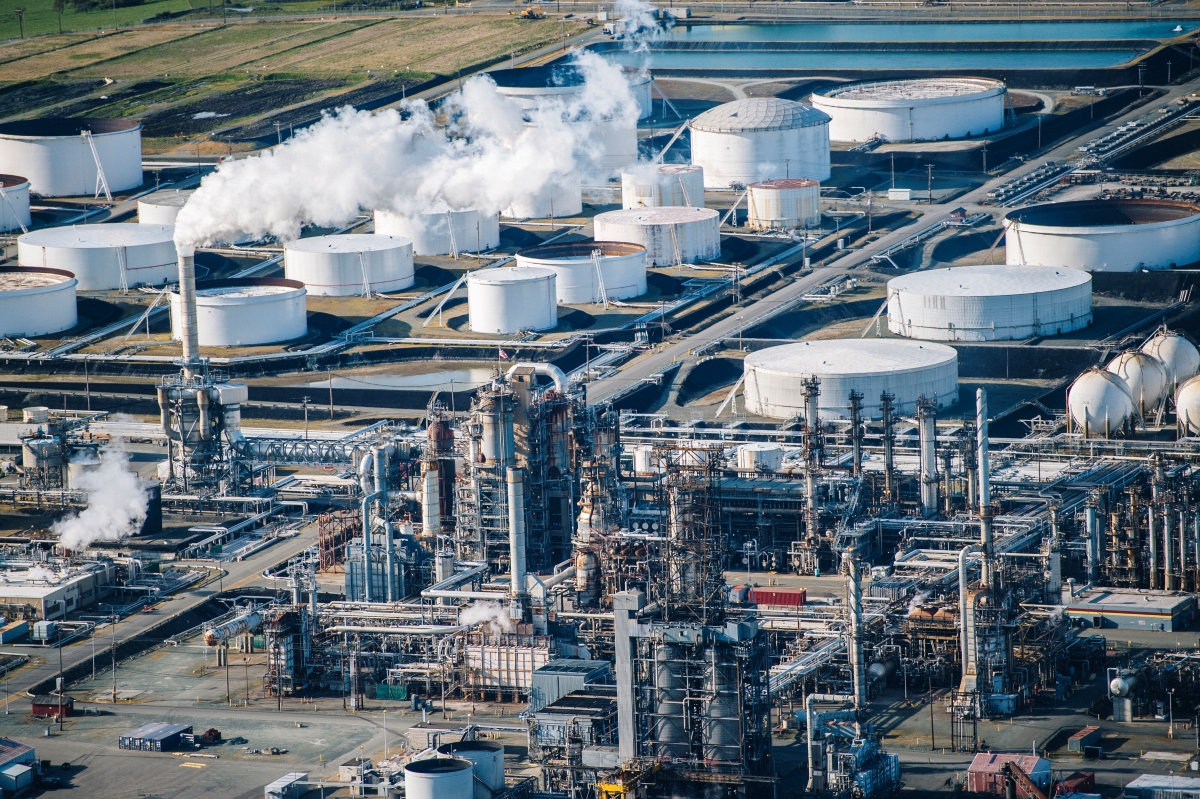
The industrial feats of Nigeria’s Aliko Dangote in cement manufacturing across more than a few African countries, and more recently in crude oil refining and petrochemicals via his 650,000 barrel/day refinery in Nigeria, which was built with Indian expertise (and increasingly adjudged as one of the key success factor) offers a viable and immediately actionable private-sector led model for African industrialisation. Indian industrial competencies are not a match for China’s now globally acclaimed industrial excellence, but they suffice for Africa’s industrial needs. And they are available with little strings attached if they are commercially sought. African firms, not African governments, should process African commodities with purchased Indian industrial expertise. The business-to-business (B2B) approach that has enabled Dangote Industries’ heavy manufacturing venture with India’s Engineering India Limited (EIL) in crude oil refining can be replicated by other African firms in their industrialisation quests; in crude oil refining, steel manufacturing, and battery minerals refining.
 Traditional African development partnerships have been deindustrialising
More than half a century since colonialism, African industrialisation continues to be underwhelming. Although western development financing has historically targeted extractive models in African economies, the positive contrast of their Asian contemporaries suggests African deindustrialisation has a more nuanced explanation. Raw materials, financing and expertise are key industrialisation minimums. To succeed, Asia, including India, tapped its diasporan talent base, saved and pooled local capital, and made industrialisation a development policy imperative. African countries have not been similarly intentional, although political instability, frequent wars, and corruption have not enabled the conducive environment for such strategic thinking and action. African state-owned enterprises have not been able to replicate the industrial successes of their Asian counterparts either. Ultimately, a historical reliance on Western money by African economies, which are often mismanaged, and deliberately steered towards extraction of commodities for processing abroad, has left the region hugely reliant on imports for the most basic manufactured goods: food, fuel, fertiliser, cement, steel, chemicals and other heavy manufactures. 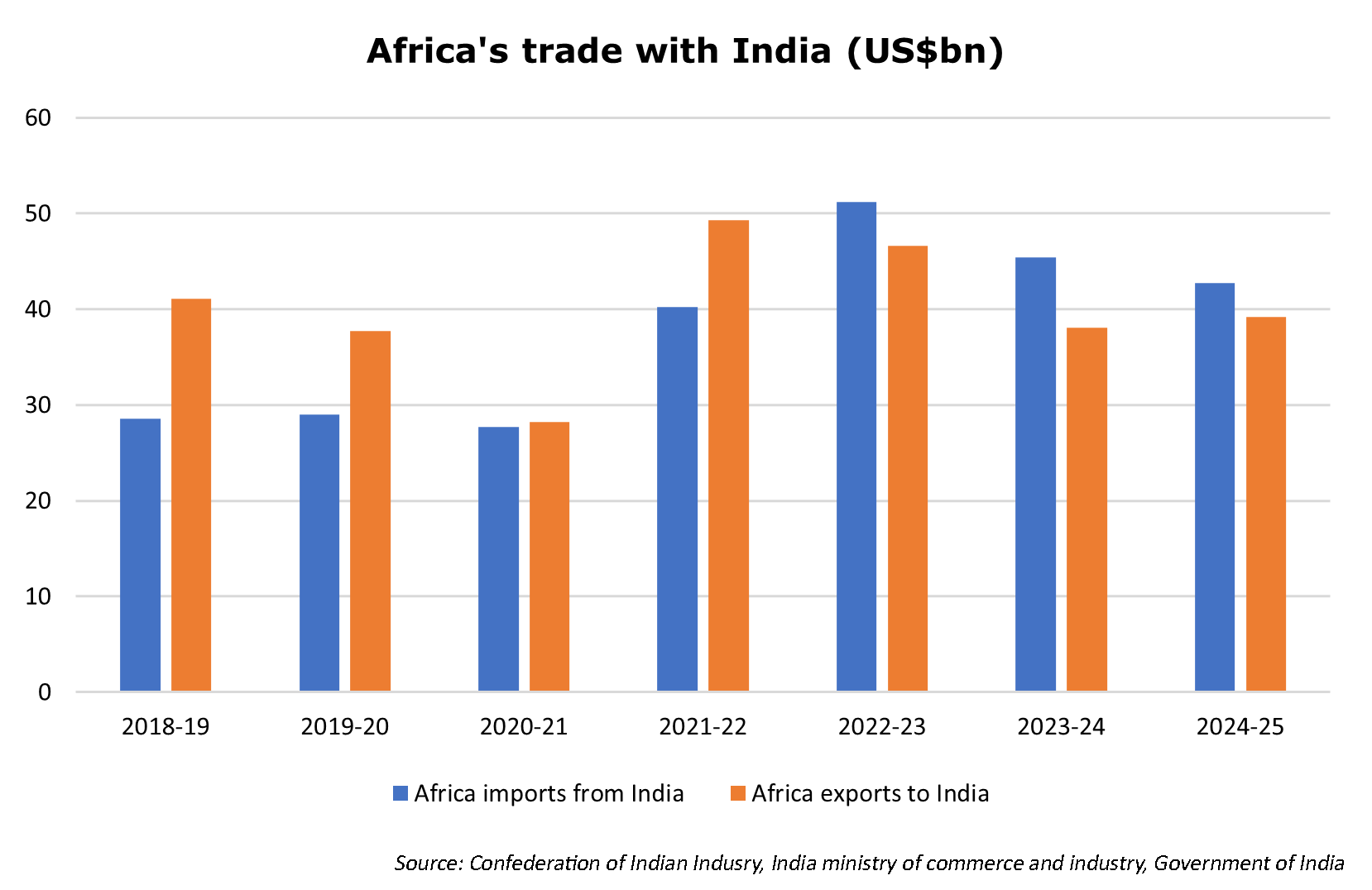 Looking eastward to Asia, especially China, has enabled a slight change in Africa’s developmental fortunes. But even with China, the extraction model remains unfortunately intractable. Like the West, China has been extracting African commodities to process on its mainland for export to Africa and the World. Until May 2026, when Chinese-bound African goods will be tariff-free, China did this by taxing manufactured African goods higher than it did African raw materials. Chinese investment in African infrastructure and industries has also been tied to Chinese finance and Chinese labour. And Chinese engagement with the African continent have almost entirely been government-to-government, with fully Chinese industrial operations (via its state-owned enterprises) along the commodities value chain they are involved in. African governments have begun to pushback against this familiar deindustrialising trend with more aggressive industrial policies. More African governments, which are increasingly motivated by the prospects of green industrialisation, now insist on a minimum level of processing for their commodities. While Chinese firms mining African minerals have been receptive to supporting this industrialisation imperative, in part due to US pressure to reduce its global trade surplus, the economic trade-offs, development-constraining political economy of most African countries, and geopolitical power imbalance of the relationship in favour of China, will potentially conspire to make this a very long winding road back to the existing deindustrialising extractive model.[1]
Incidentally, “the convergence of Africa’s resource abundance and India’s industrial dynamism offers a rare window for mutually beneficial cooperation.”[2] As a middle power, India does not yet have a strategic need for a deindustrialised Africa, nor does it have the financial resources to steer its African relationships in that direction if it wants to. Indian industrial competencies are not a match for China’s now globally acclaimed industrial excellence, but they suffice for Africa’s industrial needs. And they are available with little strings attached if they are commercially sought. African firms, not African governments (via their state-owned enterprises or joint ventures), can process African commodities with purchased Indian expertise. Indian capital is already well-invested in African light manufacturing. “Indian companies have invested substantially in Africa totalling approximately US$75bn across various sectors, including pharmaceuticals, IT, automobiles, banking and mining (CII 2025).” That Indian industrial competencies in heavy industries have been underrated or simply overlooked in African industrialisation thinking and policymaking in favour of its expertise in services, especially information and communications technology, is not entirely surprising. Globally, India has become for Information and communications technology what China has become for manufacturing.
Indian industrial competencies suffice for Africa’s immediate industrial needs
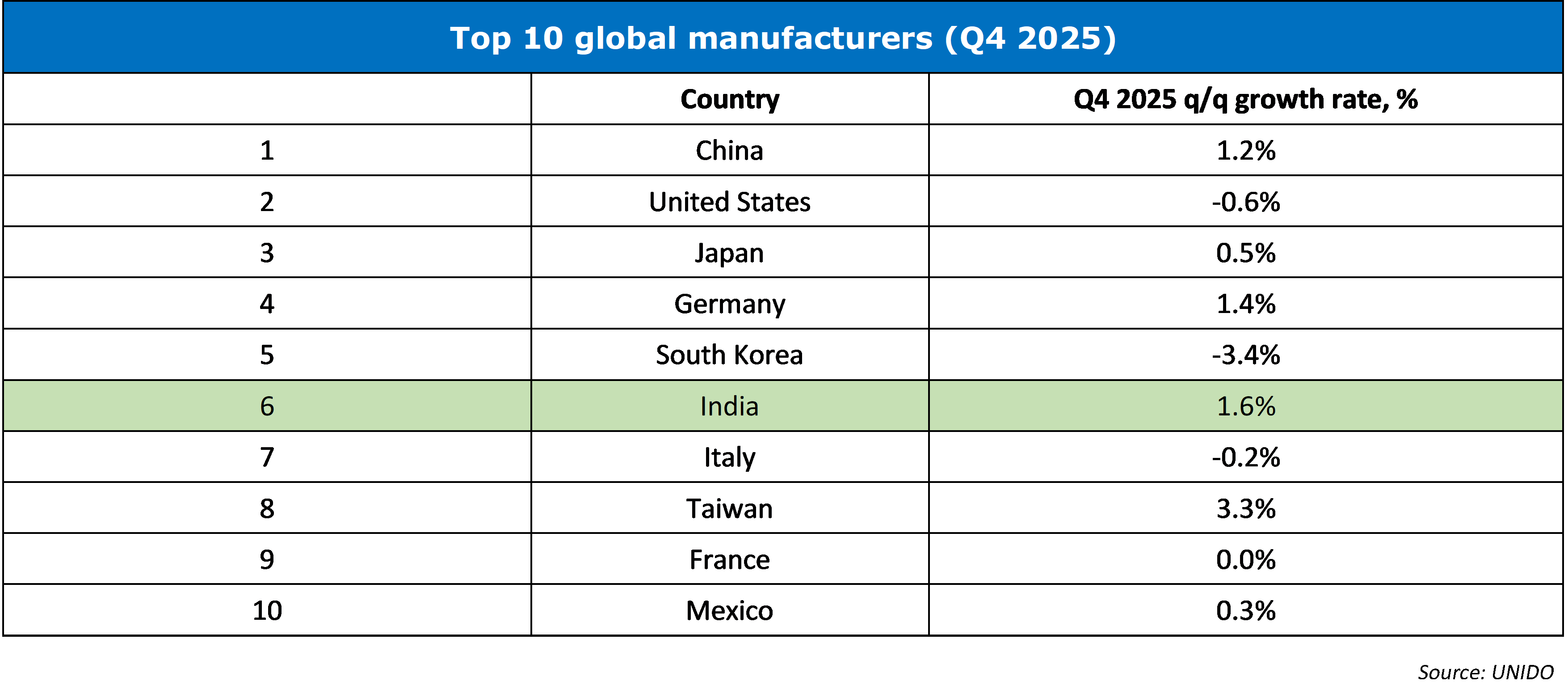
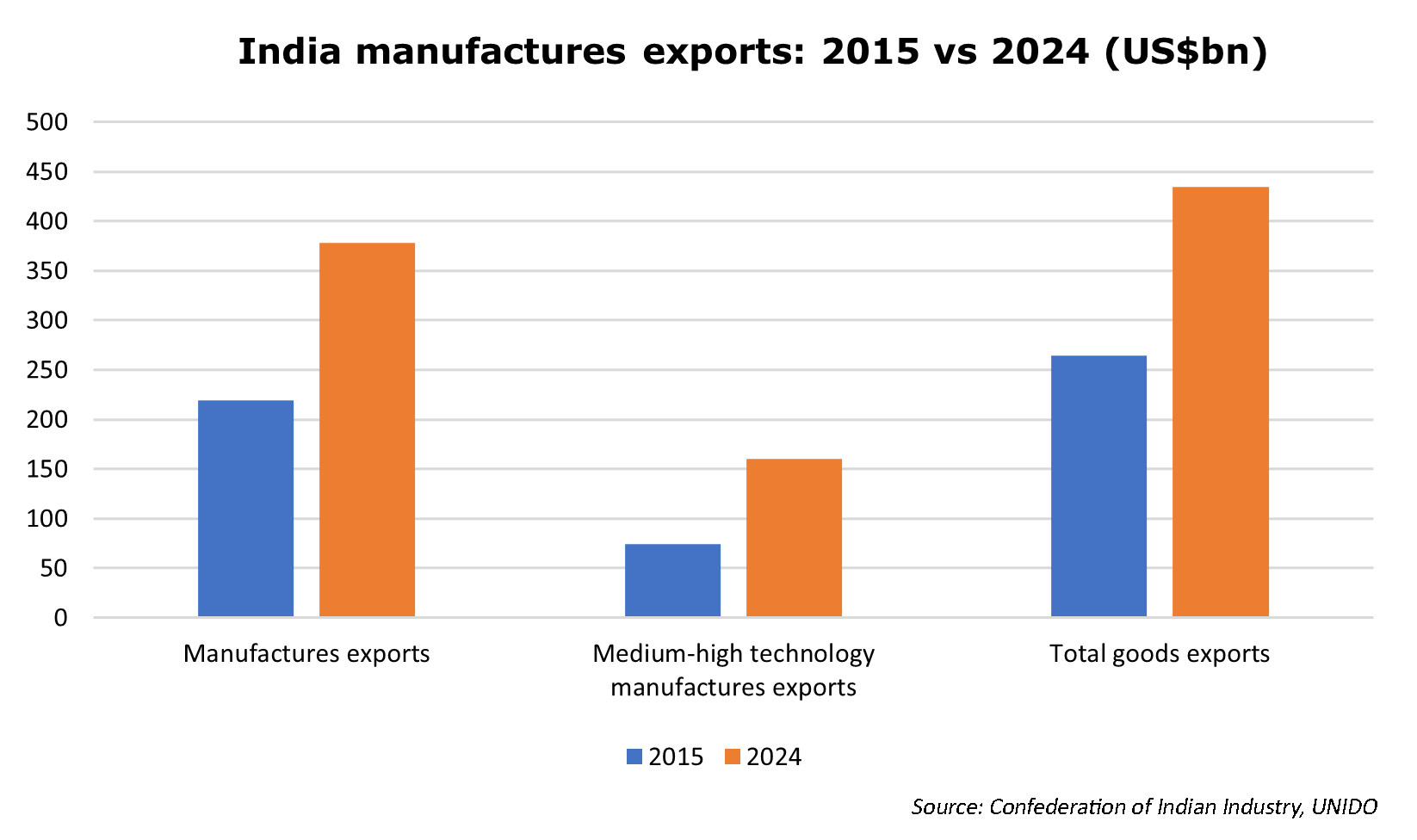
India’s industrial expertise, as understated as it is, is above the global average.[3] In fact, India is the sixth largest manufacturer in the world, ahead of Italy (7th), Taiwan (8th), France (9th) and Mexico (10th); only beat by China (1st), United States (2nd), Japan (3rd), Germany (4th), and South Korea (5th); based on United Nations Industrial Development Organization (UNIDO) data for end-2025.[4] Many of the manufactures that African countries import India produces for itself in factories it built by itself. African countries looking to industrialise can do so commercially by procuring Indian industrial expertise. The historical evidence is abundantly clear: African countries will not be able to industrialise sustainably with state-owned enterprises, as they have mostly underwhelmed thus far. India did not do so well with state-owned enterprises either. India’s industrial success only began to be assured when it embraced a private sector-led approach in the early 1990s.
“India’s industrial expertise in sectors like electric vehicles, capital goods, electronics, pharmaceuticals and automobiles can significantly contribute to Africa’s industrial development (CII 2025).”[5] India is the leading innovation economy amongst lower middle-income countries, ahead of Vietnam and the Philippines, and ranks 38th globally, according to the 2025 Global Innovation Index by the World Intellectual Property Organization (Mauritius ranks 53rd, Morocco 57th, and South Africa 61st.). Even so, the IMF in its November 2025 Article IV India report highlights how “about 50% of research and development spending is executed by the government of India compared to about 10% on average in advanced economies” (large Indian private firms spend a great deal on R&D though), adding that “Indian firms also stand out for their relatively low adoption of foreign technology”. In other words, even though India is not yet a paragon of global industrial innovation leadership, its competencies are not only clearly indigenous and certainly good enough for Africa’s requirements, India is strategically motivated to share them commercially.
Heavy industrialisation in South Korea, Japan, and Taiwan relied on a small cohort of highly-driven family-led firms. Like these Asian counterparts, India’s industrial giants like Reliance Industries (crude oil refining), Tata Industries (steel milling), Mahindra & Mahindra (automobile manufacturing) and others are also government-enabled entrepreneur-led businesses. It is not unlikely that a similar cohort of African industrialists will be able to replicate this Asian model. Unfortunately, African entrepreneurs have historically limited their industrial ambitions to agro-processing and light manufacturing ventures. The political economy of many African countries and its deliberately deindustrialising international development partnerships have been significant weighing factors. However, a confluence of factors may have begun to encourage more ambitious African entrepreneurial risk-taking.
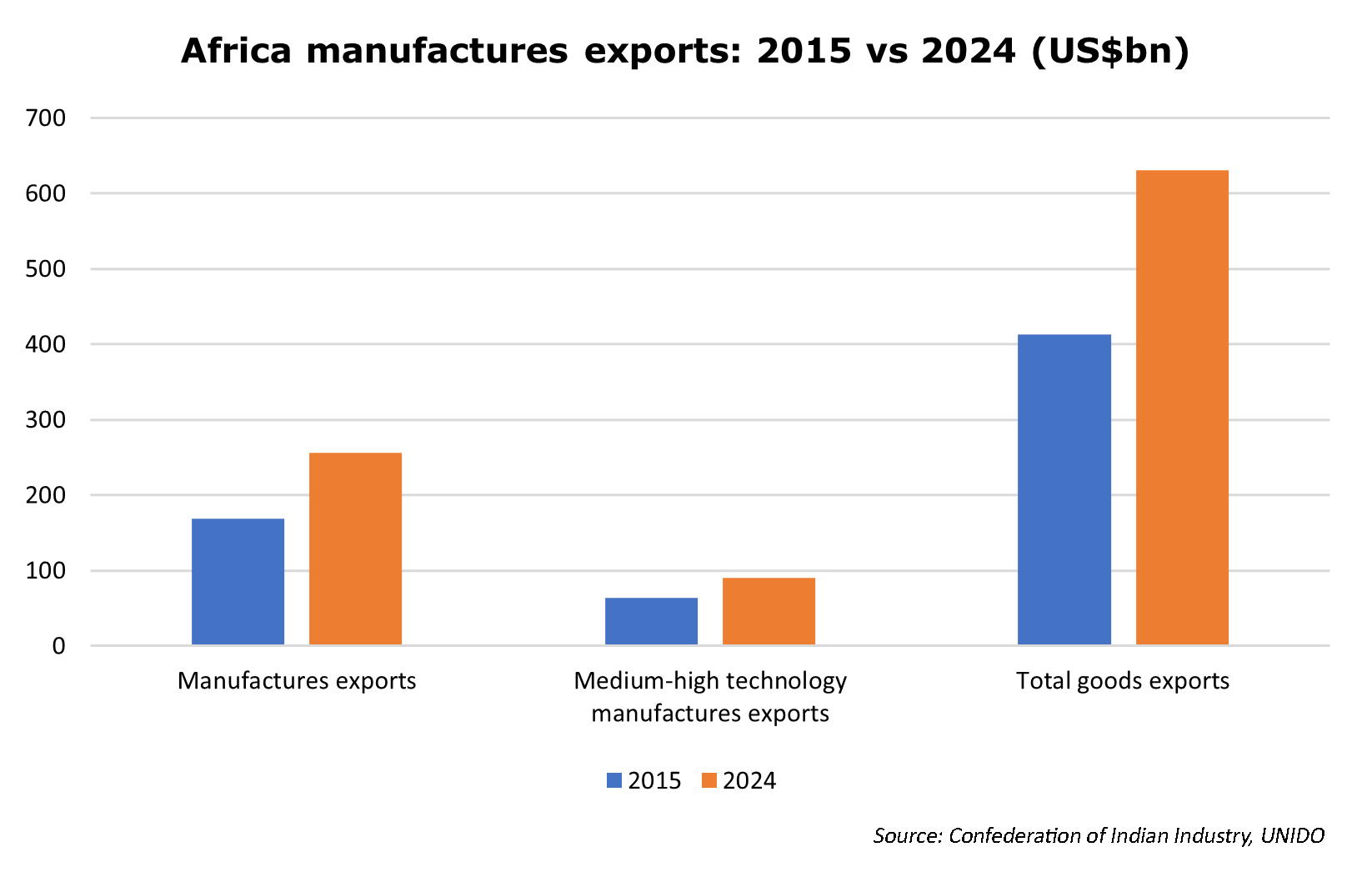 With Nigerian government support, the industrial feats of Nigeria’s Aliko Dangote in cement manufacturing across more than a few African countries, and more recently in crude oil refining and petrochemicals via his 650,000 barrel/day refinery in Nigeria, which was built with Indian expertise (and clearly one of the key success factors) offer a viable and immediately actionable private-sector led model for African industrialisation.[6],[7] Africa accounts for almost a tenth of global crude oil production, but largely imports its fuel; with even the region’s most advanced economy, South Africa, having crude oil refining capacity for just two-fifth of its fuel requirement, thus having to import the rest.[8] Africa’s mostly aged crude oil refineries, which as are mostly state-owned, are stuck from mismanagement, with repeated under-maintenance making them now very expensive to repair, and the construction of new ones constrained not only by financing but by foreign trade partners reluctant to cede their surplus, as well as a corruptly conniving African political elite happy to continue living on extractive rents over more painstaking long-term development-enhancing refining. Incidentally, Nigeria’s Aliko Dangote is quite literally following India’s Mukesh Ambani’s industrial trail.[9] Ambani’s Reliance Industries, a Fortune 500 company, owns the Jamnagar Refinery in India, the world’s largest. Dangote Industries has announced plans to increase the capacity of its refinery to match Jamnagar refinery’s 1.4m b/d using Indian technical expertise. India’s Engineers India Limited will again lead the project management as well as the engineering, procurement and construction management for the Dangote refinery expansion, after successfully doing so for the first phase of 650,000 b/d single-train facility for the plant.[10]
 There is an opportunity to similarly procure Indian expertise for African green industrialisation, especially the refining of battery minerals, as a competitive alternative to Chinese firms. African governments can support African firms to mine battery minerals (or be supplied the government share of mined minerals as seed capital) for processing using procured Indian expertise like Dangote Industries has done for crude oil processing. It is hard to see a downside to this approach. Chinese firms, which currently dominate the battery minerals mining scene in the region, will at the very least be more motivated to facilitate the region’s green industrialisation objectives. At best, local firms with procured Indian industrial expertise will compete with Chinese ones to refine African battery minerals. This will be significantly different from the Made in Africa by India status quo in African light manufacturing. Like their Indian analogues, these African industrialisation ventures will be locally-led, rely on local and international capital, using procured Indian industrial expertise towards eventually fully indigenised industrial operations.
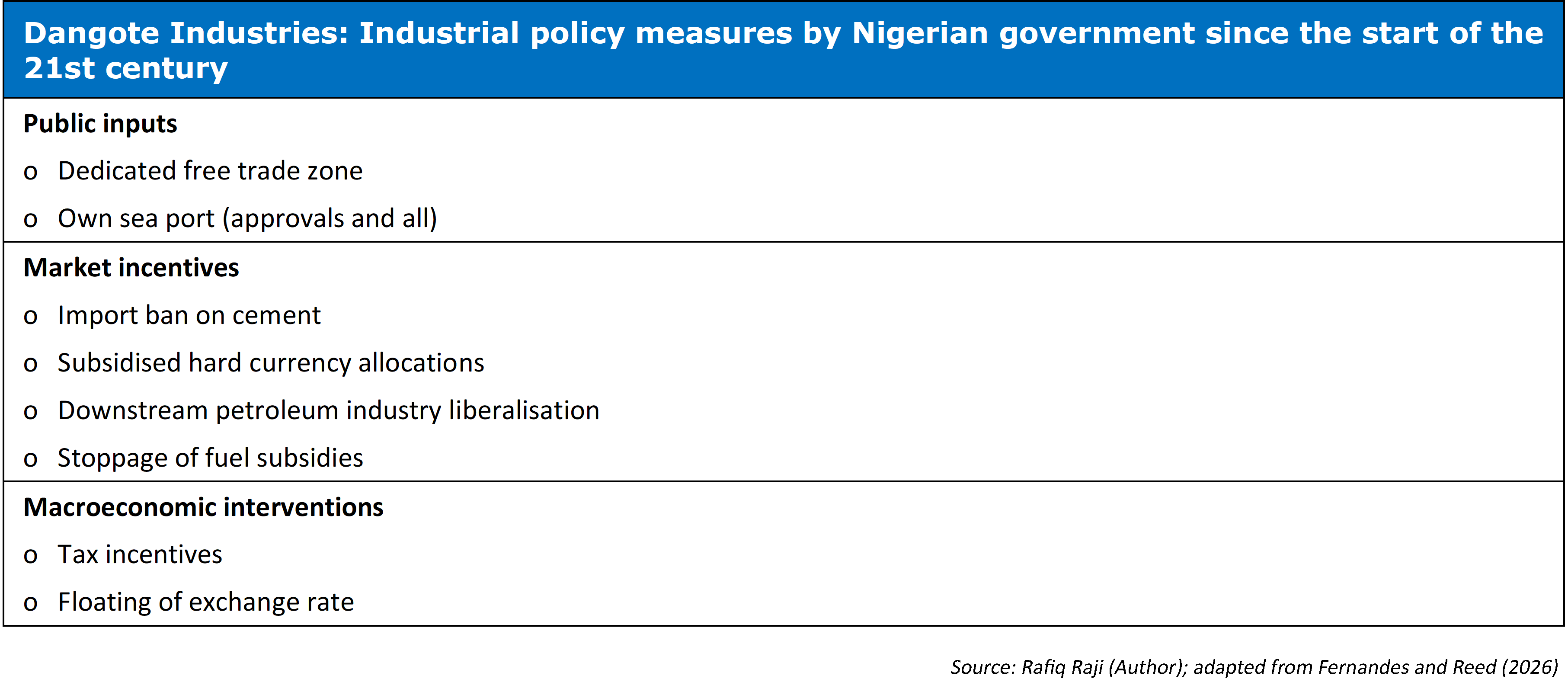
Dangote Industries’ cement business benefited from Nigeria’s industrial policy measures to manufacture cement locally, and was granted regulatory and tax incentives that enabled it become the dominant cement supplier in Nigeria, which it then leveraged to expand continentally. Dangote Industries’ success with cement manufacturing first seized on a large untapped local Nigerian market, and thereafter expanded to other African markets. For crude oil refining, the plant is situated in a dedicated special economic zone with regulatory and tax incentives that are enabling it compete internationally. Dangote Industries’ crude oil refining business enjoys significant Nigerian industrial policy advantages: A dedicated free trade zone, its own sea port (approvals and all), fuel import restrictions, subsidised hard currency allocations during the refinery construction, tax incentives, downstream petroleum industry liberalisation by the Nigerian government, and the stoppage of fuel subsidies. Dangote Industries also enjoyed unprecedented financing support from African development finance institutions, especially the Africa Export-Import Bank. Even so, it is highly doubtful the Dangote refinery would have been completed in the face of so many great odds if it did not have a mostly Indian contractor, management and workforce.
African firms should be supported to partner with Indian firms for heavy manufacturing
The World Bank criticises how Nigeria’s industrial policy measures enabled Dangote Industries’ cement business to become a monopoly, instead of creating a competitive cement industry.[11] Arguably, however, the industrial patronage that Dangote cement got did not go to waste, as it enabled Dangote Industries to use its balance sheet to build Africa’s largest crude oil refinery, which The Economist highlights in a March 2026 article. Inevitably, industrial policy measures end up propping select firms that are allied with the dominant political parties or government of the day. But it is doubtful Dangote Industries would have been able to make such great strides without the generous advantages its ventures were provided by successive Nigerian governments. Flawed as it is, a replication of this success will have to follow the same model. Leading entrepreneurs in respective African countries should be selected, nudged to venture into heavy manufacturing, and aided with diplomatic resources to engage middle powers that are strategically motivated to partner for African industrialisation.
The remarkable feat of the 650,000 barrels/day Dangote refinery, especially considering the many ways it could have failed, rests on three pillars viz. (1) The entrepreneurial acumen of its promoter Aliko Dangote; (2) Targeted Nigerian industrial policy measures to support Dangote Industries; and (3) Determined Indian industrial partnership. They are not mutually exclusive. There are examples of African industrialisation efforts that had competent industrial policy and willing international partners but failed owing to poor or exclusion of entrepreneurial talent (since state-owned enterprises have been the default platforms). For a heavy manufacturing undertaking like a crude oil refinery, a combination of entrepreneurial acumen and biased industrial policy would have underwhelmed in the face of an unwilling international partner like India. With Indian government approval and self-interested support, a business-to-business approach enabled Dangote Industries to procure the expertise required to build the refinery from Engineers India Limited (EIL), which though state-owned, operates as a business and is listed on the Bombay Stock Exchange. India itself used the B2B approach to enable its own industrialisation. India’s Reliance Industries, which owns the world’s largest crude oil refinery, has lately been trying to expand into green energy industrialisation using this tested B2B strategy by buying the equipment required for electric vehicle battery manufacturing from Chinese firms, although it now faces restrictions by the Chinese government on procuring the Chinese expertise needed to set the plant up in India.12xii]
The Reliance-China B2B holdup enables a contrast of how the Dangote-India B2B success could have been similarly constrained by the Indian government. It is not unlikely that India itself might come to view its existing technological expertise as too strategic to share with Africa in the future. The Reliance-China B2B attempt at Indian green industrialisation also highlights the approach that African countries should adopt to force the hand of China, whose firms dominate the African battery minerals scene, and would be reluctant to transfer their technological expertise (as the Reliance Industries’ example shows) even if they buckle to the industrial policy measures being forced upon them by African governments to refine the battery minerals they mine before exporting them. Unlike India, African countries like the Democratic Republic of Congo (cobalt), Zambia (copper) and Zimbabwe (lithium) have leverage, since they have the battery mineral endowments in the significant quantities that China and the world need. India is strategically motivated to partner with Africa in its quest for the refining of its battery minerals because India itself is still trying to gain the technological expertise for doing so and would need Africa’s battery mineral endowments in that quest.
The B2B approach that has enabled Dangote Industries’ heavy manufacturing venture with India’s EIL in crude oil refining can be replicated by other African firms; in crude oil refining, steel manufacturing, and battery mineral refining. African joint ventures experiences have been underwhelming. China’s success with technology transfer from western firms was due to their desire to access its large domestic market. Fragmented African markets have constrained the ability of African firms to do the same, although the African Continental Free Trade Area (AfCFTA) should ultimately change that. Being able to pay for requisite technological expertise was hitherto also a constraint. But even when financial capacity was adequate, western firms have typically not transferred their technological expertise to their African partners beyond basic maintenance capabilities. From turnaround maintenance, replacement of worn-out parts, expansion of production capacity, to the engineering, procurement and construction of new plants, western firms have historically and systematically engineered African dependence; to ensure continued viability of their home markets’ manufactures exports. A strengthened Africa-India industrial partnership will ultimately evolve to a point that India itself will begin to have a strategic need to limit its technological openness. Thus, the window for leveraging Dangote Industries’ success will increasingly thin out. Even so, there are other middle powers with capabilities similar to India’s that other African firms will be strategic to explore for the various heavy industrial needs of the continent that remain unmet.
Between refining its crude oil and battery minerals, as well as making its own steel, Africa could finally make the industrial transition that has shockingly eluded it for more than three decades after the East Asian miracle. Import-substitution and export-oriented manufacturing are not mutually exclusive. The import substitution approach can still be a viable industrialisation path for African countries if past mistakes are corrected. With protectionism on the rise in highly industrialised economies, import substitution has actually now become a necessity for African economies. But state-owned enterprises will not be well-suited to the task, in light of their consistent failure across the region over the years. And while production subsidies that target specific firms will be political patronage and prone to corruption, it is hard to see an alternative. Yes, “industrial policy is a government action expected to increase a strategic business activity (Fernandes & Reed 2026)”.[13] But lagged ex post advice to Africa by the World Bank in April 2026 for more structured and competition-focused industrial policy contradicts the evidence. When industrial policy has succeeded it was ‘industrial patronage.’
Where industrial policy has succeeded, specific firms were targeted. In fact, had Dangote Industries not been specifically targeted by the Nigerian government, its success at such a scale would have been unlikely. No one expects the World Bank to support industrial patronage, but African governments should not have any confusion about how industrial policy is ultimately industrial patronage when it works. Select African entrepreneurs need to be hugely incentivised to take the huge risks required to achieve success at scale; and as the Dangote Industries’ case shows, it almost always requires tolerating a monopoly (or at worst an oligopoly of a few select large firms), which in the African case tend to have to be allied with ruling political parties, or like in the Dangote Industries’ case, are strategically allied with the government of the day. In the same way that Dangote Industries has partnered with India on crude oil refining, other African firms can partner with India for developing their respective heavy manufacturing sectors.
References
[1] Raji, R. (2025, September 5). China-Africa trade scenarios amid global tariff war. Nanyang Business School. Retrieved from https://www.ntu.edu.sg/cas/news-events/news/detail/china-africa-trade-scenarios-amid-global-tariff-war
[2] Gopaul, P. & Vaidyanathan, V. (Eds.) (2026). The Africa-India Blueprint for Growth. New Delhi: Centre for Social and Economic Progress. Retrieved from https://csep.org/wp-content/uploads/2026/02/The-Africa%E2%80%93India-Blueprint-for-Growth.pdf
[3] India joins BRICS Centre for Industrial Competencies to promote manufacturing sector (2026, February 4). Economic Times. Retrieved from https://manufacturing.economictimes.indiatimes.com/news/industry/india-joins-brics-centre-for-industrial-competencies-to-promote-manufacturing-sector/127906644
[4] United Nations Industrial Development Organization (2026). Q4 2025 Manufacturing production and trade. Vienna: UNIDO. Retrieved from https://stat.unido.org/portal/storage/file/publications/qiip/World_Manufacturing_Production_2025_Q4.pdf
[5] Confederation of Indian Industry (2025). India-Africa momentum: A purpose-driven partnership. New Delhi: CII. Retrieved from https://www.cii.in/International_ResearchPDF/India%20Africa%20Report%202025.pdf
[6] Africa’s richest man has ambitious plans for the continent (2026, March 17). The Economist. Retrieved from https://www.economist.com/middle-east-and-africa/2026/03/17/africas-richest-man-has-ambitious-plans-for-the-continent
[7] Hayes, C. (2025, December 3). Aliko Dangote, the richest black man in the world, details $5B India partnership as he expands oil, petrochemicals, and fertilizer empire. Yahoo! Finance. Retrieved from https://finance.yahoo.com/news/aliko-dangote-richest-black-man-220700162.html
[8] Mark, M. (2026, March 25). African economies brace for fuel shortages as Iran conflict hits energy. Financial Times. Retrieved from https://www.ft.com/content/25959ede-3d9b-4d3e-8218-b878cc2f9a32
[9] Jain, A. (2025, November 29). Aliko Dangote is about to become the Ambani of Africa. Nanyang Business School. Retrieved from https://www.ntu.edu.sg/cas/news-events/news/detail/aliko-dangote-is-about-the-become-the-ambani-of-africa
[10] India’s EIL secures $350M contract for Africa’s biggest Dangote refinery (2026, January 18). Economic Times. Retrieved from https://economictimes.indiatimes.com/industry/indl-goods/svs/engineering/indias-eil-secures-350m-contract-for-africas-biggest-dangote-refinery/articleshow/126637491.cms
[11] World Bank (2026). Making industrial policy work in Africa. Washington DC: World Bank. Retrieved from https://openknowledge.worldbank.org/server/api/core/bitstreams/a3b14692-06fa-48e6-808a-45bacf1c885b/content
[12] Sachdev, A. (2026, April 14). China’s control over tech is threatening India’s manufacturing dreams. Bloomberg. Retrieved from https://www.bloomberg.com/news/features/2026-04-14/china-s-controls-on-battery-ev-tech-hurt-india-s-manufacturing-ambitions
[13] Fernandes, A.M. & Reed, T. (2026) Industrial policy for development: Approaches in the 21st century. Washington DC: World Bank. Retrieved from https://openknowledge.worldbank.org/server/api/core/bitstreams/b98ce474-f652-4b58-8c74-a65210da7d4c/content