African development requires cheaper sustainable debt
Rising cases of hidden debt and use of debt derivatives to reduce borrowing costs are reactions to overpriced external debt
By Rafiq Raji
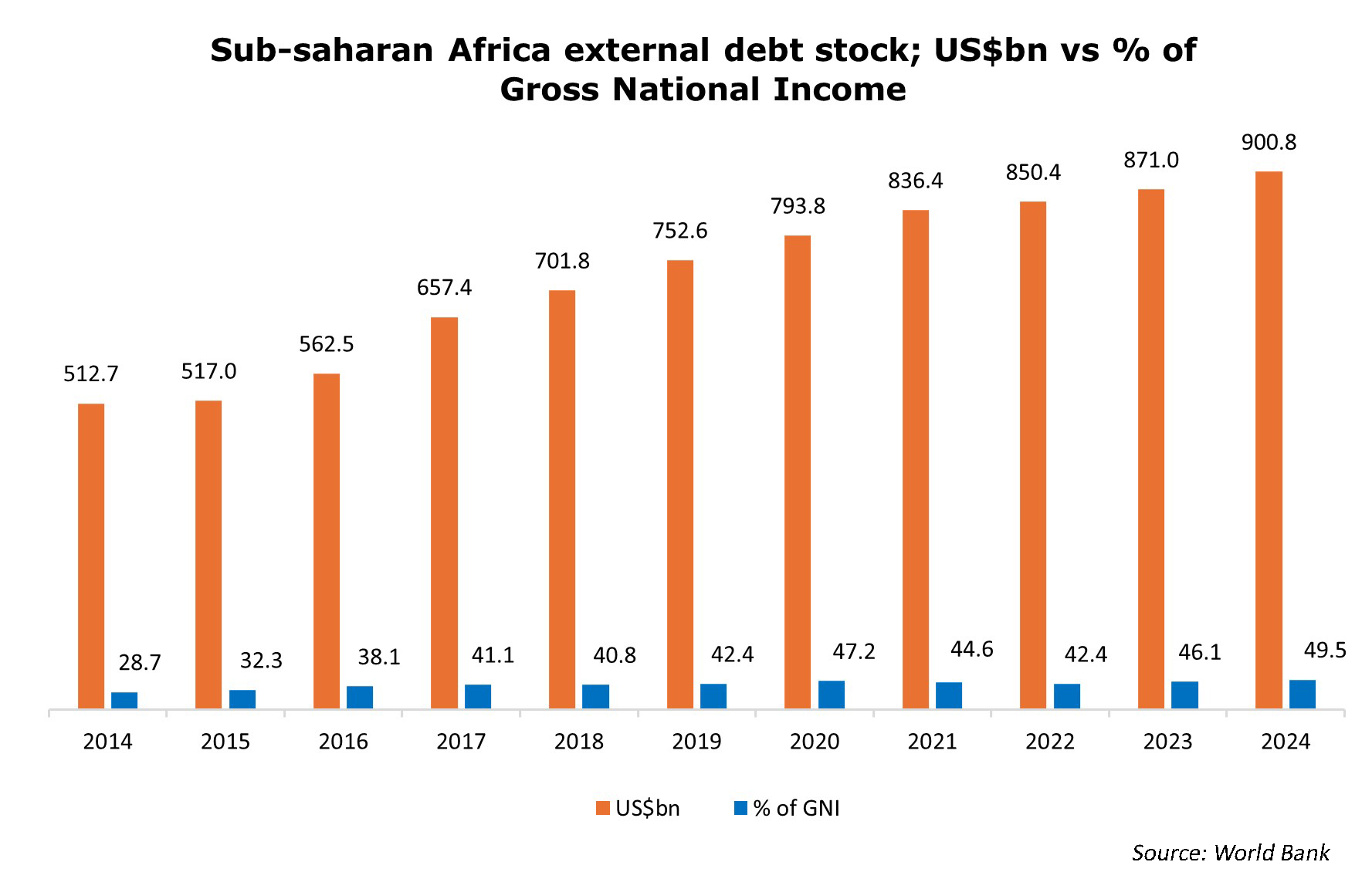
Ghana, Zambia and Ethiopia are expected to conclude their external debt restructuring under the G20 Common Framework in 2026. At least another two African sovereigns, potentially Senegal and Mozambique, will probably agree to rework their external debt before end-2026. The comparability of debt treatment amongst creditors to African sovereign debtors undergoing restructuring under the Common Framework continues to remain a challenge. The preferred creditor status of African development financial institutions (DFIs) is another bone of contention, as well as their rising role as a leading source of external financing for African governments. The use of debt derivatives, and the broader issue of hidden debt, have come to fore as well, but the more recurring difficulty of getting African debt to be less expensive continues to endure. The sustainable issuance of domestic debt that attracts foreign portfolio investment with manageable exchange rate risk is also in focus.
African debt restructurings under G20 Common Framework advance
Current African debt restructurings under the G20 Common Framework are almost completed. Ghana and Zambia are negotiating with commercial creditors, and signing individual bilateral restructuring agreements with official creditors, but Ethiopia is held up in a legal dispute with its bondholders.[1] The fiscal misreporting by Senegal, a potential (if not imminent) new entrant into the Common Framework, highlights transparency challenges with debt management by African sovereigns, and continued mistrust by global market participants who price in their misgivings into higher yield requirements. The latest challenge with Senegal’s debt relates to newly undisclosed total return swaps, which Senegalese authorities used to avoid defaulting on its external debt, and which they argue allowed them to borrow externally at relatively lower costs.[2] Similarly debt-distressed Mozambique, another likely (if not imminent) entrant into the Common Framework, is expected to agree a debt restructuring ahead of an expected IMF programme.[3]
 The Ethiopian debt restructuring holdup is a recurrence of disagreements between official creditors and Eurobond holders over comparability of treatment across the deals under the G20 Common Framework thus far.[4],[5] Debt-distressed Senegal, which has been fiscally constrained since the disclosure of US$13bn in hidden debt led to the suspension of its US$1.8bn IMF programme in 2024, is highly likely to apply for debt restructuring under the G20 Common Framework, despite the government’s reluctance to do so. In any case, it is highly unlikely the IMF would agree to resume its financing without the authorities agreeing to a debt restructuring.[6] More than half of sub-Saharan African countries currently have an IMF programme, with more expected to apply for financial support owing to the shocks of the Iran war.[7] Apart from Senegal, Mozambique is also expected to default on its external debt in 2026-27 and thus require debt restructuring under the G20 Common Framework, which for Africa since 2020 has thus far superintended debt restructurings of Chad, Ghana, Zambia and Ethiopia.[8]
The preferred creditor status of African development financial institutions came into focus during the debt restructuring negotiations of the current cohort of sovereigns under the G20 Common Framework. A major contention was whether an African DFI qualified as a multilateral lender if it had shareholders that are not sovereign states. To forestall such an ambiguity in the future, the Trade and Development Bank announced in April 2026 that it had shed itself of non-sovereign shareholders.[9] The African Export-Import Bank (Afreximbank) does not appear keen on doing similarly, although it continues to assert its status as a multilateral lender. African DFIs can pool greater amount of capital if they welcome commercial shareholding, especially African ones, although the norm is increasingly being established that the trade-off will be to give up preferred creditor status in that case. Afreximbank’s concession to take losses in the Ghana debt restructuring establishes this precedent.[10]
African sovereigns are seeking lower borrowing costs
African authorities have been exploring various creative structures to overcome high external debt costs, some of which tend to also game debt ratios used by market participants in determining debt sustainability. For instance, the IMF argues Kenya’s use of future tax income in project financing, which as per the industry practice are off-balance sheet arrangements, should be treated as on-balance sheet debt.[11] This is curious. Ultimately, multilateral lenders like the IMF and World Bank should be more focused on authorities using revenue, actual or securitized, for development purposes. Project finance arrangements, which rely on future cashflows from projects being financed (from road tolls, levies, etc.), tie the hands of governments toward using financing for development, unlike the traditional debt arrangements where authorities can put debt financing to myriad discretionary uses, which are almost always wasteful recurrent expenditure. Creditors tend to pay no mind to such diversions in so far as the authorities have the capacity to repay. It is not unreasonable for the IMF to incorporate such embargoed revenues as debt in its own analysis. But as IMF lending is concessionary, this should not be a major constraint if authorities can show ability and capacity to repay.
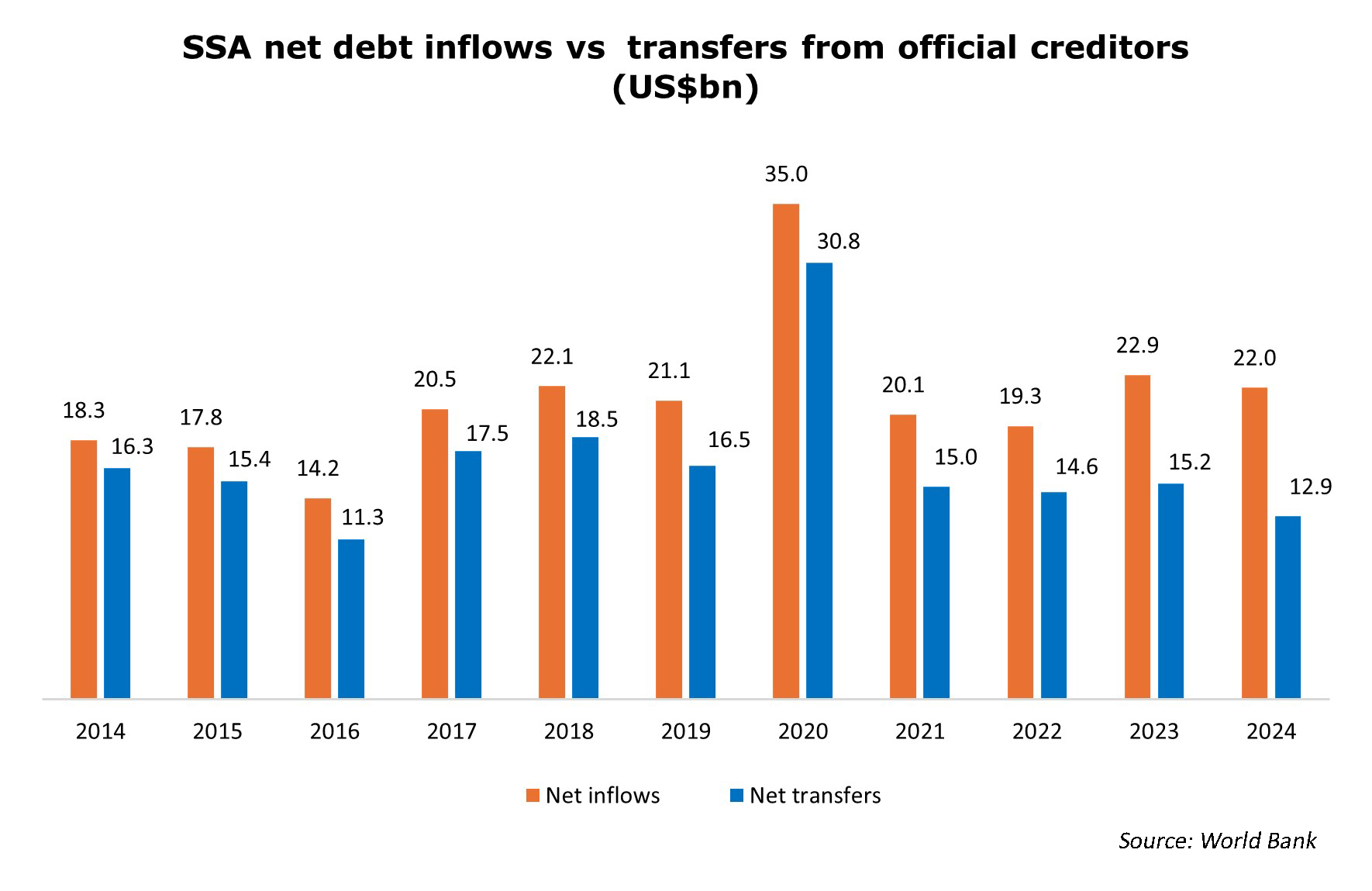 Surprisingly, multilateral lending has become progressively expensive, including most shockingly, lending rates of the IMF and IBRD, which tripled at the least for the IMF from 1% to about 4% in 2020-24.[12],[13] Interest rates for even supposedly cheaper Chinese debt to African sovereigns have also more than doubled to 5.7% from 2.5% owing to the Iran war, although this probably also reflects a changing perception of African debt risk by Chinese lenders.[14] The conversion of Kenya’s Chinese dollar loans to yuan to cut costs is another example of the growing need by African sovereigns for diversification of funding sources beyond the US dollar.[15] How to move from debt provision based on debt servicing capacity to debt for investment and development is a recurring challenge. A structuring of debt agreements to ensure governments use debt proceeds for investment, which are often stated but rarely conditioned or enforced, has become an imperative. Some creative structures are emerging. While ex post arrangements in this regard like debt-for-nature, debt-for-education swaps and other debt-for-development swaps are attempts to move the investment objective forward, debt will be better structured for developmental purposes at the outset, whereby incremental debt drawdowns are tied to developmental milestones to ensure that authorities and financing partners are structurally invested in debt proceeds being used for development rather than just servicing and refinancings.[16],[17],[18]
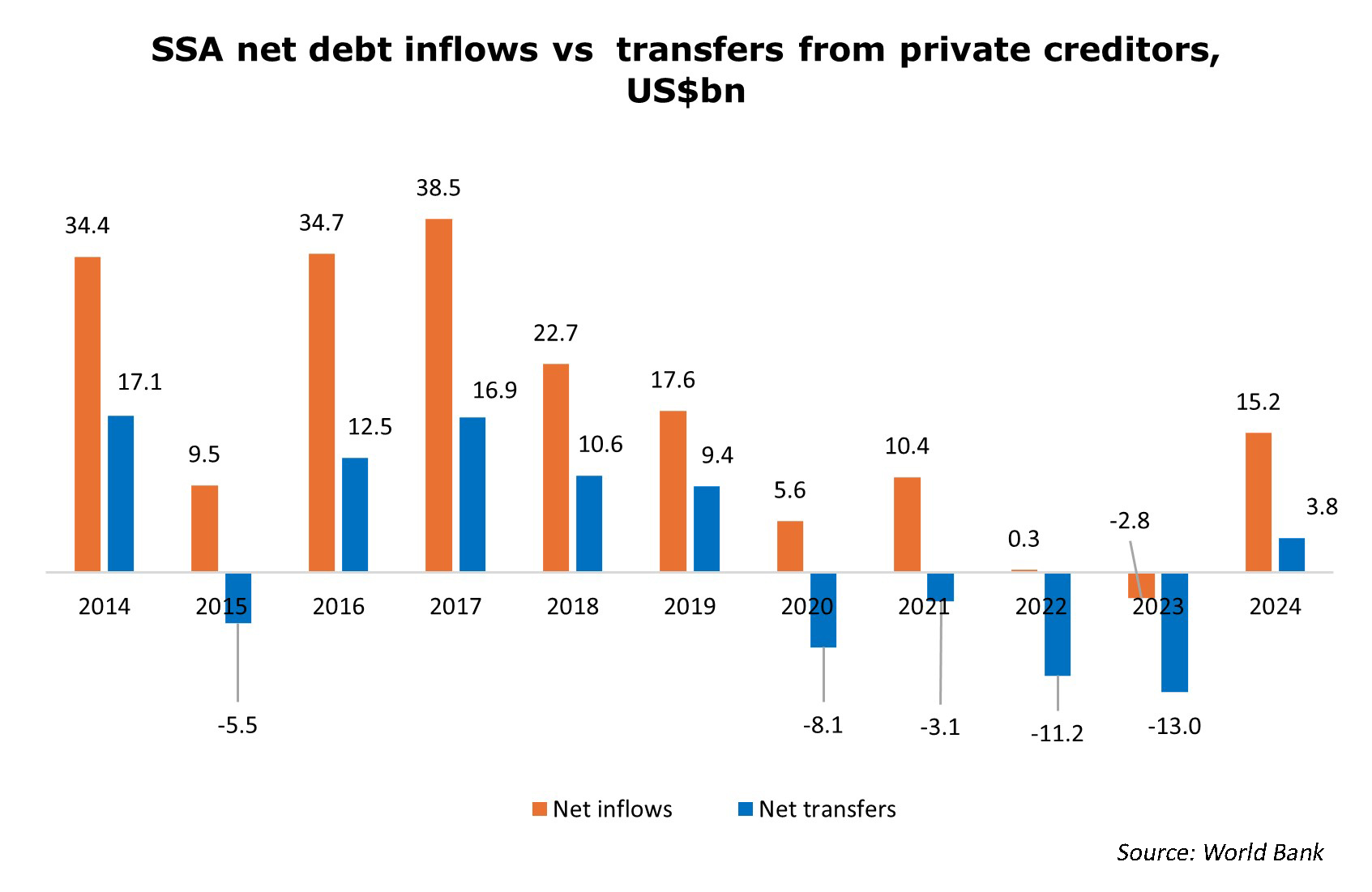 While African sovereigns have relatively modest trade exposures to the Middle East war, market participants have been pricing in relatively lower risk for net oil exporters, some of which have used the opportunity to raise new external debt, with the debt of net oil importers priced dearer owing to higher inflation risk.[19] Net fuel importer Kenya requested for an emergency World Bank loan to deal with the shocks of the Iran war in April 2026.[20] African sovereigns like Senegal, Angola and Nigeria that have resorted to debt derivatives like total return swaps argue they are cheaper than Eurobonds, which is so because the counterparties collateralise their exposure with domestic debt, which are not included in debt restructurings.[21],[22] Senegal, for instance, argues it was able to use total return swaps to get external debt at about 7%, almost half of yields of 11-12% with Eurobonds.[23] Eurobond creditors are understandably up in arms about these derivatives arrangements, and may insist in future issuance documentation that domestic debt be included in any potential restructuring. Even so, it highlights how African Eurobonds could be cheaper. Without competition hitherto, market participants were not incentivised to price African Eurobonds accurately, which by many credible analyses should be relatively cheaper than they have been historically. If African sovereigns are able to borrow externally relatively cheaply outside the Eurobonds ecosystem, why would they do otherwise? Ultimately, the challenge remains that the so-called African ‘prejudice’ risk premium has been enabling a vicious cycle of unsustainable debt, defaults and costly restructurings. To reverse this trend, African debt needs to be accurately priced, else African sovereigns and other commercial creditors will continue to look for ways to fill the gap that has been created by the entrenched mispricing.
African sovereigns have lately also been resorting to issuing more domestic debt over external debt, especially as they are increasingly accompanied by more hard currency inflows from foreign portfolio investors, although the Iran war has triggered some risk-off reversals.[24] The use of derivatives with domestic debt as the underlying instrument widens the utility of using local currency borrowing to draw in external capital at relatively lower cost over Eurobonds. Relatively higher cost of external borrowing for African sovereigns is partly also a supply issue. If African sovereigns have a diversified pool of capital to draw from, the pricing of currently expensive Eurobonds will have to be adjusted to be competitive. The efforts of African DFIs towards unlocking underused African capital estimated to be up to US$4trn in the continent’s commercial banks, insurance companies, pension funds and sovereign wealth funds, for developmental investments across the continent, is a reflection of this understanding.[25] African sovereigns like Senegal and Ivory Coast are also increasingly looking to sub-regional markets for debt financing, targeting sub-regional and continental DFIs, which have lately been taking on greater allocations of issuances.[26],[27] African sovereigns believed to be relatively unaffected by the war like Angola or strategically well placed for the emerging battery energy era like the Democratic Republic of Congo, have taken advantage of these sentiments to recently issue Eurobonds on relatively better terms.[28],[29],[30]
Volatile foreign portfolio investment in African domestic debt is a recurrent complication, which have been a source of risk as the Iran war escalates.[31],[32] It could be argued, however, that the surging trend of total return swaps collateralised with domestic debt might actually be a potential solution to the volatility risk, since they are relatively more stable, and that perhaps African sovereigns would be better served to steer the direction of hot money towards such arrangements. Growing global demand for riskier but higher yielding domestic African bonds is motivating an imminent new frontier markets index by JP Morgan (FTSE Russell has been operating one since 2021) to track them, although it may need to adjust its US$500m minimum threshold for inclusion in its current indices for its coverage to be differential.[33] Before the Iran war, S&P Global estimated African sovereigns faced more than US$90bn in external debt repayments in 2026, which is palpably conservative in the aftermath of the start of the Mideast conflict.[34] African multilateral lenders have also come to realise a unified front will be necessary to move the African development agenda forward, especially as they are better positioned for more optimal interventions for debt-distressed African sovereigns if they do so collectively, which they have begun to do since 2024 under the aegis of the Alliance of African Multilateral Financial Institutions (also known as the Africa Club).[35]
There was a positive turn in sentiment towards relatively lower borrowing costs for African sovereigns in early 2026, with up to US$6bn in Eurobond sales as at late February 2026, which included those of Kenya, Benin and Ivory Coast, a record start for an issuance year since 2013.[36],[37],[38] This was in the aftermath of louder criticisms of an Africa prejudice premium by global credit rating agencies, which they deny.[39],[40] The Iran war tightened the African Eurobond pipeline, although the Democratic Republic of Congo was able to issue its Eurobond on similarly efficient terms. But even before the war shock, African sovereigns were already looking to borrow more from multilateral lenders.[41] S&P Global estimates at least US$155bn in incremental borrowings by African sovereigns in 2026 alone, although most would probably tap initiatives by the IMF and other concessional multilateral lenders.[42] In April 2026, the IMF projected up to US$50bn in emergency support requests to mitigate the effects of the Iran war that will likely include many African sovereigns.[43]
References
[1] International Monetary Fund (2026, April 15). Global Sovereign Debt Roundtable 6th Co-chairs progress report. https://www.imf.org/-/media/files/about/faq/gsdr/041526-6th-gsdr-cochairs-progress-report.pdf
[2] Campos, R. And Crowe, P. (2026, April 21). Senegal says debt ‘fully transparent,’ aligned with IMF figures. Reuters. https://www.reuters.com/world/africa/senegal-says-debt-fully-transparent-aligned-with-imf-figures-2026-04-21/
[3]Ndlovu, R. (2026, April 20). Fitch sees Mozambique restructure its debt before new IMF deal. Bloomberg. https://www.bloomberg.com/news/articles/2026-04-20/fitch-sees-mozambique-restructure-its-debt-before-new-imf-deal
[4]Hill, M. (2026, April 17). Ethiopia Bondholders Start Process to Sue Government Over Defaulted Debt. Bloomberg. https://www.bloomberg.com/news/articles/2026-04-17/ethiopia-bondholders-said-to-start-process-to-sue-over-debt
[5] Miriri, D. and Obulutsa, G. (2026, February 2). Ethiopia investors plan legal action as row over $1 billion bond overhaul escalates. Reuters. https://www.reuters.com/world/africa/ethiopia-investors-plan-legal-action-row-over-1-billion-bond-overhaul-escalates-2026-02-02/
[6] Reuters (2026, April 16). IMF says Senegal loan talks positive, more deliberation on debt needed. https://www.reuters.com/world/africa/imf-says-senegal-loan-talks-positive-more-deliberation-debt-needed-2026-04-16/
[7] Goko, C. And Strohecker, K. (2026, April 16). Middle East conflict and aid drop push more African nations to IMF. Reuters. https://www.reuters.com/world/africa/middle-east-conflict-aid-drop-push-more-african-nations-imf-2026-04-16/
[8] Reuters (2026, April 16). Citi sees three sovereign debt defaults in Africa in coming two years. https://www.reuters.com/world/africa/citi-sees-three-sovereign-debt-defaults-africa-coming-two-years-2026-04-16/
[9] George, L. (2026, April 22). Africa’s TDB tightens ownership after ‘baby multilateral’ dispute. Reuters. https://www.reuters.com/world/africa/africas-tdb-tightens-ownership-after-baby-multilateral-dispute-2026-04-22/
[10] Agbetiloye, A. (2025, December 29). Afreximbank said to have absorbed losses on $750 million Ghana loan. Business Insider. https://africa.businessinsider.com/local/markets/afreximbank-said-to-have-absorbed-losses-on-dollar750-million-ghana-loan/y44r3ey
[11] Herbling, D. (2026, April 13). IMF Urges Kenya to Treat Securitized Cash as Debt Ahead of Talks. Bloomberg. https://www.bloomberg.com/news/articles/2026-04-13/imf-urges-kenya-to-treat-securitized-cash-as-debt-ahead-of-talks
[12] Goko, C. (2026, April 14). 'Blend' countries pay billions extra as access to cheap multilateral loans narrows. Reuters. https://www.reuters.com/business/finance/blend-countries-pay-billions-extra-access-cheap-multilateral-loans-narrows-2026-04-14/
[13] Diwan, I., London, M., and Morgan T. (2026). Emerging debt challenges for developing countries: apparent easing, persistent fragilities. Finance for Development Lab. https://findevlab.org/wp-content/uploads/2026/03/FDL_Short-Note_The-debt-landscape-in-LLMICs_Diwan-London-Morgan.pdf
[14] Ndlovu, R. (2026, April 14). Iran War Lifts Africa Debt Costs That Have Surged Since Pandemic. Bloomberg. https://www.bloomberg.com/news/articles/2026-04-14/iran-war-lifts-africa-debt-costs-that-have-surged-since-pandemic
[15] Miriri, D. (2025, October 8). Kenya converts $3.5 bln dollar loans from China into yuan to cut interest. Reuters. https://www.reuters.com/world/africa/kenya-converts-railway-loan-china-into-yuan-save-interest-2025-10-07/
[16] Miriri, D. (2026, March 23). Trio of African countries eyeing debt-for-nature swaps, Nature Conservancy says. Reuters. https://www.reuters.com/sustainability/climate-energy/trio-african-countries-eyeing-debt-for-nature-swaps-nature-conservancy-says-2026-03-23/
[17] Andrade, V. and Do Rosario, J. (2026, April 17). Angola on Track for $400 Million Debt-for-Education Swap by June. Bloomberg. https://www.bloomberg.com/news/articles/2026-04-17/angola-on-track-for-400-million-debt-for-education-swap-by-june
[18] Muiruri, K. (2026, January 28). Kenya to swap Eurobond for food in Sh129bn deal. Business Daily. https://www.businessdailyafrica.com/bd/economy/kenya-to-swap-eurobond-for-food-in-sh129bn-deal-5341612
[19] Bezuidenhout, L., Young, B.J. and Buttin, A. (2026, April 23). African sovereign ratings: Assessing exposures to the Middle East conflict. S&P Global Ratings. https://www.spglobal.com/ratings/en/regulatory/article/african-sovereign-ratings-assessing-exposures-to-the-middle-east-conflict-s101678356
[20] George, L. and Miriri, D. (2026, April 16). Exclusive: Kenya requests emergency World Bank funds to cushion Iran war shocks. Reuters. https://www.reuters.com/world/africa/kenya-requests-world-bank-funds-cushion-iran-war-shock-central-bank-chief-says-2026-04-16/
[21] Cotterill, J. (2026, April 10). African governments turn to complex derivatives as debt costs rise. Financial Times. https://www.ft.com/content/9b76876e-a2f4-46ee-8cd9-ba1ca8459475
[22] Olurounbi, R. And Osae-Brown, A. (2026, April 1). Nigeria Weighs $5 Billion Swap Deal With UAE Bank as Costs Rise. Bloomberg. https://www.bloomberg.com/news/articles/2026-04-01/nigeria-weighs-5-billion-swap-deal-with-uae-bank-as-costs-rise
[23] Crowe, P. (2026, March 26). Senegal defends use of derivatives-linked financing, citing costs. Reuters. https://www.reuters.com/world/africa/senegal-defends-use-derivatives-linked-financing-citing-costs-2026-03-26/
[24] Sy, A. and Laws, A. (2026). The New Face of African Debt. International Monetary Fund. https://www.imf.org/en/publications/fandd/issues/2026/03/the-new-face-of-african-debt-amadou-sy
[25] Changole, A. (2026, February 24). AfDB Mulls Tool to Unlock Up to $4 Trillion for African Projects. Bloomberg. https://www.bloomberg.com/news/articles/2026-02-24/afdb-mulls-tool-to-unlock-up-to-4-trillion-for-african-projects
[26] Crowe, P. (2026, February 23). West African Development Bank BOAD explains bond investment strategy amid rising regional debt issuance. Reuters. https://www.reuters.com/world/africa/west-african-development-bank-boad-explains-bond-investment-strategy-amid-rising-2026-02-23/
[27] Hoije, K. (2026, February 17). Senegal Secures Funding to Cover Eurobond Payments Due March. Bloomberg. https://www.bloomberg.com/news/articles/2026-02-17/senegal-secures-funding-to-cover-eurobond-payments-due-in-march
[28] George, L. (2026, March 27). Emerging economies' record debt spree slumps into a freeze as Iran war rocks markets. Reuters. https://www.reuters.com/business/finance/emerging-economies-record-debt-spree-slumps-into-freeze-iran-war-rocks-markets-2026-03-27/
[29] Zabasajja, J. And Almeida, H. (2026, March 27). Angola to Use $500 Million of Eurobond Proceeds for Debt Buyback. Bloomberg[xxix]. https://www.bloomberg.com/news/articles/2026-03-27/angola-to-use-500-million-of-eurobond-proceeds-for-debt-buyback
[30] Goko, C. (2026, April 9). Congo raises $1.25 billion with maiden international bond sale. Reuters. https://www.reuters.com/world/africa/congo-launches-maiden-eurobond-sale-sources-say-2026-04-09/
[31] Cotterill, J. (2026, March 18). Investors rush in amid Nigeria’s drive to shake up bond markets. Financial Times. https://www.ft.com/content/07fb9fe5-8e76-4b01-967e-1bb82345b94b
[32] Strauss, D. (2026, April 7). IMF warns of emerging markets’ exposure to ‘flighty’ hedge funds. Financial Times. https://www.ft.com/content/297349ac-34b1-478e-9b15-304175b70e4f
[33] Jones, M. (2026, February 3). Exclusive: JPMorgan closing in on new frontier market local currency debt index, sources say. Reuters. https://www.reuters.com/business/finance/jpmorgan-closing-new-frontier-market-local-currency-debt-index-sources-say-2026-02-03/
[34] Goko, C. (2026, February 3). Africa faces $90 billion debt wall in 2026, S&P says. Reuters. https://www.reuters.com/world/africa/africa-faces-90-billion-debt-wall-2026-sp-says-2026-02-03/
[35] Hill, M. and Sguazzin, A. (2026, January 30). African lenders set up early-warning network on debt distress. Bloomberg. https://www.bloomberg.com/news/articles/2026-01-30/african-lenders-set-up-early-warning-network-on-debt-distress
[36] Ombok, E. and Ndlovu, R. (2026, February 18). African Nations Rush to Sell Dollar Bonds as Costs Drop. Bloomberg. https://www.bloomberg.com/news/articles/2026-02-18/kenya-to-offer-new-dollar-bonds-repurchase-debt-as-costs-drop
[37] Ndlovu, R. (2026, February 20). African Eurobond Sales See Strongest Start to Year Since 2013. Bloomberg. https://www.bloomberg.com/news/articles/2026-02-20/african-eurobond-sales-see-strongest-start-to-year-since-2013
[38] Dzawu, M.M. (2026, February 18). Ivory Coast Raises $1.3 Billion as African Issuers Tap Eurobonds. Bloomberg. https://www.bloomberg.com/news/articles/2026-02-18/ivory-coast-raises-1-3-billion-as-african-issuers-tap-eurobonds
[39] Brand, R. and Hlakudi, M. (2025, November 17). Africa’s ‘Prejudice Premium’ Is Sparking a Bond Market Debate. Bloomberg. https://www.bloomberg.com/news/articles/2025-11-17/africa-pays-the-highest-costs-in-the-world-to-borrow-money
[40] Hill, M. (2025, November 21). S&P Rejects Africa Ratings Bias Claims: ‘No Different Treatment’. Bloomberg. https://www.bloomberg.com/news/articles/2025-11-21/s-p-rejects-africa-ratings-bias-claims-no-different-treatment
[41] Goko, C. (2026, February 24). African nations turn to multilateral lenders for diversification, S&P says. Reuters. https://www.reuters.com/world/africa/african-nations-turn-multilateral-lenders-diversification-sp-says-2026-02-24/
[42] Reuters (2026, March 18). African nations to borrow $155 billion this year, S&P says. https://www.reuters.com/world/africa/african-nations-borrow-155-billion-this-year-sp-says-2026-03-18/
[43] Shalal, A. (2026, April 9). IMF’s Georgieva expects war to trigger demand for up to $50bln in Fund support. Reuters. https://www.reuters.com/world/middle-east/imfs-georgieva-expects-war-trigger-demand-up-50-bln-fund-support-2026-04-09/