Is Decoupling the End? Why US–China Relations Might Still Rebound
Why It Matters
Amid rising tensions between global powers, most notably the US and China, the future of international cooperation seems uncertain. But history suggests that even sharp political rifts may not lead to permanent splits – and understanding these cycles of coupling and decoupling has never been more urgent.
Key Takeaways
- Complementarities Bind Nations: Countries stay coupled or recouple when they share political and economic benefits, even after periods of conflict or separation.
- Decoupling Is Often Temporary: Historical patterns show that nations can and do reconnect when underlying interests align again.
- Three Recoupling Paths: The study identifies distinct historical patterns – full reconnection, enduring estrangement, and uncertain in-betweens – to help make sense of today’s geopolitical shifts.
Poli-Economic Complementarities: What Keeps Countries Together
Why do some nations recover from a diplomatic split while others drift apart for good? The answer lies in poli-economic complementarities – the shared political and economic gains two countries derive from their relationship. When both sides benefit significantly from trade, investment, security partnerships, or ideological alignment, they're more likely to stay connected or find their way back to each other after a rupture.
History matters too. Countries with a long track record of working together build habits, institutions, and expectations that create path dependence, making it harder to walk away entirely. Even after tensions escalate, residual ties in supply chains, diplomacy, or cultural exchange can keep the door open for future cooperation. Conversely, when complementarities are weak to begin with, a break in ties is more likely to stick.
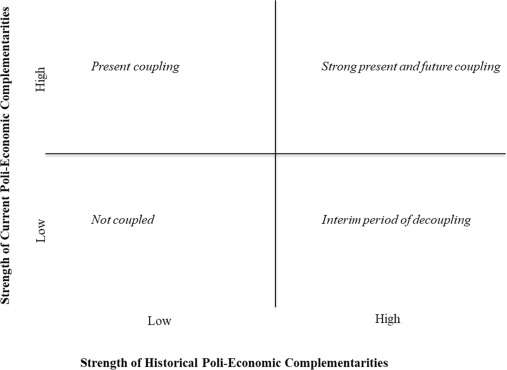
(Figure 1) illustrating how a nation-dyad’s current vs. historical complementarities (strong/weak) position it on a matrix from sustained coupling to unlikely coupling to potential recoupling. This 2×2 visual maps the conditions under which governments maintain ties, break off, or reconnect.
The US Experience: Three Decoupling Journeys
Drawing from five cases in US foreign relations, the study maps out three broad trajectories of coupling and decoupling:
- Break and Reconnect: Countries like Britain, Germany, and Japan once had close ties with the US, followed by deep ruptures – from wars to revolutions. Yet strong pre-existing complementarities allowed these relationships to bounce back, transforming old enemies into key allies.
- Weak Ties, Permanent Estrangement: The US–Soviet Union relationship was always distant, with limited trade and political friction. The Cold War marked a long-lasting decoupling, and even after the Soviet collapse, US–Russia relations have remained strained, with little economic or strategic glue to hold them together.
- Caught in the Middle: The US and China represent a hybrid path. Since the 1980s, their economies became deeply intertwined – through trade, manufacturing, and investment. But recent years have seen rising political rivalry and selective economic disengagement. Though full decoupling hasn’t occurred, the direction remains uncertain, shaped by competing forces of dependency and distrust.
Looking Ahead: Decoupling Is Not Destiny
The notion of irreversible decoupling is overstated. This research argues that decoupling is often a phase, not a final outcome. Policymakers and businesses should treat geopolitical rifts as dynamic – not static – recognising that countries can return to cooperation when circumstances change.
Even as tensions between the US and China grow – driven by national security concerns, ideological clashes, and trade restrictions – the dense web of economic ties built over decades still matters. Historical path dependencies, such as shared standards, institutional familiarity, and personal networks, could ease a return to alignment if political conditions soften.
This perspective offers cautious optimism. For governments and businesses alike, keeping channels open during periods of tension is not just a diplomatic courtesy, but a strategic asset for future recovery. The study urges decision-makers to resist zero-sum thinking and to prepare for the possibility of renewed engagement.
Business Implications
Prepare for a Rebound: Today’s geopolitical rifts may be tomorrow’s reconciliations. Companies should include recoupling scenarios in their strategic planning and avoid irreversible exits from foreign markets where long-term value still exists.
Preserve High-Value Links: Even amid decoupling, firms should identify and maintain enduring partnerships, whether in supply chains, joint ventures, or talent pipelines, that could be vital if relations improve.
Factor in History: A country-pair’s shared past can inform future risk. In regions with deep historical ties, total decoupling is less likely to last. Businesses can use this insight to decide where to scale back, hold steady, or lean in.
Authors and Sources
Authors: Dan Prud’homme (Florida International University), Nianchen Han (Nanyang Technological University), David McCourt, Aya Chacar
Original Article: Journal of World Business, Volume 60 (2025), Article 101648
---
For more research, click here to return to NBS Knowledge Lab.