Taking the internet to space
An NTU alumnus with a lifelong love for science fiction, Rohit Jha is building the technology to connect humanity beyond our planet.
Text: Derek Rodriguez | Photos: Rohit Jha

Did you know that much of the internet connecting you to the rest of the world is carried by massive cables at the bottom of the ocean? But in the not-too-distant future, our internet connection could be delivered from space, using satellites to beam data between locations on Earth.
One company working to make that a reality is Transcelestial, led by its CEO and co-founder, NTU alumnus Rohit Jha.
If Transcelestial succeeds in its mission, the implications could extend far beyond faster internet. Reliable, high-speed communication will be essential for future missions and settlements beyond Earth, where conventional communications infrastructure cannot reach.
The company has spent years developing its laser communications technology, and is now building a belt of satellites around the equator, with the aim of deploying them within the next three years.
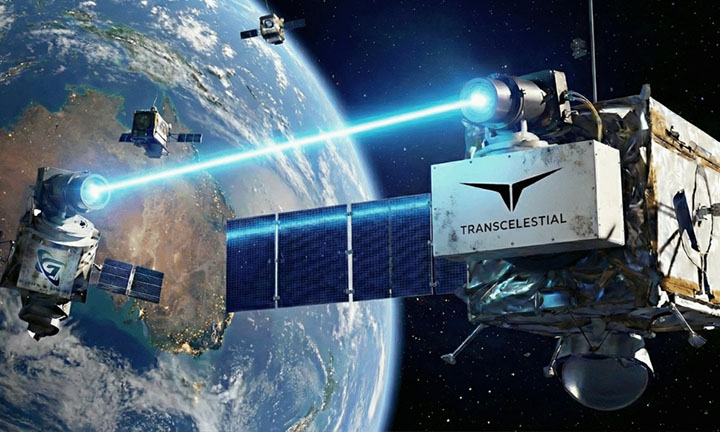 Even before pursuing its wider ambitions in space, Transcelestial is already bridging communication gaps on Earth, providing broadband and 5G connectivity to islands such as Penang, and restoring connections after disasters such as typhoons in Taiwan.
Reaching for the stars
After graduating, Rohit spent four years in investment banking and became the youngest Associate in The Royal Bank of Scotland’s Asia-Pacific history. Still, he kept tabs on the space industry.
In 2015, when SpaceX landed one of its first rockets, he made the decision to start his own company.
“I knew we arrived at a point where the space industry was going to be hyper-commercialised. It felt like no one was looking at communications in space. And the key technology there – using lasers to transmit internet – has been in science fiction since the 1960s. So I thought there needs to be a company that can make this happen. And that’s how Transcelestial was formed.”
It’s an ambitious goal for this science fiction fan raised on “Star Wars, Star Trek and anything I could get my hands on”. Since its creation in 2016, Transcelestial has raised over US$30 million and is now working with some of the largest telecommunications and defence organisations around the world, including NTT Finance, Airbus Ventures and In-Q-Tel, which are strategic investors.
Building the stuff of dreams
But dreaming big and building the seemingly impossible is nothing new for Rohit, even when he was a student at NTU.
He chose the School of Electrical & Electronic Engineering because he wanted to understand how machines worked. He had been writing code and playing computer games since he was 10, but felt he didn’t understand anything about the hardware and electronics.
“I was a horrible student,” he jokes. “I barely went for lectures. Most of my time was spent on projects. All the projects I was involved in were massive highlights in my life and I look back to those as huge learning points.”
As an undergraduate, he worked on the onboard computer for X-SAT, the first satellite designed and built in Singapore.
He later moved to a project that involved building a solar-powered car. This marked the beginning of what has become a long-running series of cars built in NTU garages and racing in competitions around the world. In his second year, he developed an autonomous robot nurse called Nightingale for his Design and Innovation Project.
No idea too big
For his final-year project, he teamed up with students from NTU’s design school to build a 60-inch multi-touch computer screen. This was a year before Microsoft demonstrated its 40-inch touch screen.
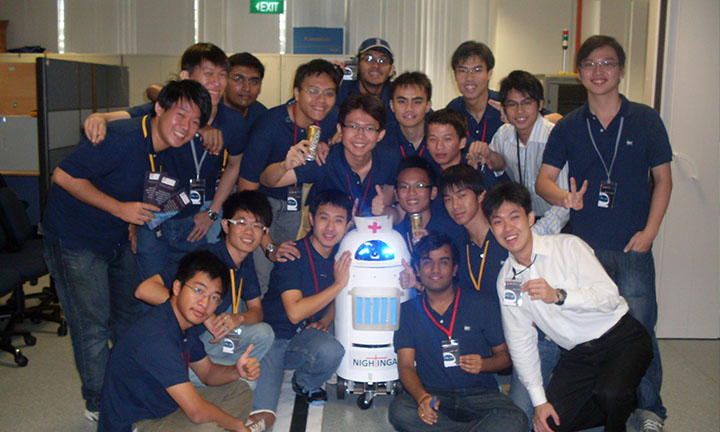 Rohit and his friends developed Nightingale, an autonomous robot nurse, for their Design and Innovation Project in Year 2.
“I had been fascinated by touch screens since I watched Minority Report. And in 2007, my uncle bought me the first iPhone, which had a 3.5-inch screen. Three years after that, when I was doing my final-year project, I was wondering why the iPhone still had the same screen size. So I built a 60-inch multi-touch screen. I hand-built the chassis, and wrote the software and operating system, including the pointing and tracking technology, and the apps and the games behind it,” he says.
“We actually showed a concept where like in Minority Report, multiple people could operate a big screen, playing games, zooming in on maps and all that cool stuff you see in movies.”
Though the project wasn’t commercialised, it connected him to students from different disciplines and gave him the freedom to experiment with an idea simply because he was curious about it.
“If you’re really ambitious about building something, NTU gives you the resources that you need to make it happen,” he says.
Another turning point was taking a minor in entrepreneurship, which he describes as “the single biggest inspiration to start Transcelestial”.
“Among my favourite courses is one where the prof challenged us to start a business and close it by the end of the semester. So we got to see the entire life cycle of the business, from ideation to being forcefully asked to close. That was an eye-opening experience, and it definitely set me on the path that I’m in right now.”
Today, Rohit remains closely connected to NTU. Transcelestial continues to work with the Satellite Research Centre on projects and testing, making use of its labs and research capabilities. The company also hires NTU graduates and interns, giving him a chance to bring NTU talent into the company.
“I think NTU has a really good culture of building things,” he says. “At the end of the day, what matters is what we build and what we do with it to make civilisation a better place.”
This article first appeared in issue 8 of U, the NTU alumni magazine.