Innovations for tropical sustainability
From sweltering heat to food waste, NTU scientists are transforming the challenges of the tropics into solutions made for the tropics, creating golden opportunities for sustainability.
Text: Lester Kok | Images: ChatGPT & Sora
A chill coat for hot building
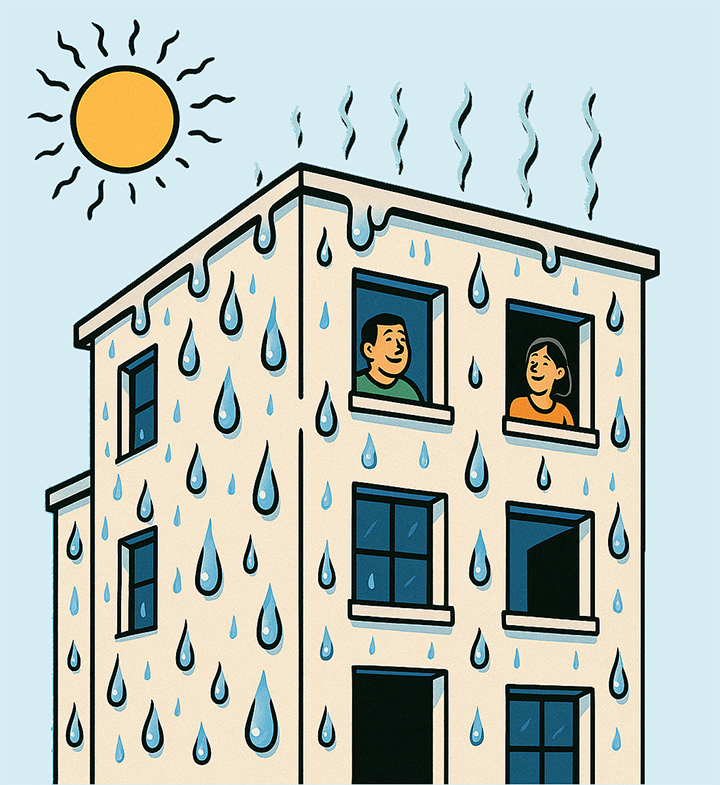 | Staying cool without air conditioning may soon be possible, thanks to a new type of paint developed by NTU scientists. Designed for tropical climates, the paint reflects sunlight and cools surfaces by slowly releasing water stored in its porous structure, much like how our skin sweats to keep us cool. |
“Passive cooling was the driving force behind our innovation,” says Assoc Prof Hong Li, a materials engineer from NTU’s School of Mechanical & Aerospace Engineering. “In humid climates like Singapore, conventional cooling paints that rely solely on reflecting sunlight or radiating heat away are less effective, because moisture in the air traps the emitted heat. That makes it difficult to break the cycle of rising surface temperatures in urban environments.”
PhD student Fei Jipeng explains that the paint’s unique feature is its ability to cool in three ways – by reflecting sunlight, releasing heat and “sweating”, much like we do on a hot day. This evaporative effect absorbs heat, making the paint especially effective at lowering temperatures in hot cities.
“And when it rains, our paint traps moisture, which boosts its cooling power when the sun comes out later,” Jipeng adds.
Tested on model houses on the NTU campus over two years, the paint stayed bright white and effective through sun and rain, unlike commercial cooling paints that yellowed over time. Buildings coated with it used up to 40% less electricity for air conditioning.
The innovation won the grand prize of $50,000 in an NTU entrepreneurship and innovation competition in 2024, and the team has since spun off a company to scale up the technology with industry partners through pilot trials.
Clay it forward
 | In tropical regions like Singapore, especially areas near the sea, construction projects often unearth vast amounts of soft marine clay, which is usually treated as waste. But NTU scientists have found a way to recycle this clay in eco-cement that can be used to build footpaths, walls and other structures. |
Their method works like instant coffee. First, the clay is processed into a dry powder using heat and is mixed with a special chemical. Later, just add water and – voilà – it becomes a liquid concrete-like material that’s strong and ready to use, but with a much lower carbon footprint than regular cement.
NTU’s “eco-crete” cuts construction costs and reduces environmental impact, says Assoc Prof Qian Shunzhi from NTU’s School of Civil & Environmental Engineering,
“We wanted to look at using discarded waste from construction, such as marine clay, which is abundant locally and regionally, and turn it into a resource for Singapore and other urban cities,” he explains. “By using less traditional cement, our eco-crete pre-mix is greener and cheaper, cutting both costs and carbon emissions by up to 20%.”
Supported by NTU’s innovation and startup funding programmes, the team is now looking for industry partners to trial the sustainable solution in actual building projects.
The breakthrough even won a top innovation award in Brunei Darussalam this year.
From bin to win
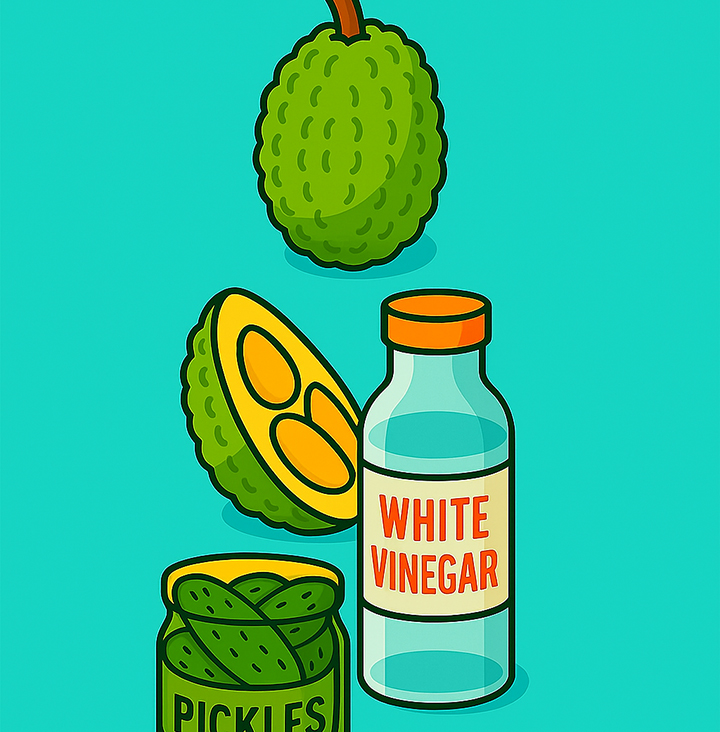 | At NTU, sustainability is truly bearing fruit. Researchers have turned the parts of tropical fruits we normally throw away into useful products for food, healthcare and even electronics. |
Take the humble jackfruit seed. Most of us toss it aside, but NTU scientists discovered it can be used to feed bacteria that produce lactic acid – the compound that gives yoghurt its tang, keeps pickles crisp and acts as an anti-bacterial preservative in food. Their new method extracts nutrients from the seeds cheaply and efficiently, offering a greener, low-cost way to produce lactic acid for the food industry.
Other NTU teams have gone beyond the kitchen. Coconut husks, orange peels and banana peels have been successfully transformed into an electrically conductive material with properties similar to graphene, a key component in next-generation electronics for water purification.
“Our synthesis process is three times cheaper than commercial methods because our source material – fruit waste – is free,” explains Asst Prof Edison Ang, who led this work.
Prof William Chen, Director of NTU’s Food Science & Technology Programme and the driving force behind many of the University’s waste-to-treasure innovations, says: “NTU’s work shows that food innovations born in the tropics can have global relevance and real industry impact.”
He adds: “By turning what was once discarded, like fruit seeds and shells, into valuable ingredients and materials, we’re closing the loop on food waste and creating new sustainable resources. It is also rewarding to see my students take these ideas forward and start new ventures, including a promising startup that transforms cashew nut shells into a natural antimicrobial solution for masks and textiles.”
This article first appeared in issue 6 of U, the NTU alumni magazine.