For us, for the planet
From the sunscreen you wear to the mobile charger you use, and even lungs grown in the lab, NTU scientists are developing innovations that improve everyday life while reducing environmental impact.
Text: Lester Kok | Visuals: Gemini
Ocean-friendly sunscreen

Sunscreen is great for your skin, but not always for the sea. Many sunscreens contain minerals that harm coral reefs, bleaching and killing them eventually. NTU scientists have found a greener way for you to stay protected from the sun.
They created the world’s first sunscreen made from pollen, the same material that helps pollinate flowers. Using Camellia flower pollen, the team developed a clear gel that blocks UV rays effectively, without releasing harmful chemicals into the water.
In lab tests, corals exposed to this pollen sunscreen stayed healthy for 60 days. Those treated with regular sunscreen bleached within two. The pollen gel also helps skin stay cooler under sunlight, reducing surface temperature by up to 5°C.
“Pollen is one of nature’s most resilient materials. It can protect its inner contents from harsh sunlight,” says materials scientist Prof Cho Nam-Joon, who led this research at NTU.
“Our goal was to create a sunscreen that protects people from harmful rays while being safe for the environment. This innovation shows how sustainable materials can replace harmful ones, protecting both nature and people – a win-win solution.”
Once seen as waste, pollen is now a gentle yet powerful protector – good for your skin, kind to corals and proof that nature already has the best solutions.
Cool, clean power

Inside your phone charger or laptop lies a small material with big potential. It’s called Gallium Nitride, or GaN. This man-made chip helps electronic devices run faster and stay cooler, while powering a cleaner world.
GaN can handle high voltages and frequencies with ease. That means chargers, power systems and communication equipment can be smaller while being more efficient. It’s already used in fast chargers, gaming systems, satellites and data centres.
GaN’s speed and efficiency also make it a key technology for future 6G communications. The same properties can support ultra-fast data transfer and high-frequency wireless networks.
To accelerate its use, NTU, the Agency for Science, Technology & Research and DSO National Laboratories launched the National Semiconductor Translation & Innovation Centre for Gallium Nitride in June this year. The centre connects researchers and companies to turn research into nextgeneration applications.
By improving how we power and connect our devices, GaN could help cut electricity waste, boost network performance, and reduce reliance on fossil fuels.
A lifeline for humans and animals
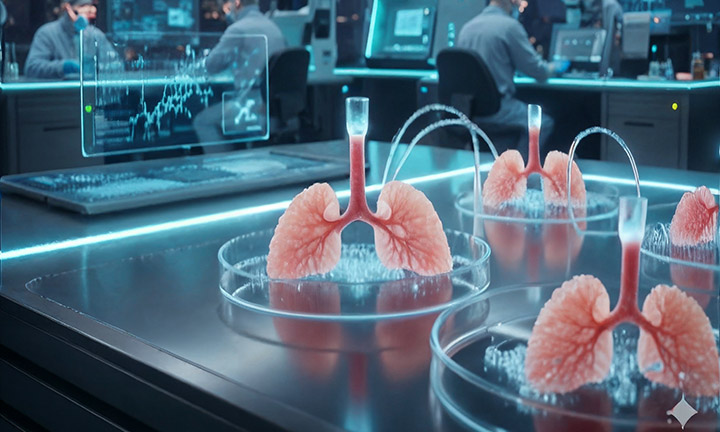
NTU scientists are growing miniature versions of human lungs in the lab. These tiny organs, called organoids, are made from real cells donated by patients. They behave like real lungs, helping researchers study how diseases spread and how new drugs might work.
The team is also creating ultrathin slices of lung tissue that can stay alive in the lab, known as precision-cut lung slices. These provide another way to study how human lungs react to infections and pollution.
Because the cells come from Singaporean donors, the models more accurately reflect Asian genetics than most global studies. They also reduce the need for animal testing while giving more reliable results in drug testing and disease research.
If a new respiratory virus were to emerge, these living models could help scientists study it early and test potential treatments quickly. This could strengthen Singapore’s readiness for future pandemics.
“We hope to advance the understanding of Asian lung biology,” says Assoc Prof Sanjay Chotirmall from NTU’s Lee Kong Chian School of Medicine, who co-led the research. “We want to improve how lung diseases, especially in the Asian context, are studied and treated, and to ensure we are ready for whatever comes next.”
Better yet, by reducing the environmental and ethical impact of animal testing and generating data that better predicts human outcomes, labgrown organoids bring us closer to truly humane and effective medical innovation.
This article first appeared in issue 7 of U, the NTU alumni magazine.