A career defined by curiosity, leadership and impact
From NTU engineering graduate to the CEO of a global technology company, Irving Tan has built a career by staying curious, embracing change and taking on challenges beyond his comfort zone.
Irving’s path from an NTU engineering classroom to the helm of a global technology company was never mapped out from the start.

His career has taken him across engineering, finance, sales, operations, strategy and technology, with leadership roles spanning regional markets and global operations. Today, as CEO of Western Digital (WD), he leads a global technology company at a pivotal moment, as artificial intelligence (AI) reshapes how data is created, stored and used.
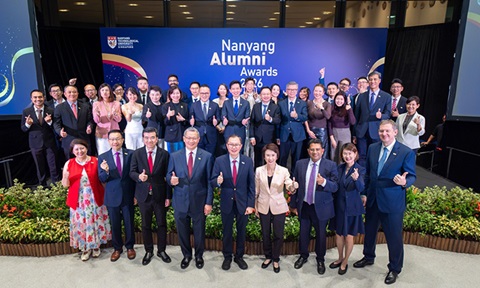
His achievements and contributions have also been recognised by his alma mater. In 2022, Irving received the Nanyang Alumni Achievement Award. This year, he is a recipient of the Nanyang Distinguished Alumni Award, NTU’s highest alumni award.
But the real value of his career lies less in the titles than in what each role taught him.
“Careers are rarely linear,” he says. “The common thread throughout my career has been a willingness to learn, adapt, and take on challenges that broadened my perspective, even when I did not have all the answers on day one.”
Building a foundation at NTU
Irving’s foundation was built at NTU’s School of Mechanical & Aerospace Engineering, where the Class of 1995 graduate developed the analytical and systematic approach to problem-solving that would become a cornerstone of his career.
As he progressed professionally, however, his curiosity took him beyond engineering. He wanted to understand how investment decisions were made, how organisations scaled and why some innovations succeeded while others did not.
An MBA at Nanyang Business School, which he earned in 2000, complemented his engineering education and gave him a broader perspective on business and organisational decision-making.
For Irving, the two disciplines are complementary.
“Engineering taught me how to solve problems. Business education helped me understand which problems matter most, how organisations make decisions, and how to turn ideas into sustainable outcomes.”
That perspective became increasingly valuable as he moved across different functions. Engineering taught him rigour. Finance and strategy sharpened his decision-making. Operations taught him execution, while customer-facing roles reinforced the importance of listening. Together, these experiences taught him to look at organisations from different perspectives, from solving technical problems to understanding customers, making investment decisions and executing strategy.
Learning to lead through uncertainty
As Irving took on regional and global leadership roles, the problems became more complex. “Assumptions that work well in one market may not apply elsewhere,” he says, highlighting the importance of listening and learning from different perspectives.
The experience also changed his understanding of leadership. Technical expertise and individual performance may help someone succeed early in their career, but leading others requires a different set of capabilities: setting direction, building strong teams, creating alignment and enabling people to deliver results.
Perhaps most significantly, Irving had to rethink his own assumptions about what a leader should be.
“I had to unlearn the idea that leadership is about certainty,” he says. “More often, it is about helping people navigate uncertainty together.”
Trust, he adds, is central to that process.
“The best leaders create confidence not because they have every answer, but because they create trust.”
Staying adaptable in an AI-driven world
Today, Irving is leading WD at a pivotal moment for the technology industry. AI is driving rapid growth in data and creating new demands for the infrastructure needed to store, manage and process it.
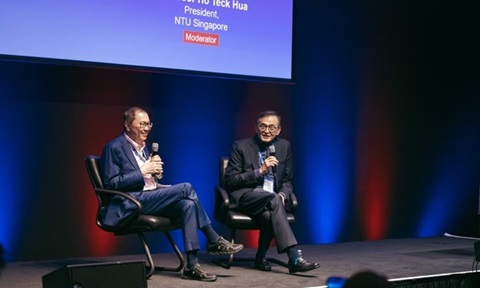
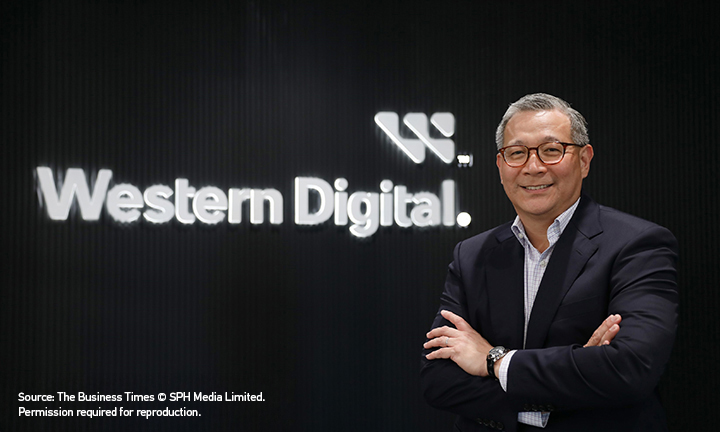 Irving, recipient of the Nanyang Distinguished Alumni Award 2026, has built a career at the intersection of technology, business and leadership.
He is watching how AI is evolving, including applications such as AI inference, agentic AI and physical AI, while considering how technology can keep pace with changing customer needs.
“Data is becoming one of the world’s most important strategic assets,” he says.
The opportunity, he believes, lies in turning data into insights that drive productivity, innovation and breakthroughs. But this also brings challenges, including cybersecurity, energy consumption, infrastructure resilience and talent.
Over the next five to 10 years, he expects AI to become increasingly embedded in how businesses operate and people interact with technology, alongside greater convergence between AI, cloud, edge computing and connected devices.
For organisations navigating this transformation, adaptability will be critical.
The same is true for individuals, he says.
Advice for the next generation
Technical expertise remains important, but Irving encourages young professionals to develop their understanding of business, communication and collaboration, and to be willing to lead without formal authority.
Most importantly, he believes they should not become too attached to a predetermined career path.
“The jobs and technologies you will encounter 10 or 20 years from now may not even exist today, so the ability to adapt will be one of your greatest advantages,” he says.
Looking back, Irving would tell his younger self not to worry about having a perfectly defined career plan. Instead, he would stay open to opportunities and take on challenges that feel uncomfortable.
“That is often where the most meaningful growth happens,” he says.
It is a philosophy that has shaped his journey from engineering student to global technology leader. For Irving, what matters is having the curiosity to keep learning, the courage to take on the challenges that come next, and the adaptability to grow along the way.
This article first appeared in issue 8 of U, the NTU alumni magazine.