

Overview
Advanced Ceramics Group
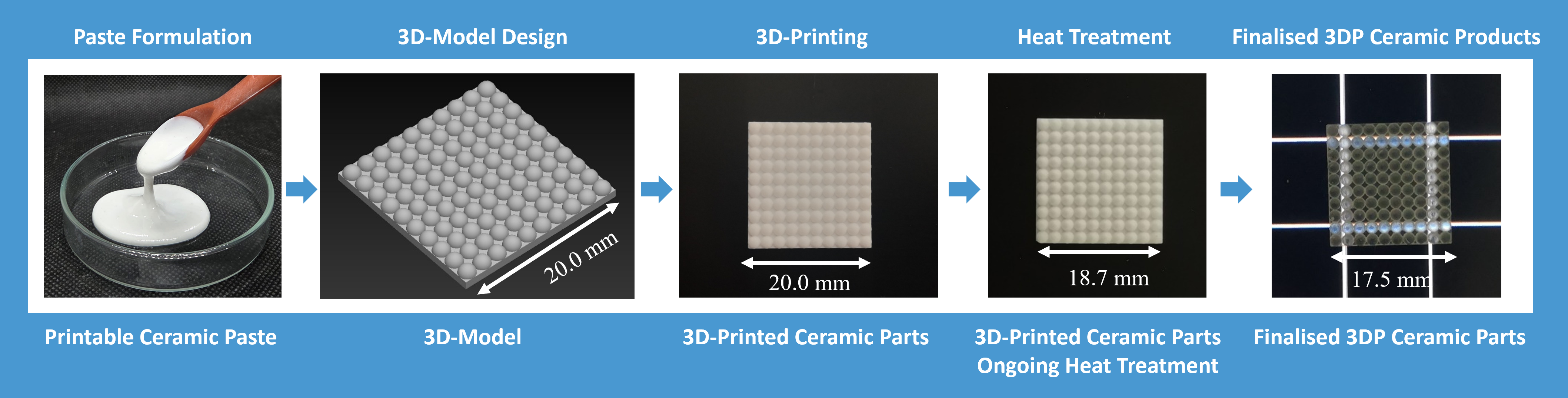
Since 2018, the Advanced Ceramics Group at SC3DP are driving the research and development in additive manufacturing of ceramics materials and products, focusing in 3D-printed(3DP) ceramics materials development. Our R&D capabilities are in the development of 3D-printable ceramic slurry and paste, specially formulated to suit the end-product specifications and the 3D-printers requirement. including post-processing such as debinding and sintering, characterisation and testing to evaluate structure, composition, and properties of the printed parts.
We actively welcome collaborations with academic and industry partners to further innovate printing techniques and expand industrial applications. For collaboration efforts, please contact duzehui@ntu.edu.sg or Andrew.ngyr@ntu.edu.sg
Capabilities and Expertise
3D Printing Ceramic Paste/Slurries Development Expertise
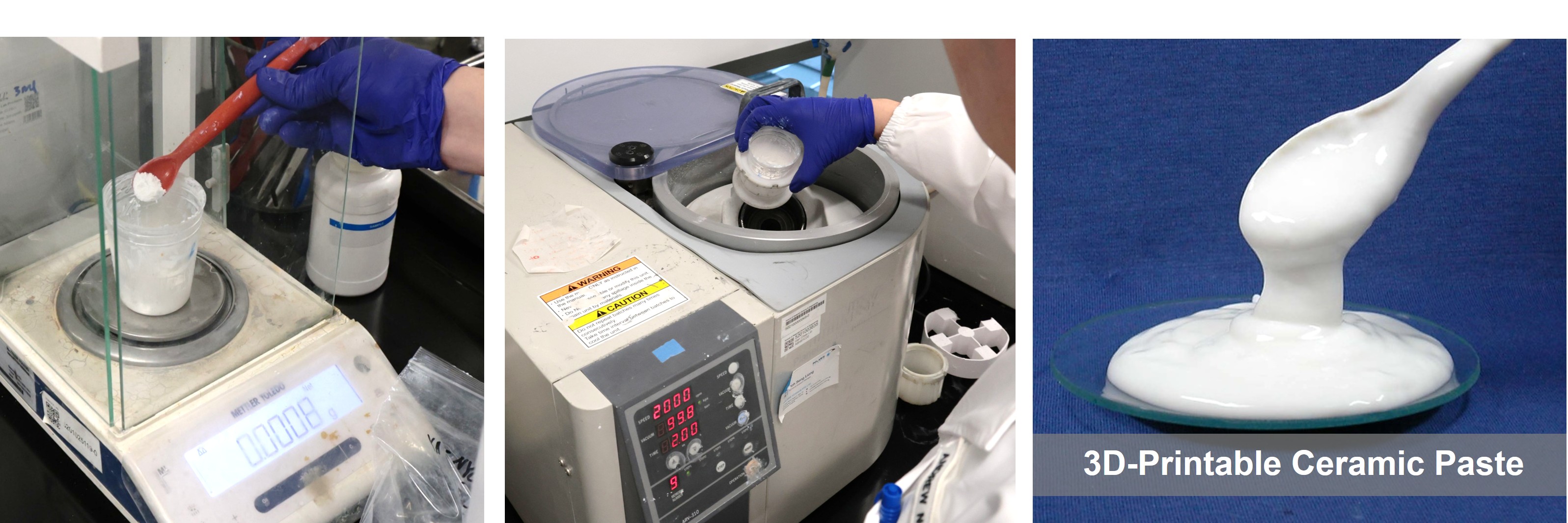
We have significant expertise in the formulation of ceramic pastes and slurries for various 3D-printing systems and applications. This includes the development of proprietary 3D-printable pastes using a range of ceramic materials such as alumina, zirconia, silicon nitride (Si₃N₄), silicon carbide (SiC), spinel, and yttrium aluminium garnet (YAG). Our in-house ceramic pastes can also be adapted to produce ceramic components with different porosities (bulk or foam structures) to meet the viscosity requirements of various vat-photopolymerisation systems.

3D Printing Facilities
Our laboratory is equipped with a range of ceramic 3D printers to meet diverse 3D printing requirements. This includes two iLaser stereolithography (SLA) 3D printers capable of producing ceramic components up to 16 cm using our proprietary pastes and slurries, as well as a MonoPrinter Digital Light Processing (DLP) 3D printer for exploring infrared 3D printing. These instruments enable rapid, precise, and versatile prototyping of complex ceramic components, allowing the production of high-density, structurally robust parts with intricate geometries that are difficult or impossible to achieve using traditional manufacturing methods.
Comprehensive Heat Treatment Capabilities
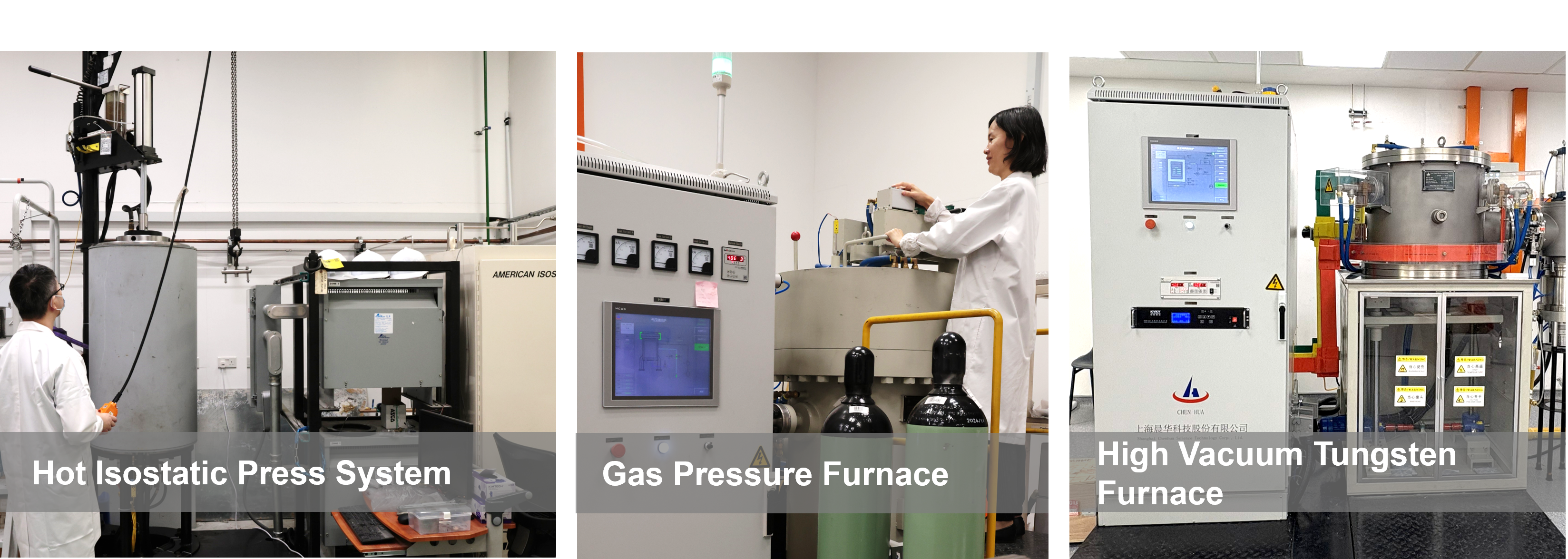
An essential post-production process for 3D-printed ceramic products is the heat treatment of the ceramics. This includes steps such as debinding and sintering. Our laboratory is well equipped with a range of furnaces for high-temperature heat treatment (≤1800 °C) under atmospheric conditions, as well as specialised furnaces such as hot isostatic press, gas pressure furnace, and high vacuum tungsten furnace for heat treatment under unique conditions.
Materials Development
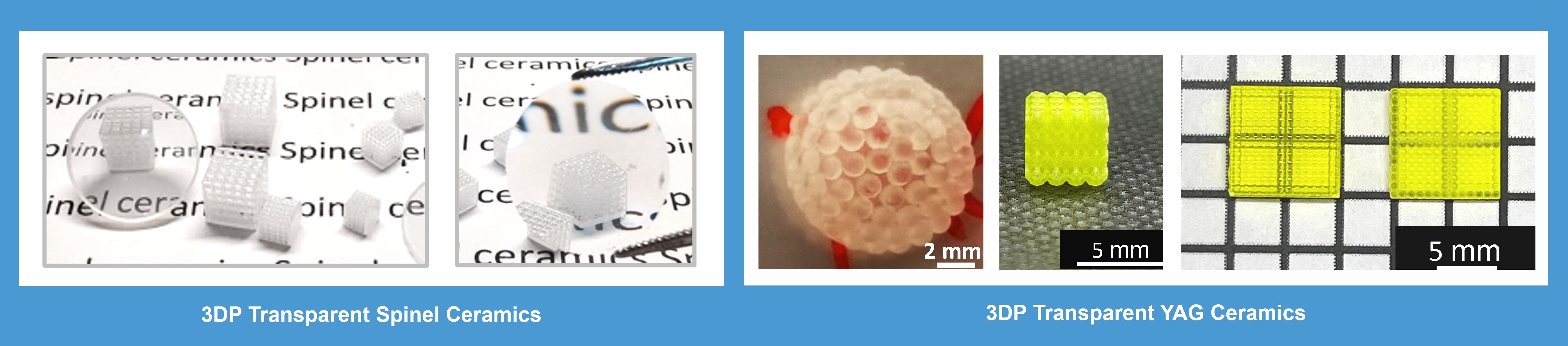
- Highly transparent spinel and Yttrium Aluminum Garnet (YAG) ceramics can be printed.
- 3DP Spinel ceramics have been printed at a resolution of 100-200 µm up to a size of 25 cm2 and have flexural strength of 290 MPa, Hardness of 13.5 GPa,
- Sample transparency exceeding 80% can be achieved at visible and near-infrared wavelengths.
- Technical Disclosure filed (IP / Know-how):
- Methods Of Stereolithography 3D Printing Of Transparent YAG Ceramics (10202107857Y;PCT/SG2022/050509).
- NTU-2024-469 Methods Of Vat Photopolymerization 3D Printing Of Transparent Spinel Ceramics With Low-Viscosity Slurries As Feedstock.
- NTU-2020-019 3D Printing Spinel Transparent Ceramic.
3D-Printing of SiC Bulk and Foam Ceramics
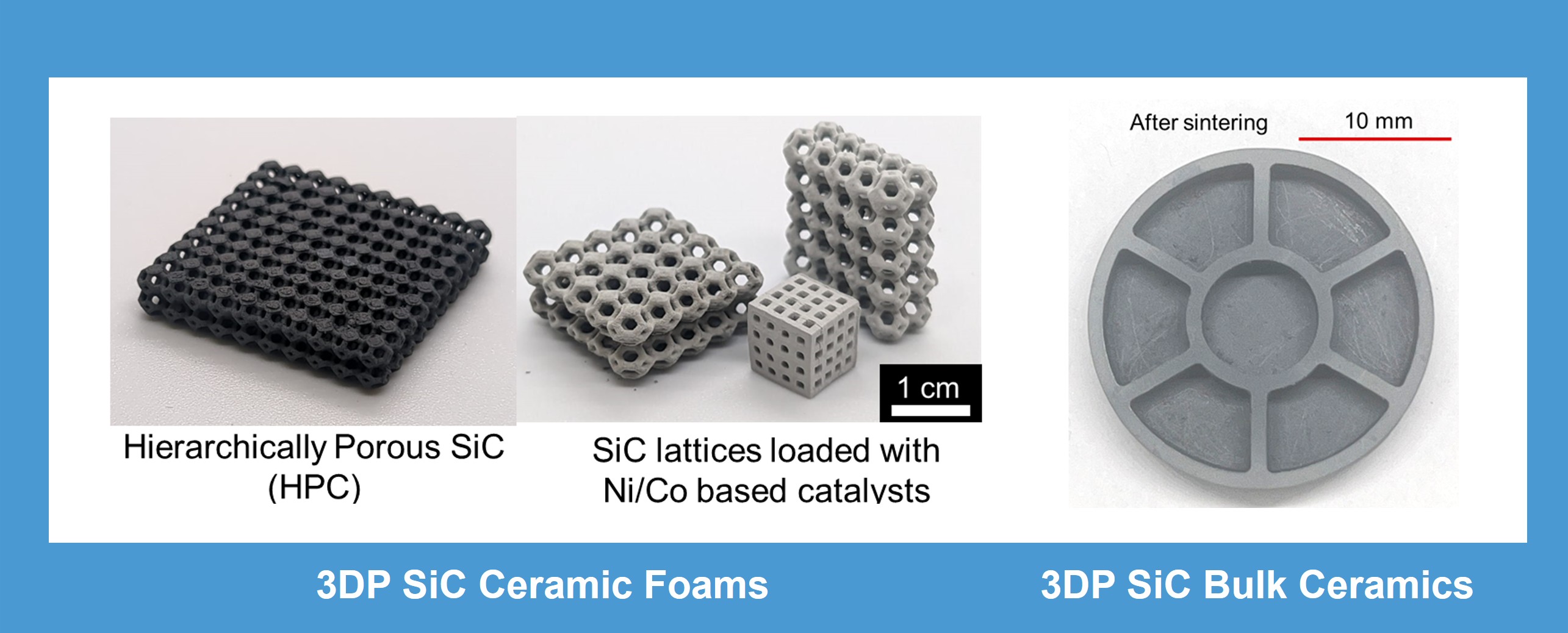
- One-step, direct vat-photopolymerization 3D printing of hierarchically porous SiC loaded with Co/Ni based catalysts was demonstrated with Pickering emulsion as feedstock for the first time.
- The resultant hierarchical porous SiC exhibit ~40% better mechanical strength compared with non-hierarchic counterpart. The catalyst loaded SiC exhibit excellent catalytic activity and reusability.
- The 3D-printed bulk ceramic samples have a relative density of 94.5 ± 0.5%, a Vickers hardness of 19.0 GPa and flexural strength of ~400-600 MPa.
- Technical Disclosure filed (IP / Know-how):
- NTU-2025-334 Methods of vat photopolymerization 3D printing of SiC ceramics with high density by tailoring Particle size Gradation
- NTU-2025-482 Integrated Optimization of Formulation, Process, And Sintering Parameters For Stereo-lithography-Based Fabrication of SiC Ceramics
3D-Printing of Zirconia Foam
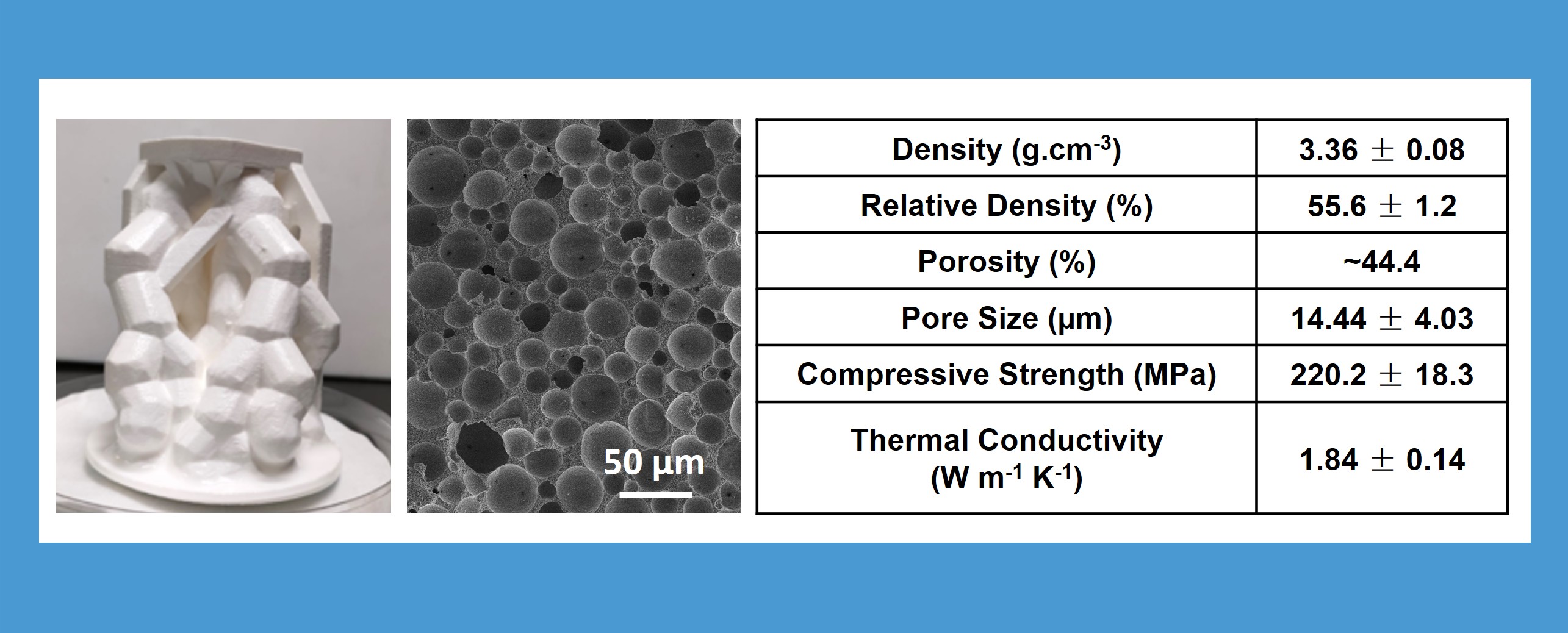
- Established a vat-photopolymerization printing method to fabricate porous ceramics with complex shapes and high printing resolution.
- Porosity from 50-80% and pore sizes of ~5-80µm are tailorable.
- Open-pore ceramics exhibit excellent capillary filtration action
- Potential medical applications: bone tissue engineering, scaffolds for regenerative medicine, and drug delivery systems.
- Technical Disclosure filed (IP / Know-how):
- Vat Photopolymerization 3D Printing of Ceramic Foams with High Open Porosity (10202500944W)
3D-Printing of Silicon Nitride (Si3N4) Ceramics
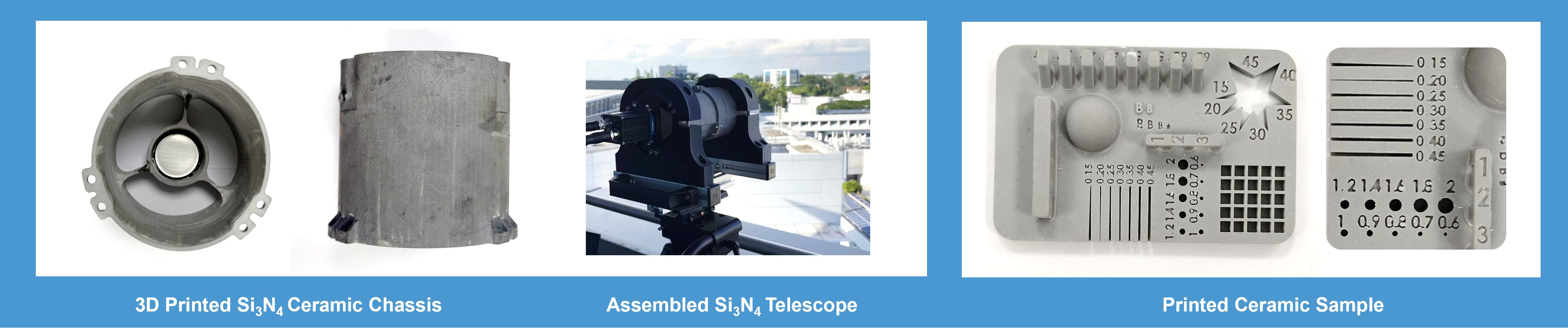
- Established a complete 3D-printing and heat treatment protocol to fabricate large (~13cm), intricate Si3N4 ceramic structures: addressing a key challenge in current state-of-the-art Si3N4 ceramic 3D printing.
- Size tolerance of parts was optimised to ≤ 0.5mm.
- 3D-printed bulk ceramic samples has relative density ~98.6%, flexural strength ~800 MPa and thermal conductivity ~80-90 W/m·K.
- Cassegrain-type optical telescope system has been designed and built based on 3D-printed Si3N4 ceramics: high-resolution and long-range optical imaging performance was demonstrated.
- Technical Disclosure filed (IP / Know-how):
- NTU-2025-092 Methods of Ultrafast and Pressureless Joining of Silicon Nitride Ceramics.
- NTU-2024-201 Methods of Vat Photopolymerization 3D Printing of Silicon Nitride Ceramics with High Thermal Conductivity.