Data Without Borders: How Analytics, Governance and AI Tools Are Reshaping Organisations
Read on to find out how the data tide is sweeping across wide-ranging fields of retail, logistics, finance, healthcare and government.

Data has long been described as a strategic asset, but what is changing today is not its importance, it is the way data capabilities are being organised and operationalised inside organisations. As digital transformation deepens, analytics, governance and AI are no longer evolving on parallel tracks. They are increasingly shaping one another in ways that many organisations did not initially anticipate. In Singapore, this convergence is especially pronounced. As a highly digitalised economy with strong regulatory oversight, organisations are under pressure to extract value from data while maintaining trust, security and compliance. The challenge is no longer simply about collecting more data points or adopting new tools, it is about aligning insight generation, automation and accountability in a coherent way.
Data Analytics Beyond Reporting
The shift is not simply toward more dashboards or more complex models, it is toward embedding analytics directly into operational decision-making. In retail and logistics sectors, data analytics is increasingly used to support micro-decisions. Demand forecasting models influence inventory replenishment on a daily basis. Route optimisation analytics are applied continuously to manage delivery constraints in a dense urban environment. These decisions rely on near real-time data rather than periodic reviews.
Within the financial sector, analytics is deeply embedded in risk management and customer monitoring. Transaction data is analysed not only to identify fraud, but to comply with anti-money laundering requirements and detect unusual activity patterns. Analytics serves both commercial and regulatory objectives, often within the same workflow. As analytics becomes operational rather than retrospective, the tolerance for poor data quality diminishes. Errors that once only surfaced in periodic reporting can now influence automated or time-sensitive decisions within hours or minutes.
Data Governance as an Operational Capability
Governance was once designed centrally and enforced after insights were produced. Today, it increasingly operates closer to where data is accessed, analysed and acted upon. Singapore’s regulatory environment has accelerated this shift. Under the Personal Data Protection Act, questions around consent, purpose limitation and data retention arise during analysis, not after results are generated. Analytics teams must consider whether datasets can be combined, how derived insights may be used, and who is accountable for those decisions.
In the public sector, governance plays a similar role. Public agencies analysing citizen data for policy planning or service delivery must balance innovation with accountability and transparency. This has led to clearer data ownership, role-based access controls and stronger auditability built directly into analytics platforms. Governance, in this context, is less about compliance checklists and more about enabling responsible use at speed.
AI’s Role in Data Handling
Machine learning tools are now used to detect anomalies in datasets, flag potential data quality issues and classify sensitive information. In regulated industries such as banking and healthcare, AI-assisted data classification helps organisations identify personal or confidential data that may otherwise be overlooked. This supports both analytics and compliance objectives.
In analytics workflows, AI is also being used to recommend variables, surface correlations and automate parts of model development. While this accelerates insight generation, it also raises new questions about explainability and bias, particularly when models influence high-impact decisions. These developments reinforce a critical point: As AI becomes more accessible, understanding data provenance, context and limitations becomes more important, not less.
When Tools Lower Barriers but Raise Expectations
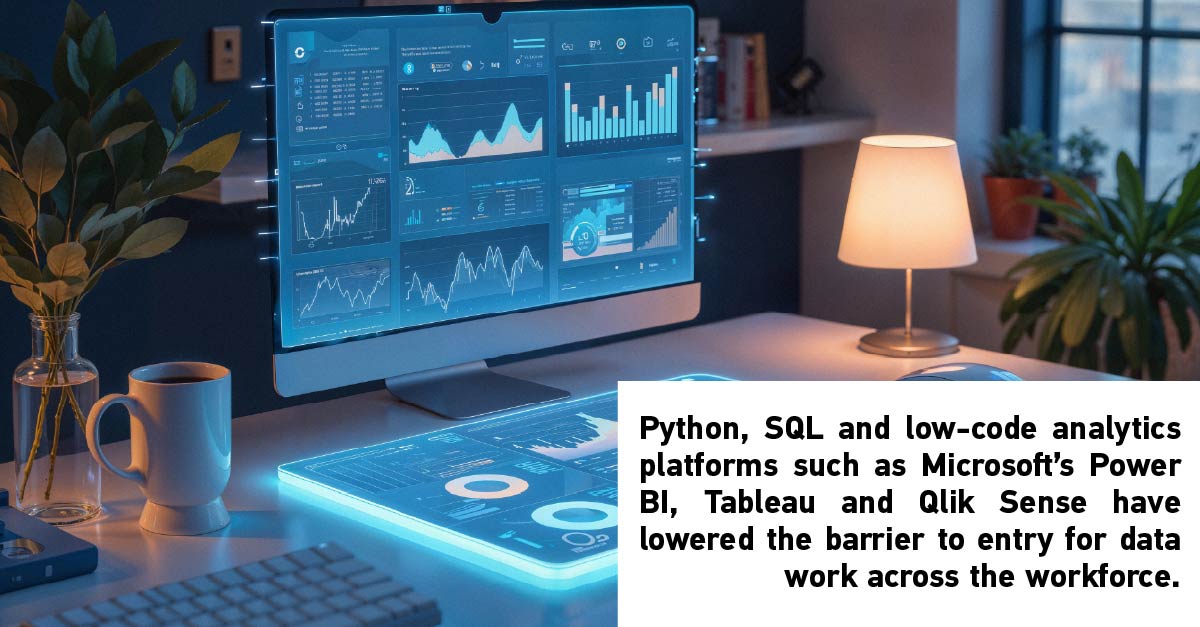
Professionals outside traditional technical roles are increasingly able to query data, build models and visualise trends. This democratisation has subtly reshaped expectations within organisations. Decisions that were once guided primarily by experience or judgement are now expected to be supported by data, even in areas not traditionally seen as analytical. At the same time, the outputs of analytics are increasingly expected to withstand internal review and regulatory scrutiny. These parallel expectations have produced a data environment that is more inclusive and responsive, yet also more complex to govern. As more functions engage directly with data, questions of consistency, interpretation and accountability become harder to manage through centralised controls alone.
In practice, this has heightened the importance of professionals who can bridge analytics and governance. They may not sit in formal data roles, but they are able to navigate data structures, analytical tools and regulatory considerations well enough to translate business objectives into technically and operationally sound decisions.
The Emerging Shape of Data Capability
Professionals are expected to understand how data is generated, how insights are produced, and how risks are managed across the lifecycle. This includes recognising when automation is appropriate and when human judgement remains essential.
For organisations operating in a highly digital and regulated environment, this integrated capability is becoming a source of resilience. Data effectiveness is shaped less by how much data is available, and more by how coherently AI, analytics, governance are aligned. In a landscape where data increasingly crosses systems, functions and regulatory boundaries, the real differentiator may be this - the ability to move fast with data, without losing sight of accountability, trust and context.
Discover how data fluency across analytics, governance and emerging tools can shape your professional role, join our upcoming information sessions.