The multiplicand matters
AI can accelerate almost any idea, which is exactly why Professor Luke Ong believes the expertise behind a venture now counts for more than the speed of building it.
Artificial intelligence has become extraordinarily capable in a remarkably short time. However, capability alone, Professor Luke Ong cautions, guarantees nothing. “AI amplifies capability. It does not create capability from nothing,” says Prof Ong, who is NTU’s Vice President (AI & Digital Economy). “That is why I often describe it as a multiplier. The quality of the outcome still depends on the quality of the underlying expertise.”
The framing carries a direct implication for anyone building or backing AI ventures. A multiplier applied to a weak foundation produces a weak result, however advanced the technology. The people extracting the most value from
AI, Prof Ong observes, are those who already hold deep domain expertise and a precise understanding of the problem they are solving.
What speed cannot replace
The most visible change in moving research from lab to market is pace. Foundation models and widely available tools have shortened the distance from concept to prototype, opening room for experimentation across healthcare, finance, manufacturing, education, sustainability and myriad other fields. Some of the most interesting work now emerges
from collaboration between AI specialists and domain experts, as AI settles into the role of an enabling technology across the economy.
Faster iteration cuts both ways. “Faster experimentation means that poor assumptions can also be scaled more quickly,” adds Prof Ong, who is also the Dean of the College of Computing and Data Science (CCDS) and the Deputy Executive Chairman (Applied and Translational) of AI Singapore. The lowered barrier to building prototypes has not lowered the bar for building businesses. A prototype shows that something can work, but a durable venture requires a clear grasp of the problem, sound technical foundations and the capacity to keep adapting as the technology moves. The founders who endure tend to understand both the capabilities and the limits of what they use, and they reason carefully about trade-offs and risk. “Technology changes rapidly. Strong foundations do not.”
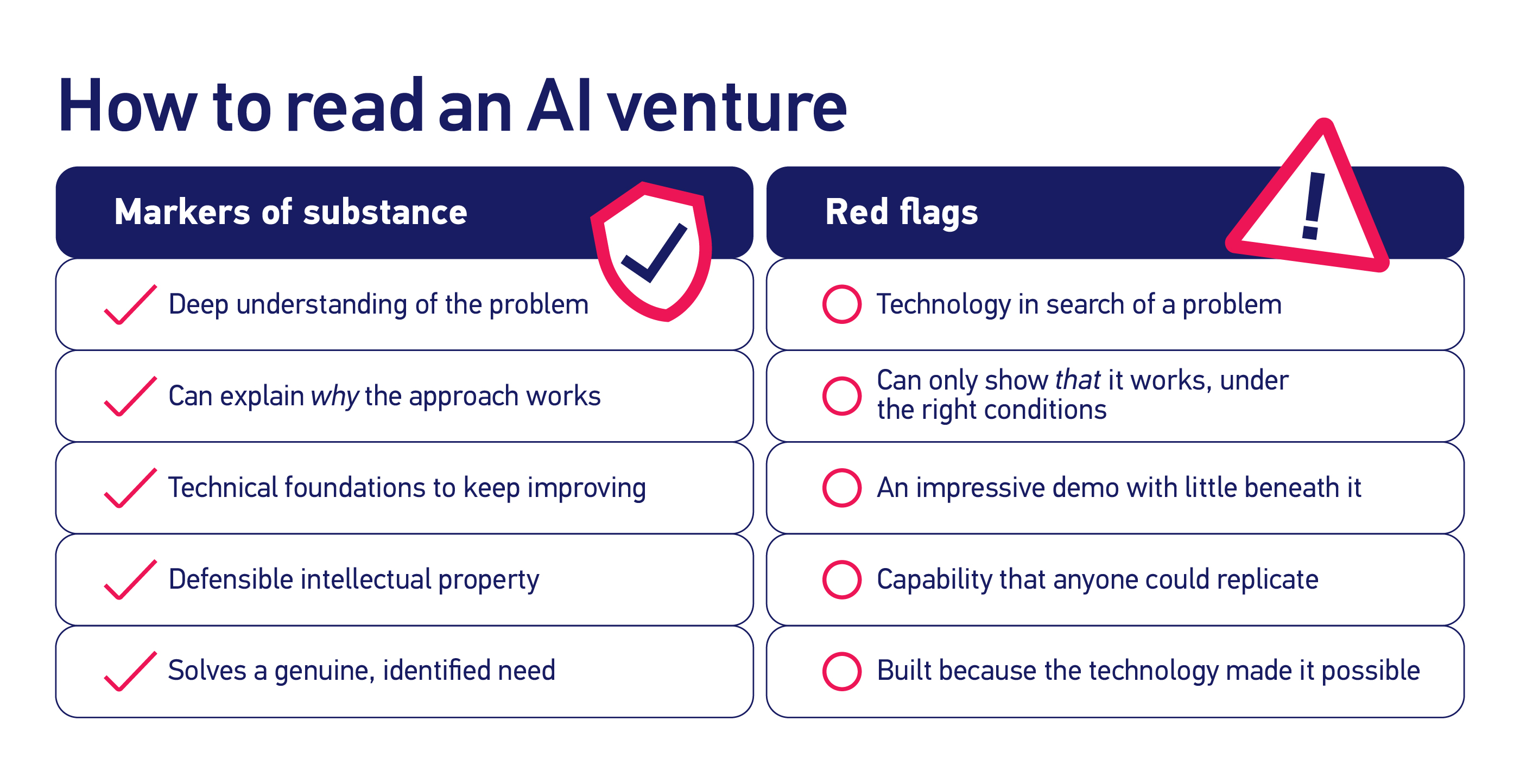
That distinction is the one for investors to test. NTU’s portfolio of spin-offs and startups carries a cumulative valuation of around S$1.6billion, and Prof Ong’s first filter is the depth of understanding behind the technology. Building a demonstration is now straightforward; the harder question is whether a team holds the foundations to keep improving its solution. Markers of substance include genuine technical expertise, defensible intellectual property, a clear reading of the domain and evidence that the product meets a real need. He places particular weight on whether a team can explain why its approach works, beyond showing that it works under favourable conditions. What gives him pause is the inverse: heavy reliance on the technology with little understanding of the problem it serves.
Training the multiplicand
That conviction shapes how CCDS prepares the people who will go on to build these ventures. The college is embedding a “Learn With AI” approach across its curriculum, in which students learn to direct AI, critique its outputs, verify results and recognise where the systems fail, while continuing to develop the fundamentals of computing and reasoning. The aim is graduates who retain ownership of their thinking: bright minds who know how to obtain an answer and how to judge whether it is correct, useful and trustworthy.
From August 2026, every NTU undergraduate will gain access to a suite of premium Google AI tools. As that fluency becomes commonplace, Prof Ong expects the real differentiators to lie in judgement, adaptability and what he calls meta-skills, which include learning how to learn, critical thinking and intellectual curiosity. Entrepreneurial experience earns its place here too, exposing students to ambiguity and resource constraints and building the ownership mindset of spotting opportunities and creating value.
Asked what, five years out, would show the investment had paid off, Prof Ong points to neither a technology nor a marquee startup. “Success will be measured not by how much AI our graduates use, but by how well they think, learn and create in partnership with it.” The multiplier will keep improving on its own. The multiplicand is the work.
Read the full newsletter or subscribe to NTU I&E for the latest updates, events and programmes.