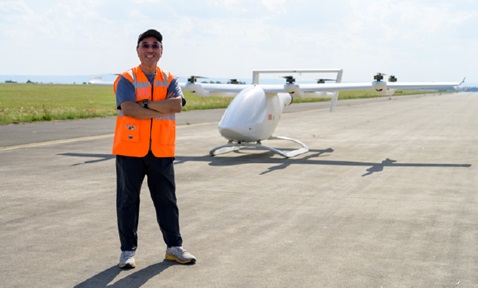
The control problem: Making quantum computing work
NTU physicist Associate Professor Rainer Dumke has built a company around quantum computing’s most overlooked bottleneck: the control layer that connects classical machines to quantum processors.
Quantum computing promises to crack problems beyond the reach of any classical supercomputer, from cryptography to drug discovery to materials science. Less discussed is why that promise remains largely confined to national laboratories and a handful of technology behemoths. Associate Professor Rainer Dumke thinks the answer lies in an unglamorous part of the system. “A beautiful physical effect is only the beginning,” he says. “The decisive question is whether you can control it repeatably, precisely and at scale.”
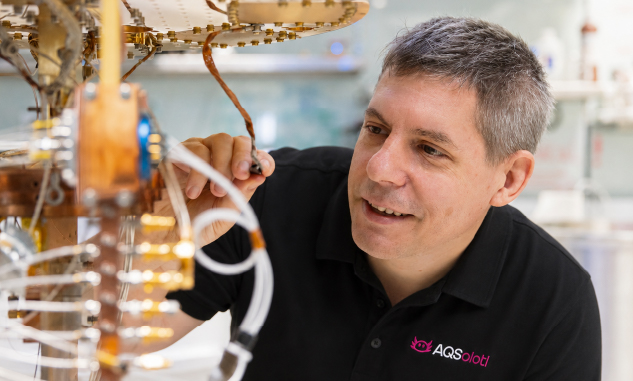 Assoc Prof Dumke has spent close to two decades at NTU working on exactly that boundary, across quantum sensing, atom optics and superconducting circuits. A Principal Investigator at the Centre for Quantum Technologies and the Quantum Sensing Centre in Singapore, and hardware lead for the National Quantum Computing Hub, he is also the co-founder of AQSolotl, the deep-tech startup commercialising his group’s control technology. Its name plays on the axolotl, the salamander known for regrowing what it loses, a quietly fitting choice for a hardware company built to scale.
The nervous system of a quantum computer
The problem came to the fore around 2019, when Assoc Prof Dumke’s group began building superconducting qubit processors. At the time, many laboratories ran one or two qubits using general-purpose microwave equipment. A four channel setup for two qubits could cost around S$100,000, acceptable for a single experiment but unsustainable as an architecture. “Once you think in terms of hundreds or thousands of qubits, the electronics around the processor become one of the defining constraints,” he says. The insight was that the classical layer would constrain quantum computing as tightly as the algorithms or the chip. That layer translates an algorithm into precisely timed physical signals and reads back the result.
This is what AQSolotl’s flagship product, CHRONOS-Q, provides. A quantum processor does not understand conventional code; it responds to carefully shaped microwave pulses with the right phase, amplitude, frequency and timing. CHRONOS-Q turns a quantum program into those pulses, then reads the faint return signals and processes them for the next step of the computation. Assoc Prof Dumke describes it as “the nervous system of a quantum computer.” It determines qubit states in under 14 nanoseconds, enabling real-time feedback, and replaces bespoke laboratory rigs with a reusable control architecture that system builders can scale.
The move from research to enterprise asked a second discipline of him. “As a researcher, you are trained to look ahead to the next hard problem,” Assoc Prof Dumke says. “As an entrepreneur, you have to solve a concrete problem for a customer.” He credits NTU’s innovation and entrepreneurship (I&E) ecosystem with the translation, describing a process that moved a technology insight into a company structure investors and partners could understand.
Building for the error-correction era
Assoc Prof Dumke is measured about what comes next. He does not expect quantum computers to replace classical ones; the near term gains, he argues, will come in optimisation, chemistry, materials and hybrid workflows where quantum and classical processors run together. The larger shift is towards fault-tolerant machines that correct their own errors, and he treats this as a hardware challenge before a software one. What matters is how fast a system can measure, decode and respond to errors while running, because a shorter feedback loop leaves less room for errors to accumulate.
This is where AQSolotl has positioned itself. “It is a picks-and-shovels position in the quantum stack, but a critical one,” he says. “Without reliable, fast and economical control, the most promising chips cannot become practical systems.” The startup’s product roadmap follows that logic. CHRONOS-Q, then Hyperion-Q and Phoebe-Q, are stages of a single control architecture engineered towards error correction, with principles that can extend from superconducting systems to neutral atoms, spin qubits and ion traps.
Spun out in late 2024 and incubated by NTU I&E, AQSolotl has its control technology piloted at the National Quantum Computing Hub and NTU’s Nanyang Quantum Hub. Its commercial thesis rests on accessibility, which Assoc Prof Dumke frames as an engineering requirement. An industry that sells only a few costly systems to governments and hyperscalers, he notes, is too narrow to sustain. The larger market opens when smaller firms in materials, logistics, finance and manufacturing can take part. That depends on bringing down cost per qubit, footprint and complexity.
“We are turning custom laboratory electronics into purpose-built infrastructure,” he says. “Lowering the control cost is one concrete step toward that future.”
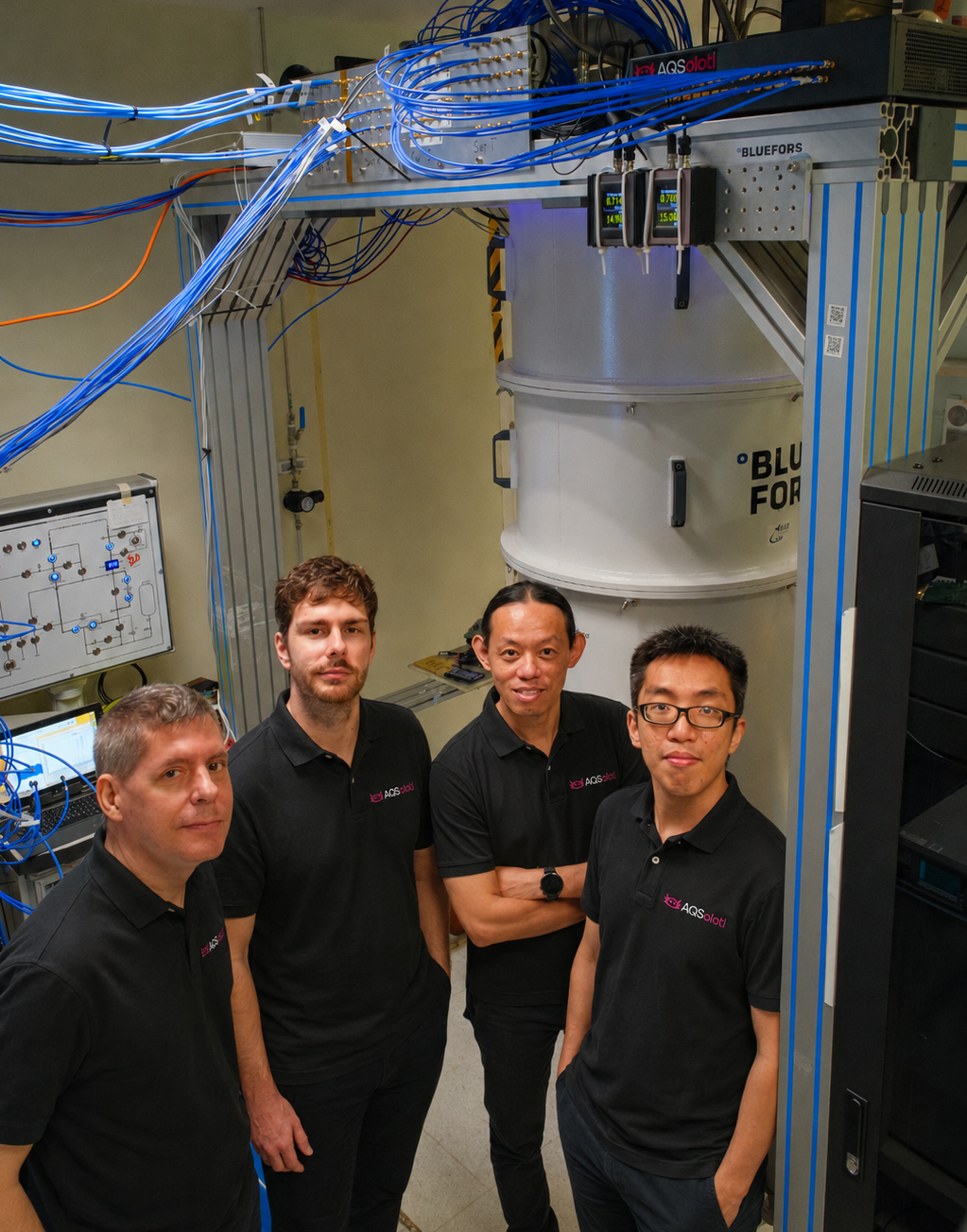 (Left to right) Associate Professor Rainer Dumke with fellow AQSolotl co-founders CEO Mr Patrick Bore, CTO Dr Yap Yung Szen, who is also a Senior Lecturer at Universiti Teknologi Malaysia, and Head of Quantum Algorithms Mr Paul Tan. The startup’s flagship product, Chronos-Q, visible at the upper right of the quantum computer, lets users control quantum computers efficiently from standard laptops and desktops.
Read the full newsletter or subscribe to NTU I&E for the latest updates, events and programmes.