The inventor behind Singapore's first home-grown eVTOL
Professor James Wang spent more than three years turning a bold design into a working electric aircraft. The research centre and partnerships built around his team are now shaping its path towards commercial use.
Eight electric rotors spun to life, lifting the aircraft vertically from the ground. As it gathered speed, the wings began to carry its weight while a rear propeller drew it forward. Within the same flight, a machine that had hovered like a helicopter began zipping through the air like an aeroplane.
The manoeuvre brought together more than three years of work by Professor James Wang and his team at NTU’s School of Mechanical and Aerospace Engineering.
During a month-long campaign at the German Aerospace Center’s test facility in Cochstedt, the larger of NTU’s two electric vertical take-off and landing (eVTOL) demonstrators climbed above 90 metres, while a smaller version exceeded 120 kilometres per hour. The flights marked a first for Singapore, showing that the country could take a complete electric aircraft from design through to flight.
Not designed to carry passengers, the prototypes are research demonstrators, built to generate data. The German campaign gave the team its clearest evidence yet that the integrated design could work in the air.
Vertical integration and engineering ingenuity
Prof Wang’s career has been shaped by vertical flight. Over three decades, he has worked on more than 30 crewed and uncrewed aircraft programmes. He coined the term “eVTOL” in 2008 and, two years later, led the development of AgustaWestland’s Project Zero, the world’s first all-electric tiltrotor demonstrator.
Aircraft are also a personal pursuit. Prof Wang has designed and piloted model aircraft and helicopters for years, with more than 10,000 flights under his belt. In Germany, he was among the pilots remotely controlling NTU’s prototypes.
After joining NTU in 2019, he launched the University’s eVTOL Research and Innovation Centre with a motto that captures his outlook: “If it can be dreamt, it can be built.”
Professor Louis Phee, Vice President (Innovation and Entrepreneurship) at NTU, who played a role in establishing the centre, called its original objective a “moonshot goal”: to develop the know-how to design and build an airworthy electric aircraft in Singapore.
That goal required the team, which consists of about 30 research engineers, to understand how every part shaped the aircraft in its entirety. Under Prof Wang’s direction, they designed the motor and electrical system, then wrote the software that controlled the aircraft and sent flight data to the ground. The same team also built the airframe and integrated the propulsion system with its onboard electronics and sensors.
Their work converged in one of the aircraft’s most challenging manoeuvres — the transition between hover and forward flight. As the aircraft gains speed, the wings gradually take over from the lift rotors in keeping it aloft. The control system must continually adjust the power sent to the lift rotors and rear propeller as the aerodynamic forces change, keeping the aircraft stable throughout the transition. During the tests at Germany, the team also transferred control between outdoor and indoor pilots while the aircraft remained airborne, further validating the system and its operating procedures.
Coordinating that work was one of the programme’s toughest tasks. The aircraft eventually brought together team members and industry partners from 11 countries, with each contributing to a design whose success depended on the whole.
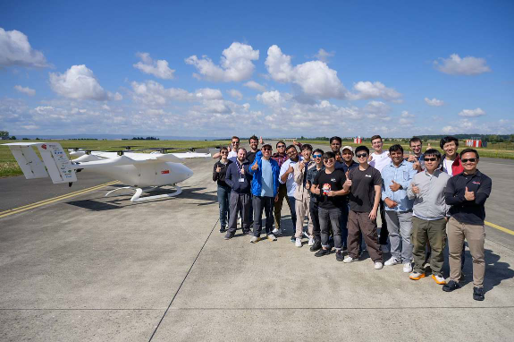
The NTU team and their collaborators with the 8-metre wingspan eVTOL prototype, at the DLR National Experimental Test Center for Unmanned Aircraft Systems.
Building a path for commercialisation to take flight
The programme grew with support from NTU and the Industry Alignment Fund – Pre-Positioning initiative under Singapore’s Research, Innovation and Enterprise 2025 plan, in collaboration with the Agency for Science, Technology and Research. This backing sustained the work through several years of development and into the flight campaign in Germany.
The data gathered there will guide further research into electric aviation, allowing the team to refine the aircraft based on how it performed in the air. Prof Wang said the results are also essential for showing the programme’s funders and industry partners how the technologies worked in flight. Meanwhile, potential investors will be able to draw on the same evidence when assessing their work.
“We look forward to turning this government-supported research into useful technologies by finding real-world applications and exploring possible spin-offs,” he added.
With working prototypes now in the air, Prof Wang’s “moonshot” has moved beyond the drawing board. “The journey from zero to one has been made,” Prof Wang said. “Now, the journey from one to the future begins.”
Read the full newsletter or subscribe to NTU I&E for the latest updates, events and programmes.