Built to scale: From lab breakthrough to global power player
Amperesand, a deep-tech spin-off from NTU, is rewriting what power infrastructure can do for the world’s AI data centres.
Electricity demand is surging as digitalisation and AI adoption accelerate. The International Energy Agency projects that data centres could more than double their global electricity use to around 945 terawatt-hours by 2030 — roughly Japan’s current consumption — with AI-optimised facilities driving the fastest growth. Against this backdrop, lead times for traditional transformers have quadrupled since 2019, grid bottlenecks are stalling new deployments and power reliability has become a strategic concern for governments and hyper-scalers alike.
Long before today’s power crunch, a small team at NTU was working on an unconventional idea — a solid-state transformer (SST) that could one day replace bulky hardware with compact, semiconductor-enabled systems offering speed, control and efficiency that legacy infrastructure simply could not hold a candle to. What started as a light-bulb moment would, over a decade of dedicated work, flourish into Amperesand, a deep-tech spin-off now backed by global investors and preparing to deliver 30 megawatts of commercial systems by 2026.
Unlike a traditional transformer made of heavy coils and magnetic cores, an SST uses fast-switching power electronics and software controls to convert and manage electricity in one integrated unit. This results in higher efficiency, a far smaller footprint and the precise power management indispensable to AI data centres.
A decade of research, a clear path to market
Amperesand’s story begins at the Energy Research Institute @ NTU (ERI@N), where researchers launched a programme in 2016 to reimagine medium-voltage power conversion. Supported by two NRF-funded projects, the team built a series of increasingly powerful prototypes — first a 150 kW proof-of-concept SST, and later a full 1 MVA containerised demonstrator capable of handling real-world grid conditions.
These years of iterative testing, validation and systems engineering created more than a dozen deep-tech IPs, laying a technical foundation strong enough for commercial interest. But turning an academic success into a globally deployable product required more than engineering. It required a coordinated pathway through NTU’s innovation ecosystem.
NTU I&E’s processes helped the team navigate early investor discussions, licensing structures and commercial readiness. In 2023, the technology was spun out as Amperesand, incubated by Xora Innovation and backed by seed funding from four venture capital firms. The Temasek x NTU x NUS pilot programme further supported the spin-off’s initial growth, recognising its potential to address a critical infrastructure problem with significant economic and strategic implications.
As the company took shape, much of ERI@N’s core SST team transitioned to Amperesand in 2024, ensuring continuity between research and product development. A research collaboration agreement allowed the company to continue accessing NTU’s facilities while refining industrial design and preparing the system for certification.
To accelerate technology maturation, NTU and Amperesand jointly secured the NRF Central Gap Fund — a national scheme that supports high-impact technologies nearing market deployment. The funding enabled the team to incorporate manufacturing considerations, safety requirements and modular architecture refinements into what would become the company’s commercial Medium Voltage Solid-State Transformer (MV SST) platform.
By 2024, Amperesand had completed full-power, overload and bidirectional testing on its Generation 2 system. A pilot with the Port of Singapore followed soon after, demonstrating how the technology could support mission-critical megawatt-scale charging under real operating conditions.
Turbocharging the future of AI
The leap from validated prototypes to global commercialisation came into full view in 2025, when Amperesand raised an oversubscribed US$80 million Series A co-led by Walden Catalyst Ventures and Temasek. The investment will enable the deployment of 30 MW of commercial systems in 2026, with a strong emphasis on meeting the urgent needs of hyperscale AI data centres.
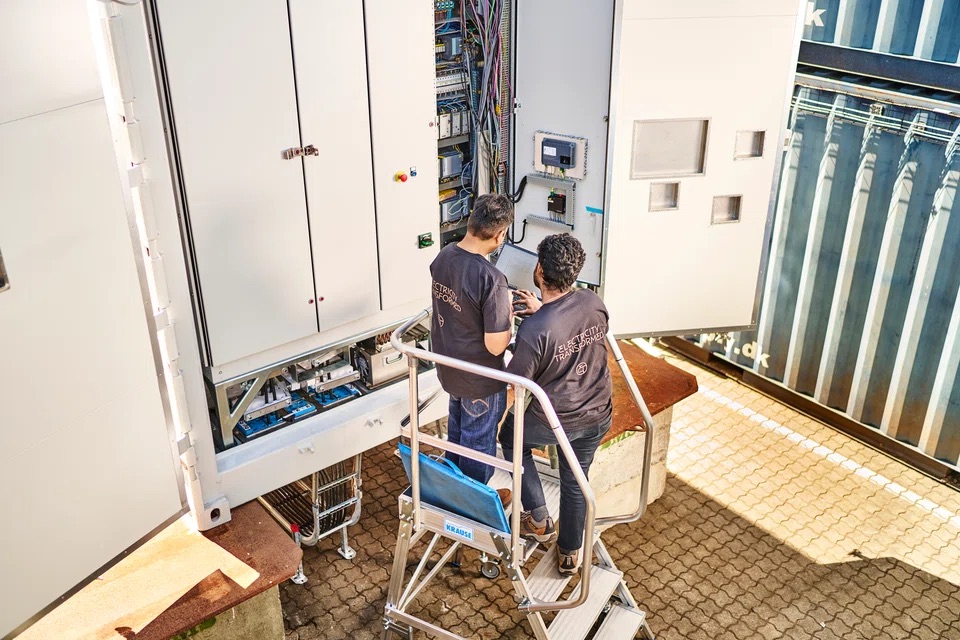
Amperesand’s MV SST platform consolidates multiple electrical components into a compact, factory-built product that cuts installation labour by half and accelerates time-to-power by up to tenfold. Its power density results in an 80% reduction in equipment footprint, freeing valuable space in high-power facilities. Crucially, the system’s intelligent controls allow variable, energy-intensive loads to interact seamlessly with the grid — an essential capability as nations confront the growing strain of AI-driven electricity demand.
The company is now expanding engineering and manufacturing operations across San Francisco and Reno, while maintaining strong R&D ties with Singapore. Amperesand expects to exceed 100 employees worldwide in 2026, positioning itself to deliver critical power infrastructure at scale.
“Amperesand has uniquely benefited from Singapore’s support in long-horizon deep-tech research and commercialisation of breakthrough power conversion technologies,” shares CEO Brian Dow. “Our journey to bring a new generation of medium-voltage electrical equipment to AI Factory and industrial customers would not be possible without the coordinated pipeline of early R&D, translational funding, talent, and university partnerships in Singapore.”
Read the full newsletter or subscribe to NTU I&E for the latest updates, events and programmes.