Prof Wang Yifan: From Kitchen Table Puzzles to Shape-Shifting Wearables
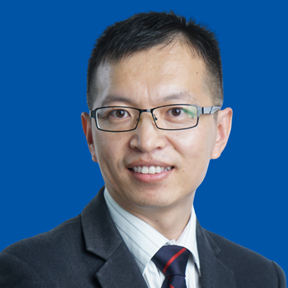
Prof Wang Yifan, faculty in the School of Mechanical and Aerosapce Engineering (MAE), is the winner of the 2025 College of Engineering Research Young Faculty Award. This award is designed to identify and enhance early career development of NTU rising stars.
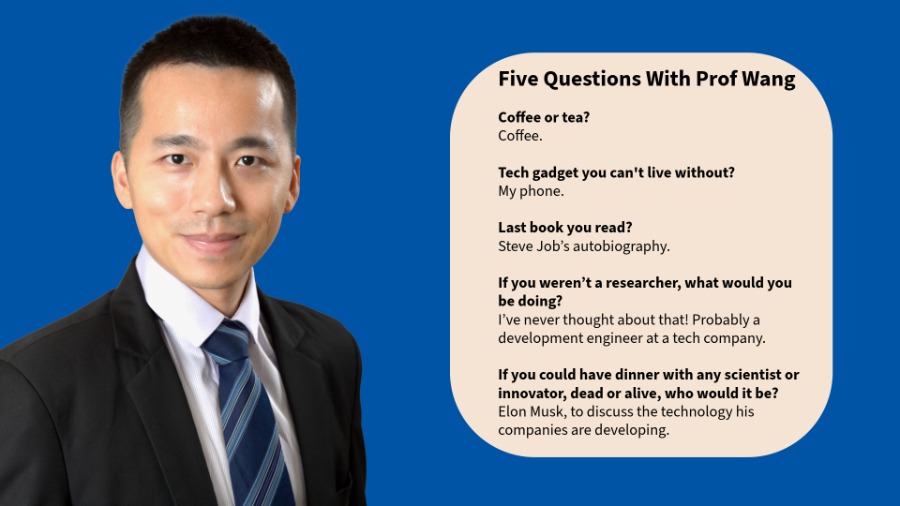
A love for puzzles and problem solving found Prof Wang Yifan early, and it found him at his grandfather’s kitchen table.
“My grandfather was a mathematics teacher,” he recalled. “Sometimes he would give me questions to solve, which made learning fun and challenging.”
Around the age of 13 Wang found himself picking up –and loving- Stephen Hawking’s Brief History of Time.
That mix of curiosity and comfort with complex physics and problem solving at a young age set the stage for Wang’s early career success. He was still completing his PhD programme in soft matter physics at the University of Chicago when he found the inspiration that would become his life’s work.
“I was looking at some interesting phenomena, specifically ‘jamming,’ which is how certain granular materials can become rigid under certain conditions,” explained Wang. “You can imagine a bag of vacuum-packed rice or beans. It can switch between rigid when the bag is sealed but when you open the bag it becomes soft.”
This principle, he realized, exists in nature too. The scales of pangolins or fish can stiffen for protection or relax to allow movement.
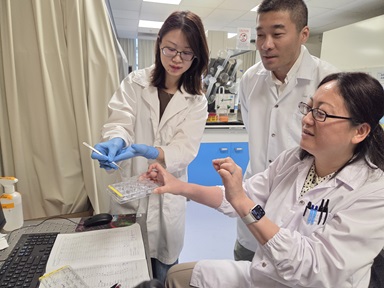
That insight became the seed for his later research into wearable materials. During his postdoc in engineering at Caltech, and from 2020 onward as faculty at NTU, Wang drew on the problem-solving skills nurtured at his grandfather’s kitchen table to develop fabrics made from interconnected rigid scales and soft fibers. The materials are designed to stiffen or relax on demand using electric motors or air pumps.
The shape-shifting wearables have the potential to address significant challenges in both healthcare and industry. They can provide crucial support for patients with muscular diseases, such as Parkinson’s, by stabilizing joints and reducing tremors. They can also assist industrial workers by protecting vulnerable body parts and reducing muscle fatigue during heavy lifting.
Wang’s lab has already patented the glove for Parkinson’s patients, and he’s expanding the technology for broader medical and industrial use, like adaptive casts for injured bones and industrial exoskeletons. He envisions that one day this advanced wearable support will be accessible to everyone.
But Wang’s vision doesn’t stop at protective wearables. He imagines a future where humans and robots collaborate seamlessly in factories, where robotic assistance and adaptive materials combine to enhance safety and efficiency.
“Besides that, the main objective is to bring these technologies from the lab into real-world products, and that requires further work in translation and product design,” he concluded.
To learn more about Prof Wang’s work visit his research page.
You can also read more about the other 2025 CoE Award winners.
Story by Laura Dobberstein, NTU College of Engineering