For Cells and Viruses, Shape Matters
By sculpting cell membranes into nanoscale curves, NTU researchers uncovered how geometry can guide virus replication. Their findings reveal shape as a critical lever for stopping infection and building faster, more precise antiviral tests.
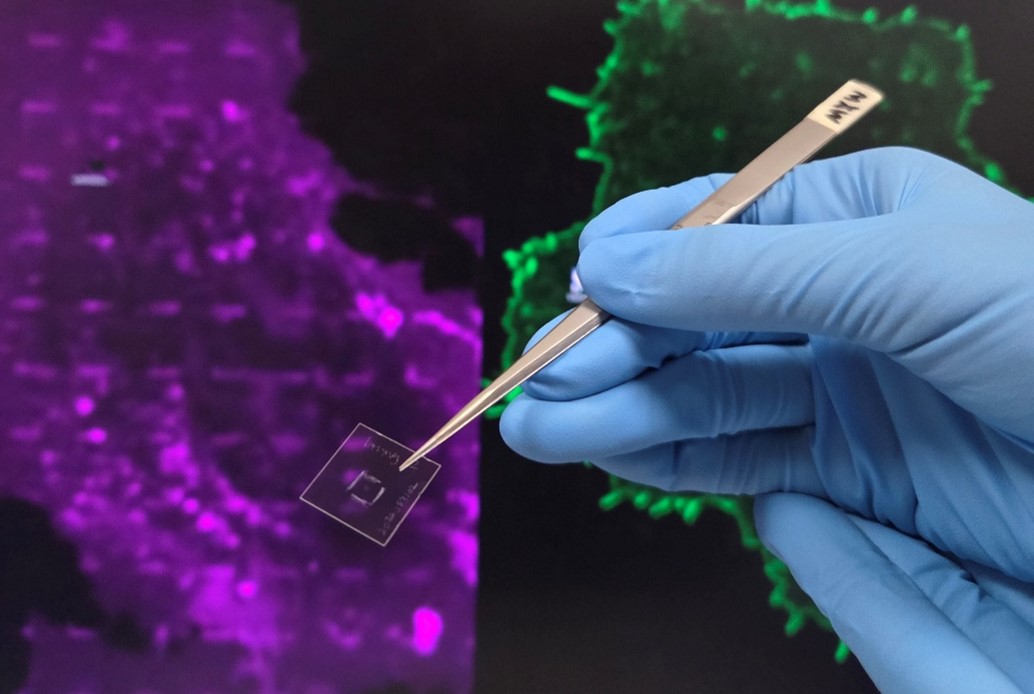 Image of nanochip with nanostructure shown
At first glance, the boundary of a cell seems flat and featureless. But researchers at NTU’s College of Engineering have proven that it’s worth a closer look at subtle curves and bends at the nanoscale, as those features hold the key to understanding how viruses take over.
“Traditionally, researchers focused on biochemical interactions at viral infection sites rather than their physical shapes, largely because nanoscale structures were difficult to study,” explained Professor Wenting Zhao from the School of Chemistry, Chemical Engineering and Biotechnology (CCEB).
“But if you zoom into the interface enough, it’s never flat,” she added. “And that curvature matters.”
Because viruses and their replication machinery also operate at the nanoscale, even tiny shifts in membrane shape can change how a virus behaves. As it turns out, viruses not only read shape; they seek, exploit, and depend on it, as much as a non-living entity can.
Architecting Shape
For their study, published in April 2025 in Nature Communications, the team built precisely shaped nanostructures on quartz wafers using electron-beam lithography.
These structures acted like tiny moulds to create defined curves in the membranes of living cells. Some bent outwards like a sphere or cylinder, while others bent inward like a saddle or neck of a bottle.
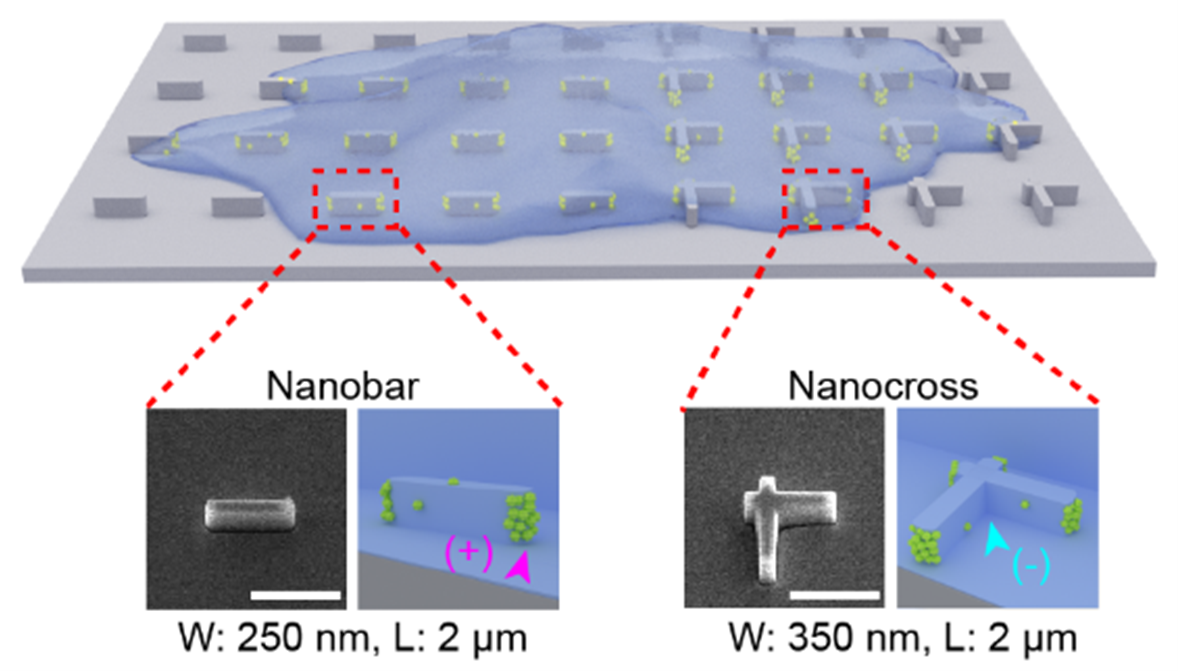
Illustration and Scanning Electron Microscope (SEM) image of the nanostructures. Pink arrow indicates positive curvature, blue arrow indicates negative curvature.
Together, they allowed the researchers to test a full range of curvatures that naturally emerge as a virus reshapes a relatively flat membrane into the tightly curved, bubble-like compartments it needs for replication.
The researchers then introduced Chikungunya virus and tracked where its key membrane-binding protein, nsP1, chose to gather on these different shapes.
They also examined how factors such as lipid composition and specific protein regions affected this behaviour, and used high-resolution molecular simulations to reveal how curvature influences nsP1’s ability to latch onto and stabilise on the membrane.
Viral Concentration
The results were clear: when examined outside the context of infection, individual viral proteins such as nsP1 did not distribute randomly. Instead, they consistently clustered at highly curved membrane sites, strongly favouring inward-bending regions (positive curvature). They largely ignored outward-bending (negative curvature) zones, and once bound, protein clusters remained stably locked in place.
By isolating nsP1 and watching its behaviour alone, the team found out why. Small, flexible segments of the viral protein that act like anchors or feet insert more deeply into positively curved membranes and give the protein a physical reason to favour those sites. When these hydrophobic loops were mutated or removed, nsP1 lost this preference entirely.
The team next tested whether this preference shaped what the virus did during a real infection. Using tiny ring structures, or nanorings engineered to create precise pockets of positive curvature, they tracked fully functional Chikungunya replication complexes, marked by bright dsRNA signals.
The researchers found the replication machinery concentrated exactly within the curved nanoring spaces.
This showed that membrane curvature doesn’t just influence where nsP1 binds - it can physically guide where the virus builds its replication factories, offering a reliable and measurable way to test antiviral strategies.
“If you can block the replication. You can block the viral infection,” explained first author on the study and team member Xinwen Miao.
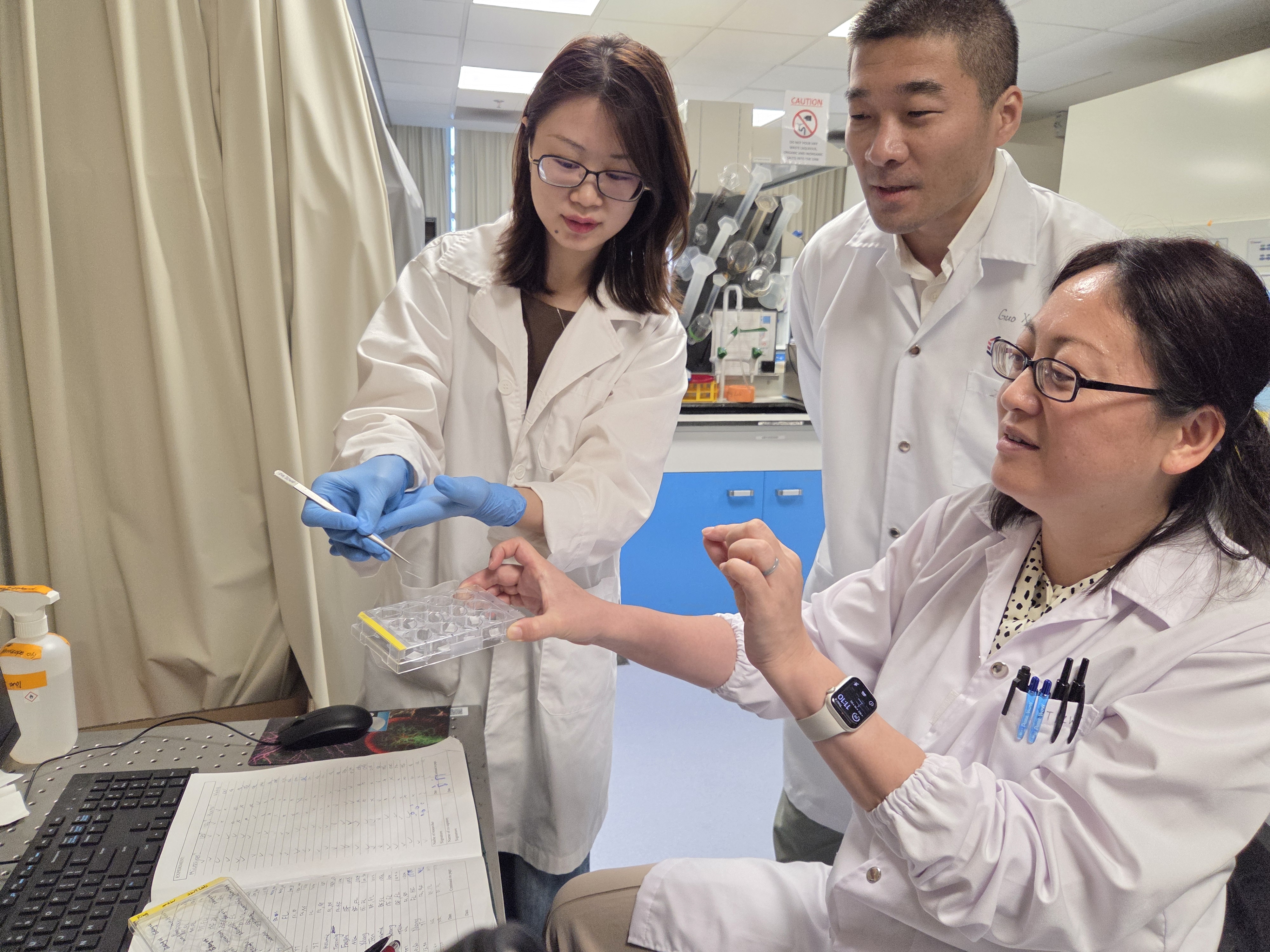 Researchers Xinwen Miao, Dahai Luo and Wenting Zhao, in the lab
Why Chikungunya
The Chikungunya virus is an increasingly common mosquito-borne virus that draws comparisons to Zika and dengue. It can cause debilitating fever and persistent joint pain in humans. Like many mosquito-borne viruses, it is prone to sudden mutations that can drive new outbreaks.
“Scientists are always watching for the next one to mutate and become the big one,” noted Miao.
By focusing on Chikungunya, the team found a model system that is serious but manageable, with lessons that extend to other, even deadlier viruses.
A New Playbook for Antivirals
The work opens an entirely new front in antiviral strategy. If replication can be steered or disrupted by shaping the membrane environment, researchers can begin designing drugs, assays, and even biomaterials that target these areas specifically - or even interfere with the very geometry viruses rely on.
The nanoring platform itself could evolve into a rapid, high-precision screening tool, allowing scientists to test how different compounds affect replication long before visible damage appears in cells.
The team already has a patent in progress based on the research. The patent-pending tool could prove exceedingly useful for drug companies and research institutes.
Looking Beyond a Single Discipline
To truly understand the virus behaviour, a team of interdisciplinary scientists was needed. Working alone, virologists couldn’t see nanoscale curvature, cell biologists couldn’t manipulate it, and physicists couldn’t interpret the resulting biological behaviour.
“For this project, we needed people from nano, mechanical, and bio backgrounds. The discovery needed a use case, and that meant building a team that could cross those fields,” said Zhao.
But for Zhao, that’s the nature of the work she does. Her lab understands shape at a very intricate nanoscale level and the resulting fundamental principles extend across many emerging applications, not just viruses.
This year her lab has published research that not only advances antiviral drug screening, but also cancer detection, and antimicrobial research. The team published this May in Proceedings of the National Academy of Sciences (PNAS) on how the nuclei of cancer cells deform under external stress. That work revealed a separate set of nanoscale shape principles that influence how tumours grow and spread.
As their findings extend across fields, their focus shifts to finding where their understanding of nanoscale architecture can be applied most effectively.
Story by Laura Dobberstein, NTU College of Engineering